
 exploring Bremen & its surrounding areas
 You are here: attractions in the city center
 Stephani district (1/2)
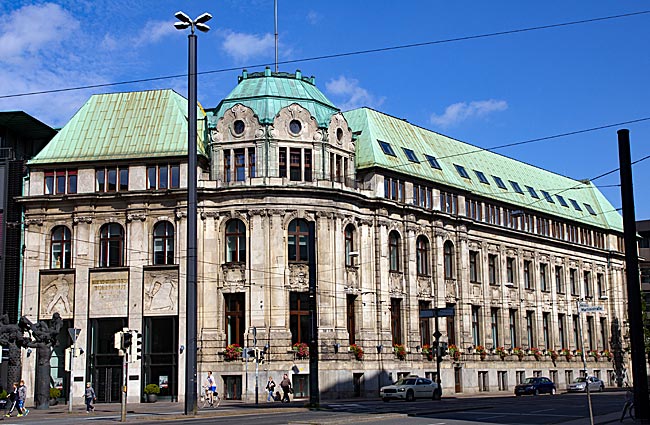
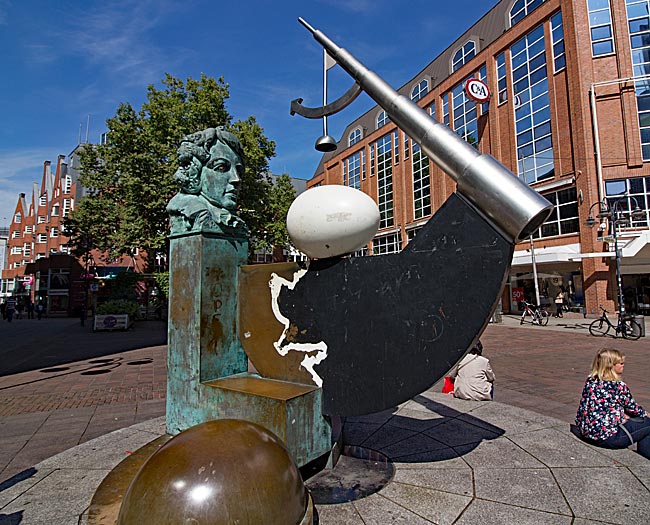
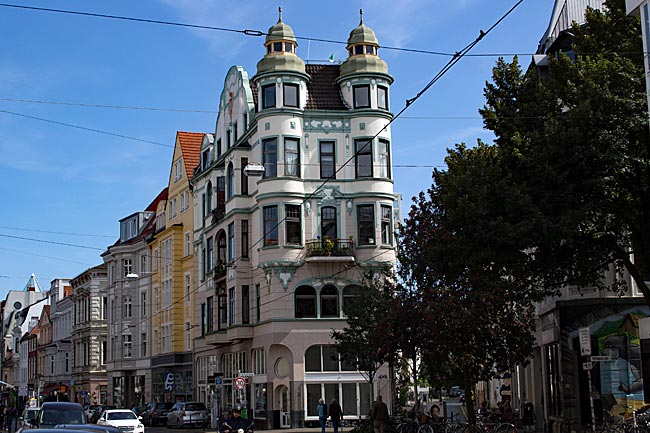
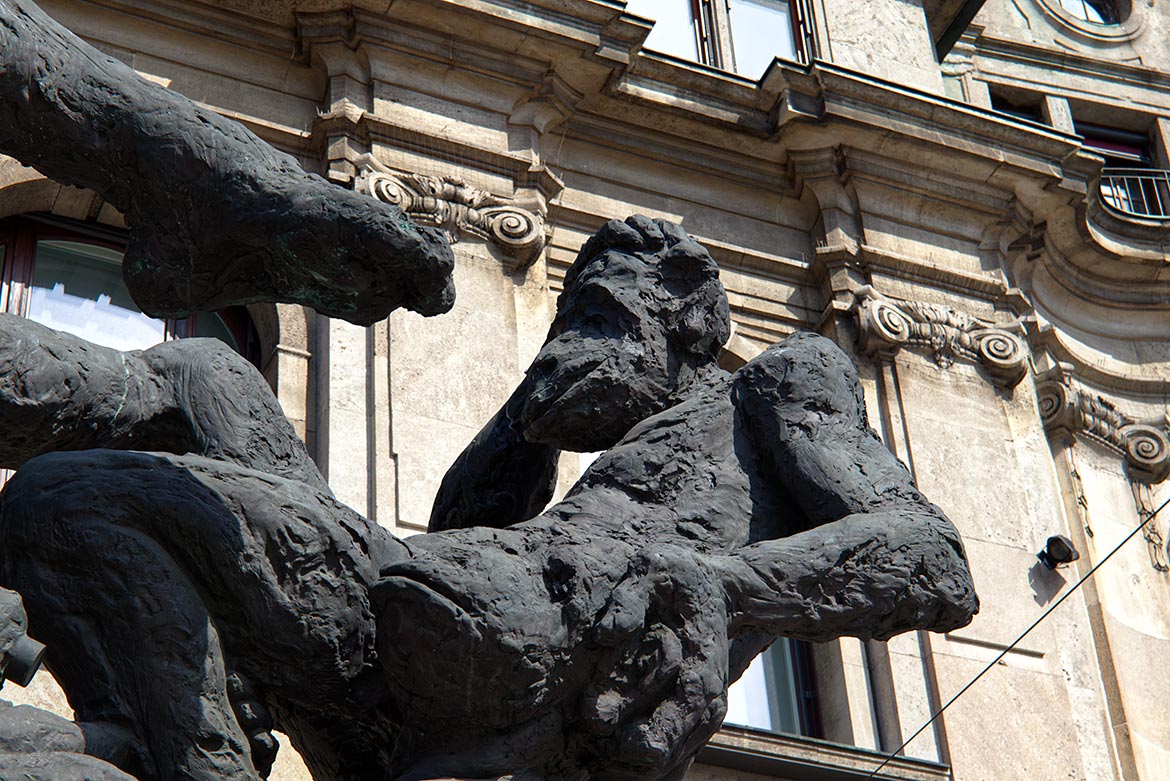
Historical caçade from 1906 at the corner of Am Brill street. On the left in the image: The bronze sculpture Affentor by sculptor Jörg Immendorff, which has stood here since 2007
The Stephani district forms the western terminus of Bremen's Old Town and is considered the city's birthplace, making it one of its oldest districts. As early as 1050, Archbishop Adalbert I founded a priory in honor of St. Stephen. The priory, located on a dune, was called Steffensberg (mons sancti Stephani) in German translation. Adalbert's episcopal successors established a parish and built the first church in what was then also called Steffensstadt. After this burned down in the 13th century, a new church was constructed, of which the choir and transept are largely preserved in today's St. Stephani Church. The nave of this church became Bremen's first cultural church on New Year's Day 2007. Since then, services for the congregation have been held in the north aisle, as they were in the post-war years due to destruction.
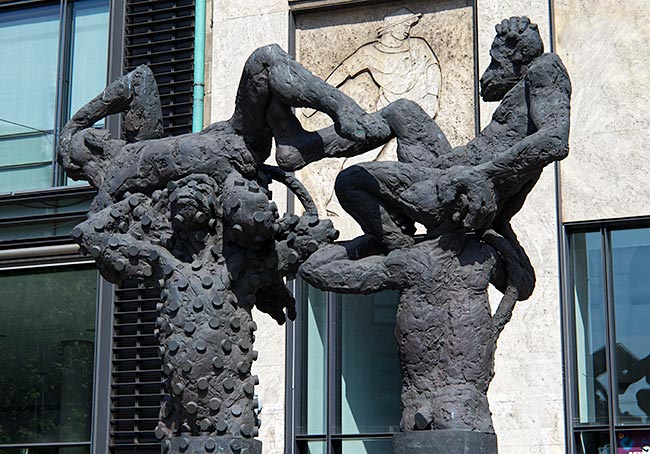
Bronze sculpture Affentor by Jörg Immendorff
Langenstraße, which extends into the Stephani district, is considered Bremen's oldest merchant street. It is therefore not surprising that archaeological finds have frequently been uncovered during excavation work in the past, prompting the involvement of state archaeologists. For example, in 2003/04, during the construction of the Überfluss Hotel (since March 1, 2025, Nena Hotel), visible wall remnants made of boulders were found, likely belonging to a fireproof storage and residential tower from around 1200. Imported earthenware from the 13th and early 14th centuries was also excavated in 2013 on the opposite side of the street from the hotel.
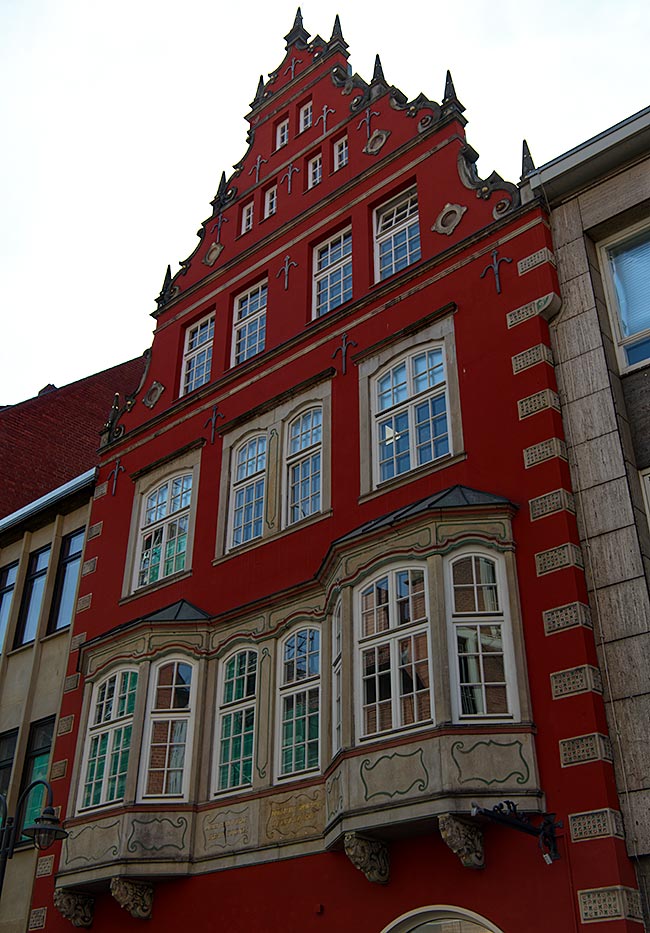
Originally built in 1625 or, according to another source, 1590, and renovated in 1910, this residential and commercial building is located at the other end of Langenstraße
In the area of the adjacent cross streets Fangturm and Wenkenstraße, a city wall ran around 1229, enclosing only part of the still-unfortified Stephani district within today's Old Town. At that time, the namesake tower stood directly on the Weser as the terminus of the protective wall. The externally octagonal structure made of large monastery-format bricks had walls three meters thick and was partially clad in sandstone. Although it was no longer needed as part of the defensive structures by the mid-16th century - since a new city wall had already been built further west in the 14th century, incorporating the quarter while retaining the old one - it was used as a prison. Later, the above-ground part of the tower disappeared, but the well-preserved basement was rediscovered during the construction of the municipal pawnshop in 1928, renovated, and used as a vault until the almost complete destruction of the Stephani district by air raids in October 1944.
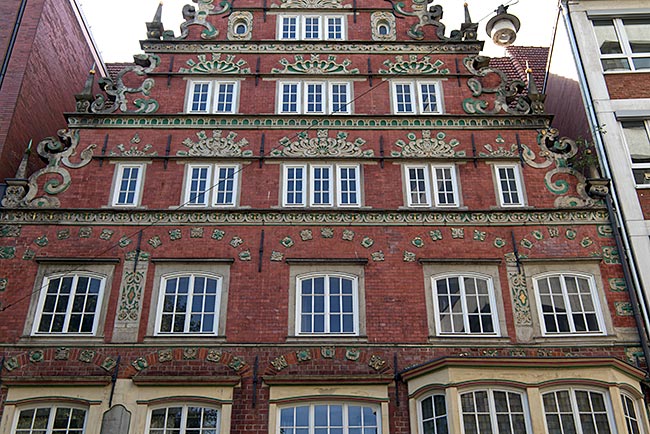
This Renaissance façade on Langenstraße dates from around 1620 and, like the house mentioned above, is a protected cultural monument.
Not far from this spot stands a man who seems to be shouting over the Weser - without a sound emerging. The three-meter-tall bronze statue "Der Rufer" (The Caller) is by sculptor Gerhard Marcks, who also created the Bremen Town Musicians near the Old Town Hall and the sculpture Ägina in the Theater Garden of the Wallanlagen. His estate is managed by the Gerhard-Marcks-Haus at Ostertor. Although there are several casts of "Der Rufer "installed in various locations - even in Perth, Australia - the original on the Weser was created by the artist in 1966 on commission from Radio Bremen. In addition to the timeless representation of radio and television, other interpretations are possible due to ignorance of the commissioner. On November 24, 1967, the sculpture was unveiled at its former location of the broadcaster's television department on Hans-Bredow-Straße. With the consolidation of television and radio in the new building in the Stephani district in 2007, "Der Rufer" also moved to the Weser.
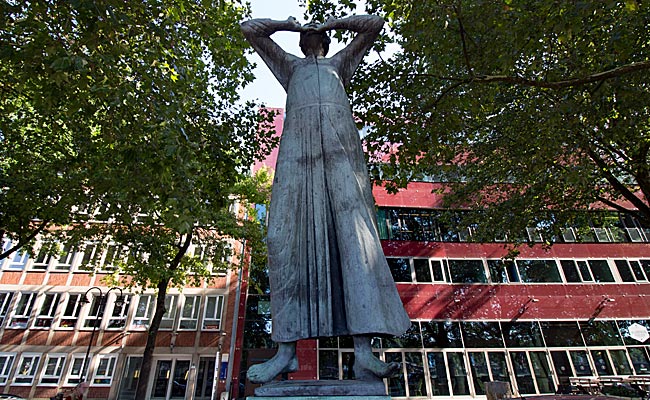
The bronze statue "Der Rufer" by Gerhard Marcks
Much of the historical architecture was not spared by the bombs. At the Brill intersection, where the busy Bürgermeister-Smidt-Straße, which crosses the Weser, separates the Stephani district from the rest of Old Town, the historicizing façade of a corner building erected in 1906 with stylistic elements from Baroque, Renaissance, and Art Nouveau by Berlin architect Wilhelm Martens draws attention (photo at text beginning). For a long time, the bank Sparkasse Bremen was located behind these walls.
Starting from the side streets Wenkenstraße/Hankenstraße, the main street running east-west through the Stephani district is called Faulenstraße, which is why it is sometimes referred to as the Faulenquartier. The name does not derive from the legend of the "Seven Lazy Ones" (Sieben Faule), whose houses the Bremen writer Friedrich Wagenfeld located here shortly before the mid-19th century, but rather likely from the medieval term for "bad" or "dirty," as it was first mentioned in 1365 as Vulenstraße. Since 1945, after several name changes, it has been called Faulenstraße.
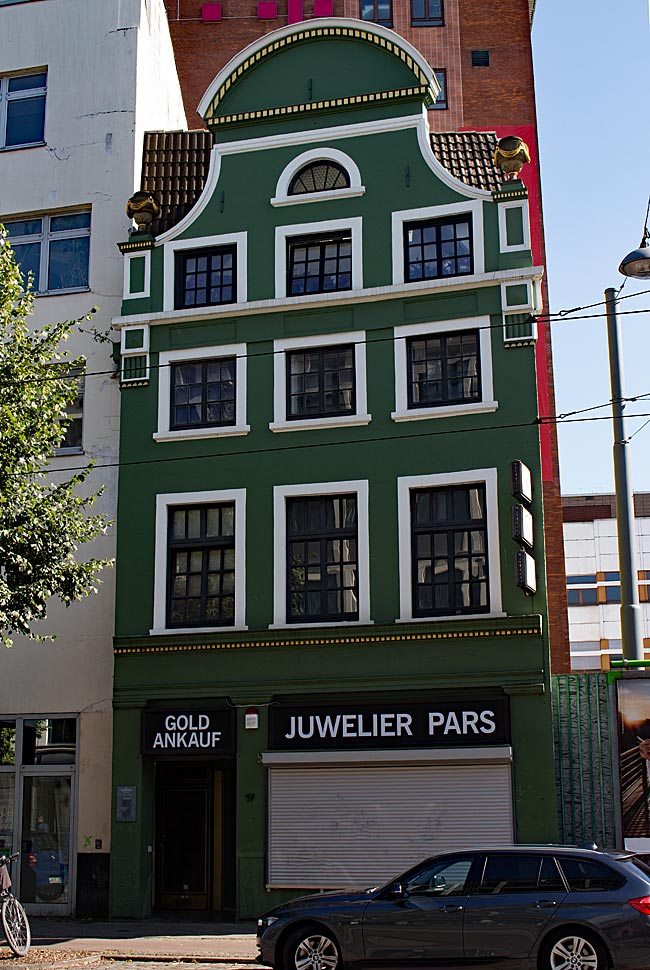
Captain's House on Faulenstraße
At house number 17 on Faulenstraße, a gable house has been preserved. The building, which has been under monument protection since 1973 with its neobaroque façade from the mid-19th century, was originally constructed as a packing and storage warehouse and dates back to around 1790. The captain who commissioned it was not the only one active in shipping; many shipping companies and shipbrokers had their offices here. Beyond city limits, the drugstore and chemical wholesale business operated by Hermann Zinke from 1902 in the ground-floor premises became well-known; his successors closed in 2012.
A few meters further on, at the corner of Faulenstraße/Doventorstraße, stands the "Bamberger," a building not necessarily worth seeing but one with history. It was merchant Julius Bamberger who opened a modern department store in what was then the city's first high-rise building with nine stories in 1929; it also featured the first electric escalator. From the design by architect Carl Heinrich Behrens-Nicolai, the "Bamberger" soon became known colloquially among Hanseatics as "Bambüddel." After 1907, it was his second department store. However, after the Nazis seized power, he faced additional economic problems because he was Jewish. Soon followed the closure of the business and two years later, forced auction in 1939. Like the lives of other Jews, his was also in danger, and so he fled to the USA via brief imprisonments in Bremen and France, where he died in '51.
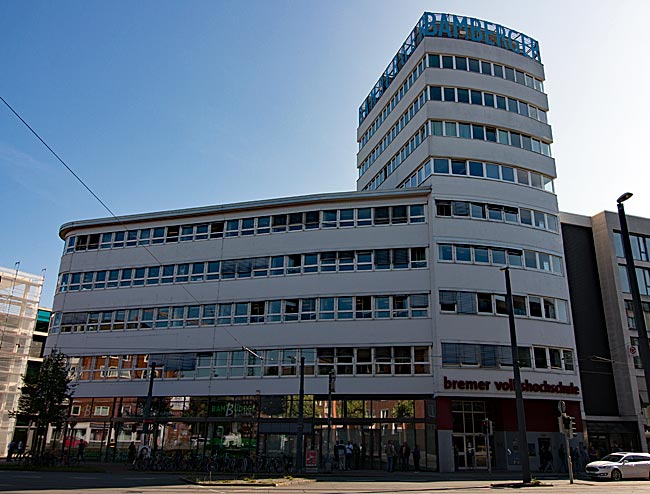
The "Bamberger" at the corner of Faulenstraße/Doventorstraße
At the end of the war, the building was severely damaged by air raids but rebuilt in the following decade and used as an office building. After parts of the tower had to be demolished in the decade before the millennium, its complete demolition was even threatened afterward. Thanks to investor Klaus Hübotter, the old building could largely be preserved and comprehensively renovated. The current Bamberger opened in 2007, and the semicircular tower, a characteristic part of the building, was restored to its original height. This section is crowned by an observation platform offering a good view over parts of the city, only interrupted by the large blue letters of the surrounding building name. The main tenant of the premises is the adult education center. The market hall in the ground floor of the flatter part of the building is called "Bambüddel." It houses the Bistro Julius and a Maribondo grocery store.
previous page
 next page
Map
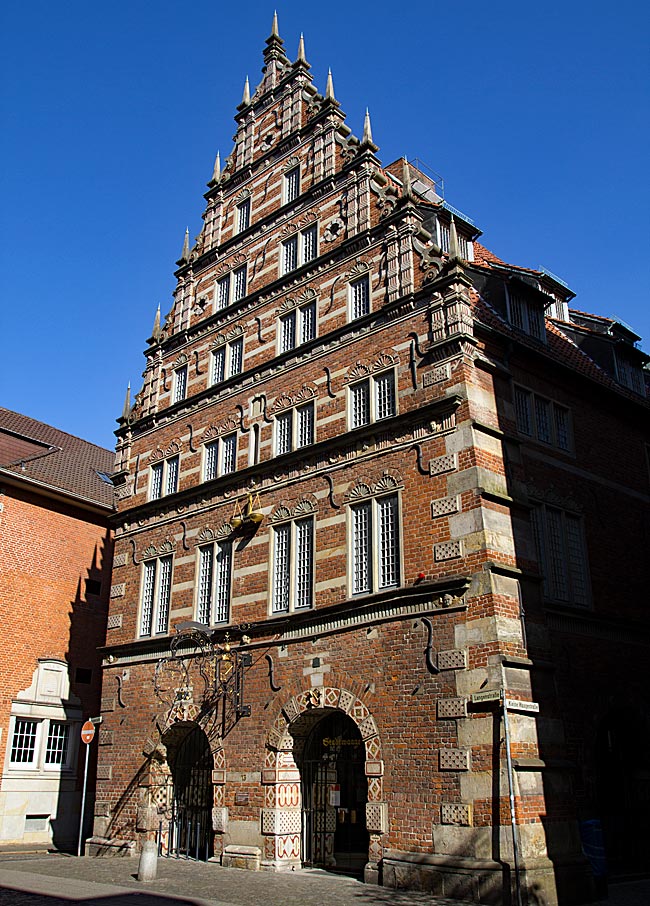
City Weigh House
Located directly next to the market square and near the Schütting, the house of the merchants' guild, stands the City Weigh House on Lange Straße. During the Middle Ages, Lange Straße was one of Bremen's main thoroughfares and is considered the city's oldest merchant street. The existence of a weigh house in this street dates back to the year 1440. However, even before that, as documented since 1330, Bremen had a city weigh house, just like every other major trading center in the Middle Ages.
read more ...
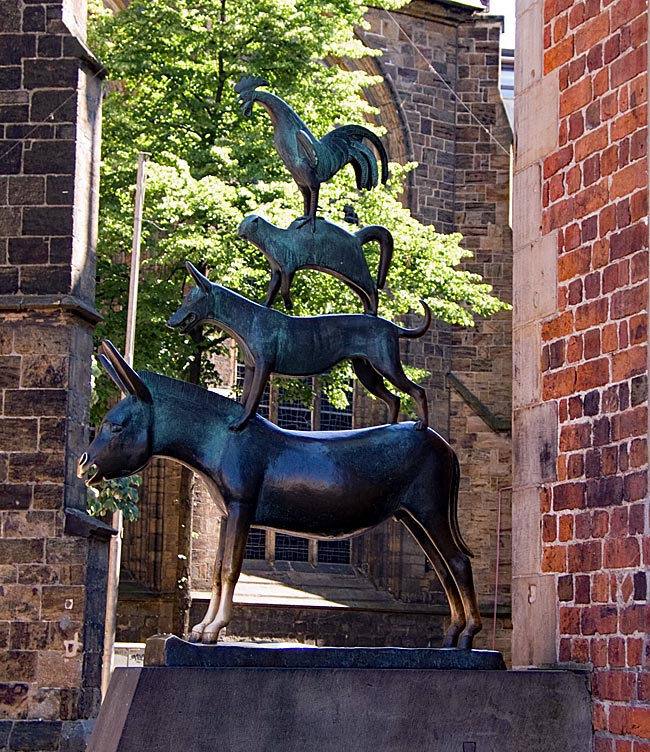
The Bremen Town Musicians
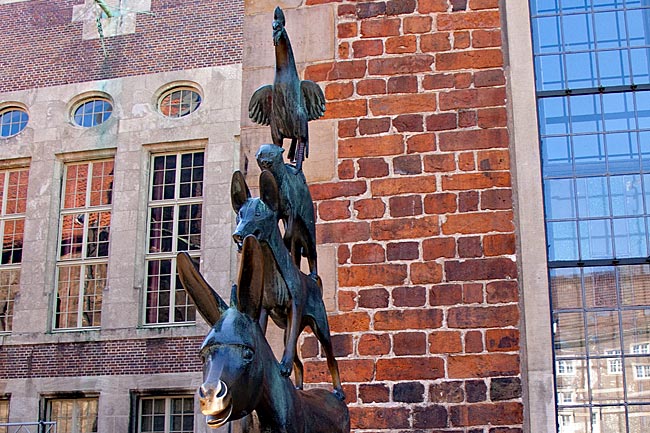
On the left broad side of the Old Town Hall, next to the entrance to the lower town hall hall, stand four bronze-cast heroes of a world-famous fairy tale - the Bremen Town Musicians. However, it remains a contentious point whether these mismatched four - donkey, dog, cat, and rooster - actually made it all the way to Bremen, as the fairy tale does not provide a clear answer on this matter. But perhaps that is not so important, for what truly matters is the message conveyed in the fairy tale.
read more ...
The Seven Lazy Ones (Sieben Faule)
The Seven Lazy Ones. Besides the Bremen Town Musicians, there is another, albeit far less known fairy tale whose setting is the Hanseatic city of Bremen: "The Seven Lazy Ones" by the Bremen writer Friedrich Wagenfeld (1810-1846). Just like the Bremen Town Musicians, the heroes of this story also have a monument dedicated to them in the city. In Böttcherstraße, you can encounter the supposedly lazy brothers at two different locations.
read more ...
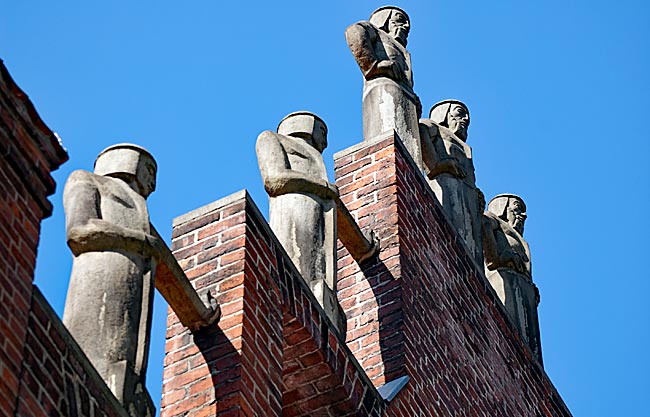
Wallanlagen
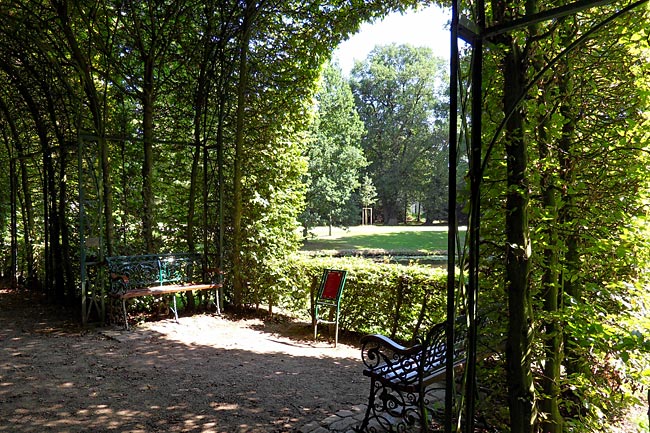
Almost entirely surrounding the old town is a zigzagging park landscape with a moat. This represents the last visible remnants of the fortifications that once encircled the old town and parts of the new town until the early 19th century. The transformation into a garden landscape began in 1802 with the first section between the Weser River and the Herdentor gate.
read more ...
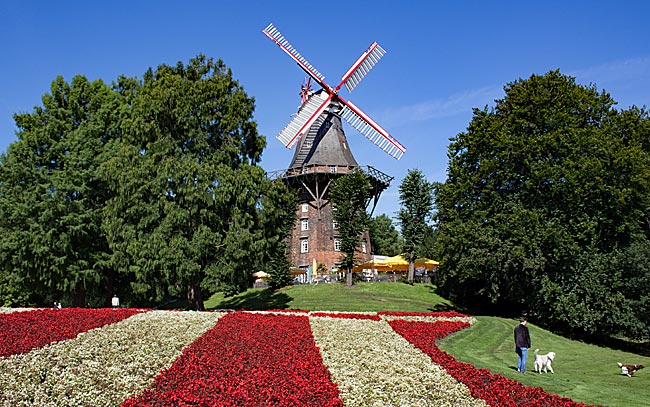
A stroll through the Neustadt
The Alte Neustadt, as part of today's neighborhood, was only established in the 17th century. The planned expansion of the city was also prompted by the increasing threat posed by the development of offensive weapons. Remnants of the fortifications built at that time are still present today as parks, but there is much more to discover, such as the "Kleine Roland".
read more ...
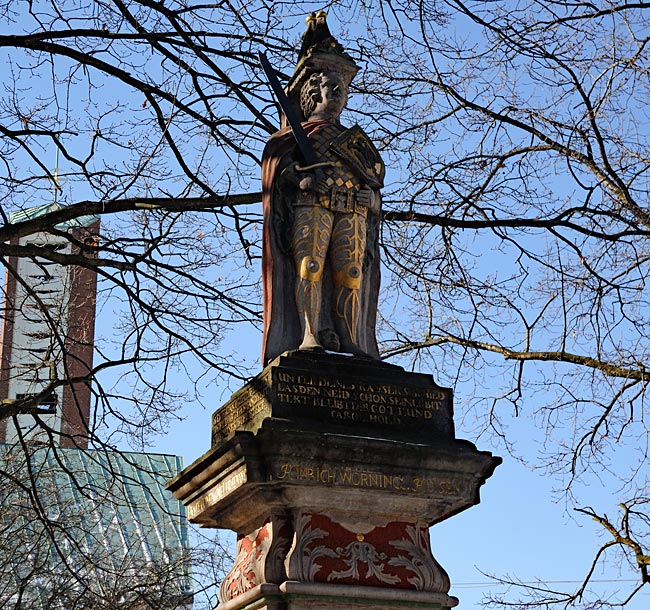
Überseestadt (Overseas City)
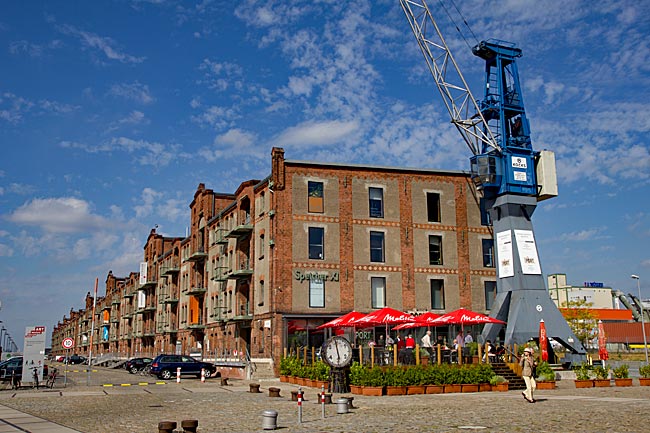
When the Overseas Port required renovation, the decision was made in 1991 to simply close off the basin instead. In 1998, the Overseas Port was finally filled with sand obtained from dredging operations in the Outer Weser. Alongside the also decommissioned but still existing Europa Harbor basin, this formed the foundation for the conceptual development and creation of today's Überseestadt (Overseas City).
read more ...
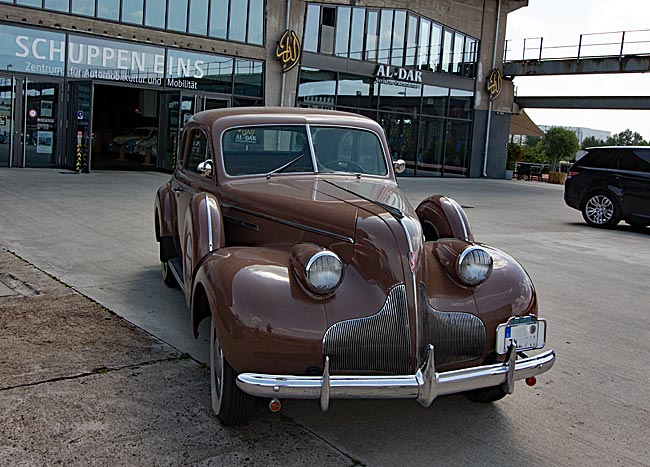
Through Woltmershausen to Lankenauer Höft by bike
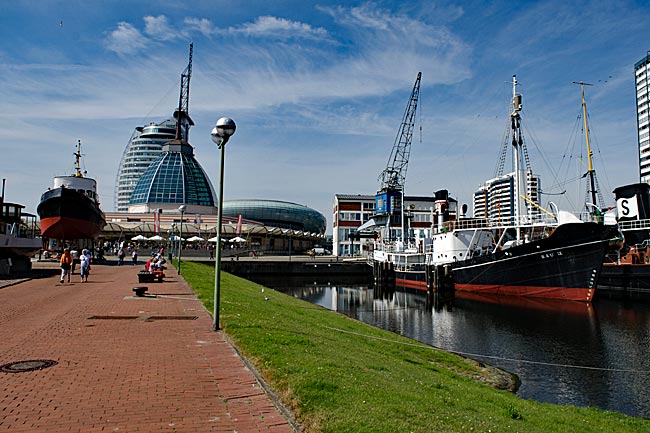
A truly maritime bike ride to Lankenauer Höft. This scenic cycling route begins at the Stephani Bridge, passing through Hohentorshafen and Woltmershausen before reaching Lankenauer Höft, which is almost entirely surrounded by water. Behind the Höft, several ships - including the 1957-built tugboat Greif - are moored in an unrestricted part of the harbor. This picturesque view of the harbor marks the end of this tour.
read more ...
Schlachte
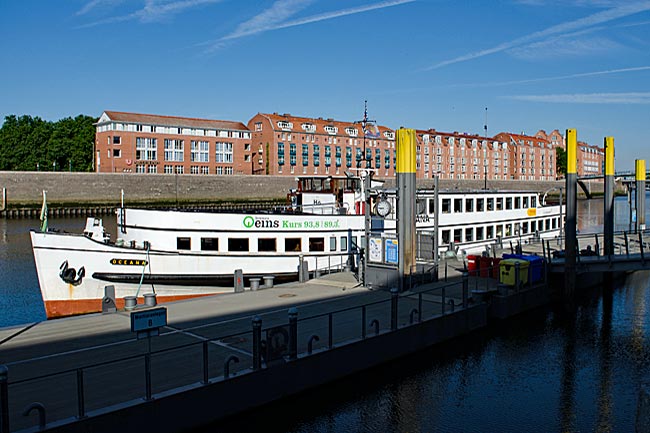
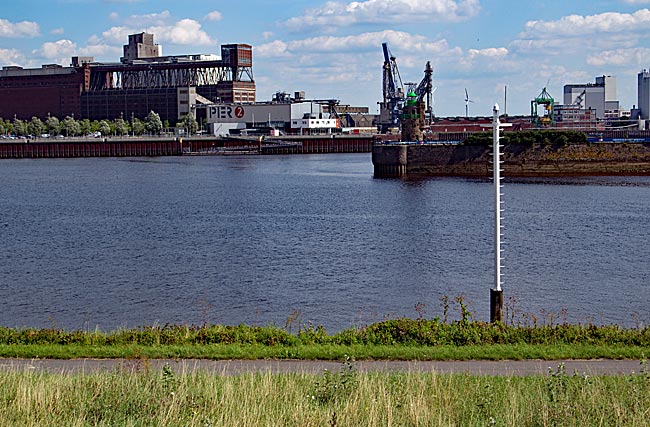
From the start of construction in 1993 until its grand opening on May 27, 2000, a promenade with a boulevard, ship docks, and numerous dining establishments offering something for every palate was created between the Wilhelm-Kaisen Bridge and the Stephani Bridge. This project cost over 20 million euros, largely funded by the EU, and featured 60 trees and ample granite paving. Today, this area - where medieval harbor workers once worked hard - has been transformed into a vibrant leisure destination.
read more ...
City Center: the main shopping streets
Another traditional café can be found at Sögestraße 42/44. The Knigge confectionery was established in 1889 and offers a variety of baked goods, chocolates, and ice cream, making it well-known throughout the city. Diagonally across from the café, branching off from the row of shops, is the glass-covered Katharinen-Passage, which - with an interruption - leads into the Domshof-Passage, ending at the Domshof. On this site, which now houses retail stores and a parking garage, once stood the namesake St. Katharine's Monastery.
read more ...