
 exploring Bremen & its surrounding areas
 You are here: attractions in the city center
 The Viertel (1/2)
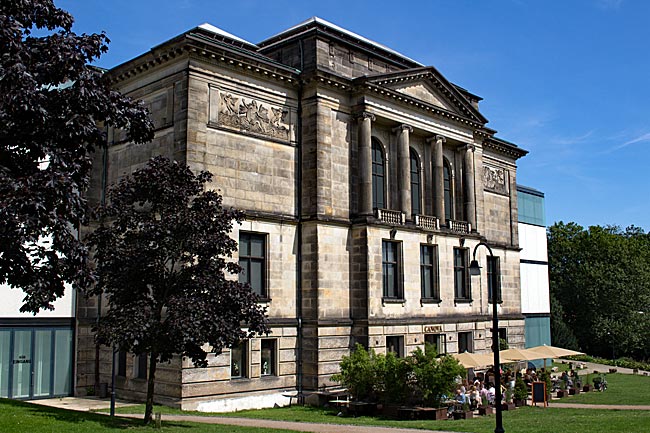
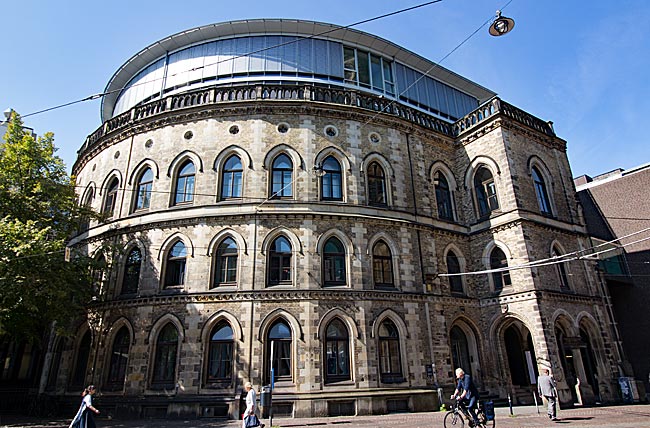
Back of the Kunsthalle with gastronomy on the lower floor
Coming from Domsheide, a short path past Schnoor in an outward direction begins in the Wallanlagen, the former medieval defensive ring of Bremen, where the "culture mile" starts with the Kunsthalle. Just a few meters further along, two nearly identical classical buildings flank both sides of Ostertorsteinweg. The guardhouse and detention building of the former Ostertorwache were built between 1825 and 1828 according to designs by architect Friedrich Moritz Stamm in Bremen's state service and, like many other buildings in the city, were placed under monument protection in 1973. On the street side of the Kunsthalle, the Gerhard-Marcks-Stiftung opened a museum in 1971. The current Gerhard-Marcks House is dedicated to the sculptor and graphic artist who created the bronze statue of the Bremen Town Musicians in 1953, which continues to attract visitors next to the historic town hall. Changing exhibitions also feature works by other artists.
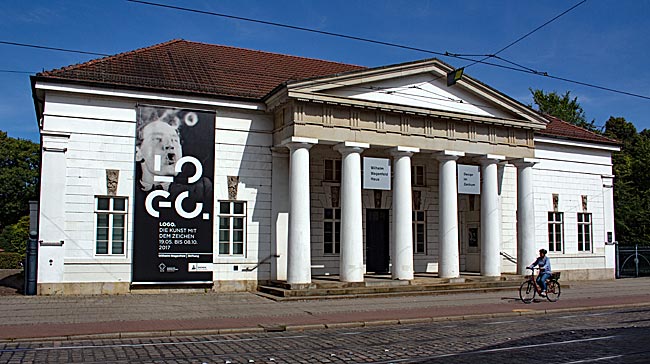
Former prison, today Wilhelm-Wagenfeld House
Visitors have been able to view exhibitions in the opposite Wilhelm-Wagenfeld House since 1998. The renowned product designer and Bauhaus student Wagenfeld, born in Bremen in 1900, offered his estate to the Senate of the Hanseatic City two years before his death in 1990. Since 1992, this has been managed by the "Center for Product Design," now known as the "Gesellschaft für Produktgestaltung e.V. Bremen." Not only are works by the internationally acclaimed industrial designer displayed here, but special exhibitions also feature products by other designers up to the present day. The darkest period in its history was during the Nazi era when the building served as a Gestapo prison. Long before that, the infamous poisoner Gesche Gottfried was imprisoned behind these walls until she was beheaded on Domshof in 1831.
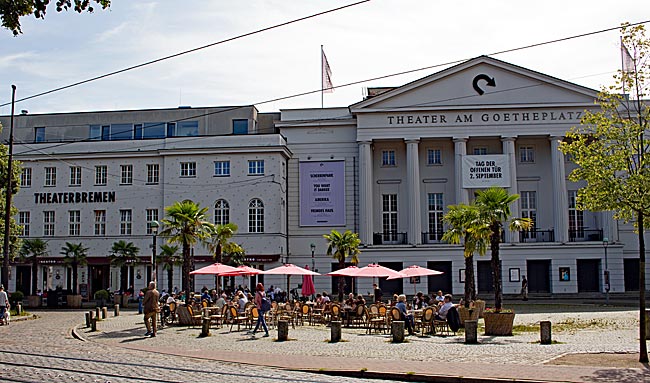
Theater on Goetheplatz; when the weather is nice, the staff of the café 'Theatro' also serve drinks and food outdoors
The spatially slightly set-back Theater am Goetheplatz completes the "culture mile." The neoclassical building, whose main portal is supported by six columns, was originally planned and commissioned as a theater by author and theater director Johannes Wiegand and theater director Eduard Ichon. The first performance took place on August 15, 1913, during the opening ceremony. Wiegand and Ichon, who is buried at Riensberg Cemetary, likely did not anticipate that the venue would develop into a four-genre theater with opera, drama, dance theater, and the "Model Experiment Artists and Students" (MoKS Bremen).
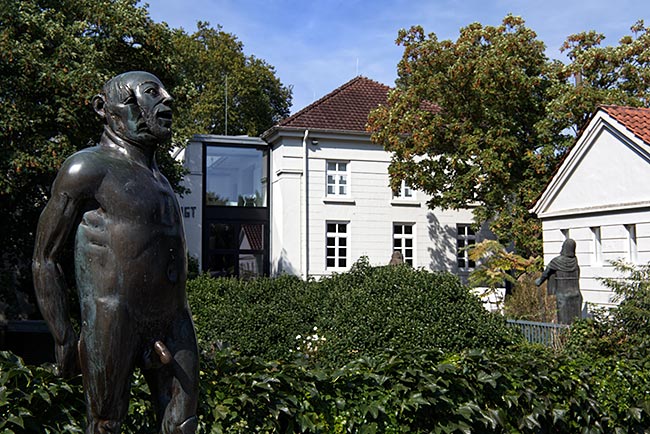
Giuliano Vangi's "Man with Mask"
In front of the theater, not only gastronomy takes place when the weather permits, but public art is also displayed with Giuliano Vangi's "Man with Mask" (1974/87). While viewing the art in the aforementioned buildings requires an entrance fee, the path from the stairs next to the bronze statue by the Italian sculptor to the Kunsthalle or the park at Osterdeich as part of the Wallanlagen is free and airy.
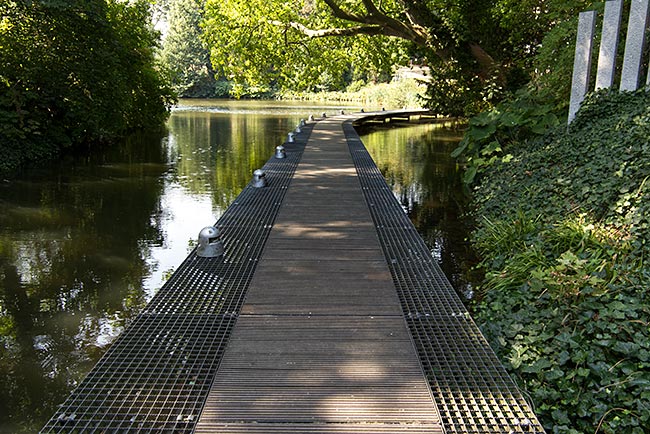
Paula Modersohn-Becker Steg
The Paula Modersohn-Becker Steg crosses part of the former city moat, which once surrounded the old city from the Weser to the Weser. The walking surface is covered with wooden planks, but when encountering oncoming pedestrians, one must step onto the steel grid plates on either side. It only gets wet in case of a misstep, as there is no railing. In the green area, you come across a bronze bust of the famous namesake artist from Worpswede by Clara Rilke-Westhoff, who lived and worked in Fischerhude.
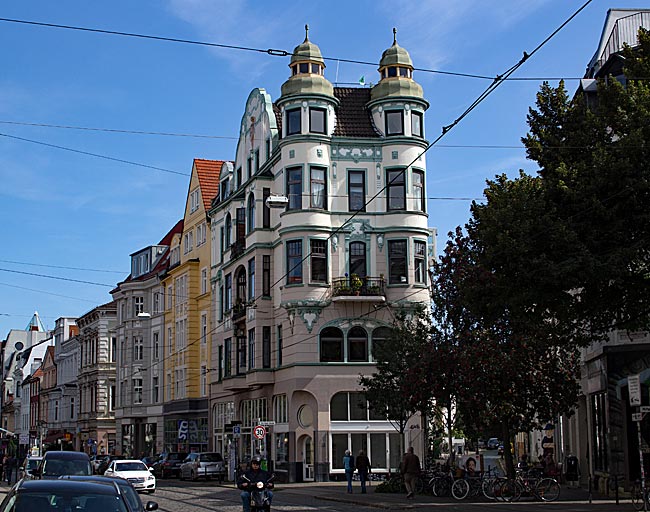
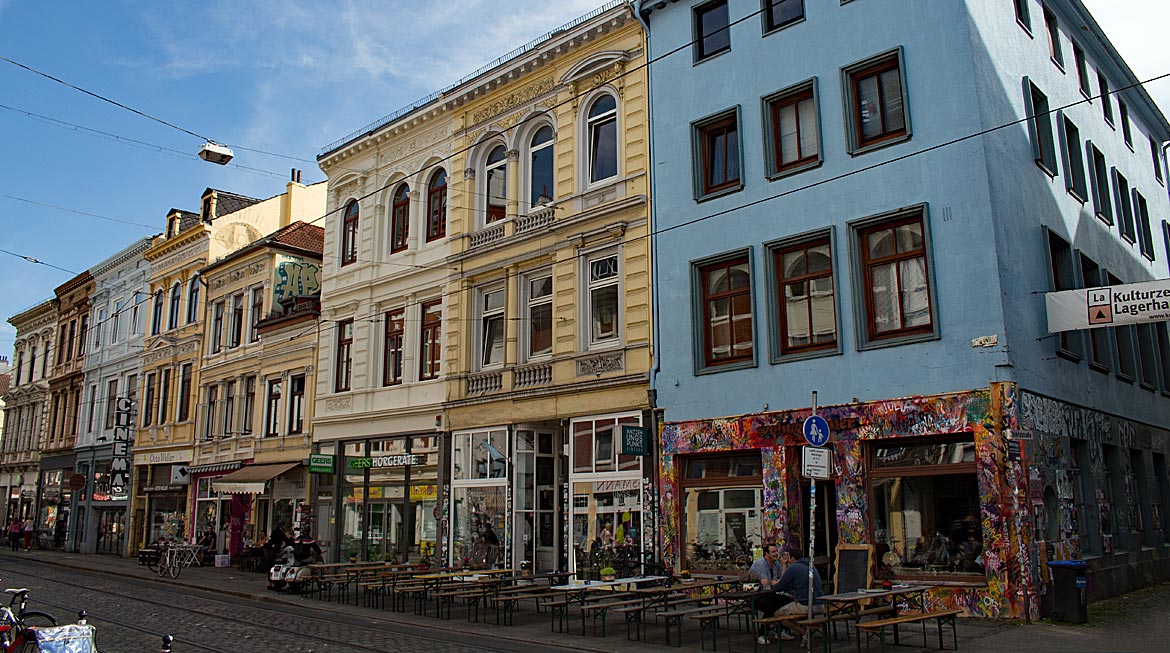
And suddenly you're right in the middle of the Viertel
The naming of the main streets "Ostertorsteinweg" and its continuation "Vor dem Steintor" has historical significance. In earlier times, when the defensive ring around the current old town was heavily fortified, this area contained the eastern entrance to the Hanseatic city, the Osttor. Nearby and adjacent to the city wall, a Benedictine monastery was founded in 1050, though it no longer exists since 1523. Only the street names "Beim Paulskloster" and "Klosterpad" remind of its existence, as well as the "Pauliner Marsch," which refers to the monastery's pastureland.
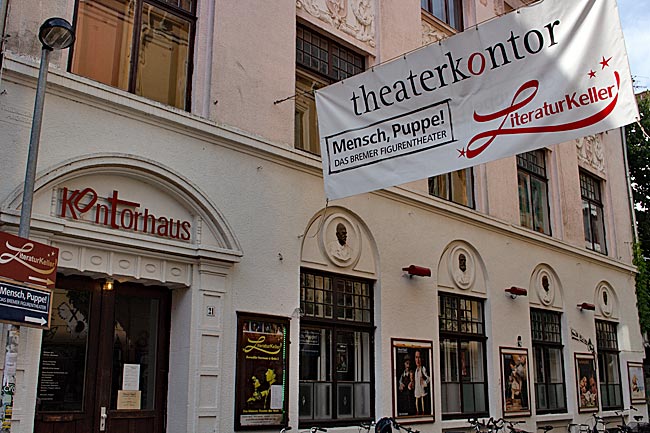
The Kontorhaus with theater and literary cellar next to the Lagerhaus cultural center
On a mill hill near Paulskloster that has not existed since around 1530, something tragic occurred on June 20, 1430: the former mayor Johann Vasmer was executed after being convicted of high treason. This followed political events that had divided the city council, led to Bremen's prosecution before the emperor and the Hanseatic League, and ultimately resulted in its expulsion from the latter. However, Vasmer’s son Hinrich did not want his father to be remembered as a traitor in Bremen’s history. He sued the Hanseatic city before the emperor and the empire, achieving rehabilitation for the deceased five years after the execution and the erection of an atonement cross. Initially placed at the execution site, it was later moved.
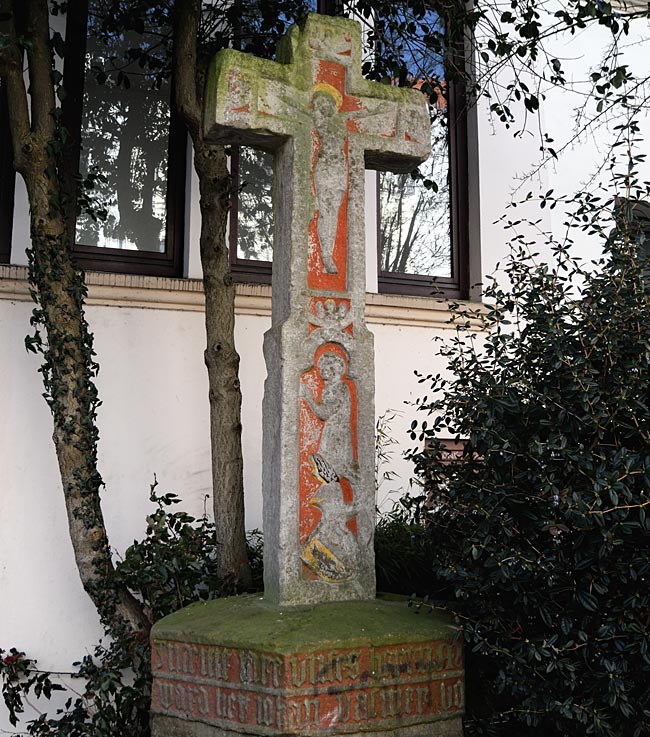
The Vasmer cross on the street "Beim steinernen Kreuz" in Ostertor
Today, the cross made of Portasandstein can be found on the street "Beim steinernen Kreuz" in Ostertor. The cross features a relief of the crucified Jesus and below it, the kneeling Vasmer with his coat of arms. The cross stands on a hexagonal pedestal bearing the inscription: "In deme iare unses Heren MCCCC an dem XXX iare des dinxedages vor Johannes Baptiste ward her Johan Vasmer, Borghermester, hie ghedodet. Biddet got vor de sele." The memorial is a replica; the original was moved to the Focke-Museum in 1977.
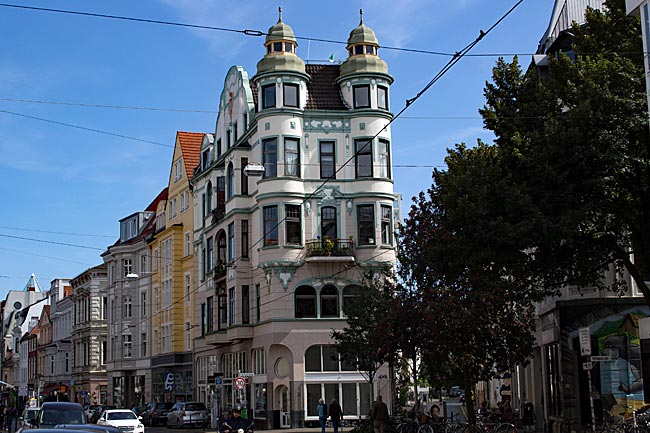
Although the area around the two main streets and their many small side streets partially belongs to the Mitte district and partially to the Östliche Vorstadt, Bremen residents simply refer to it as "das Viertel." It is loved, hated, feared, and much more.
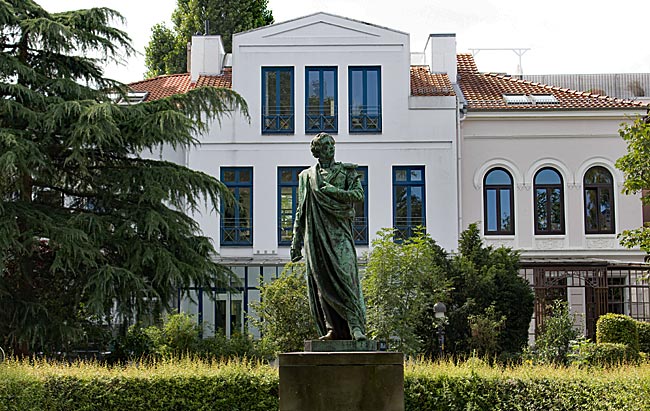
"The Cousin from Bremen" was one of the works by poet and dramatist Theodor Körner, written in 1812, a year before his death. The monument to Körner by sculptor Johann Andreas Deneys at Körnerwall, surrounded by greenery, was unveiled on November 26, 1865.
Nowhere else in the Hanseatic city have contrasts been as openly and sometimes violently evident over decades as they were in the Viertel. On one side stood bourgeois high culture with its institutions along the "culture mile," while on the other were prostitution and the center of Bremen's drug scene, with all its accompanying issues. It was once common for passersby to be begged by addicts with phrases like "Haste mal 'ne Maak?" or to be openly offered drugs, especially at the notorious Sielwall intersection or at Ziegenmarkt (goats market) opposite Helenenstraße, Bremen’s red-light district. A memorial stone there honors the victims of illegal drugs who did not manage to free themselves from their addiction in time but died. The Sielwall intersection has also been the site of repeated violent clashes between political or pseudo-political groups, such as the Autonomen and the police. Infamous were the recurring riots on New Year’s Eve, which at times resembled war-like conditions.
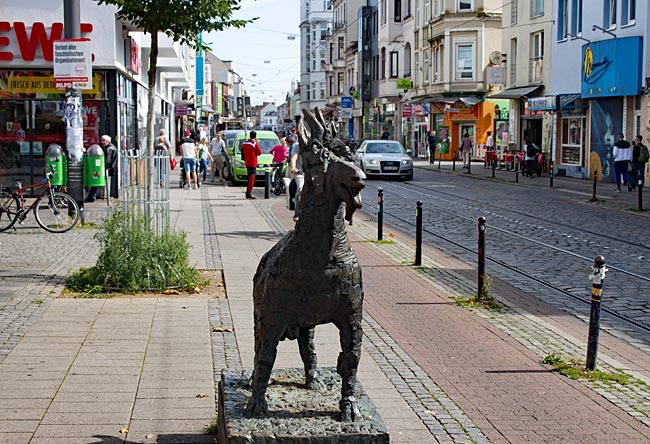
The Ziegenmarkt is a focal point for prostitution in Helenenstraße and drug dealing in front of it, but on Wednesdays, there is an organic market - a quirky combination typical of the Viertel.
previous page
 next page
Map
Further information
https://dasviertel.de
tischlerei museum
Köpkenstraße 18
28203 Bremen
https://tischlerei-museum-bremen.de
Phone: +49 (0)421 171703
Kulturzentrum Lagerhaus Bremen e.V.
Schildstraße 12-19
28203 Bremen
Phone: +49 (0)421 701000-10
Email:info@kulturzentrum-lagerhaus.de
https://www.kulturzentrum-lagerhaus.de
Kino: https://www.Bremerfilmkunsttheater.de/site/aktuell.html
Domsheide
As the name suggests (in german), Domsheide is not far from the cathedral, just a stone's throw away. Passing by Börsenhof A, a historic business and office building constructed between 1861 and 1864 opposite the cathedral and renovated at the turn of the millennium, you quickly arrive at one of the most important public transportation hubs in the city center. Here, trams primarily operate in nearly all directions, including to the airport, Viertel district, central station, university, and Überseestadt.
read more ...
Schnoor
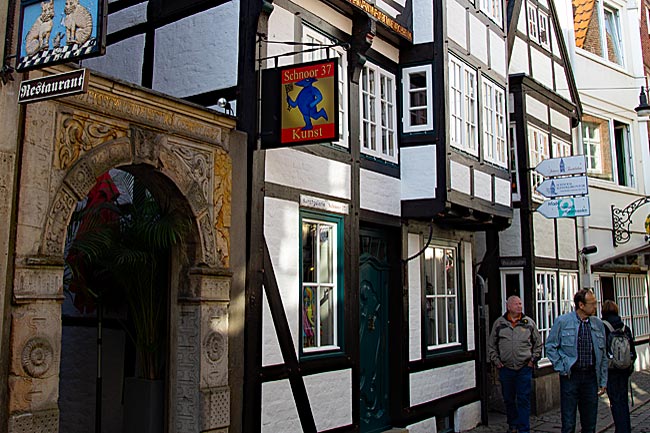
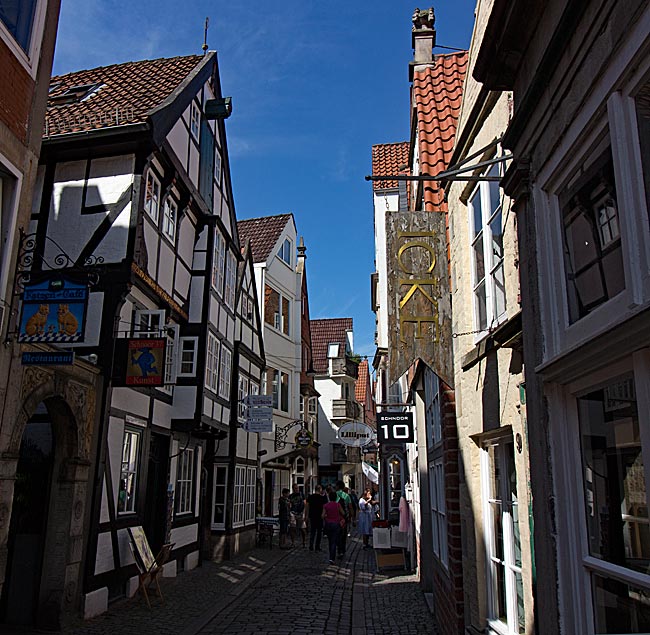
Bremen's oldest preserved neighborhood is the Schnoor. In earlier times, this area was primarily inhabited by fishermen and sailors, as it was here that the Balge - a tributary of the Weser - ran, and one of Bremen's first harbors was located. Many of the small houses date back to the 17th century or have been reconstructed based on historical models. The house at No. 15 in Schnoor Lane, built in 1402 on medieval foundations, is one of the oldest structures in the Schnoor, alongside the Packhaus (1401).
read more ...
Wallanlagen
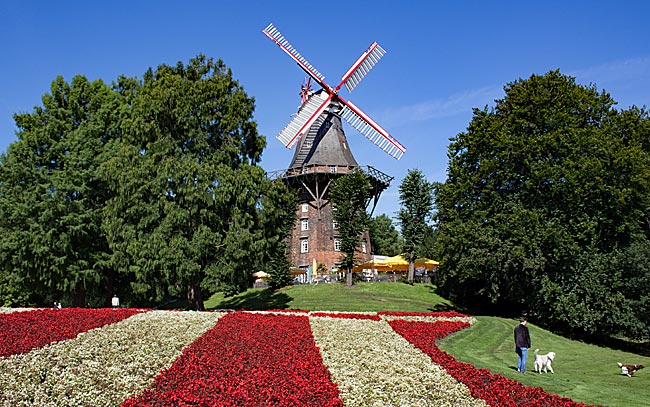
Almost entirely surrounding the Old Town, a zigzagging park landscape with a moat stretches out. These are the last visible remnants of the fortifications that once encircled the Old Town and parts of the New Town until the early 19th century. The transformation into a garden landscape began in 1802 with the first section between the Weser River and Herdentor Gate.
read more ...
Kunsthalle
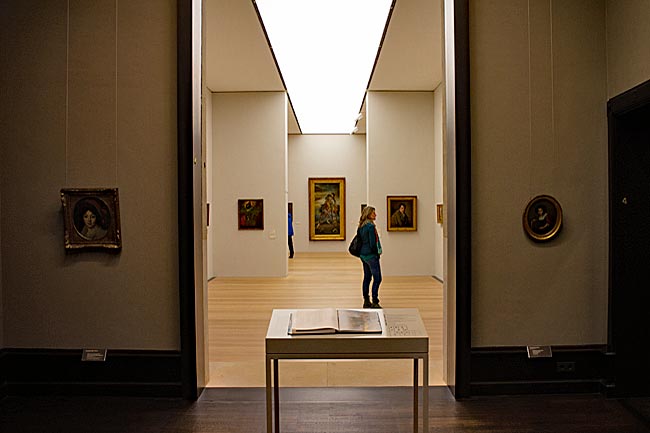
The core of the Kunsthalle's collection consists of European painting from the Middle Ages to the present day. A particular focus is on French painting of the 19th and 20th centuries, which is primarily represented by one of the largest collections of Delacroix's works. German Impressionism is another key highlight, featuring works by artists such as Liebermann, Corinth, and Slevogt. The collection also includes painters from the renowned Worpswede artist colony near Bremen, such as Heinrich Vogeler and Otto Modersohn.
read more ...
Focke-Museum
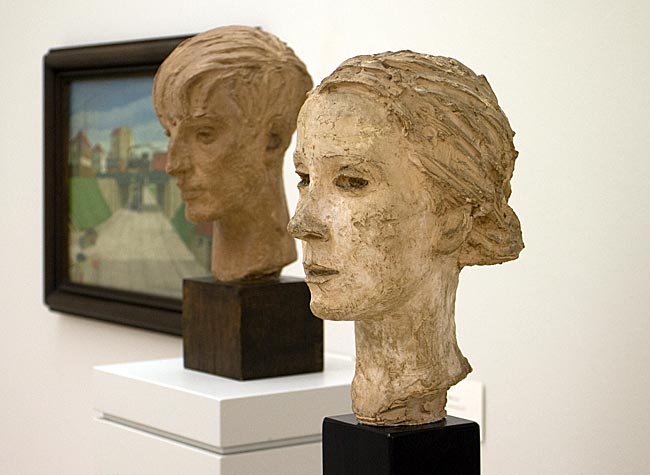
Every city has its history, and in many cities there is a museum that tells this story. In the Hanseatic city, it is the Focke Museum in the Riensberg district, where the city's history is presented most vividly. The 'Bremen State Museum for Art and Cultural History' was created in 1924 by merging two collections: the Gewerbemuseum founded in 1884 and the 'Historical Museum for Bremen Antiquities' founded six years later, whose founder, who died in 1922, also gave his name to today's museum.
read more ...
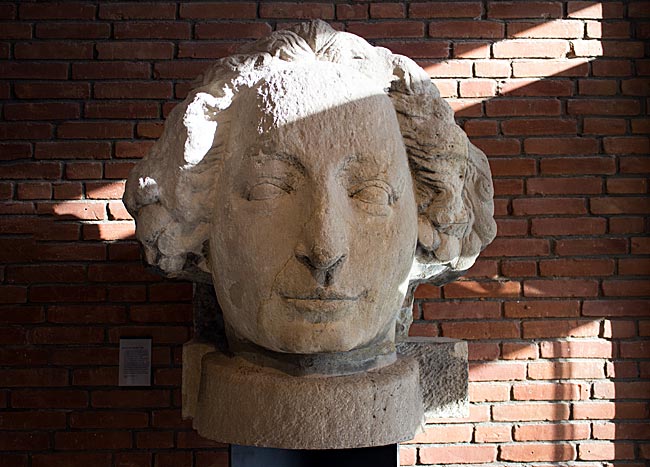
Round trip: from the city center to the Weser weir & back
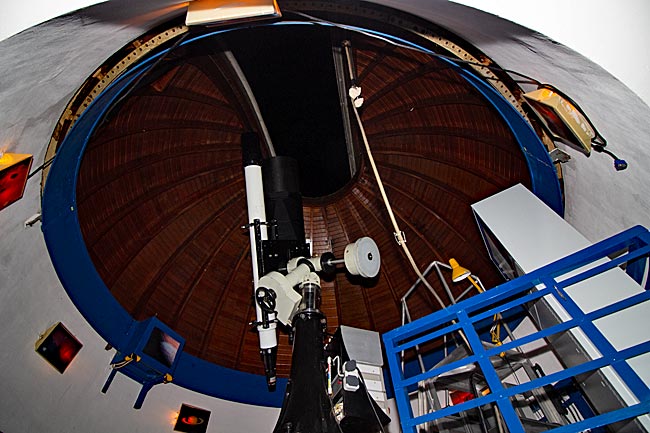
Starting from Tiefer or Altenwall, the section of the Weser riverbank in front of Schnoor and diagonally opposite the DGzRS (German Maritime Search and Rescue Service), the Planetarium, and the Observatory on the other side of the river, a beautiful path for pedestrians and cyclists runs directly along the water upstream towards the Weser weir. After crossing the Weser weir, the return route takes you back via Stadtwerder.
read more ...
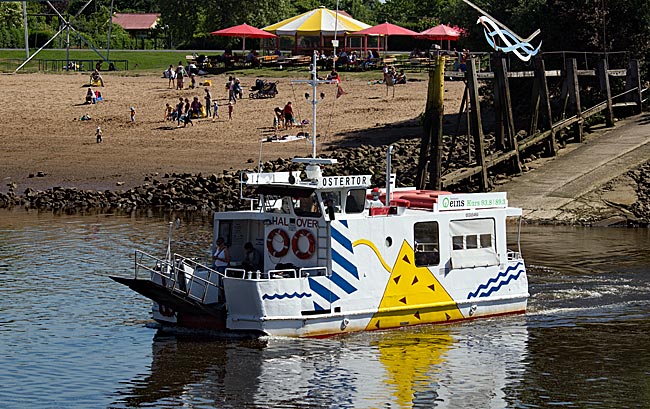
Neustadt district
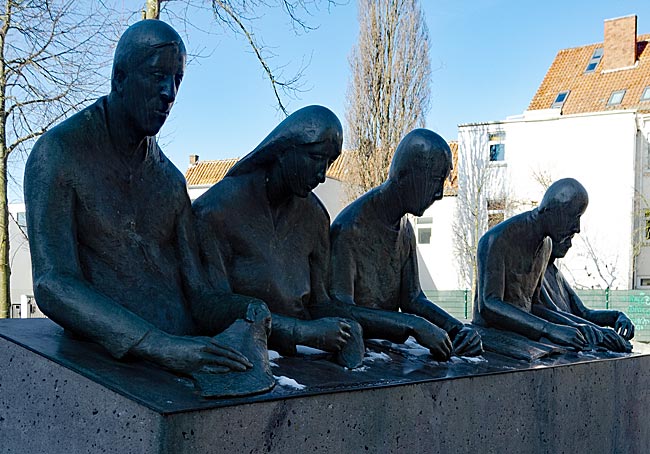
Since around 1820, cigars have been produced in Bremen, partly as home-based work. Just over 30 years later, about 10,000 people were employed in the production of tobacco products, roughly one in six Bremers. A cigar maker could produce up to 1,000 cigars a day, with workdays of 12 to 14 hours being quite common. Often, they paid readers to read newspapers and political writings - often socialist - to them while they worked. To assert and protect their rights, they founded the first trade union in 1849.
read more ...
Worpswede
In 1889, the painters Fritz Mackensen, Otto Modersohn, and Hans am Ende laid the foundation for this art center by deciding to work and live in the small, previously unknown village. They were quickly joined by other artists such as the painter Paula Becker, the poet Rainer Maria Rilke, Clara Rilke-Westhoff, Fritz Overbeck, Heinrich Vogeler, and later the sculptor, painter, and craftsman Bernhard Hoetger, after whose designs, among others, the Paula-Becker-Modersohn-House in Bremen's Böttcherstraße was built.
read more ...
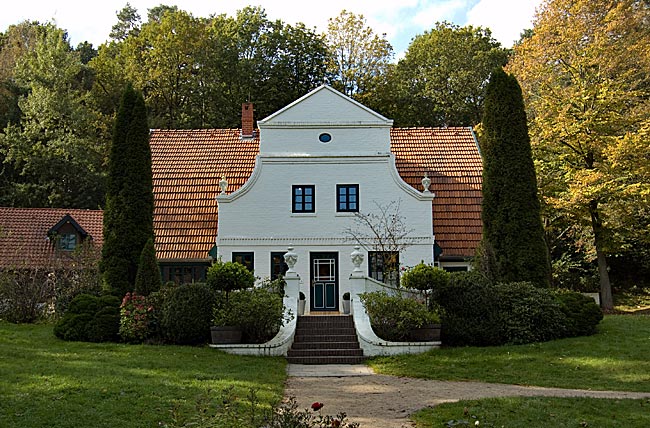
Artists' colony & peasant village: Fischerhude
Signposts make it clear to every previously unaware visitor that this place differs significantly from many other traditionally agricultural villages. Fischerhude is hip. Numerous cafés and restaurants, ceramics studios, art galleries, a local history museum, the Modersohn Museum, and more vie for the favor of an audience that is sometimes more and sometimes less interested in art but regularly strolls through Fischerhude in large numbers.
read more ...