
 exploring Bremen & its surrounding areas
 You are here: attractions in the city center
 Kunsthalle
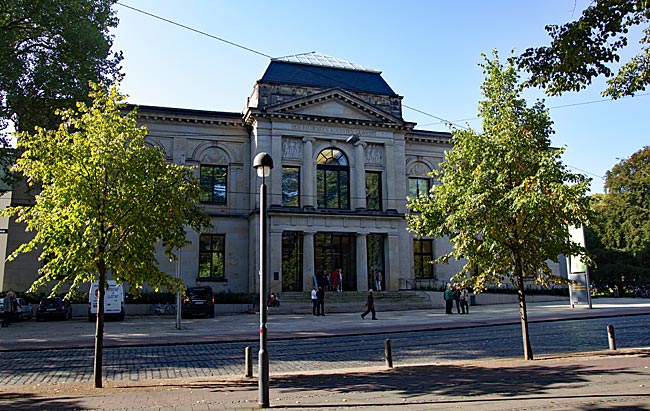
Main building with entrance portal
In 1849, after a two-year construction period, the Kunsthalle at Ostertor opened its doors to the public for the first time. The architect was Lüder Rutenberg, a master builder born in Bremen in 1816. The original structure was his first significant work. However, early in the 20th century, the Kunsthalle underwent extensive renovations and expansions based on plans by another Bremen-born architect, Eduard Gildemeister. The grand reopening took place in 1902. After severe damage during World War II, it wasn’t until the 1960s that the museum was nearly fully renovated.
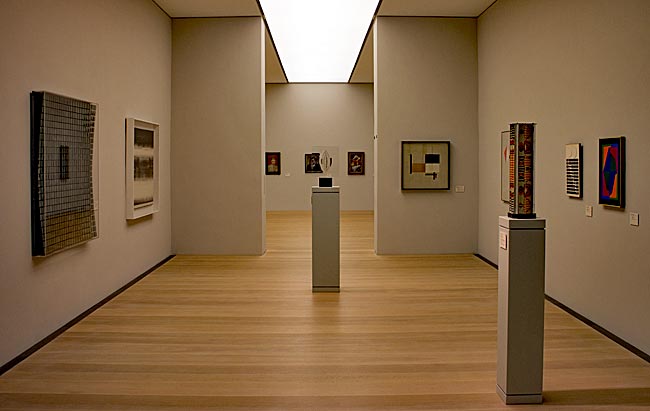
View into exhibition rooms in one of the two annexes
But time takes its toll, so extensive renovations were necessary in the 1990s—first from 1990 to 1992 and then again four years later for another two years. After the turn of the millennium, a 1982 extension had to be demolished as part of the last major construction project. To create more exhibition space for permanent and special exhibitions, the sandstone building—listed as a historic monument since 1977 and located on the "Kulturmeile" (Cultural Mile)—was expanded with two modern wings between 2009 and 2011, adding over 5,500 square meters of space. In addition to constructing the two cubic annexes, the much larger main building between them was also modernized. Although the measures cost around €33.5 million, they were a worthwhile investment, as not only does the new lighting concept in a more modern setting showcase the museum’s impressive artworks even better.
The core of the Kunsthalle’s collection consists of European paintings from the Middle Ages to the present day. A particular focus is French painting of the 19th and 20th centuries, represented primarily by one of the largest Delacroix collections in existence. German Impressionism is another highlight, featuring works by artists such as Liebermann, Corinth, and Slevogt. The collection also includes painters from the famous Worpswede artist colony near Bremen, such as Heinrich Vogeler and Otto Modersohn.
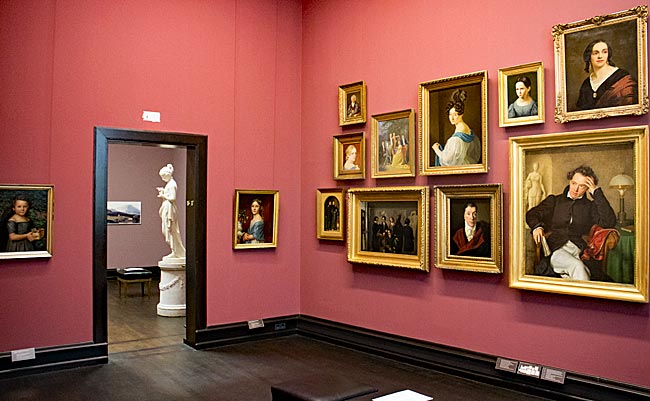
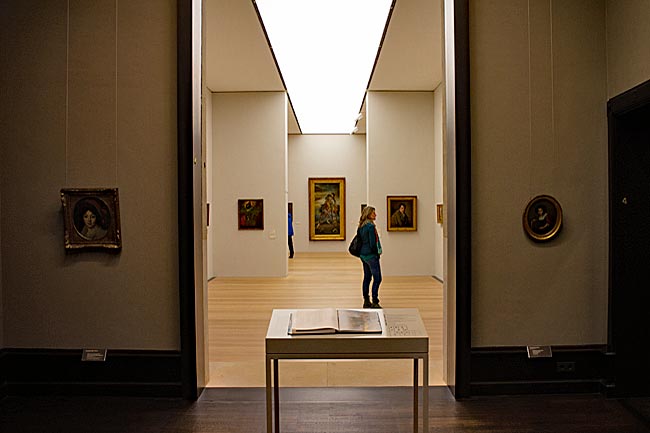
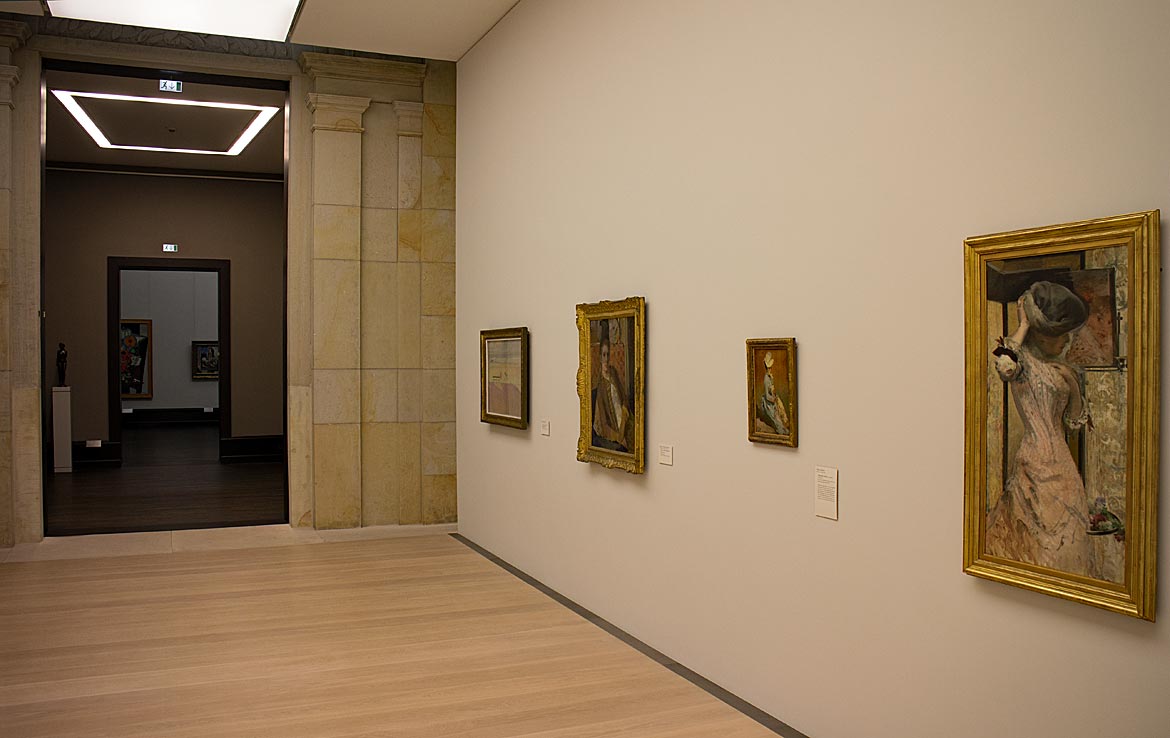
Exhibition rooms in the main building
One of the most significant collections is the Kupferkabinett (Print Room), which houses over 200,000 sheets of drawings and prints.
Changing special exhibitions featuring works by international artists often attract large crowds, drawing both locals and visitors from afar to the Kunsthalle.
The first director of the museum was Gustav Pauli, a Bremen art historian. The son of Bremen’s mayor Alfred Pauli was, in a sense, the first in a long line of successors, as he became the Kunsthalle’s first scientific employee in 1899 before being appointed director in 1905. His lasting impact as the museum’s leader was so significant that a square in the Schwachhausen district of Bremen was named after him. After his death, he was buried at Riensberg Cemetary, within view of the Focke Museum.
Appropriately, Gustav-Pauli-Platz is located right next to Klugkiststraße. Hieronymus Klugkist was not only a senator but also the initiator of the founding of the Kunstverein (Art Association) in Bremen. At the time of its establishment in 1823, the association had 34 members - including eleven senators like Klugkist himself, as well as merchants, lawyers, doctors, and professors, all representing high society. The membership was initially limited to 50, later raised to 75. Its written mission was to "promote and cultivate a sense of beauty" in the Hanseatic city, though this was limited to the visual arts.
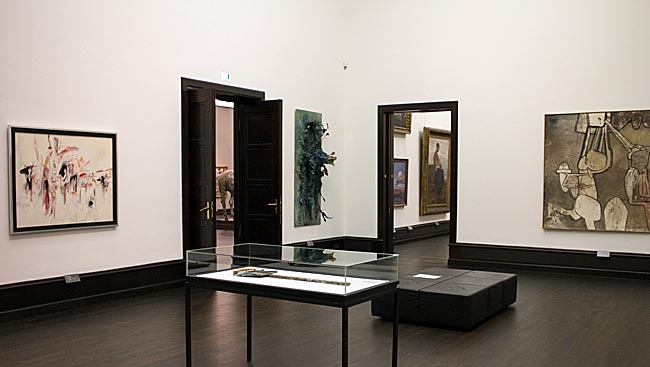
View into part of the exhibition rooms in the main building
Over the years, not only individual members but also the financially well-off association itself purchased paintings and drawings, some of which formed the foundation for today’s Kupferstichkabinett (Print Room), and organized highly successful exhibitions. It was the Kunstverein that ultimately initiated the construction of the Kunsthalle. The non-profit association remains the museum’s operator to this day, not the city. With 75 members? No, after the membership limit was lifted in 1843, there were already 500 members, and today there are around 9,000. Personal commitment, donations, bequests from significant collections, substantial financial contributions, and a passion for art have all helped not only preserve the Kunsthalle but also make it renowned beyond the city’s borders.
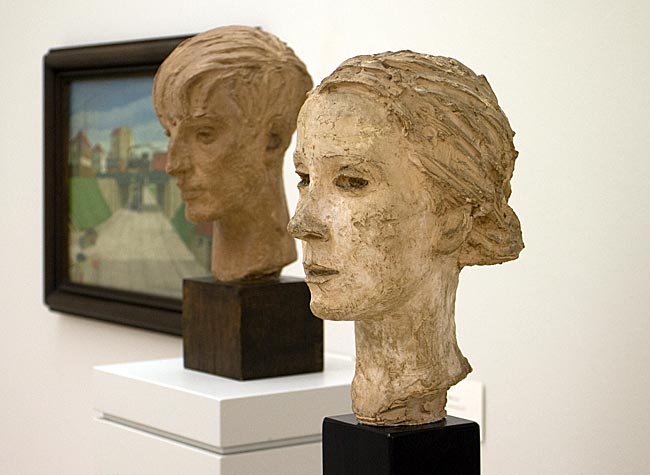
Portrait M.H. (Woman’s Head), 1923. A work by Kurt Edzard, an artist born in Bremen in 1890.
The Kunstverein Bremen is the oldest, but by no means the only, association dedicated to promoting and preserving art and culture in the local museum landscape. The Friends of the Focke Museum Association can look back on a history dating to 1910 and has half as many members as the Kunstverein. Since 1985, the Friends of the Übersee-Museum have been active.
previous page
 next page
Map
Further information
Kunsthalle Bremen
Am Wall 207
28195 Bremen
Phone: +49 (0)421 32 90 80
Open: Wednesday - Sunday 10 AM - 6 PM (or 5 PM starting February 8), Tuesday 10 AM - 9 PM, Monday closed
Email: info@kunsthalle-bremen.de
www.kunsthalle-bremen.de
www.kunsthalle-bremen.de/kunstverein/ueber-uns-kv/
Wallanlagen
Almost entirely surrounding the old town is a zigzagging park landscape with a moat. These are the last visible remnants of the fortifications that enclosed the old town and parts of the new town until the early 19th century. The transformation into a garden landscape began in 1802 with the first section between the Weser River and Herdentor Gate.
read more ...
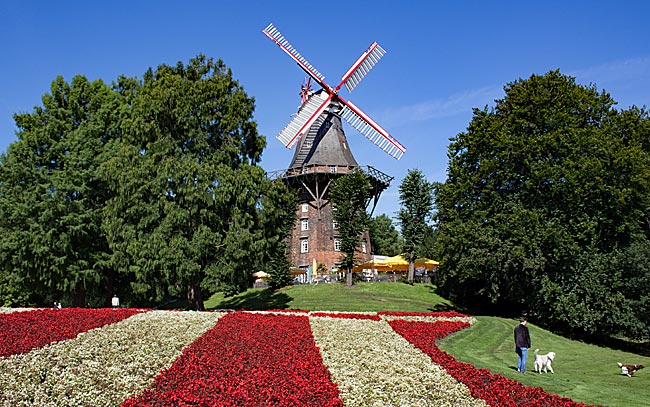
Das Viertel (The Quarter)
Although the area around the two main streets and their many small side streets partly belongs to the Mitte district and partly to the Eastern Suburb, the locals simply call this quarter "the Viertel." It is loved, hated, feared, and much more. Perhaps in no other neighborhood of the Hanseatic city have contrasts been so openly and sometimes even violently evident over decades as they have been in the Viertel.
read more ...
Worpswede
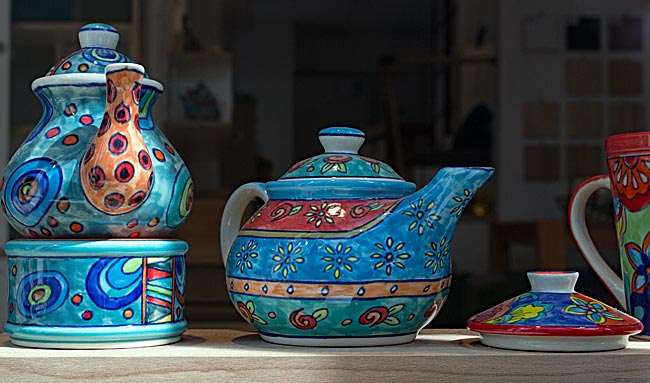
In 1889, the painters Fritz Mackensen, Otto Modersohn, and Hans am Ende laid the foundation for this art center by deciding to work and live in the small, previously unknown village. They were quickly joined by other artists such as the painter Paula Becker, the poet Rainer Maria Rilke, Clara Rilke-Westhoff, Fritz Overbeck, Heinrich Vogeler, and later the sculptor, painter, and craftsman Bernhard Hoetger, after whose designs, among others, the Paula-Becker-Modersohn-House in Bremen's Böttcherstraße was built.
read more ...
Focke-Museum
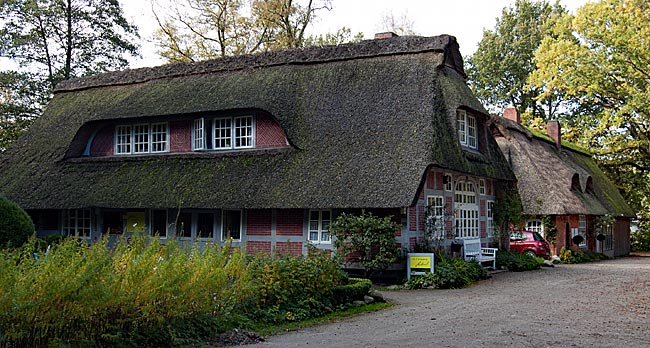
Every city has its history, and in many cities, there is a museum where this story is told. In the Hanseatic city of Bremen, it is the Focke Museum in the Riensberg district that presents the city's history most vividly. The "Bremer State Museum for Art and Cultural History" was established in 1924 by merging two collections: the Gewerbemuseum, founded in 1884, and the Historisches Museum für bremische Altertümer (Historical Museum of Bremen Antiquities), founded six years later. The museum's namesake was its founder, who passed away in 1922.
read more ...
Übersee-Museum
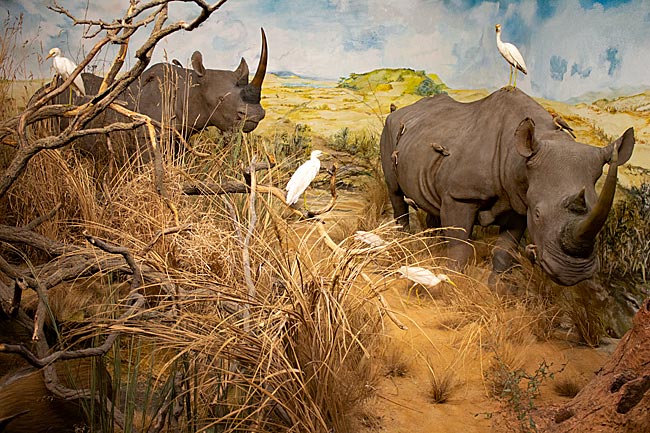
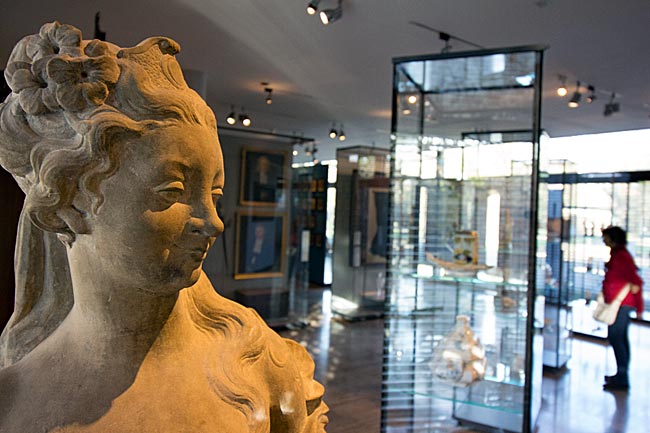
In 1896, the current Übersee-Museum first opened its doors under the name "Municipal Museum of Natural History, Ethnology, and Commerce." The exhibits initially came from the "Municipal Collections of Natural History and Ethnography," which were partly displayed as a "Trade and Colonial Exhibition" at the "Northwest German Trade and Industry Exhibition" in 1890 with great success. Since its founding, the museum's concept has evolved several times, leading to a stronger focus on museum education, which remains in place today.
read more ...