
 exploring Bremen & its surrounding areas
 You are here: Museums
 Museums in Bremen – a selection
Altes Pumpwerk (Old Pumping Station)
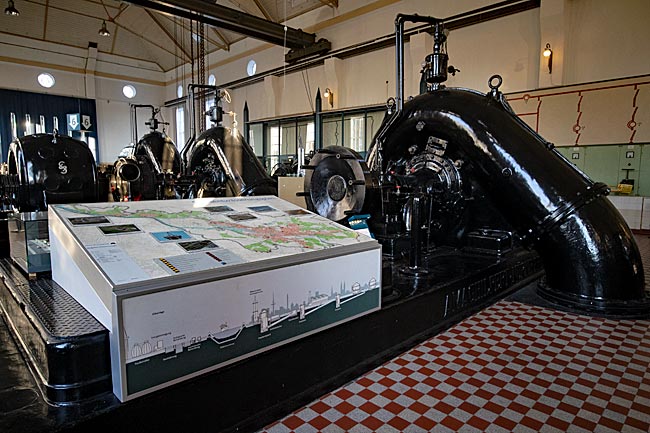
Built in the second decade of the 20th century, this facility served as a sewage disposal system in Bremen until 1995 and is now a protected monument. In 1997, former employees founded the non-profit association "Altes Pumpwerk e.V.," which, with financial support from the local utility company "Hanse-Wasser Bremen GmbH," transformed the facility into a museum and living cultural monument. The project received the Monument Conservation Award in 2010.
Open: Usually on the first Sunday of each month, 3:00 PM – 6:00 PM
Altes Pumpwerk e.V.
Salzburger Straße 12
28219 Bremen
Phone: +49 (0)421 988-1111
Email: kontakt@altespumpwerk.de
www.altespumpwerk.de
Bremer Rundfunkmuseum (Bremen Broadcasting Museum)
Founded in 1978, this museum displays around 700 objects from 80 years of radio, phonograph, and television history across 400 square meters. Throughout the year, numerous events related to broadcasting take place here, such as radio flea markets.
Those looking to repair a defective tube radio or preserve old sound recordings can find expert assistance at the museum.
Open: Tuesday to Thursday and Sunday, 10:00 AM – 3:00 PM; closed on public holidays
Bremer Rundfunkmuseum e.V.
Findorffstraße 22 – 24
28215 Bremen
Phone: +49 (0)421 357406
Email: info@Bremer-rundfunkmuseum.de
www.Bremer-rundfunkmuseum.de
Dom-Museum (Cathedral Museum)
Ecumenical Museum of Bremen Church History
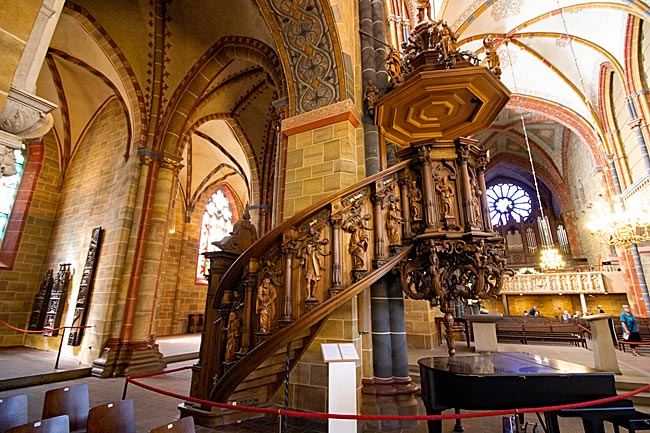
Founded in 1987, the Dom-Museum showcases grave goods and textiles from the 11th to 15th centuries, recovered during excavations in the nave from medieval bishops' graves in the 1970s, as well as ecclesiastical art objects.
Open: Monday – Friday 10:00 AM – 4:45 PM, Saturday 10:00 AM – 1:30 PM, Sunday 2:00 PM – 4:45 PM
Closed: Good Friday, May 1st, October 3rd, December 24th/25th, December 31st, and during church services
Access through the main portal of St. Peter's Cathedral at the end of the southern (right) transept.
Group tours: Phone: +49 (0)421 3347142
https://dommuseum-bremen.de
Gerhard-Marcks-Haus
Opened in 1971, this museum manages a significant portion of the works by the namesake artist who died in 1981. In 1969, he donated a substantial collection of his own creations to the foundation. Additional works - sculptures, woodcuts, and graphic prints - have been acquired through subsequent donations and purchases. The famous Bremen Town Musicians near the town hall are also by him.
The foundation also manages other estates, including those of sculptor Waldemar Grzimek (since 2005) and Gerhart Schreiter (since 2007).
The diverse world of modern and contemporary sculpture is the central theme of rotating exhibitions featuring international artists held multiple times a year.
Those interested in artistic activities may find suitable courses led by experts in the museum’s atelier.
Open: Tuesday, Wednesday, Friday – Sunday 10:00 AM – 6:00 PM, Thursday 10:00 AM – 9:00 PM; closed May 1st, December 24th and 31st
Gerhard-Marcks-Haus
Am Wall 208
28195 Bremen
Phone: +49 (0)421 9897520
E-Mail info@marcks.de
www.marcks.de
Hafenmuseum Speicher XI (Harbor Museum Warehouse XI)
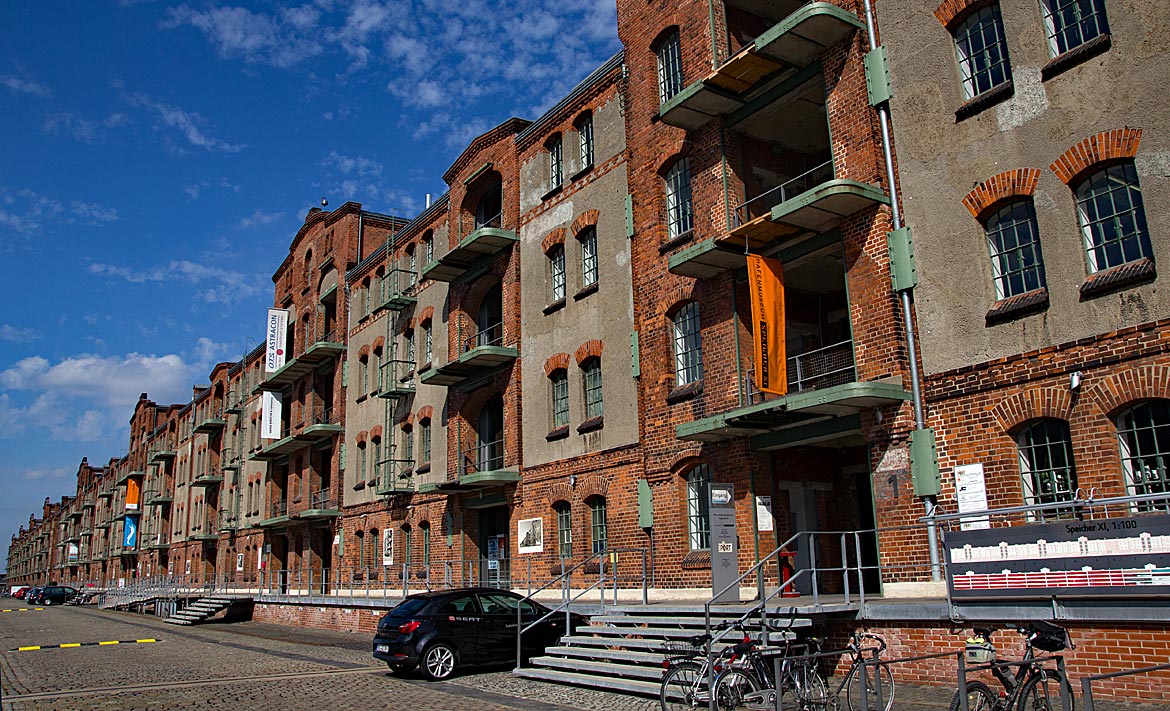
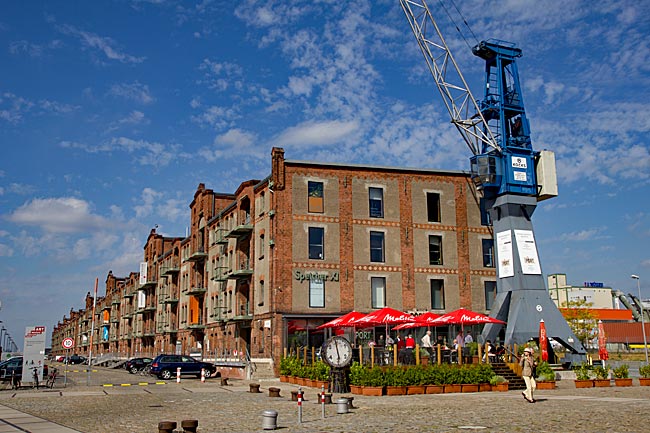
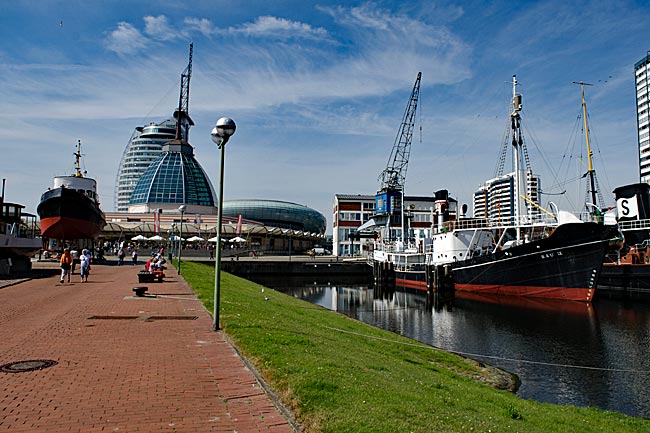
Alongside institutions such as the University of Arts, the Harbor Museum is housed in the renovated industrial monument Speicher XI. The building is one of the last remnants of the filled-in and now developed Overseas Harbor. The museum’s permanent exhibitions cover not only the history of this harbor but also the past 120 years of Bremen’s harbors - from construction to port economics to repurposing. Additionally, rotating special exhibitions are held.
Open: Tuesday – Sunday 11:00 AM – 6:00 PM; open on all holidays from 11:00 AM – 6:00 PM
Hafenmuseum Seicher XI
Am Speicher XI 1
28217 Bremen
Email: info@hafenmuseum-speicherelf.de
www.hafenmuseum-speicherelf.de
Museen Böttcherstraße
Paula Modersohn-Becker Museum
Ludwig Roselius Museum
Sammlung Bernhard Hoetger
Since June 2, 1927, masterpieces by the painter Paula Modersohn-Becker (born 1876), who lived and worked in the artists' village of Worpswede near Bremen for many years, have been displayed in the expressionist building of the Paula-Becker-Modersohn-Haus on Böttcherstraße. The coffee entrepreneur Ludwig Roselius initiated and financed both the museum and the house, which he named after the artist (though its original name was "Paula-Becker-Modersohn-Haus"). It was the first museum in the world dedicated to a female artist. Since Roselius’ death in 1943, the collection has been expanded through new acquisitions and loans from the Paula Modersohn-Becker Foundation.
Additionally, the museum holds the most comprehensive collection of works by Bernhard Hoetger, who designed this building and others on Böttcherstraße at Roselius' request.
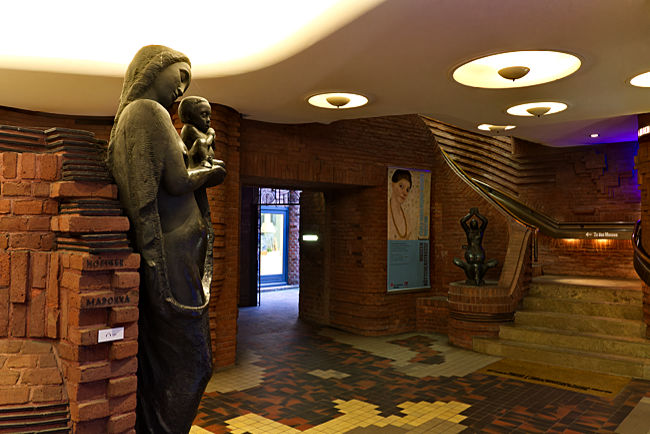
The Museum im Roselius-Haus opened a year later. It was Roselius’ private collector’s museum, where he sought to realize the ideal of a historically North German residence. Nine rooms were furnished in different styles for various purposes - from dining rooms to skylight halls - with selected objects from the 12th to the 19th century. The collection includes works by Lucas Cranach the Elder and Tilmann Riemenschneider (Lamentation Group, circa 1515).
Open: Tuesday – Sunday 11:00 AM – 6:00 PM; closed Monday, Easter Monday, May 1st, Whit Monday, December 24th and 31st
Museen Böttcherstraße
Paula Modersohn-Becker Museum
Ludwig Roselius Museum
Sammlung Bernhard Hoetger
Böttcherstraße 6–10
28195 Bremen
Phone: +49 (0)421 3388222
Email: info@museen-boettcherstrasse.de
www.museen-boettcherstrasse.de
Overbeck-Museum
Opened in 1990, this exhibition space focuses primarily on the art of the painter couple Fritz and Hermine Overbeck. The selection of works rotates, so not all are displayed simultaneously. Fritz Overbeck (died 1909) became known as one of the founding fathers of the artists' colony Worpswede, which remains a magnet for art enthusiasts today. Consequently, the art of other Worpswede artists is also frequently featured in exhibitions. Additionally, regular guided tours are offered, and visitors can attend lectures or readings and participate in art travel organized by the Kunstreisen association.
Open: Tuesday – Sunday 11:00 AM – 6:00 PM; closed Monday.
Closed: Good Friday, December 24th–26th and 31st, January 1st
Overbeck-Museum
Verein der Freunde des Overbeck-Museums e.V.
Altes Packhaus Vegesack
Alte Hafenstraße 30
28757 Bremen
Phone: +49 (0)421 /663 665
Email: info@overbeck-museum.de
www.overbeck-museum.de
Universum® Science Center Bremen
This architecturally futuristic building from the Millennium year offers hands-on science with numerous interactive stations. Experimental setups, spatial installations, and media exhibits on technology, humans, nature, and a children’s area called "Milky Way" invite visitors to explore and experience with all their senses across three levels and 4,000 square meters of exhibition space.
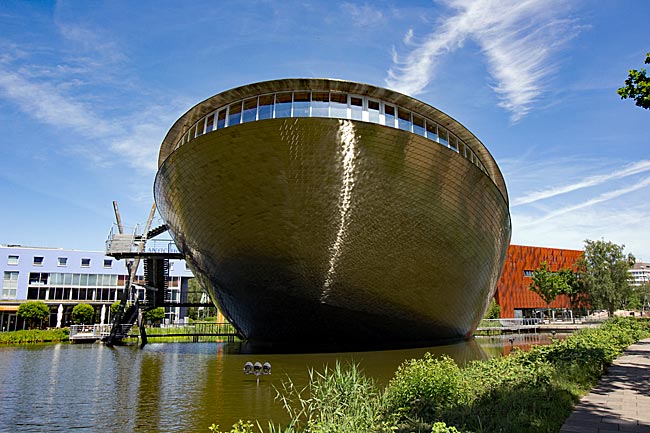
In October 2007, an outdoor area (EntdeckerPark) was added across the street, featuring attractions such as the Tower of Winds and the SchauBox - a cube for demonstrations, special exhibitions, and a restaurant.
Open: Monday – Friday 9:00 AM – 6:00 PM; Saturday, Sunday, and holidays 10:00 AM – 6:00 PM
Universum® Science Center Bremen
Wiener Straße 1a
28359 Bremen
Phone: +49 (0)421 33460
Email: info@universum-bremen.de
https://universum-bremen.de
Weserburg | Museum für moderne Kunst (Weserburg | Museum of Modern Art)
Located on Teerhof between the arms of the Weser River, the Weserburg is Bremen’s museum for modern art. The collector’s museum presents a selection of contemporary artworks from 1960 onward, including pieces by renowned artists such as Warhol, Beuys, Segal, and Trockel. These works come from the collections of international private collectors.
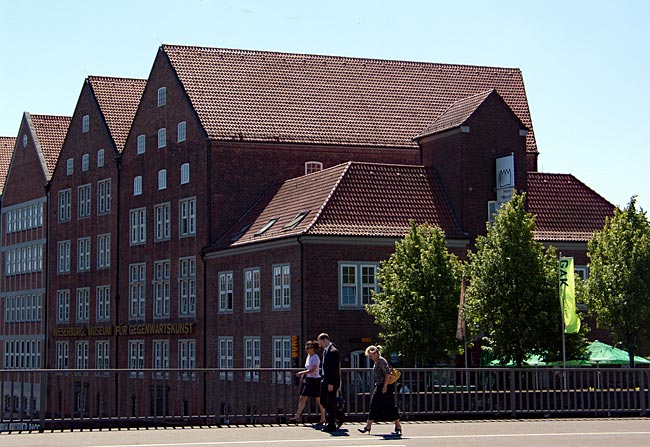
Additionally, the museum’s Study Center for Artist Publications holds the largest and most significant collection of artist publications (artist books, records, video films, etc.) in Europe since the 1960s. The collection comprises 60,000 published artworks from multiple sources.
Open: Tuesday – Sunday 11:00 AM – 6:00 PM; Thursday 11:00 AM – 8:00 PM; closed Monday, as well as Good Friday, Easter Monday, May 1st, Whit Monday, Christmas Eve, Christmas Day, New Year’s Eve, and New Year’s Day.
Weserburg | Museum für moderne Kunst
Teerhof 20
28199 Bremen
Phone: +49 (0)421 598390
Email: sekretariat@weserburg.de
www.weserburg.de
Wilhelm Wagenfeld Stiftung (Wilhelm Wagenfeld Foundation)
Wilhelm Wagenfeld Haus
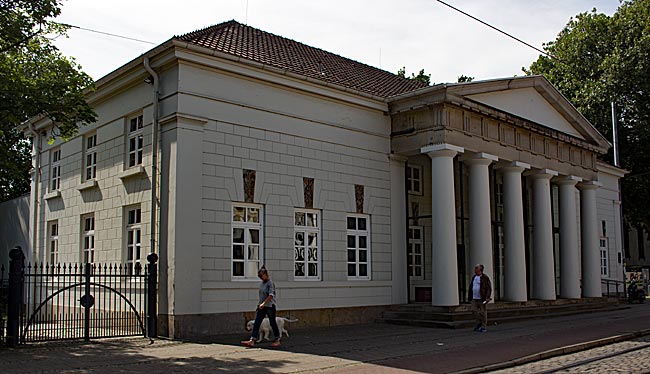
Across from the Gerhard-Marcks-Haus is the Wilhelm Wagenfeld Foundation, housed in the old classical Ostertorwache, a former prison. The foundation manages the estate of Wilhelm Wagenfeld (1900–1990), an internationally renowned Bauhaus student born in Bremen who is considered one of the most influential pioneers of industrial product design in 20th-century Germany.
The house’s 300-square-meter exhibition space hosts special exhibitions on design and everyday culture.
Open (only during exhibition times): Tuesday 3:00 PM – 9:00 PM; Wednesday – Sunday 10:00 AM – 6:00 PM
Wilhelm Wagenfeld Stiftung
Wilhelm Wagenfeld Haus
Am Wall 209
28195 Bremen
Phone: +49 (0)421 3399933
Email: info@wilhelm-wagenfeld-stiftung.de
www.wilhelm-wagenfeld-stiftung.de
For more detailed information, see the Focke-Museum, Kunsthalle, and Übersee-Museum in the right or lower column.
previous page
 next page
Focke-Museum
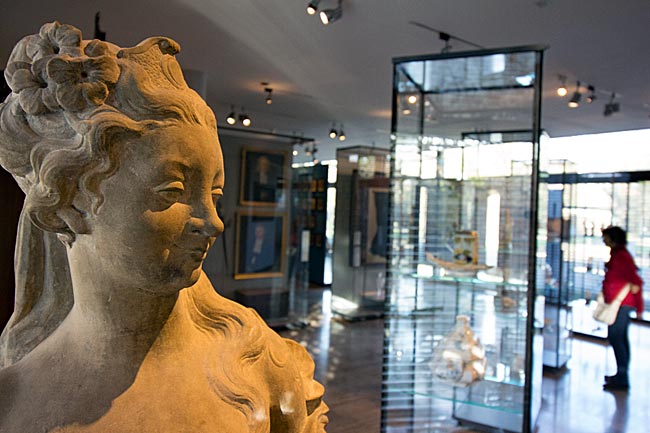
Every city has its history, and in many cities, there is a museum where this story is told. In the Hanseatic city of Bremen, it is the Focke Museum in the Riensberg district that presents the city's history most vividly. The "Bremer State Museum for Art and Cultural History" was established in 1924 by merging two collections: the Gewerbemuseum, founded in 1884, and the Historisches Museum für bremische Altertümer (Historical Museum of Bremen Antiquities), founded six years later. The museum's namesake was its founder, who passed away in 1922.
read more ...
Kunsthalle
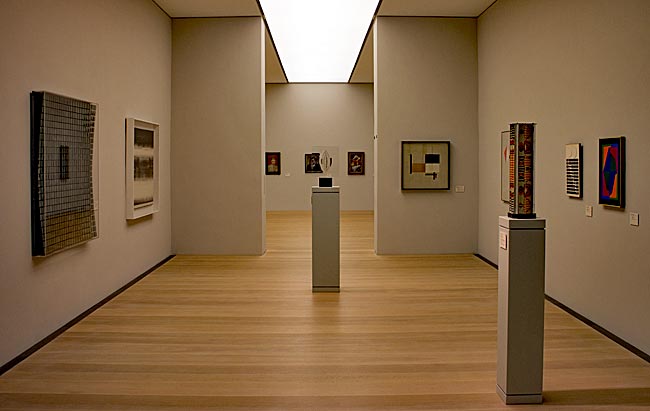
The core of the Kunsthalle's collection consists of European painting from the Middle Ages to the present day. A particular focus is on French painting of the 19th and 20th centuries, primarily represented by one of the largest collections of Delacroix's works. German Impressionism is another key highlight, featuring works by artists such as Liebermann, Corinth, and Slevogt. The collection also includes painters from the renowned Worpswede artist colony near Bremen, such as Heinrich Vogeler and Otto Modersohn.
read more ...
Übersee-Museum
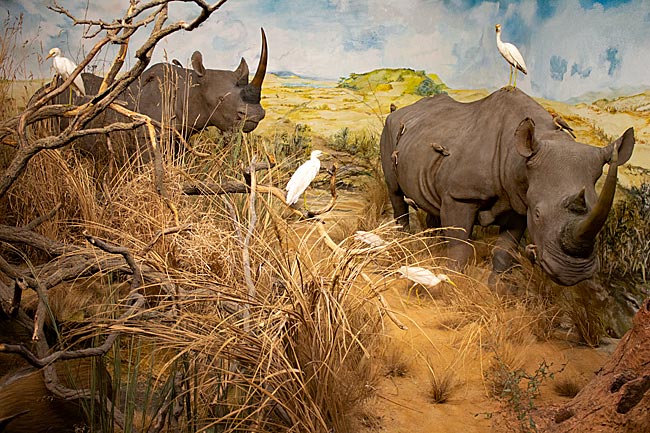
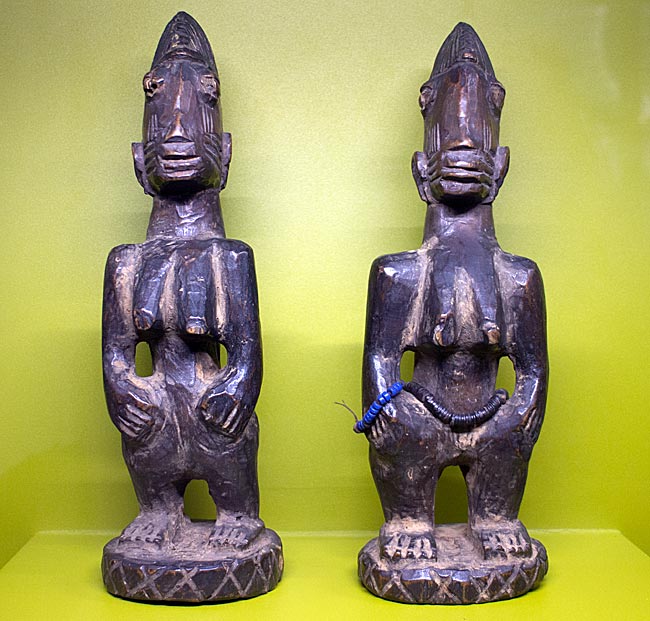
1896, the current Übersee-Museum first opened its doors under the name "Städtisches Museum für Natur-, Völker- und Handelskunde" (Municipal Museum of Natural History, Ethnology, and Trade). The exhibits initially came from the "Städtische Sammlungen für Naturgeschichte und Ethnographie", which were partly displayed as a "Trade and Colonial Exhibition" at the "Northwest German Trade and Industry Exhibition" in 1890 with great success. Since its founding, the museum's concept has evolved several times, eventually shifting toward a stronger focus on museum education, an approach that remains in place today.
read more
...
Bremen Town Musicians
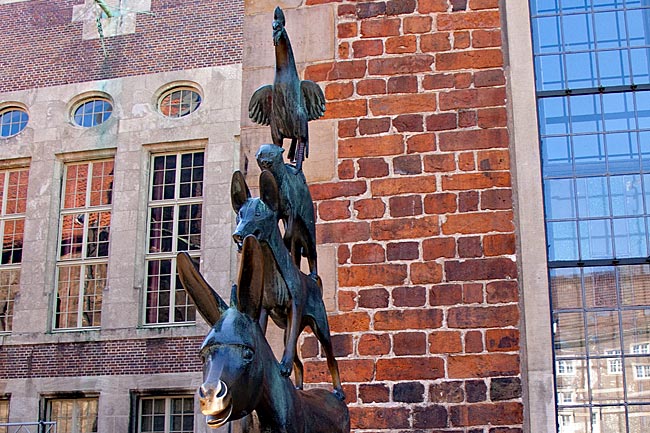
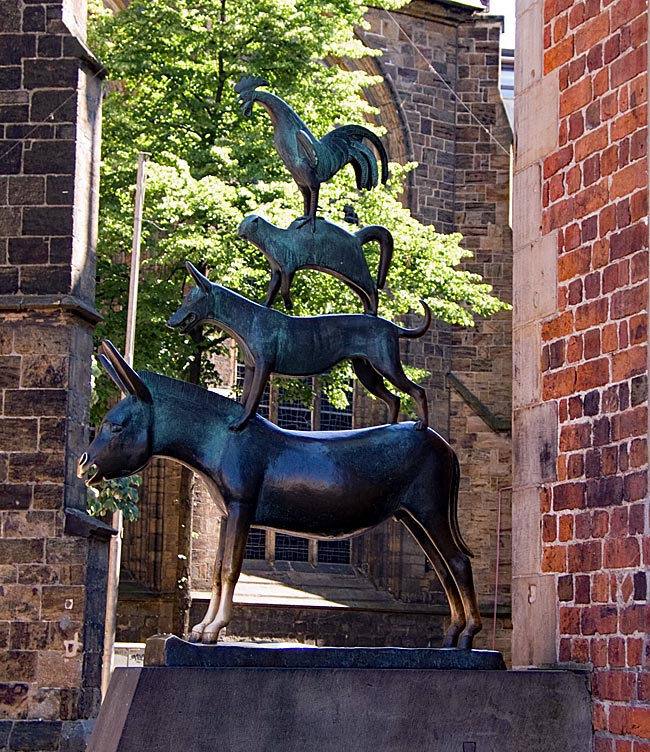
On the left side of the Old Town Hall, next to the entrance to the lower hall, stand four bronze-cast heroes of a world-famous fairy tale - the Bremen Town Musicians. However, it remains a contentious point whether these mismatched four - donkey, dog, cat, and rooster - actually made it to Bremen, as the fairy tale does not provide a clear answer on this matter. But perhaps that is not so important, for what truly matters is the message conveyed in the story.
read more ...
Böttcherstraße
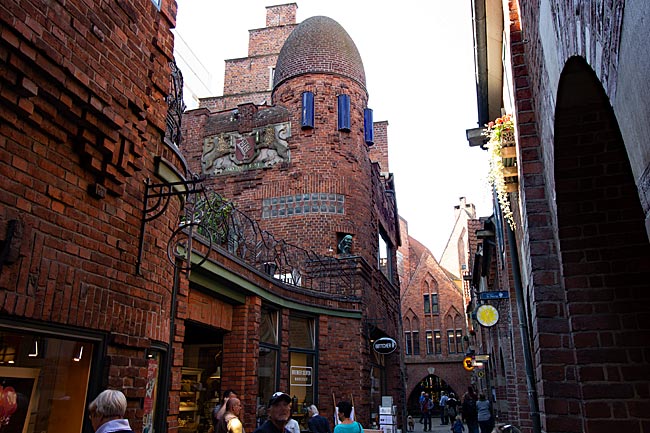
Since at least 1931, the name Böttcherstraße is no longer primarily associated with the scent of wood and the sound of coopers' hammers, but rather with a very special, almost enclosed ensemble of buildings. Over a length of just over one hundred meters, museums, open artist workshops, specialty retailers offering upscale goods, dining establishments, and a hotel create a unique atmosphere between brick and sandstone structures that is unparalleled in Bremen.
read more
...
Das Viertel (The Quarter)
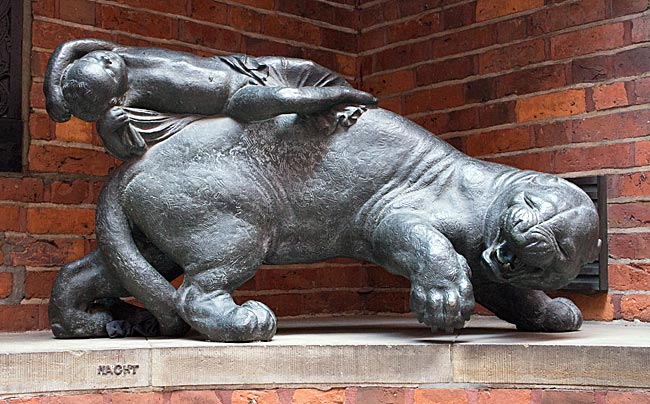
Even though the area around the two main streets, Ostertor and Steintor, with their many small side streets still belongs to the Mitte district, Bremen residents simply refer to it as "Das Viertel" (The Quarter). It is loved, hated, feared, and much more. In no other neighborhood of this Hanseatic city have contrasts been so openly - and sometimes violently - visible over decades as in the Viertel.
read more
...
Schnoor
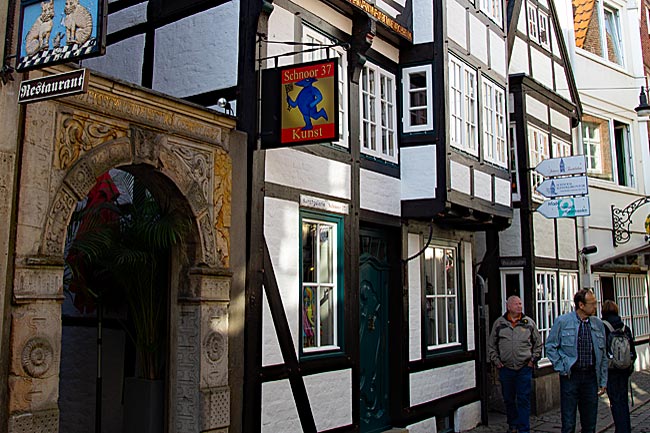
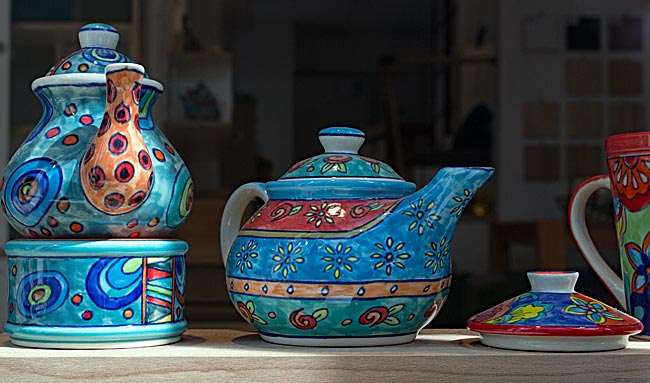
Bremen's oldest preserved neighborhood is the Schnoor. In earlier times, this area was primarily inhabited by fishermen and sailors, as it was here that the Balge - a tributary of the Weser - ran, and one of Bremen's first harbors was located. Many of the small houses date back to the 17th century or have been reconstructed based on historical models. The house at No. 15 in Schnoor Lane, built in 1402 on medieval foundations, is one of the oldest structures in the Schnoor, alongside the Packhaus (1401).
read more
...
Wallanlagen
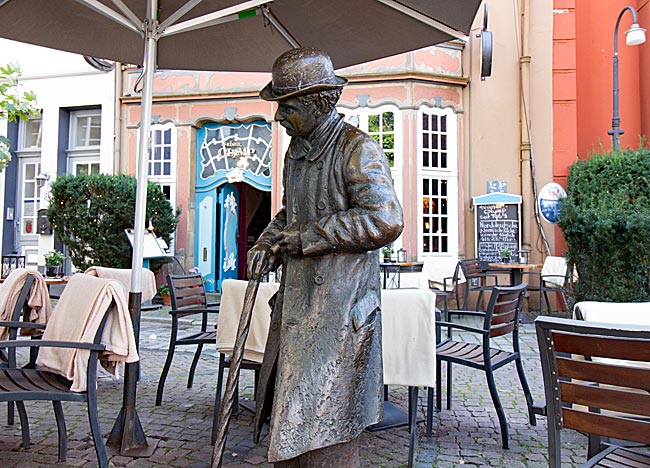
A zigzagging park landscape with a moat stretches almost entirely around the Old Town. This is the last remaining visible trace of the fortifications that once surrounded both the Old Town and the New Town until the early 19th century.The transformation into a garden landscape began in 1802 with the first section between the Weser River and Herdentor Gate.
read more ...
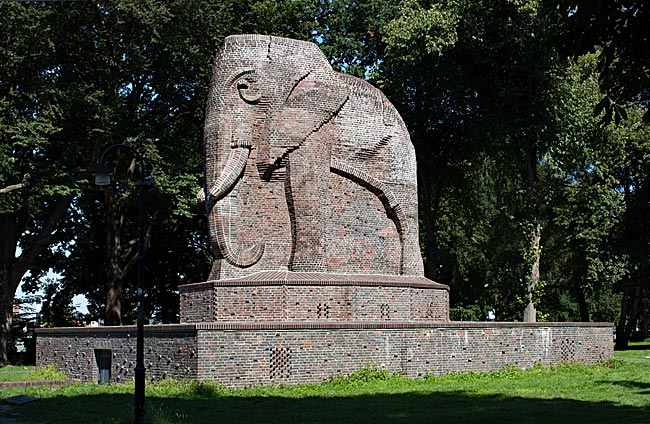
Anti-Colonial Elephant Monument
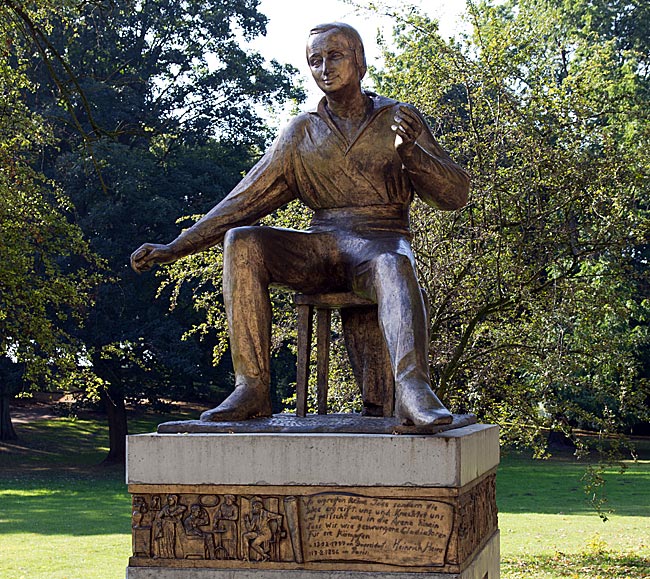
The brick structure was commissioned by the German Colonial Society, which inaugurated the monument on July 6, 1932. However, even in this traditionally cosmopolitan Hanseatic city, the monument was controversial from the start - not only did it commemorate German soldiers who died in World War I in former German colonies, but it also symbolized the oppression and exploitation of the indigenous populations there. After restoration work and its redesignation in 1989, the Elephant now stands as an Anti-Colonial Monument representing equality and justice, serving as a warning against racism, oppression, and exploitation.
read more ...
Findorff district
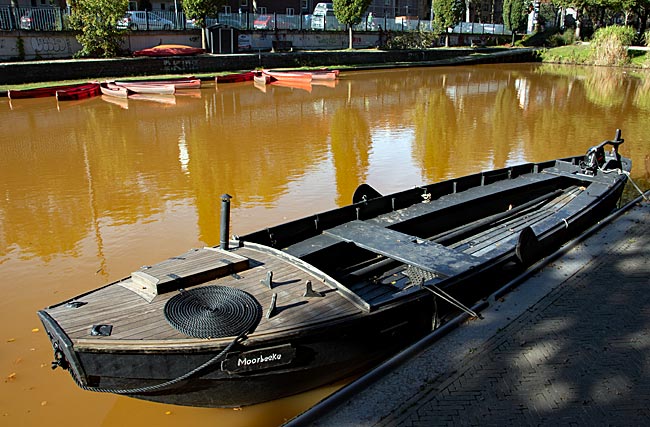
The history of the Findorff district is closely tied to the moors of Lower Saxony's surrounding countryside. In 1819, the so-called "Torfkanal" (Peat Canal) was dug to transport peat as fuel, particularly from Teufelsmoor, by waterway to Bremen. Even today, the second peat harbor, built in 1873, exists in a smaller form within the district, with traditional peat barges still moored there. However, peat transportation no longer plays any role.
read more ...