
 exploring Bremen & its surrounding areas
 You are here: attractions in the city center
 The Town Hall – UNESCO World Heritage Site
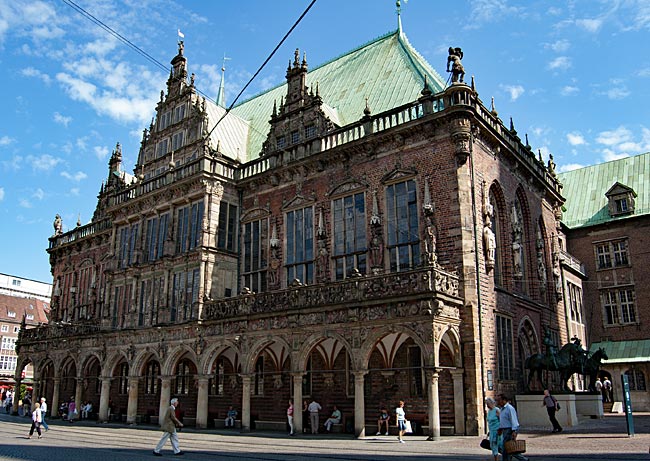
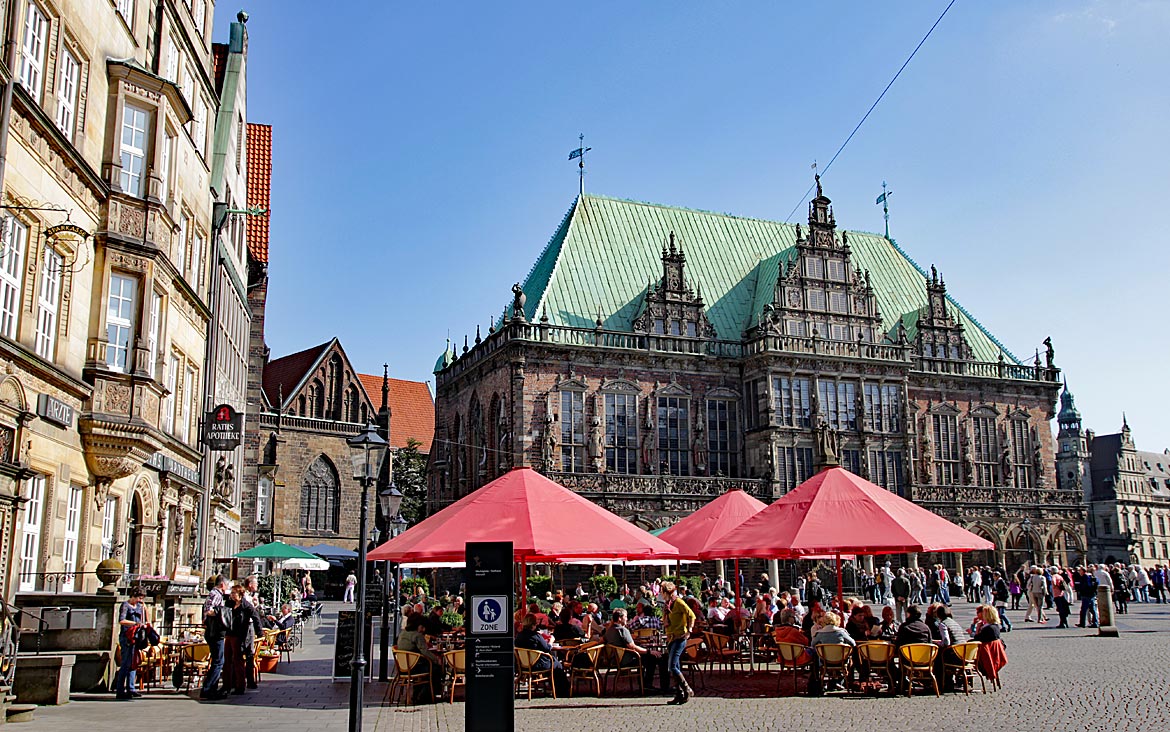
View of the Old Town Hall with its magnificent Renaissance facade. In 2017, the roof received a new copper covering; the green patinated old plates were sold individually
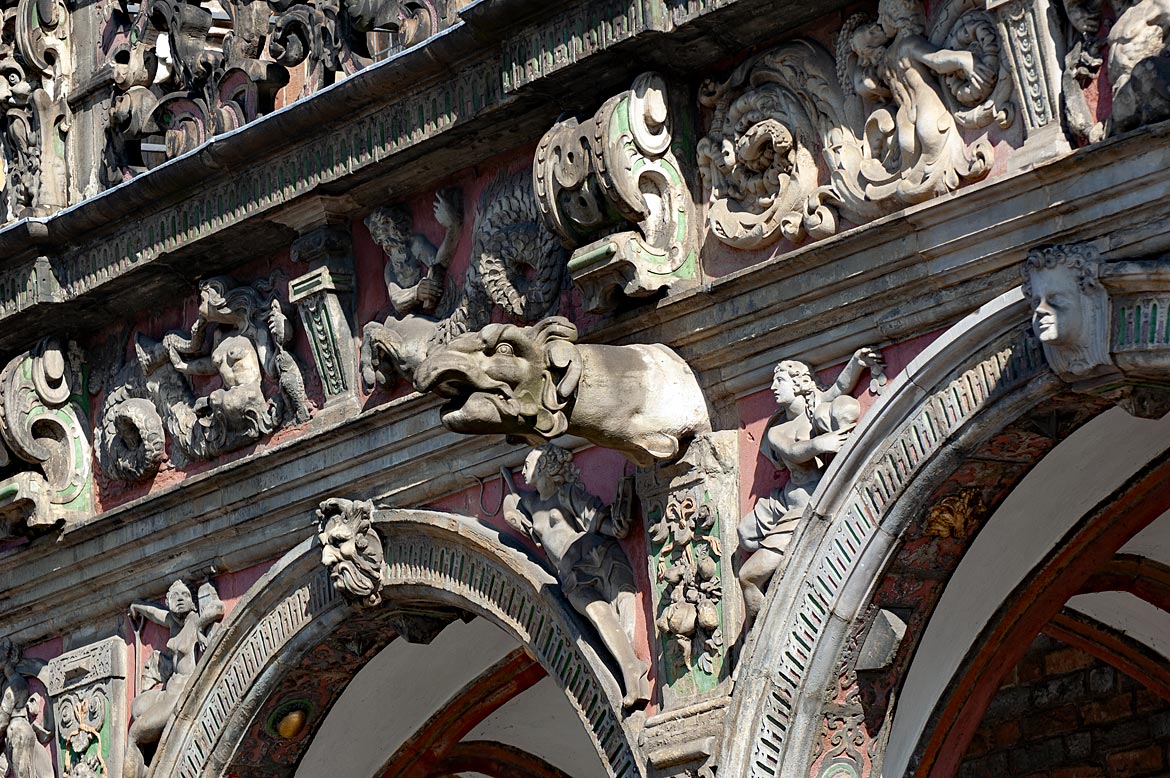
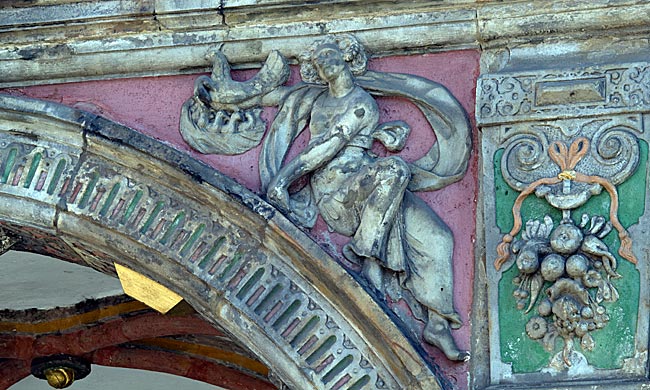
The original Old Town Hall on the market square was built between 1405 and 1412. Of this rather plain late Gothic brick building, little remains visible from the market side today. The Renaissance facade that gives the UNESCO-protected structure its elegant appearance was erected by Lüder von Bentheim between 1608 and 1614. Particularly above the arcades on the market side, it is lavishly adorned with various depictions from ancient mythology, which blend in an idiosyncratic way with Christian symbolism, Bremen city symbols, and other representations. In the upper part of the second of eleven arches, there is a depiction of the Bremer Gluckhenne, a legend that the Bremen writer Friedrich Wagenfeld put to paper in 1844. Allegedly, this Bremen folk tale had been passed down orally from generation to generation for centuries before that.
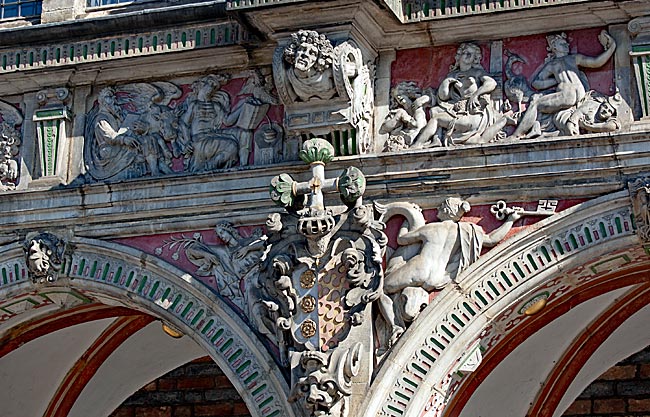
Depictions above the arcades
The dimensions of the town hall, which no longer quite match today's due to expansion work at the beginning of the 20th century, are actually based on a rather peculiar action before the foundation stone was laid. The basis for measuring the new town hall arose from the idea of having all eligible citizens stand in a rectangle on Bürgerweide (Citizens' Meadow), measure them, and use these dimensions as the ground plan. The result was 40 by 13 meters, which presumably corresponded to no more than 200 participating citizens.
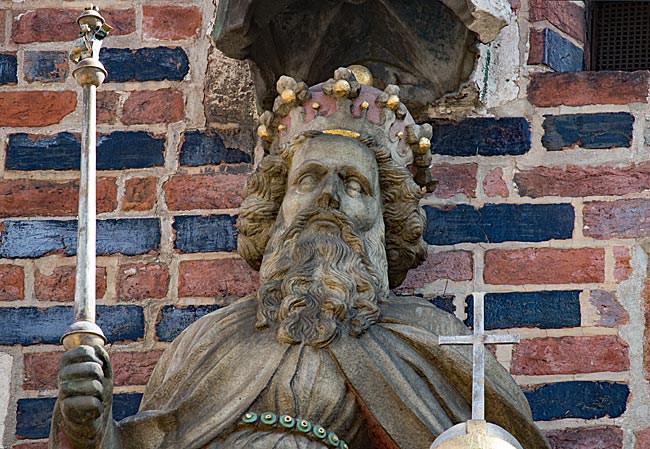
Even the once powerful have their place on the facade
Today, the historic town hall is primarily used for representative purposes. For example, under the lavish splendor of the Renaissance and Baroque periods in the upper town hall hall, the traditional Schaffermahl (Guild Feast) has taken place since 1545. As the statutes only allow men to participate, this somewhat stiff-looking event has been criticized by women for several years, although women have long successfully established their own Schafferinnenmahl (Women's Guild Feast).
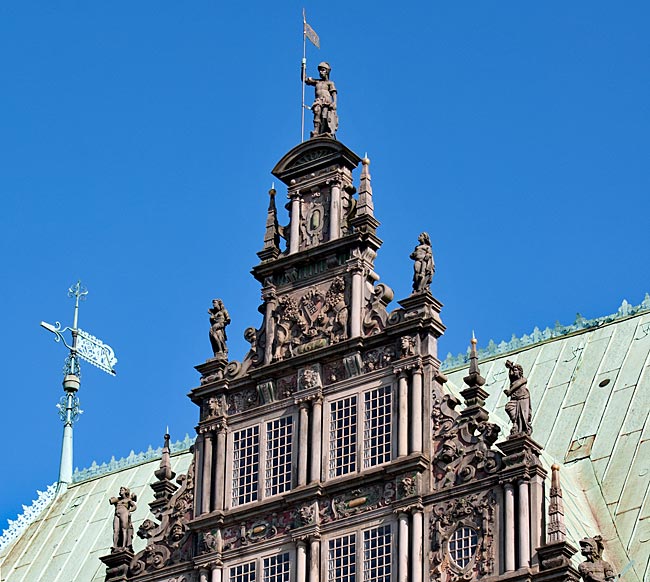
Detail view of the attic room
In the lower town hall hall, on the other hand, public events such as exhibitions and the annual craft market in the pre-Christmas period take place. The three-aisled hall, accessible through the 1660 town hall portal on the left transverse side of the building, still bears the plain features of late Gothic architecture. Once, bustling activity took place here: trade was conducted, taxes were paid, and justice was administered. To the left of the entrance to the lower town hall hall is one of the city's landmarks, the Bremen Town Musicians.
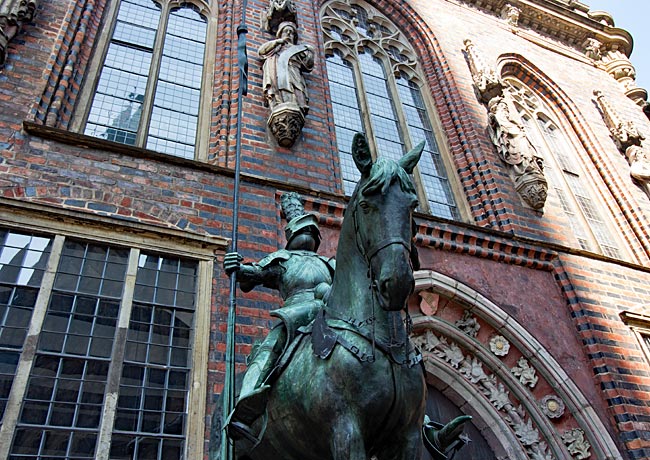
A herald on horseback at the town hall entrance
On the opposite transverse side of the lower town hall hall, the East Portal is flanked by two heralds on horseback. The equestrian statues are by the sculptor Rudolf Maison, who presented them at the 1900 World's Fair in Paris. They came to Bremen through the donation of banker John Harjes, who purchased the bronzes. They were installed here in 1901.
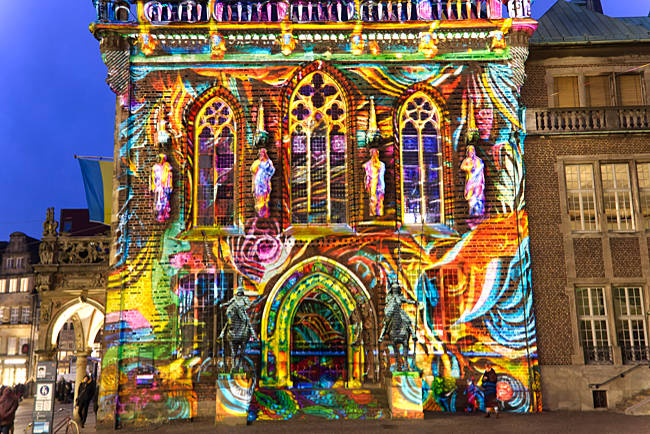
And this is what the East Portal looked like in early January 2025. This artistic and creative light sculpture could be admired as part of the "Lichter der City" (Lights of the City) project on one of the historic buildings after dusk
To the right of the heralds, the New Town Hall adjoins. It was built between 1909 and 1913 according to designs by Gabriel von Seidl, an architect from Munich. Architecturally, the New Town Hall blends perfectly with the Old Town Hall.
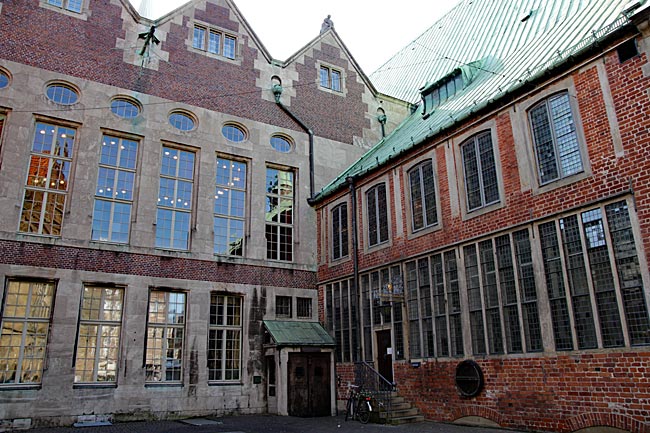
New meets old
This fact is also why both parts, along with the Roland statue on the market square, were included as an ensemble in the UNESCO list. The New Town Hall houses the mayor's office, the Senate Chancellery, and the state government in its premises.
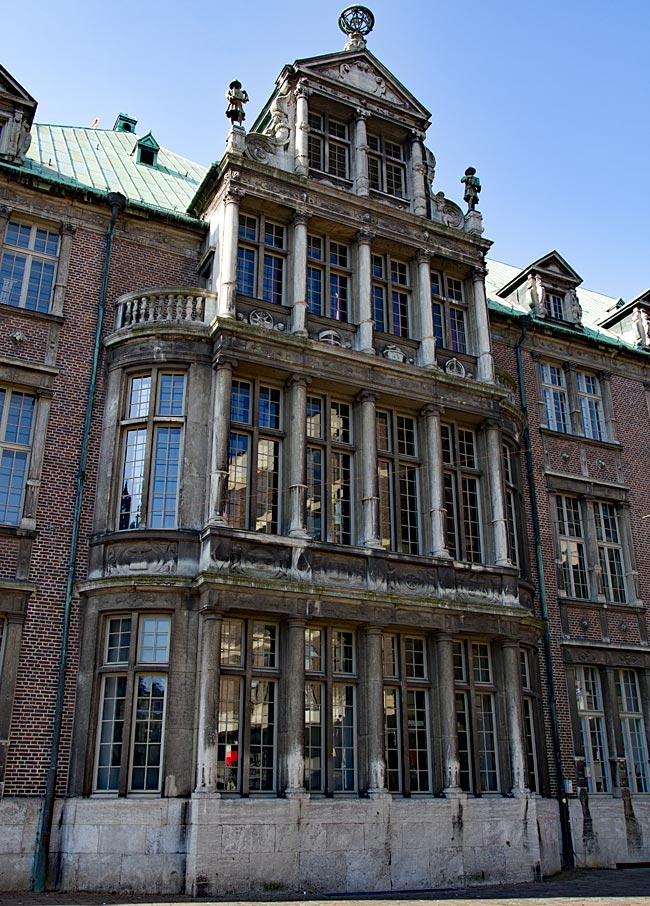
Risalit with protruding window front of the New Town Hall seen from Domshof
In the cellar vaults of the town hall is the Ratskeller (Council Cellar), a wine restaurant with a history dating back to the 15th century. Up to three-quarters of a million bottles of German wine are stored, especially in the treasury, the wine cellar of the house, during its heyday. However, the true treasure is stored in the Rosekeller (Rose Cellar). It houses the oldest German barrel wines dating back to the 17th century. Thus, the Ratskeller also stands for Bremen's long tradition as a wine city. Incidentally, you can buy Ratskeller wine outside the Ratskeller, namely next to the main entrance of the New Town Hall on the north side facing Domshof.
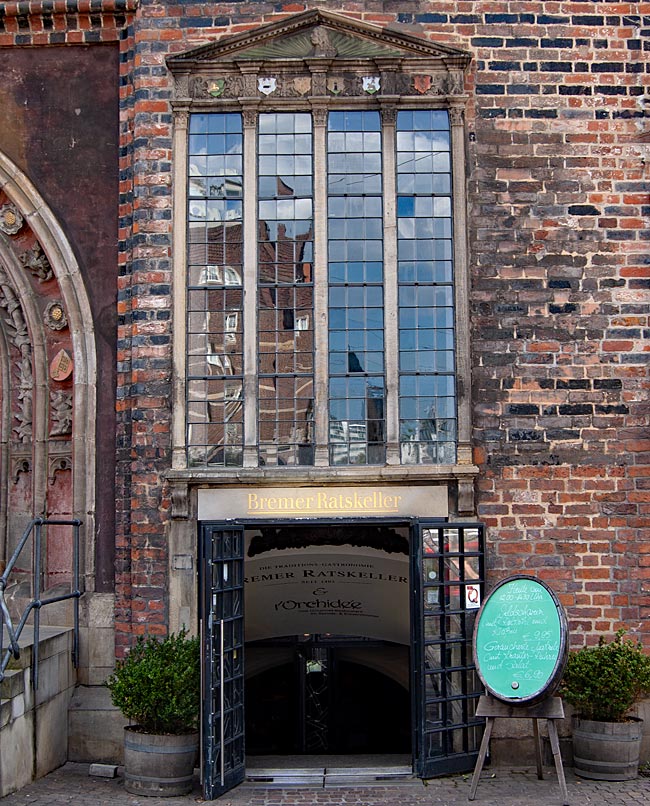
Entrance to the Ratskeller next to the entrance to the lower town hall hall
And when night falls in front of the town hall ... it is particularly beautiful on some days, and many people peacefully populate the market square, often with children. For example, in October, when carousel rides spin and tempting aromas fill the air at the small Freimarkt (Fair), as well as during the Christmas market in December.
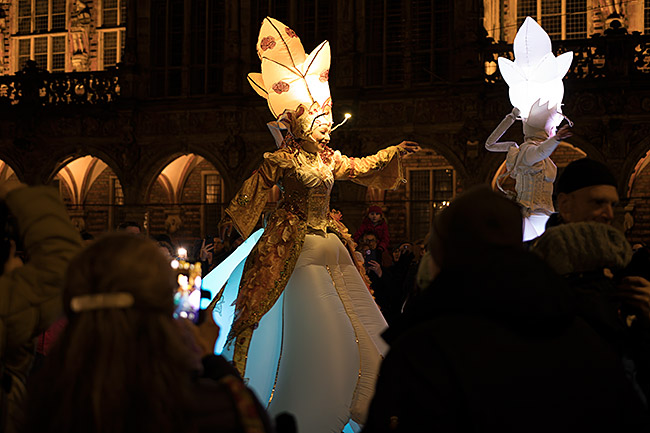
Performance by stilt walkers from "Stelzen Art" as part of the "Lichter der City" (Lights of the City) project in 2025 in front of the historic town hall on the market square
The "Lichter der City" (Lights of the City) project (photo further above) also attracted many people to the city center and market square for a few days at the beginning of the year after dusk. A special highlight, not just for children, was the performance by stilt walkers in their imaginative costumes.
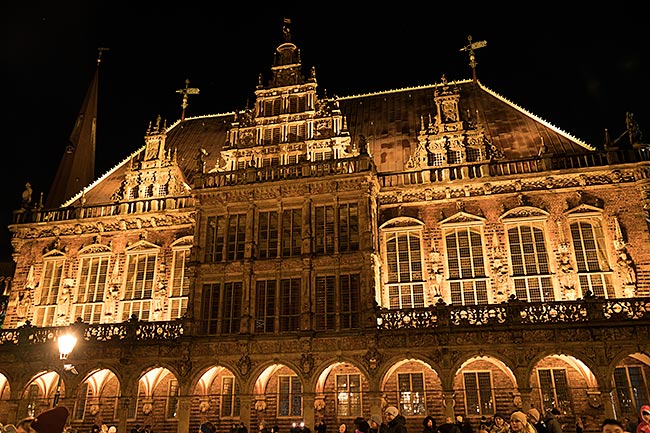
Even when no event is taking place in front of the town hall and its surroundings, the historic city center has a special charm in the evening and at night
previous page
 next page
Map
The legend of the Bremer Gluckhenne
Bremen writer Friedrich Wagenfeld interpreted the legend of the "Bremer Gluckhenne" as a story of freedom and even went further to consider it as a founding myth of Bremen. In his brief creative period, Wagenfeld also wrote the tale of the "Seven Lazy Ones."
read more ...
Bremen Town Musicians
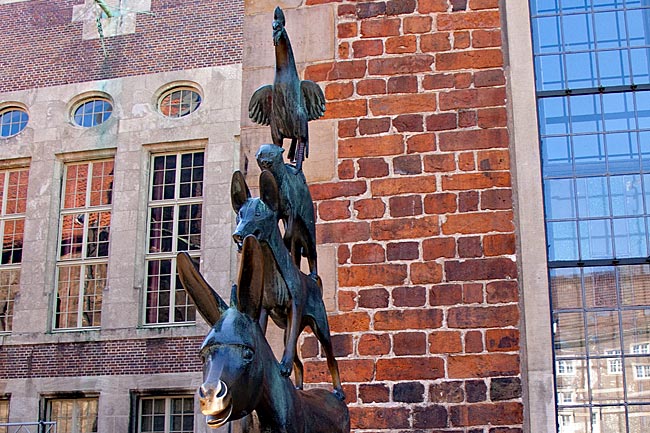
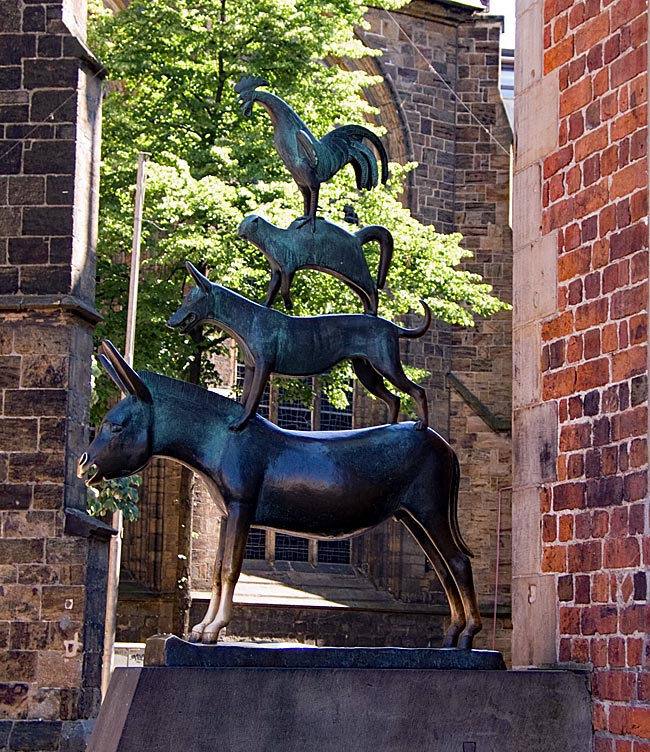
On the left side of the Old Town Hall, next to the entrance to the lower hall, stand four bronze-cast heroes of a world-famous fairy tale - the Bremen Town Musicians. However, it remains a contentious point whether these mismatched four - donkey, dog, cat, and rooster - actually made it to Bremen, as the fairy tale does not provide a clear answer on this matter. But perhaps that is not so important, for what truly matters is the message conveyed in the story.
read more ...
Roland statue
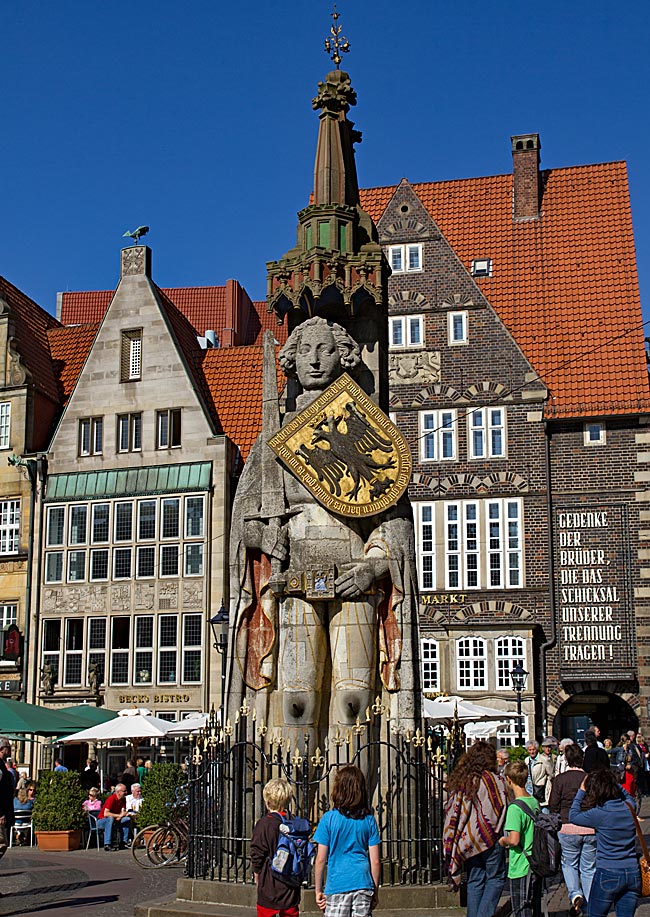
The Roland statue stands on the market square in front of the town hall and has been there since 1404. It is a 5.55-meter (10.21-meter total) tall sandstone figure of a knight with a drawn sword and shield in front of his chest. Like in many other European cities, the Roland in Bremen symbolizes the city's freedom, which historically stemmed from market rights and its own jurisdiction.
read more ...
Ratskeller (council cellar) and Bremen as a wine city
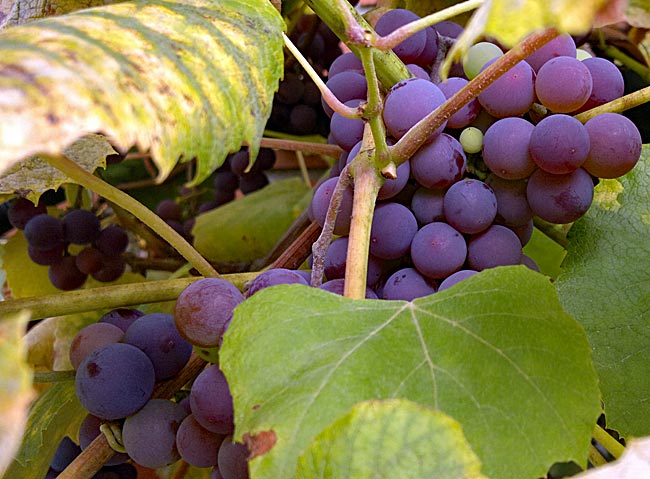
In earlier times, only the councilmen had the right to serve Rhine wine thanks to a Rhine wine monopoly. A source from 1370 mentions for the first time that it had long been mandatory for those who brought wine into the city to offer it to the council first and that no one was allowed to serve wine without permission. A detailed wine ordinance in Bremen is only known from 1635 onwards.
read more ...
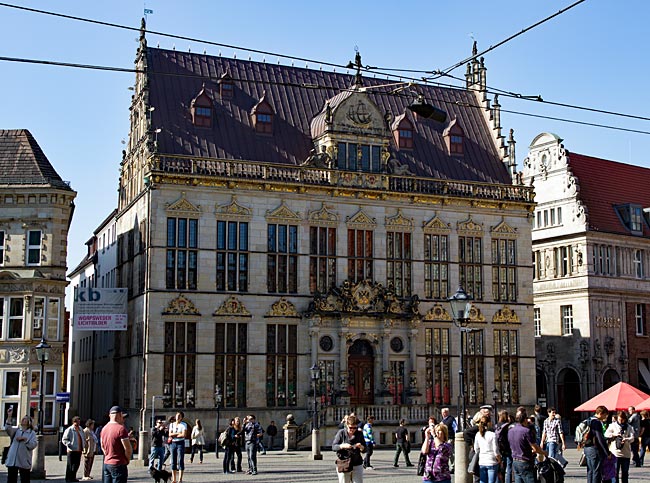
The Schütting
The Schütting, the house of the merchant guild, formerly served as a guild hall and banquet venue. Built between 1537 and 1538 by an Antwerp architect in the style of Flemish Renaissance, it was the second structure to occupy this site. The east gable, created in 1565 by a Bremen stonemason, has remained almost entirely in its original form to this day. A redesign of the market-facing façade in 1595 introduced stylistic elements of Weser Renaissance architecture.
read more ...
Market Square
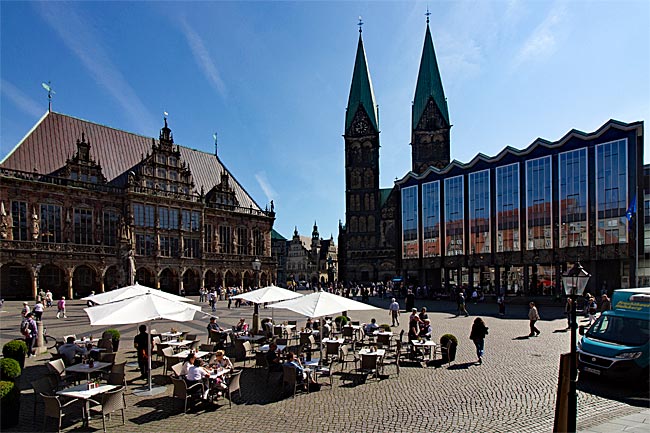
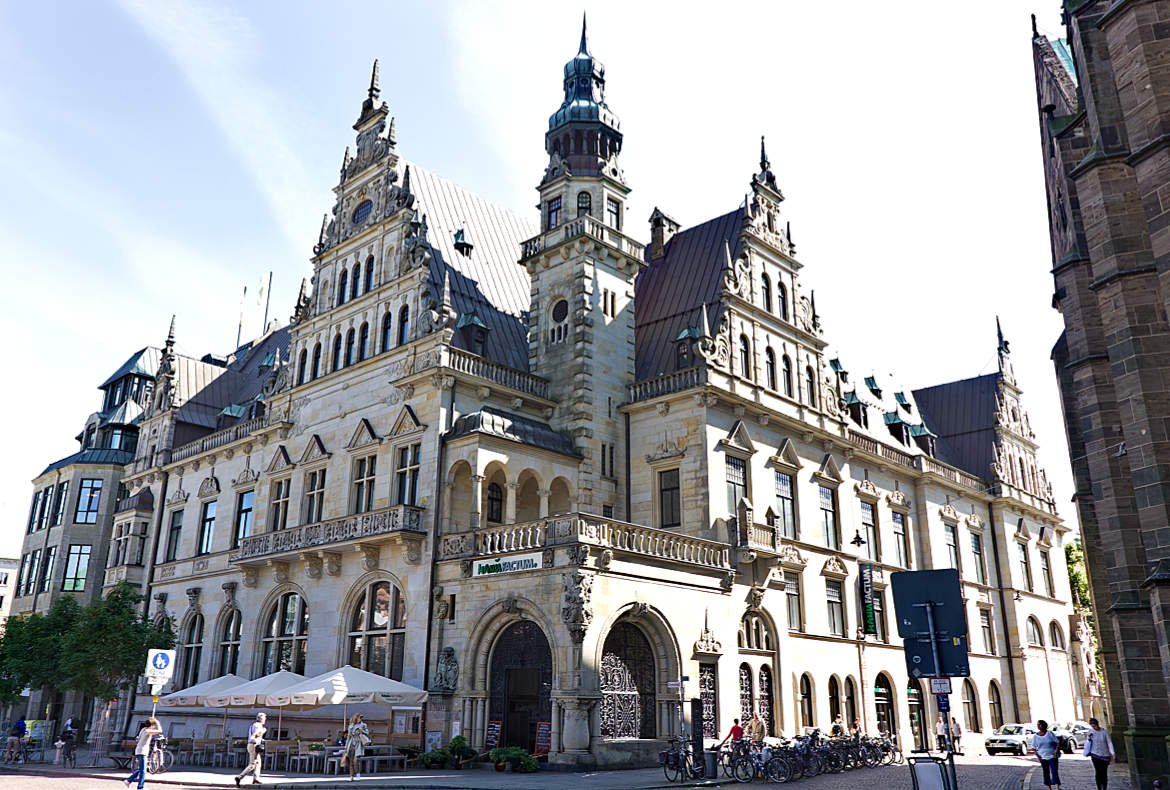
As it was in the past, today's Market Square remains the political heart of Bremen and a major attraction for thousands of tourists - undoubtedly due to its distinctive architectural setting. The Bürgerschaft (Bremen's parliament) stands almost unobtrusively and plainly next to the magnificent Old Town Hall.
read more ...
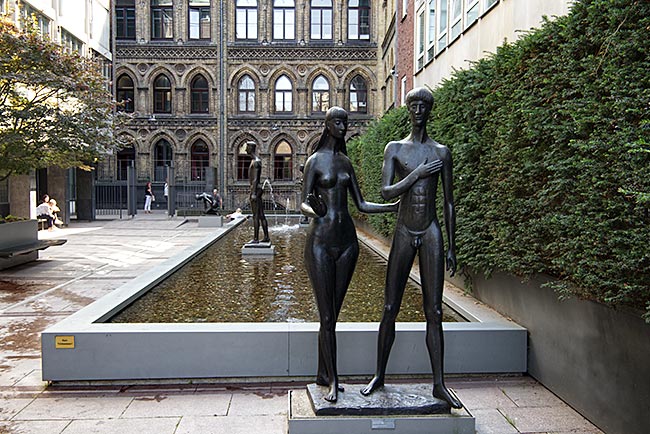
Domshof
In the shadow of the cathedral stretches the Domshof. Until 1803, the cathedral district - and thus the large square - belonged to the respective bishops, Sweden, and later the Electorate of Hanover, who ruled Bremen at times. The buildings, including townhouses, and the planting of numerous trees made the Domshof one of the most beautiful squares in the Hanseatic city during the 18th and 19th centuries.
read more ...
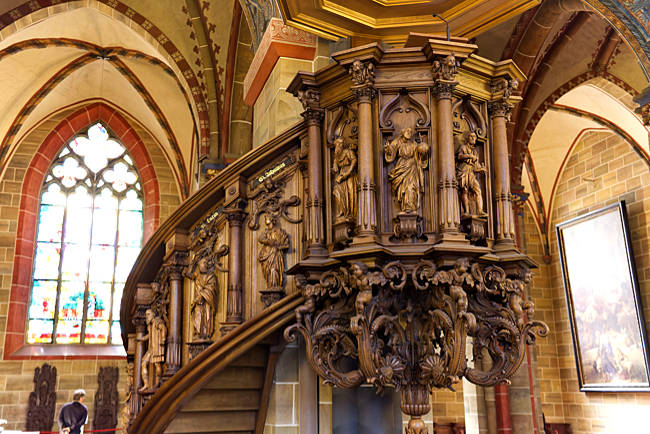
St. Peter's Cathedral
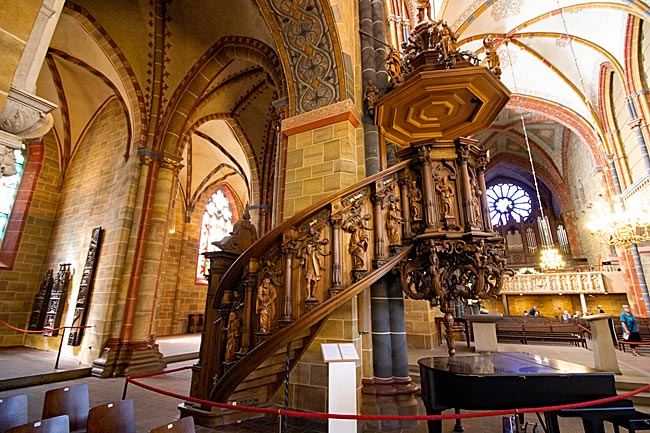
The history of the cathedral, Bremen's oldest church, begins with the Christianization of the region - originally settled by the Saxons - by Charlemagne in the 8th century. While it is uncertain exactly when the first cathedral was built on the highest point of the so-called Bremer Düne (Bremen Sandhill), it was likely destroyed by invading Vikings from Denmark in 858. The subsequent Romanesque structure, begun in 1041 and completed with its two towers in the 13th century, was later remodeled in the Gothic style during the 16th century.
read more
...
Böttcherstraße
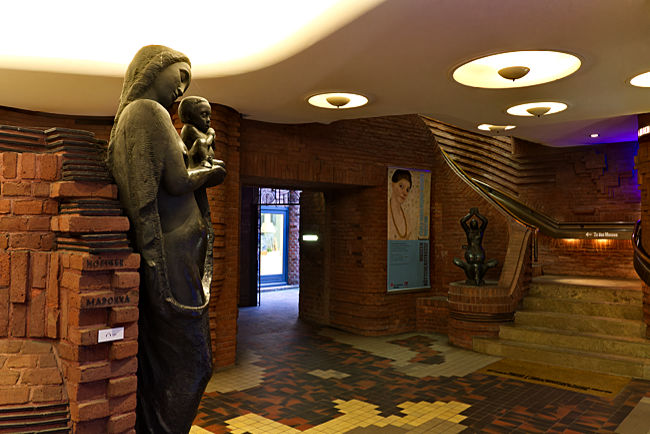
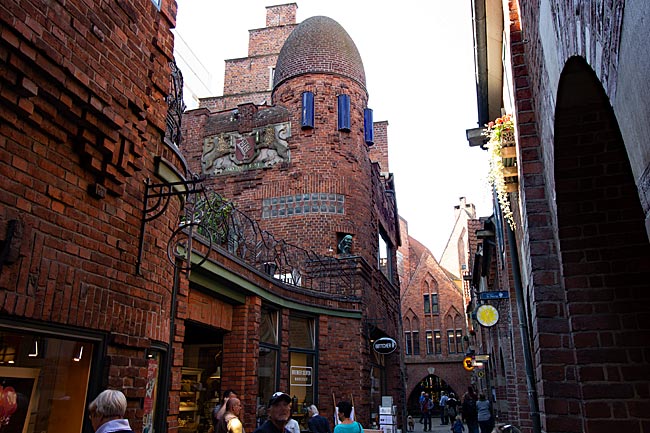
Since at least 1931, the name Böttcherstraße is no longer primarily associated with the scent of wood and the sound of coopers' hammers, but rather with a very special, almost enclosed ensemble of buildings. Over a length of just over one hundred meters, museums, open artist workshops, specialty retailers offering upscale goods, dining establishments, and a hotel create a unique atmosphere between brick and sandstone structures that is unparalleled in Bremen.
read more ...