
 exploring Bremen & its surrounding areas
 You are here: backgroundstories
 The Legend of the Bremer Gluckhenne
Many people may know the story of the "Bremen Town Musicians", those four animal companions who came together by chance to flee from death and suffering into the free city of Bremen - or, in another interpretation of the tale, to defend that freedom against the powerful forces of their time. The legend of the "Bremer Gluckhenne" was interpreted by the Bremen writer Friedrich Wagenfeld, who also wrote the story of the "Seven Lazy Ones" during his brief creative period, as a story of freedom and even as the founding myth of Bremen.
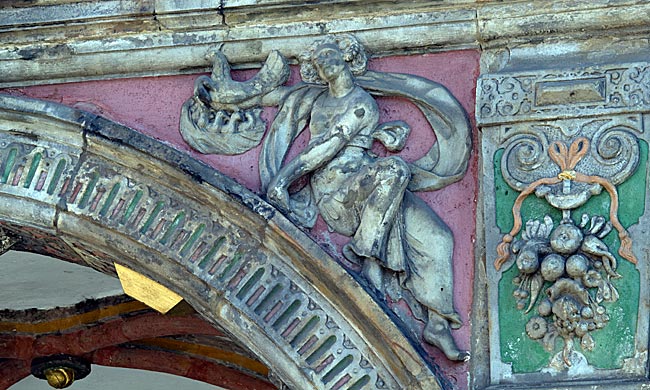
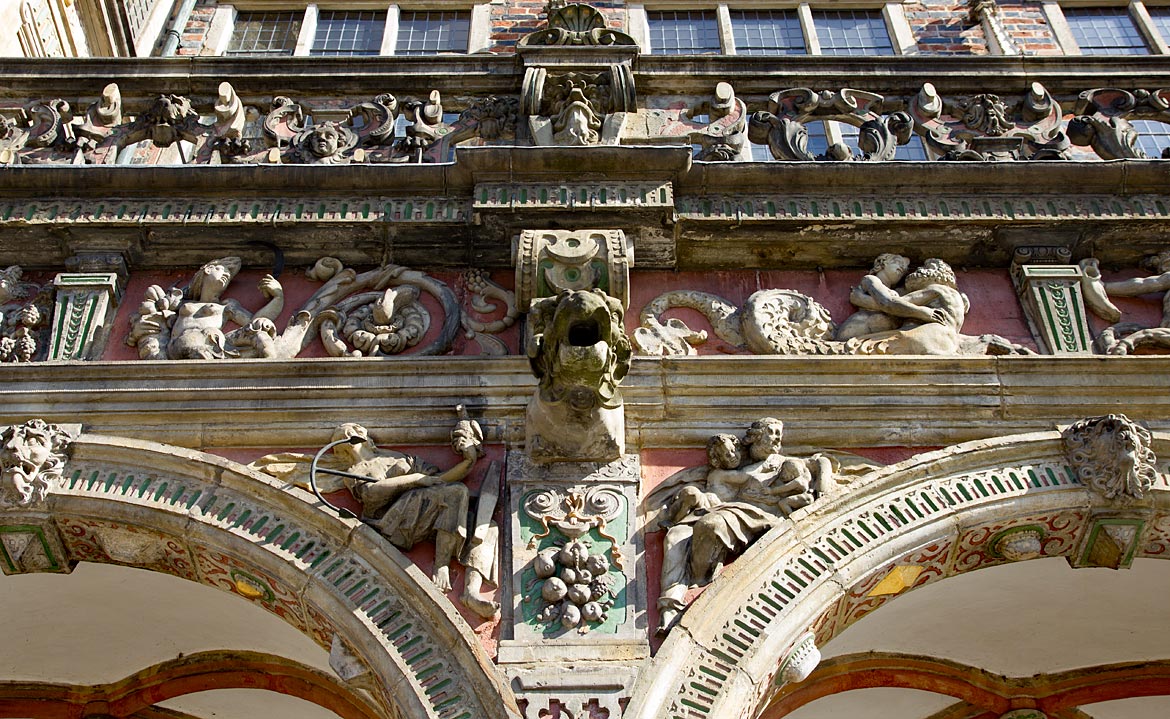
Depiction of the Bremer Gluckhenne on the Renaissance façade of old the town hall
According to Wagenfeld’s version of the tale, it was poor fishermen - men, women, and children - who arrived in their boats at this stretch of river. Because there was an abundance of fish here, they wanted to stay. They had fled from their predatory neighbors up to this point. Homeless as they were, they now sought a new place to settle, build huts, and make a home. Apart from their boats and nets, they had little left that would have been worth stealing, and thus no raider would have been satisfied. But their most precious possession, more valuable than gold, was their freedom - and they refused to give it up at any cost. Therefore, they remained skeptical and stayed on the river, waiting despite the overcast sky for a sign from the "spirits of the land." Yet by evening, no such sign had appeared. They lamented and wailed, finding no comfort in their situation. They were already preparing to move on from this beautiful place when a ray of the setting sun broke through the otherwise thick clouds that had covered the sky all day, bathing the landscape in a wondrous light. In this evening glow, they saw a hen searching for a safe night’s shelter for herself and her chicks. The people on the river interpreted this as a sign to stay, leapt joyfully ashore, and followed the hen from the shore up a hill where she hid herself and her brood in the heather. The people saw themselves in a similar situation to the hen - they too sought protection in a safe place - and so they decided to build their new huts on this hill. This hill was to remain a bastion of freedom for all future generations.
Wagenfeld describes this as the laying of the foundation stone around the year 778 for what would later become the city of Bremen. And because the first settlers were fishermen, Wagenfeld claims that the Fishermen’s Guild is the oldest in the city. The hen with her chicks at the Old Town Hall is a visible emblem of Bremen.
In fact, since 1612 - the time when the much older, simple Gothic town hall received its magnificent Renaissance façade - there has been a finely carved depiction of the Glückhenne in the right spandrel of the second arch from the left in the arcade. A female figure places her right arm protectively around the nest with the small group of poultry. But chicks without a rooster? That wouldn’t do, so the rooster is found in the left spandrel of the arch on the hand of a youth.
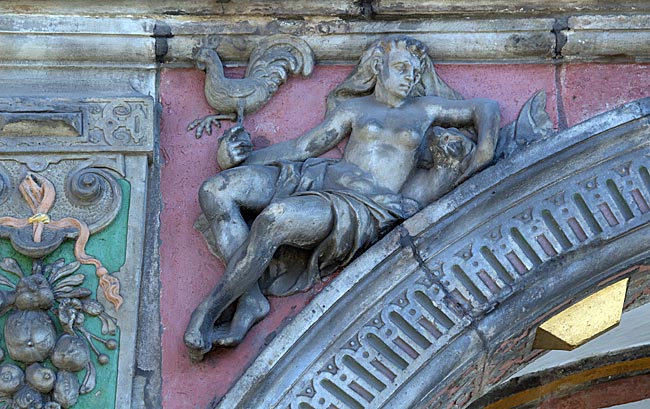
The rooster accompanying the Bremer Gluckhenne on the town hall façade. A coincidence? Certainly not.
The depiction of the animals on the town hall has clear symbolic meaning—for example, fertility and protection; according to another interpretation, with regard to the rooster, also vigilance and cunning.
How much truth lies at the heart of the legend is likely impossible to determine. However, it is a fact that the Bremen dune, where, for example, St. Peter’s Cathedral stands today, was the first settlement area of the Hanseatic city. From here, the city expanded over the centuries to its present size. And as far as their freedom is concerned, the citizens of Bremen have always been very insistent - after all, it is still called the "Free" Hanseatic City, and the Roland statue on the market square could tell many tales if only he could speak. But perhaps you should visit the Focke Museum sometime; there, Bremen’s city history is told quite well.
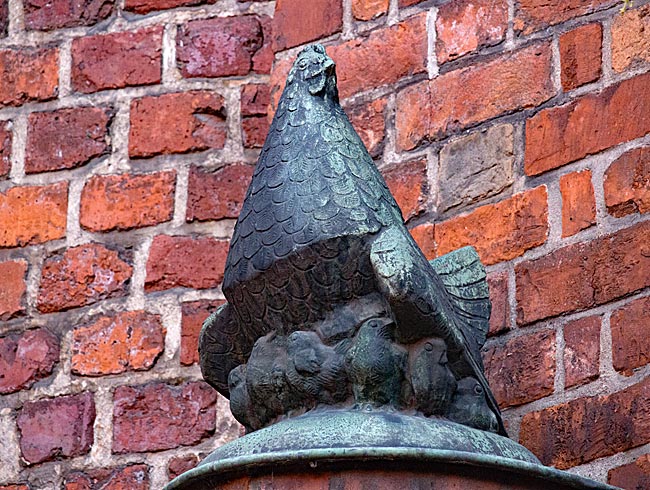
Bronze sculpture of the Bremer Gluckhenne in the Böttcherstraße
In the Böttcherstraße, one also encounters an image of the Glückhenne with her chicks. The bronze sculpture on a wall projection near the House of the Glockenspiel was created by the sculptor Alfred Horling, who completed the work in 1957/58. Also from his workshop is the plaque installed below the sculpture that tells the legend.
previous page
 next page
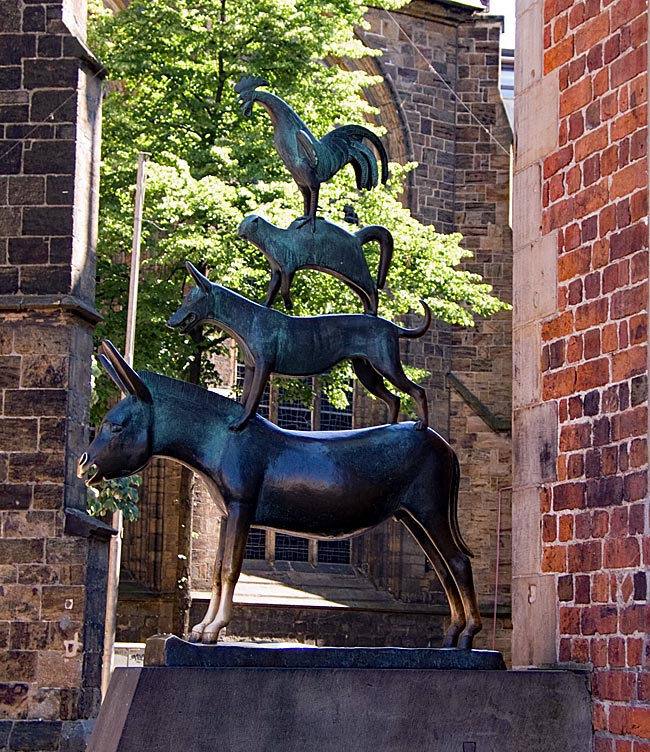
The Bremen Town Musicians
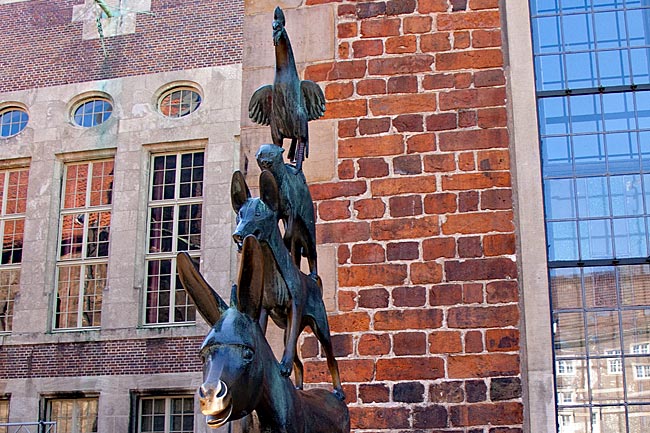
On the left broad side of the Old Town Hall, next to the entrance to the lower town hall hall, stand four bronze-cast heroes of a world-famous fairy tale - the Bremen Town Musicians. However, it remains a contentious point whether these mismatched four - donkey, dog, cat, and rooster - actually made it all the way to Bremen, as the fairy tale does not provide a clear answer on this matter. But perhaps that is not so important, for what truly matters is the message conveyed in the fairy tale.
read more ...
The Seven Lazy Ones (Sieben Faule)
The Seven Lazy Ones. Besides the Bremen Town Musicians, there is another, albeit far less known fairy tale whose setting is the Hanseatic city of Bremen: "The Seven Lazy Ones" by the Bremen writer Friedrich Wagenfeld (1810-1846). Just like the Bremen Town Musicians, the heroes of this story also have a monument dedicated to them in the city. In Böttcherstraße, you can encounter the supposedly lazy brothers at two different locations.
read more ...
Town Hall
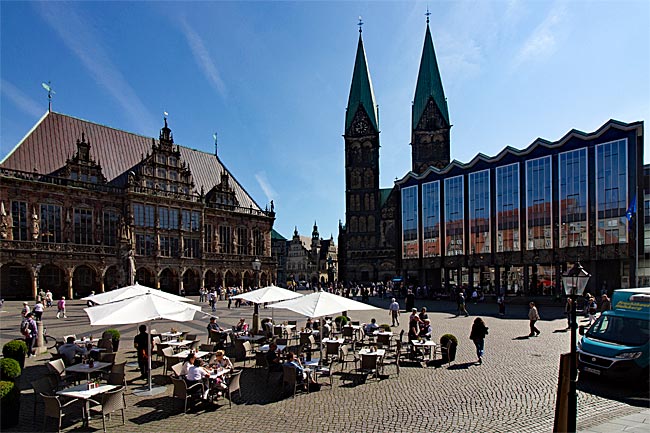
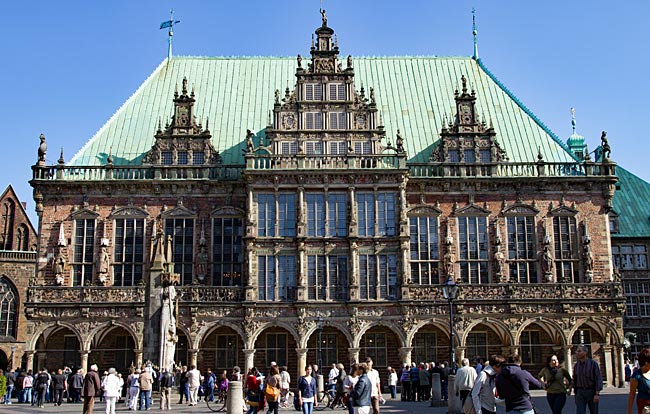
The original Old Town Hall on the market square was built between 1405 and 1412. Little remains today of this rather plain late Gothic brick building. The Renaissance façade, which gives the UNESCO-protected structure its distinctive appearance, was erected by Lüder von Bentheim between 1608 and 1614. Above the arcades, it is lavishly adorned with various depictions from ancient mythology, blending uniquely with Christian symbolism, Bremen city symbols, and other representations.
read more ...
Böttcherstraße
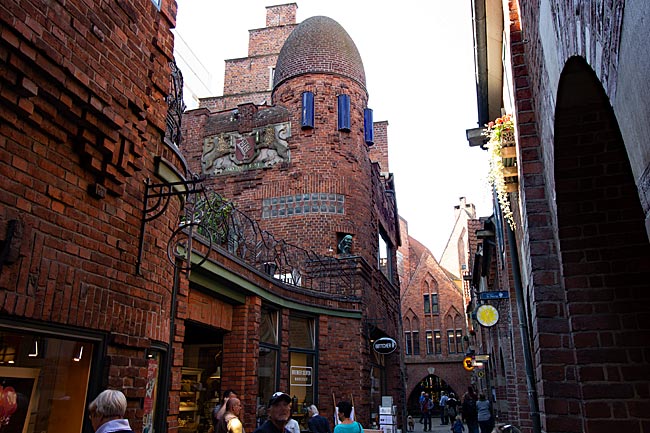
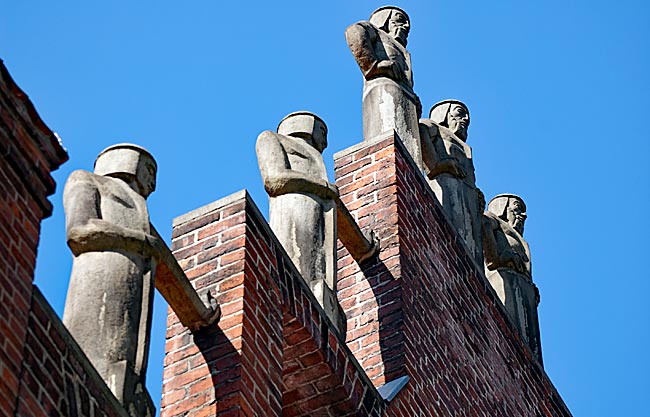
Since at least 1931, the name Böttcherstraße is no longer primarily associated with the scent of wood and the sound of coopers' hammers, but rather with a very special, almost enclosed ensemble of buildings. Over a length of just over one hundred meters, museums, open artist workshops, specialty retailers offering upscale goods, dining establishments, and a hotel create a unique atmosphere between brick and sandstone structures that is unparalleled in Bremen.
read more ...