
 exploring Bremen & its surrounding areas
 You are here: attractions in the city center
 City center: the main shopping streets (1/2)
Of course, there are many other notable meeting points in the city center where people gather for strolling, shopping, or visiting cafés. A classic spot is "Die Schweine" (The Pigs) on Sögestraße. This bronze sculpture group of five pigs and four piglets with a shepherd and his dog was created in 1974 by Peter Lehmann, a sculptor born in Bremen in 1921. It serves as a popular photo opportunity and monument at the entrance to the car-free shopping street. The ensemble, financed by merchants located on the street at the time, is not merely a whim but has historical significance. Along with Langenstraße and Obernstraße, Sögestraße is one of Bremen’s oldest main streets in the historic city center.
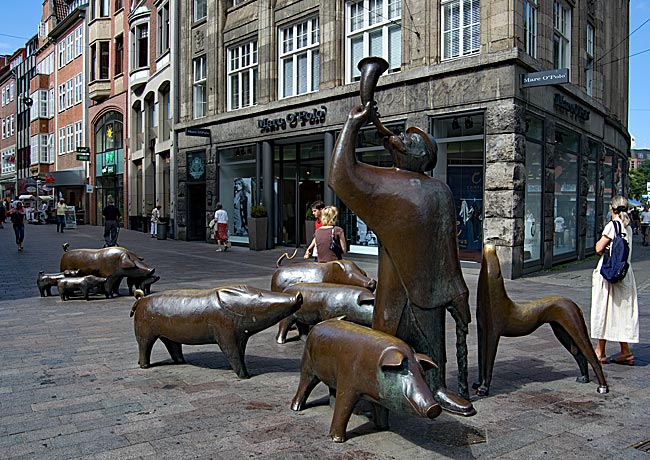
The pig herder with dog and pigs on Sögestraße; in the background, the former Seidenhaus Koopmann, built as a commercial or office building in 1910/11
The name "Söge" means "sows" in Low German, and early references to the street - such as "patea porcorum" in 1261 and "Soghestrate" in 1306 - indicate that pigs were kept here in large numbers at the time. This section of Sögestraße bordered the medieval city wall, whose existence is documented as early as 1229 in historical records. Even today, the continuation of Sögestraße toward the train station is called "Herdentor" (Herder’s Gate), through which pigs were once driven to the communal pasture, Bürgerweide. Located between the central station and the exhibition halls, this paved area now serves as a venue for Bremen’s fifth season, the Freimarkt - one of Germany’s oldest and largest folk festivals.
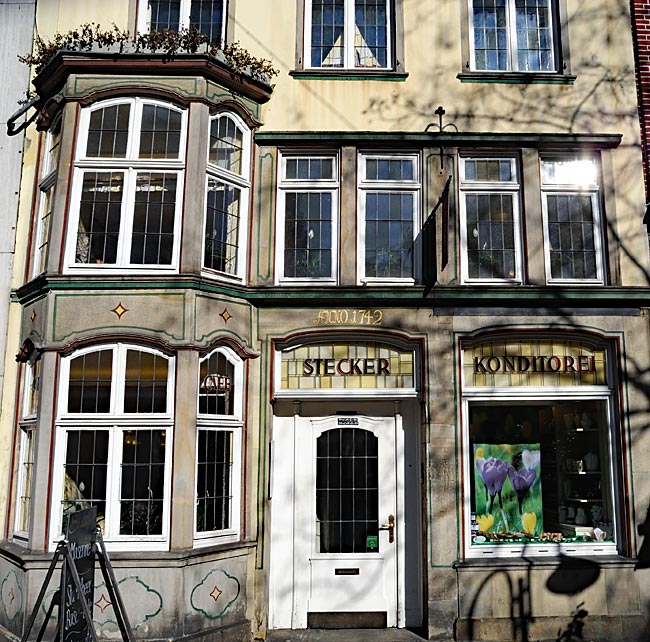
The Konditorei Stecker passed from the founding family to current owners in 2000
The imposing corner building on Knochenhauerstraße is one of the few structures on Sögestraße that survived World War II bombings. The "Seidenhaus Koopmann" was completed in 1911 according to designs by two Bremen architects. Between 1930 and 1932, Friedrich Neumark’s plans also led to the construction of the Karstadt department store at the other end of Sögestraße. Heinrich Wilhelm Behrens, a prolific architect in Bremen, designed works such as the Columbarium on Riensberg Cemetary. A brief detour into Knochenhauerstraße leads to another cultural monument at house number 14: a Renaissance-era building from the second half of the 16th century that has housed Konditorei Stecker since 1948. Nearly diminutive, this four-story gabled house - renovated with a Rococo façade in 1742 - blends into the row of buildings.
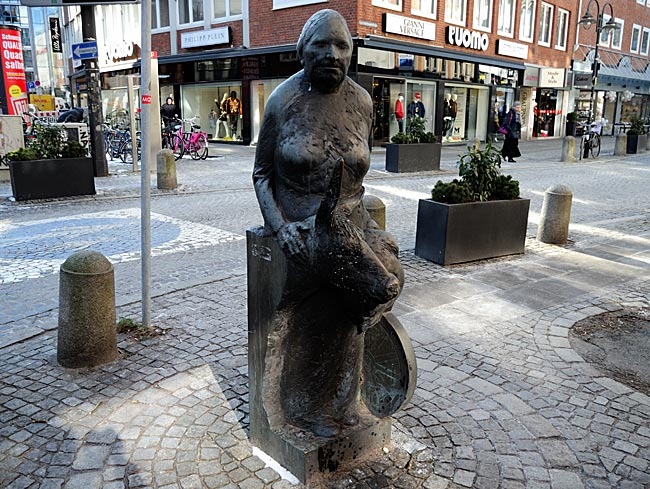
Mudder Cordes with her donkey Anton
In front of the confectionery stands the bronze sculpture of "Mudder Cordes." The original, born Metta Behrens in Oberneuland district in 1815, was immortalized by sculptor Christa Baumgärtel in 1987. She only became known as Cordes after marrying a cigar maker in 1833. Like many cigar makers of the time, they lived in Neustadt district and had five children. However, her husband died young, leaving her with little income, forcing four of their children into an orphanage. To support herself and her youngest daughter, she sold vegetables from her cart, initially pulling it herself through the streets. From 1860 until nearly his death six years later, her dog Sultan given to her as a gift - pulled her cart. He was eventually replaced by Anton, the donkey who accompanied her for 30 years in the city. After Anton’s death in 1895, he was stuffed and displayed at the Übersee-Museum. She spent her final years with her daughter in Delmenhorst, where she died in 1905.
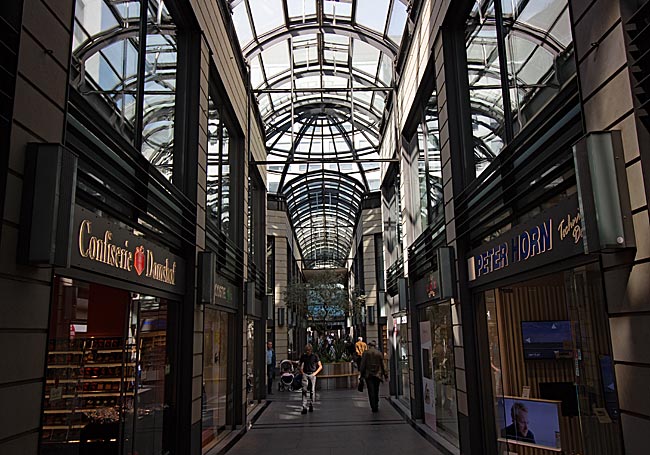
In the Domshof Passage
Another traditional café is located at Sögestraße 42/44: Konditorei Knigge, founded in 1889. It offers a variety of baked goods, chocolates, and ice cream and is well-known throughout the city. Across from the café, the glass-covered Katharinen-Passage branches off from the row of shops, transitioning - with an interruption - into the Domshof Passage, ending at Domshof. The area once housed the namesake St.-Katharinen-Kloster (St. Catherine’s Monastery). The Dominican monastery existed from the mid-13th century until 1528. Four years earlier, the Reformation had taken hold in the Hanseatic city, and since the monks did not follow it, they became unwelcome. Over the centuries, the buildings were repurposed and nearly completely demolished; only parts of the cloister and refectory remain preserved under monument protection. A restaurant now occupies this site.
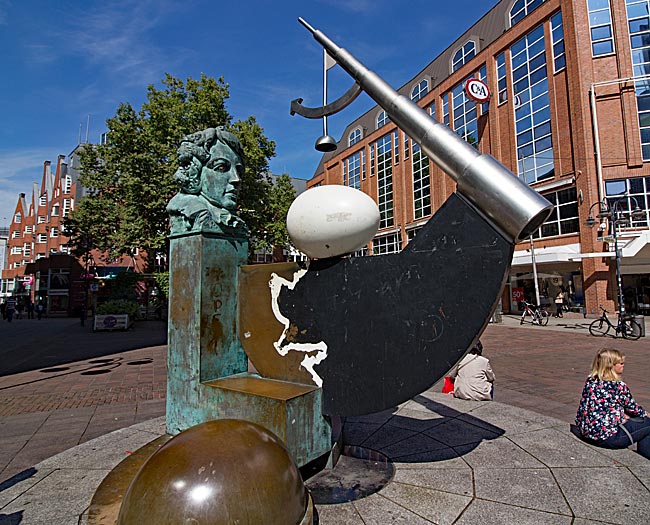
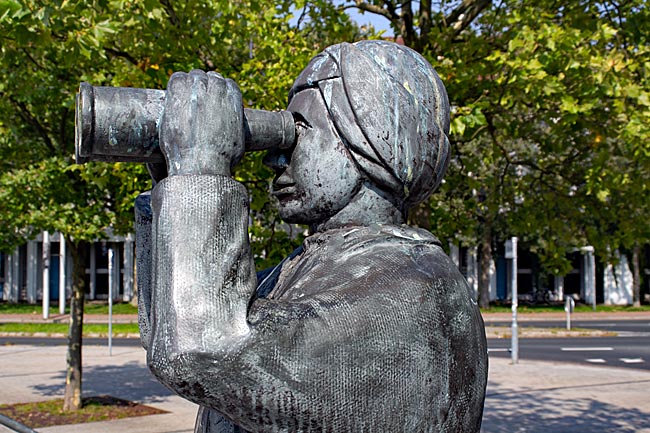
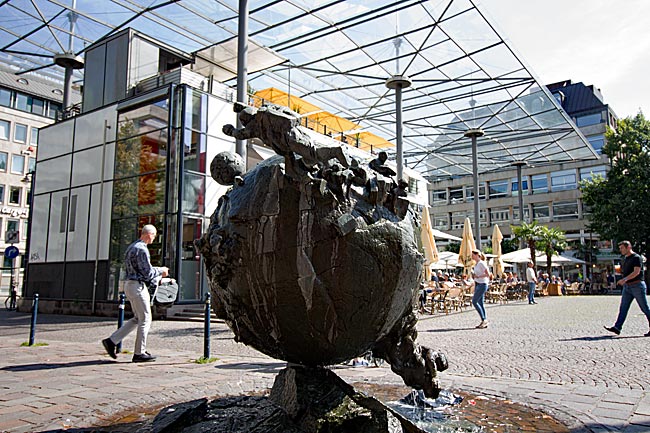
Besselei by Jürgen Goertz: monument to the significant astronomer and geodesist Friedrich Wilhelm Bessel (1784-1846) on Hanseatenhof
previous page
 next page
Map
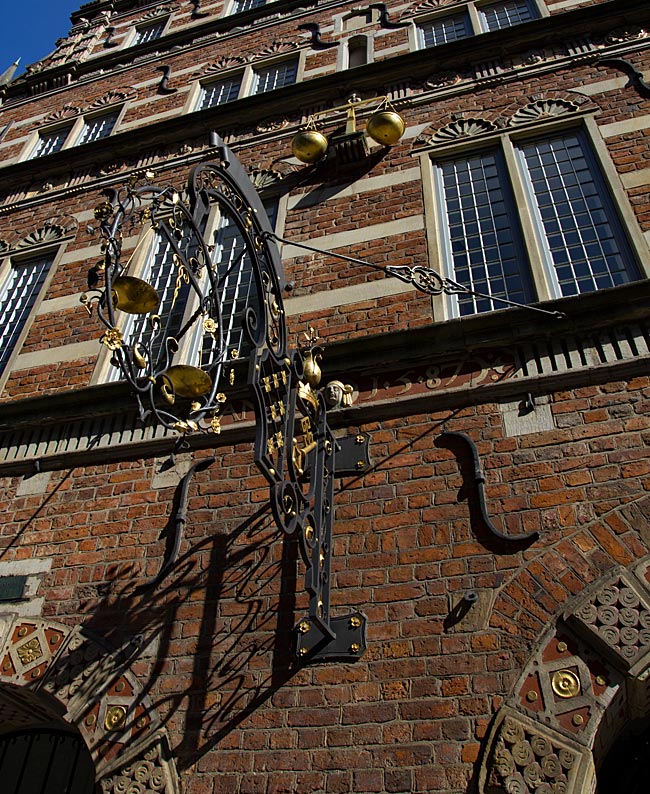
City weigh house
Directly adjacent to the market square and near the Schütting, the house of the merchant guild, stands the city weigh house on Langenstraße. In the Middle Ages, Langenstraße was one of Bremen's main thoroughfares and is considered the city's oldest merchants' street. The existence of a weigh house in this street dates back to the year 1440. However, even before that, documented since 1330, there was a city weigh house in Bremen, as at every major trading center in the Middle Ages.
read more ...
Freimarkt
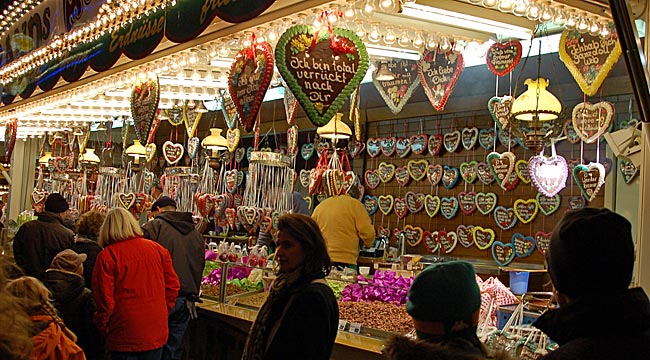
What for some is simply a fair or large amusement park, for others it is an event that stands on equal footing with Christmas in terms of importance. However, the fact is that for most people in Bremen, the Freimarkt is considered the 'fifth season' and an unshakable Bremen tradition. This is not without reason, as the citizens of Bremen can look back on a nearly thousand-year history of their folk festival - and thus the Freimarkt is Germany's oldest folk festival.
read more ...
Übersee-Museum (Overseas Museum)
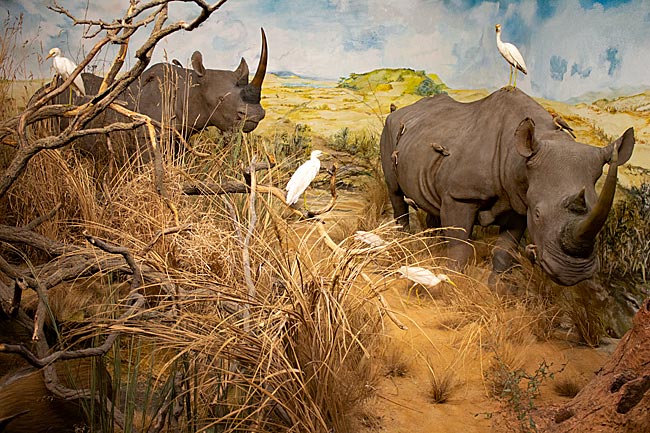
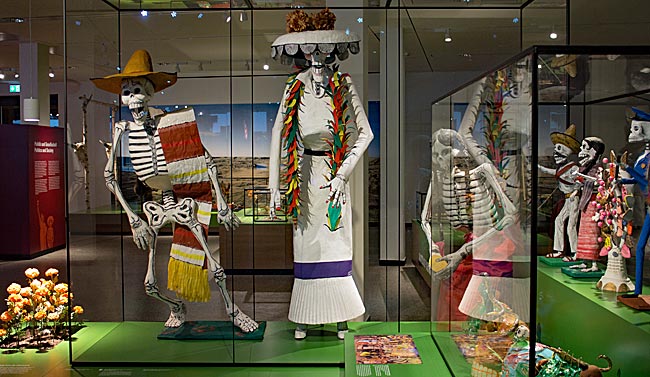
In 1896, what is now known as the Übersee-Museum first opened its doors under the name 'Municipal Museum for Natural History, Ethnology, and Commerce.' The exhibits initially came from the 'Municipal Collections of Natural History and Ethnography,' which were partly displayed as a 'Trade and Colonial Exhibition' at the 'Northwest German Trade and Industry Exhibition' in 1890 with great success. Since its founding, the museum's concept has changed several times, evolving toward a stronger focus on museum education that continues to this day.
read more ...
Domshof
In the shadow of the cathedral lies the Domshof. Until 1803, the cathedral precinct - and thus the large square - belonged to the respective bishops or, later, to Sweden and the Electorate of Hanover, which ruled Bremen at times. The existing buildings, including townhouses, and the planting of numerous trees made the Domshof one of the most beautiful squares in the Hanseatic city during the 18th and 19th centuries.
read more
...
Liebfrauenkirche (Our Lady's Church) & Liebfrauenkirchhof
Around 1020, a first parish church made of wood was built on the site of today's Liebfrauenkirche, outside the enclosed cathedral precinct. The church was dedicated to St. Vitus, who is venerated as a saint in the Roman Catholic Church. About 80 years later, the building received its current southern tower, which is now the oldest preserved part of the structure. Parts of this church - alongside St. Peter's Cathedral, the oldest in Bremen - were reused when, around 1160, a three-aisled basilica with three apses was constructed on the same site, atop the city's oldest market.
read more ...