
 exploring Bremen & its surrounding areas
 You are here: attractions in the city center
 Liebfrauenkirche & Liebfrauenkirchhof (Our Lady's Church & Our Lady's Churchyard)
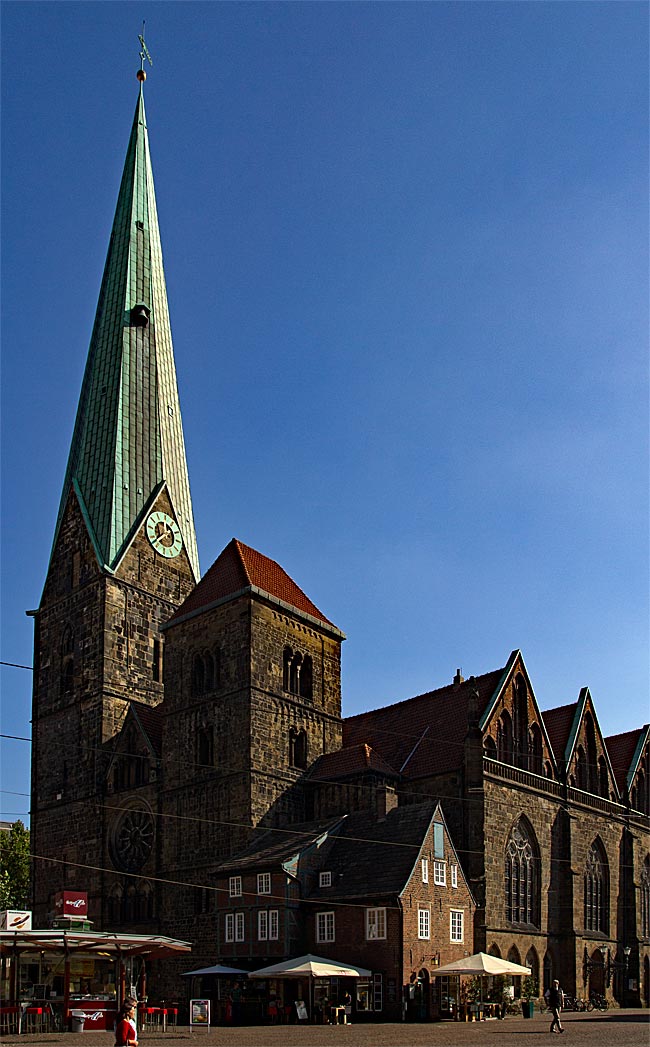
The Liebfrauenkirche, whose decorative gables show traits of brick Gothic architecture
Around the year 1020, a first parish church made of wood was built on the site of today's Liebfrauenkirche, outside the enclosed cathedral precinct. The church was dedicated to St. Vitus, who is venerated as a saint in the Roman Catholic Church. The man, known in Latin as Vitus and considered by many as their patron saint, died around 304 as a martyr in southern Italy. About 80 years later, the building received today's south tower, which is now the oldest preserved part of the structure. Parts of what was then, alongside St. Peter's Cathedral, the oldest church were used when, around 1160, a three-aisled basilica with three apses was erected on the city's oldest market square at the same location. Some of the masonry has survived to this day.
Since approximately 1220 - perhaps even earlier -the holy Veit is no longer the patron saint of the church, which held parish rights for Bremen from the cathedral until the 13th century. Instead, it has since been under a Marian patronage. About ten years later, the parish church, now known as Unser-Lieben-Frauen-Kirche or Liebfrauenkirche, was converted into a hall church in the early Gothic style as one of four parishes in the city at that time. During this renovation, the sacred building also received the taller of today's two towers, further emphasizing the church's asymmetry. The slightly over 84-meter-high north tower with its copper-covered spire, which has stood on the masonry again since 1965 after war damage, housed the city council's documents for centuries. This documentary treasure in what is therefore called the Tresekammer is considered the first municipal city archive of the Hanseatic city.
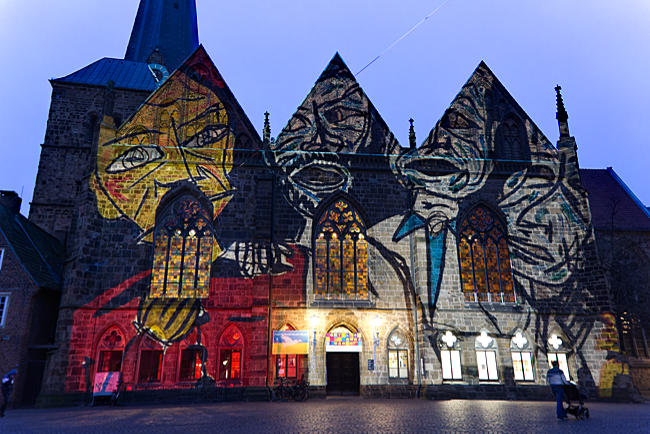
The Liebfrauenkirche can also be colorful and sometimes musical inside, but also outside. On this occasion, as part of the "Lichter der City" action, funded by the Zukunftsfonds Innenstadt, where for 15 days in February, after dusk, 10 buildings were used as projection surfaces for still images and videos (with musical accompaniment) by artists
The church building roughly maintained its current size shortly before the transition to the 15th century when the choir and church aisles were expanded by a fourth on the south side. In 1524, the Reformation also took hold in this church.
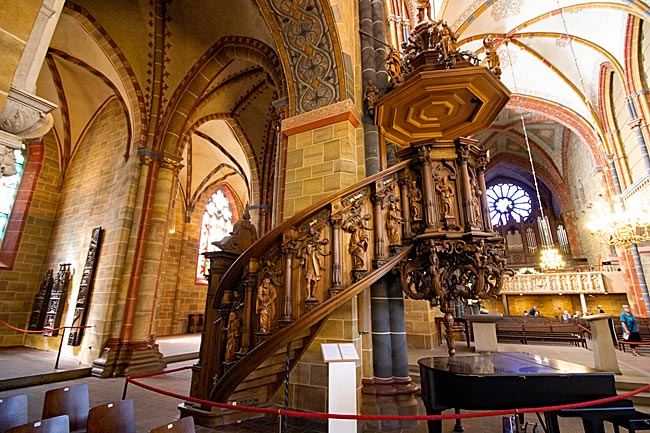
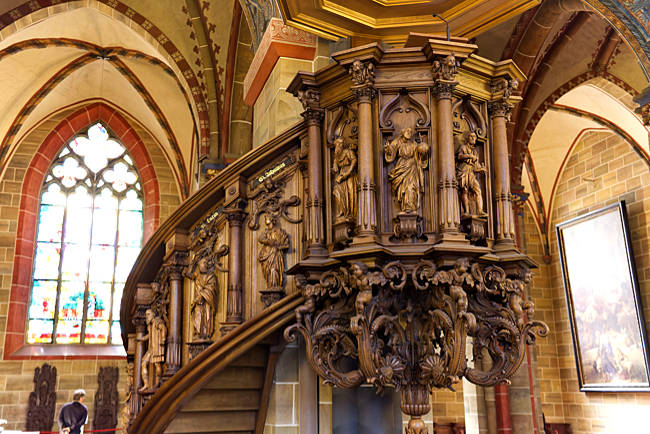
In 1944, after air raids, parts of the Liebfrauenkirche fell victim to flames. The fire, which spread from the north tower into the interior, destroyed the entire neo-Gothic interior furnishings. The pulpit from the year 1709 survived; while its craftsmanship is not as impressive as that of the cathedral's, it is still worth seeing. The organ and windows, on the other hand, date from the second half of the 20th century after the reconstruction. Beneath the northern part of the church lies a crypt likely built in the first half of the 12th century. This room with four cross vaults was used as a meeting space and as an ossuary - a storage room for human bones - later serving less sacred purposes, such as a storage room and coal cellar. Of interest is a partially preserved fresco from the 15th century in what is called the St. Vitus Chapel crypt.
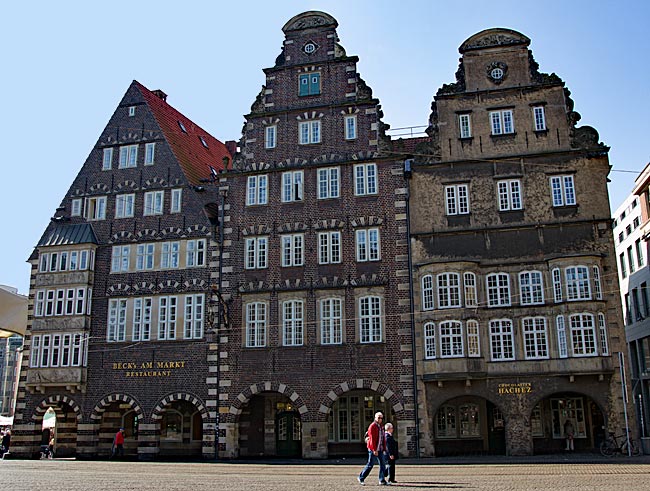
View from the Liebfrauenkirchhof across Obernstraße to old merchant houses; to the left is the market square
Next to the neo-Romanesque entrance of the church at the front stands an equestrian statue depicting the German field marshal Helmuth von Moltke (1800-1891). Alongside Bismarck (as a political figure), von Moltke is considered the military founder of German unification in 1871. The monument, whose base is embedded in the church wall, was donated by citizens of Bremen in 1909. That such a statue honoring a high-ranking military figure stands precisely at a church seems somewhat odd from today's perspective.
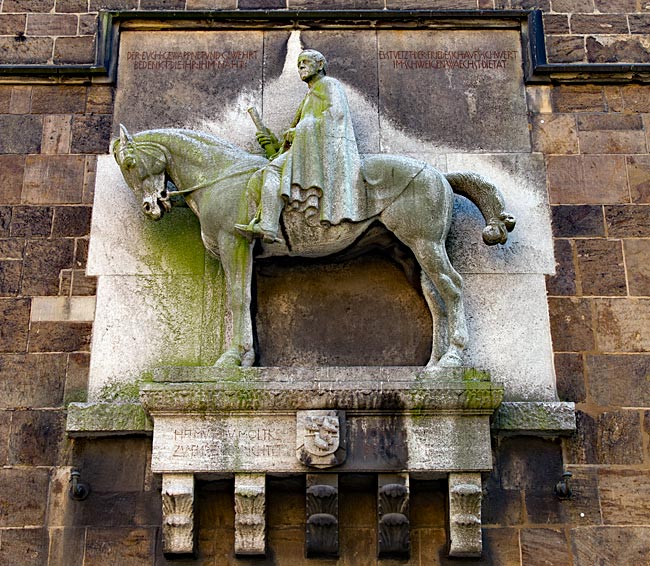
Moltke equestrian statue at the Liebfrauenkirche
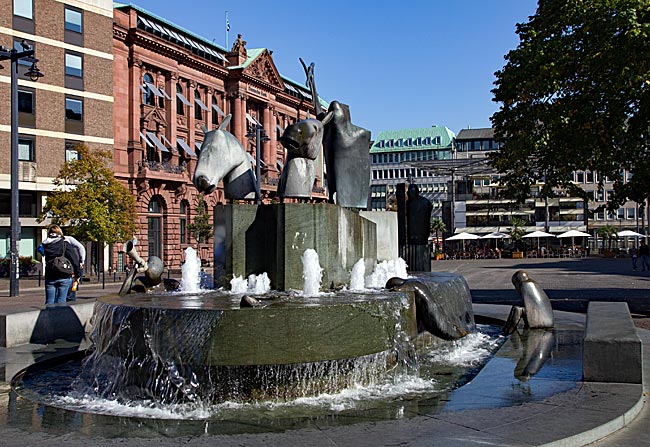
Of the former cemetery around the church, the Liebfrauenkirchhof, which also served as a market square until 1813, only the name remains. Today, a large flower market takes place here year-round, and people often grab a quick snack, such as a Thuringian sausage at Stockhinger's pavilion. Since 1909, a fountain - the Marcus Fountain - has stood on the granite-paved churchyard. There are actually two in the city, both named after the former mayor Victor Marcus. The older and significantly larger fountain, erected in 1883, still stands today in Bürgerpark near Parkhotel. The fountain on Liebfrauenkirchhof was completed in 1908 and has been under monument protection since 1973.
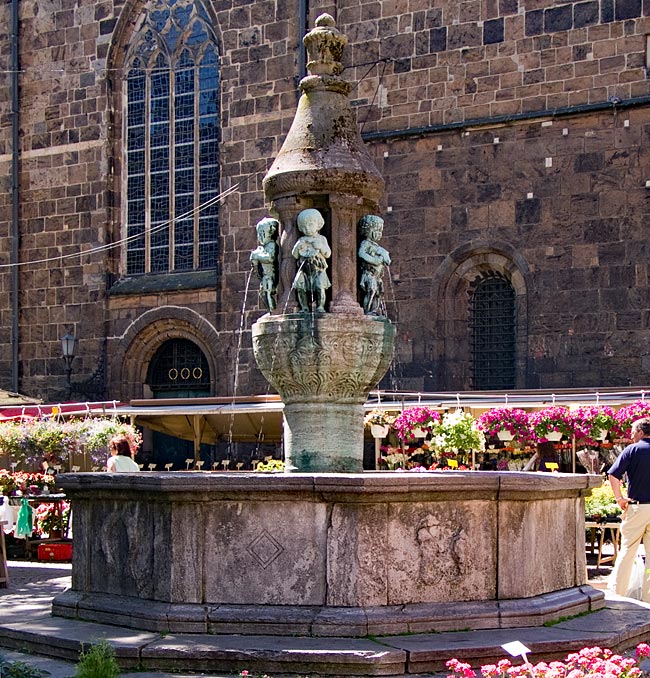
Fountain on the Liebfrauenkirchhof
Until the turn of the millennium, it was popular among tourists and locals alike to throw money into the fountain and make a wish. Tradition dictated that coins should be thrown into the water backward, though few did so because they were unaware or found it too difficult to aim. The goldfish swimming in the fountain didn't mind; for them, every wish came true because the money was used by nearby taxi drivers waiting for customers to buy their food, which is why the fountain was often colloquially called the "Taxi Fountain." But that is history. What remains is the fountain itself, which underwent major restoration in 2017.
previous page
 next page
Map
Further information
https://www.orgelpunkt-bremen.de
St. Peter's Cathedral
The history of the cathedral, Bremen's oldest church, begins with the Christianization of the region - originally settled by the Saxons - by Charlemagne in the 8th century. While it is uncertain exactly when the first cathedral was built on the highest point of the so-called Bremer Düne (Bremen Sandhill), it was likely destroyed by invading Vikings from Denmark in 858. The subsequent Romanesque structure, begun in 1041 and completed with its two towers in the 13th century, was later remodeled in the Gothic style during the 16th century.
read more
...
Domshof
In the shadow of the cathedral lies the Domshof. Until 1803, the cathedral district - and thus the large square - was owned by the respective bishops, Sweden, and later the Electorate of Hanover, who ruled Bremen at times. The buildings, including townhouses, and the planting of numerous trees made the Domshof one of the most beautiful squares in the Hanseatic city during the 18th and 19th centuries.
read more ...
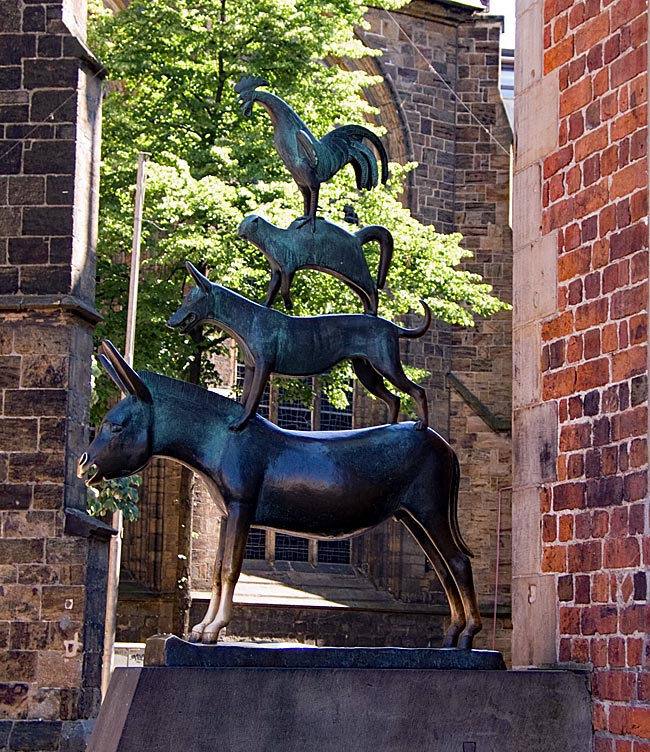
The Bremen Town Musicians
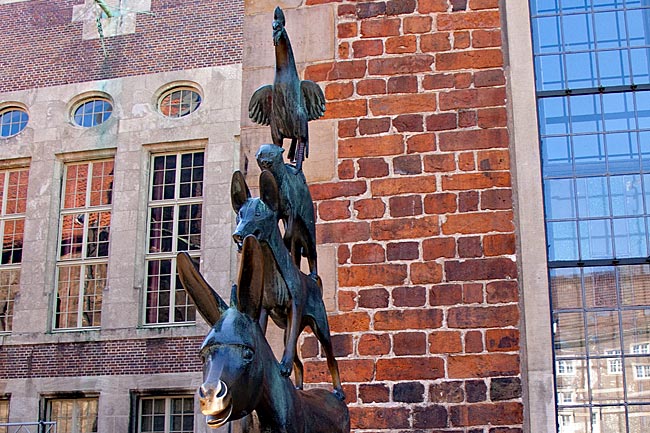
On the left broad side of the Old Town Hall, next to the entrance to the lower town hall hall, stand four bronze-cast heroes of a world-famous fairy tale - the Bremen Town Musicians. However, it remains a contentious point whether these mismatched four - donkey, dog, cat, and rooster - actually made it all the way to Bremen, as the fairy tale does not provide a clear answer on this matter. But perhaps that is not so important, for what truly matters is the message conveyed in the fairy tale.
read more ...
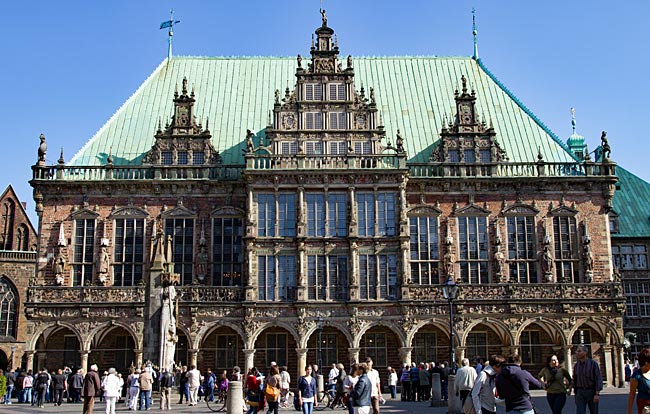
Town Hall
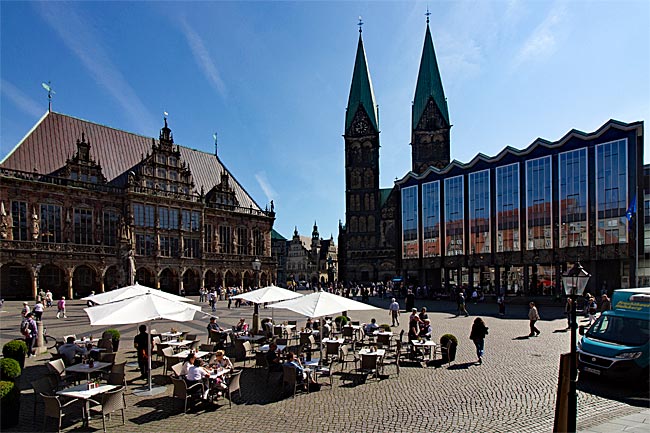
The original Old Town Hall on the market square was built between 1405 and 1412. Little remains of this rather plain late Gothic brick building today. The Renaissance façade that gives the UNESCO-protected structure its distinctive appearance was constructed between 1608 and 1614 by Lüder von Bentheim. Particularly above the arcades, it is lavishly adorned with various depictions from ancient mythology, which uniquely blend with Christian symbolism, Bremen city symbols, and other representations.
read more ...
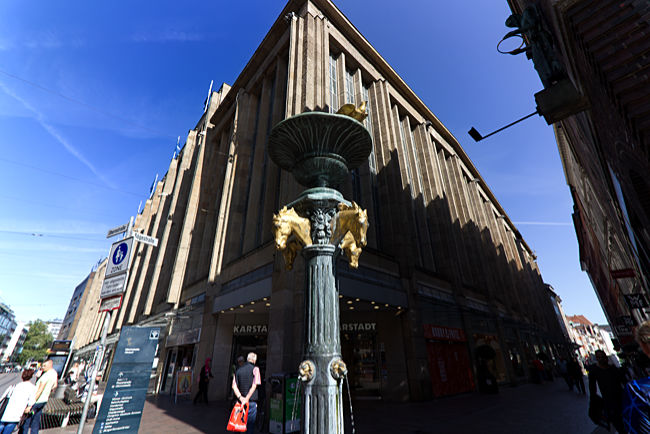
City Center: the main shopping streets
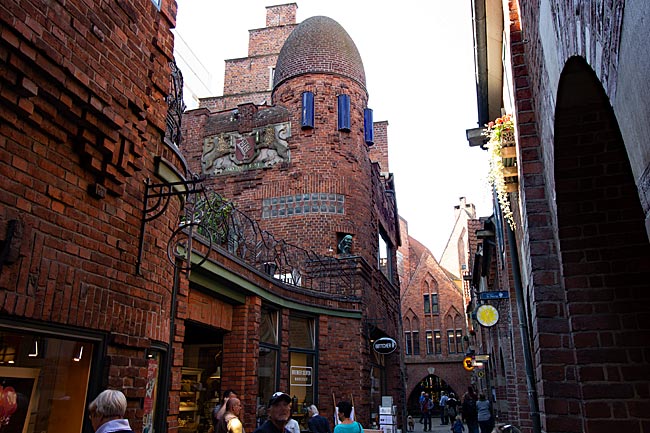
The Lloyd-Passage runs parallel to Obernstraße, where Sögestraße also ends. Here stands the "Horse Fountain," another popular meeting spot. Often, people gather here waiting for someone. The attractively designed bronze and brass fountain was donated by the jeweler Brinkmann & Lange on the occasion of their 100th company anniversary and has stood in this location on the pedestrian path since 1974. Although the design is not by Gerhard Lange, the fountain closely resembles the three other horse fountains he designed in different parts of the city.
read more ...
Market Square
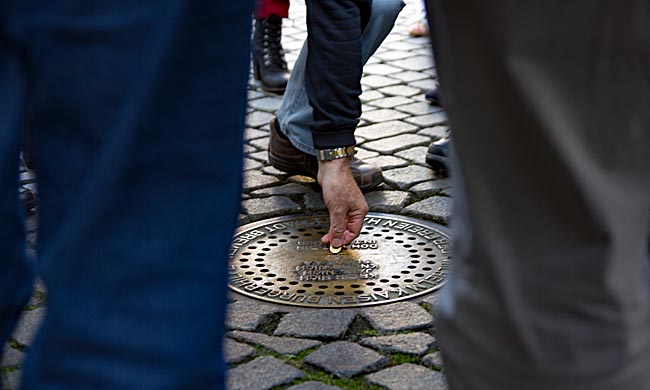
Relatively new is the so-called "Bremer Loch" (Bremen Hole) near the steps of the Bürgerschaft (city council). This is a 90-centimeter-deep public donation box embedded in the ground and sealed by a bronze cover with a diameter of 50 centimeters, which passersby might mistake for a manhole cover. The installation was initiated by the Wilhelm Kaisen Bürgerhilfe, a charitable organization in the Hanseatic city.
read more ...