
 exploring Bremen & its surrounding areas
 You are here: attractions in the city center
 City center: the main shopping streets(2/2)
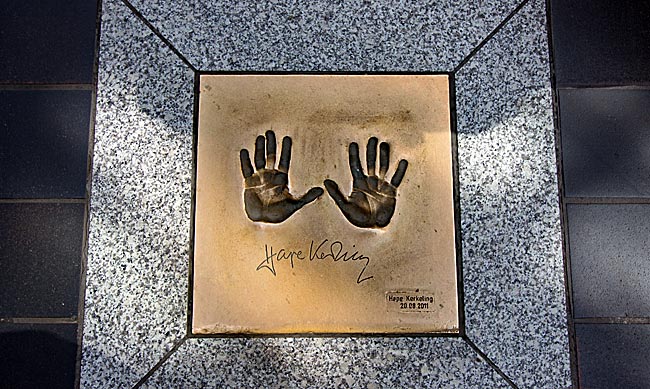
Handprints of Hape Kerkeling in the Lloyd-Passage
Following the course of Sögestraße further, a row of houses opens up to the left at Liebfrauenkirchhof. On the right side, starting from the corner of the Karstadt department store, extends the also covered Lloyd-Passage. The approximately 250-meter-long passage, with a glass roof supported by a steel structure, runs partly between the large department store and buildings opposite and ends at Hanseatenhof. In addition to other shops, the shopping street opened in 1990 has noticeably many snack and drink stores. Since 2003, visitors can also step heartily on the hands of celebrities - Los Angeles sends a little greeting. In the "Mall of Fame," prominent figures with ties to the Hanseatic city have left their bronze handprints. For example, the handprints of musicians James Last and Peter Maffay, former Werder players Ailton and Pizarro, Tatort (crime series) commissioner Sabine Postel, and Hape Kerkeling can be found on the metal plates embedded in the floor.
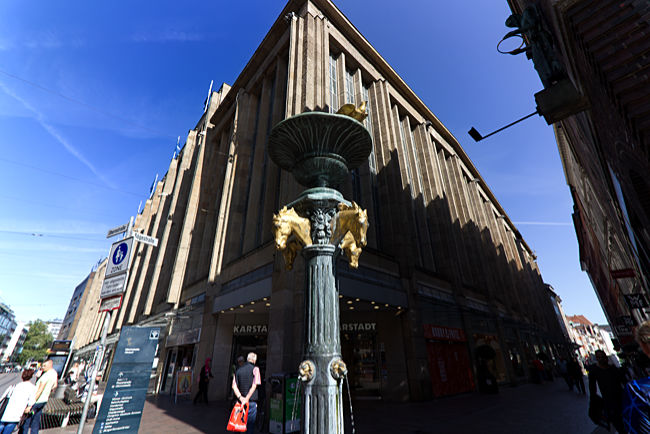
The horse fountain in front of Karstadt department store
The Lloyd-Passage runs parallel to Obernstraße, where Sögestraße also ends. Here stands another popular meeting point: the "horse fountain." People often gather here waiting for someone. The attractive bronze and brass fountain was donated by the jeweler Brinkmann & Lange on the occasion of their 100th company anniversary and has stood at this location since 1974. Although the design is not by Gerhard Lange, the fountain strongly resembles the three other horse fountains he designed in different parts of the city.
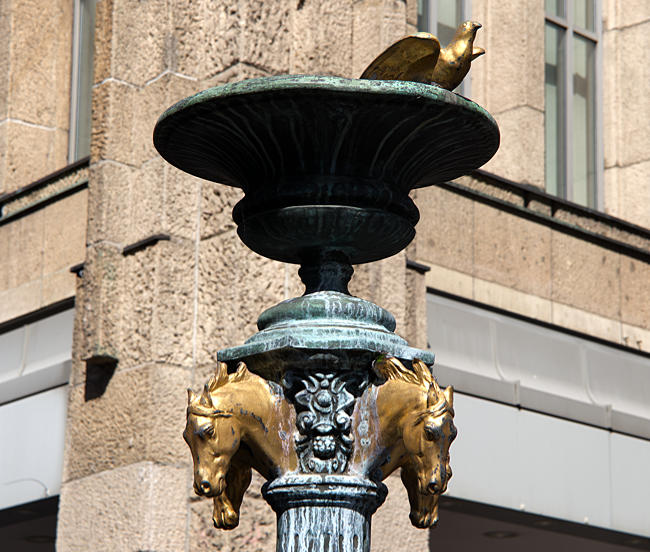
Details
The bustling shopping street with many stores was largely a residential area in the first half of the 19th century. One of the houses was home to Gesche Gottfried from 1821 to 1824, a poisoner who murdered a total of 15 people, including her own children, and was beheaded on Domshof in 1831. Even today, Obernstraße is not entirely safe, as the tram runs through this now car-free street from the nearby market square toward Stephaniviertel and further to Überseestadt.
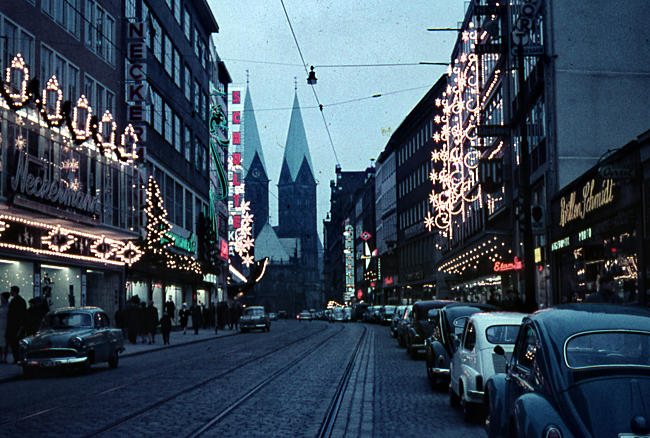
View down Obernstraße towards the cathedral during Christmas time in 1961. At that time, the street was not yet a car-free pedestrian zone. Archive image
As early as the Middle Ages, Obernstraße was one of the most important main streets between Liebfrauenkirchhof and Stephaniviertel, though not the only one. Parallel to it runs Langenstraße, which begins or ends at the market square. At the height of the old city weighhouse, a staircase leads down from Obernstraße into Langenstraße, making it clear how the street got its name. The nearby cathedral was built on Bremer Düne, and Obernstraße was also laid out on the upper part of this dune. As early as 1374, the street is mentioned as "Overenstrate." The archive photo above shows Obernstraße at Christmas 1961, with the towers of the cathedral visible in the background.
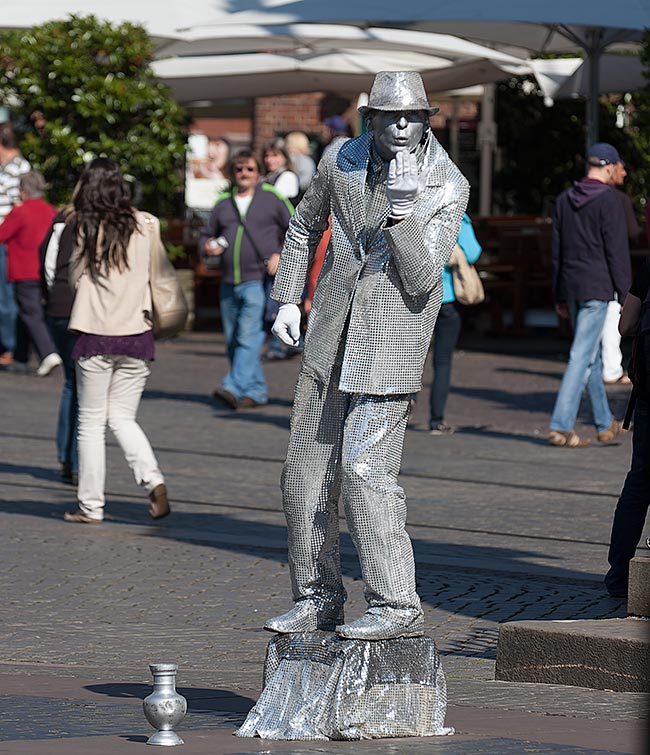
Street performer
Toward Stephaniviertel, where Oberstraße transitions into Hutfilterstraße, Ansgarikirchhof extends on the right side. As early as the first half of the 13th century (1224/29), construction of a church began here. After fires and collapses of building parts, the sacred structure changed its appearance over the centuries through repairs. At times, the tower of St. Angarii Church was the tallest in the city at 118 meters. It collapsed into the nave after bomb hits on September 1, 1944, causing devastating damage. Even after the 1950s, there were long discussions about whether the protected monument should have been rebuilt instead of demolishing the ruins and redeveloping the area. Nearby, the medieval Ansgaritor in the city fortifications once stood, later replaced by the elevated Ansgaribastion, where today "the creator of the WALLanlagen," Isaak Altmann, is honored. Today, the Ansgar Column designed by sculptor Kurt-Wolf von Borries in front of Gewerbehaus reminds us of St. Ansgarii Church. The top of the stele is adorned with a ship parting water in waves, featuring a stylized split mast ending in a cross. The monument was erected in 1965, marking the 1100th anniversary of the death of Archbishop Ansgar of Bremen, whose earlier monument by Carl Steinhäuser had been destroyed along with St. Ansgarii Church.
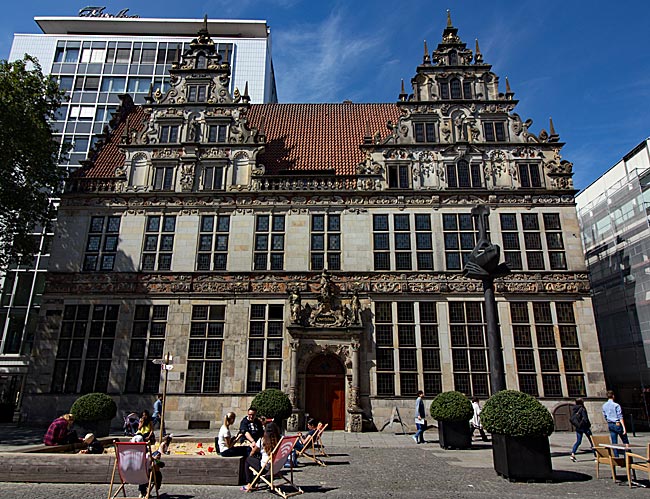
The ornate facade of Gewerbehaus with Ansgar-stele in front of it
The charming Gewerbehaus, in front of which the stele stands, was originally built for the cloth merchants, who traded textiles produced in regions like Flanders during the Middle Ages. The Weser Renaissance building, protected as a historic monument since 1973, was completed after two years of construction in 1621. The house originally consisted of two buildings constructed at the corner into today's Wandschneiderstraße to the right of the portal. Guild business was conducted in these guild houses, and member meetings were held, but the large halls were also available to non-members for family celebrations such as weddings upon request - hence the former name "Wedding House." Elsewhere, special buildings were erected for this purpose at the end of the Middle Ages. A wedding painting by Bremen artist Franz Wulfhaben, who died in the Hanseatic city in 1670, can be seen today in the Focke Museum: "The Wedding at Cana" from 1660, which likely hung briefly in the house of the cloth merchants.
In 1685, the guild had to sell the house due to financial difficulties, and it became the Kramer-Amtshaus. In 1861, after purchasing the house, the Chamber of Commerce moved in, having been established following a constitutional change in 1849. Throughout this time, the building underwent various renovations until October 6, 1944, when aerial bombs caused the most comprehensive transformation in its history - the building was almost completely destroyed.
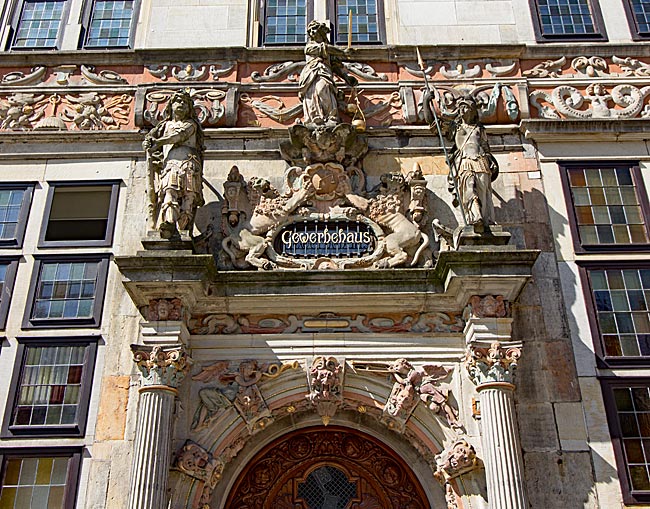
Detail view: well-preserved entrance portal of the Gewerbehaus
Just four years later, reconstruction of the house began. For example, preserved gable parts from a house on Langenstraße were incorporated into the gable facing Hutfilterstraße. The reconstruction of the magnificent gables at Ansgarikirchhof - Venus Gable on the left, Mercury Gable on the right - was completed in 1959. In the same year, the Chamber of Crafts purchased the sandstone-facade building and has since occupied the premises. Largely preserved in its original state is the entrance portal shifted from the right side to the center of the facade, featuring Justitia, the goddess of justice, flanked by Hercules (left) and Minerva (right) one step lower on either side.
previous page
 next page
Map
Market square
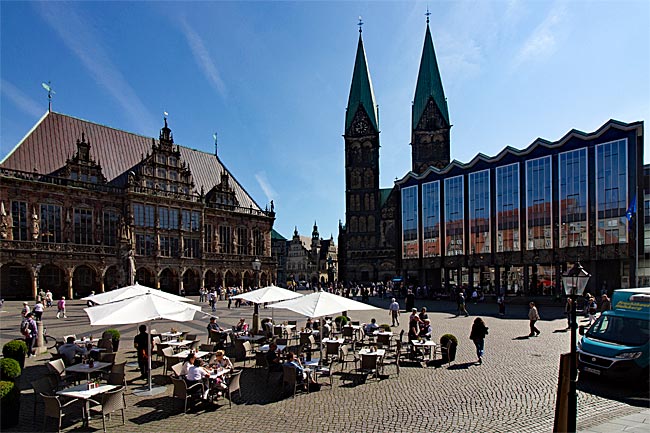
As it was in the past and as it is today, the market square is the political center of Bremen and also a major attraction for thousands of tourists, undoubtedly due to its unique architectural atmosphere. Almost unobtrusive and plain in appearance, the Bürgerschaft (Bremen's parliament) stands next to the magnificent Old Town Hall.
read more ...
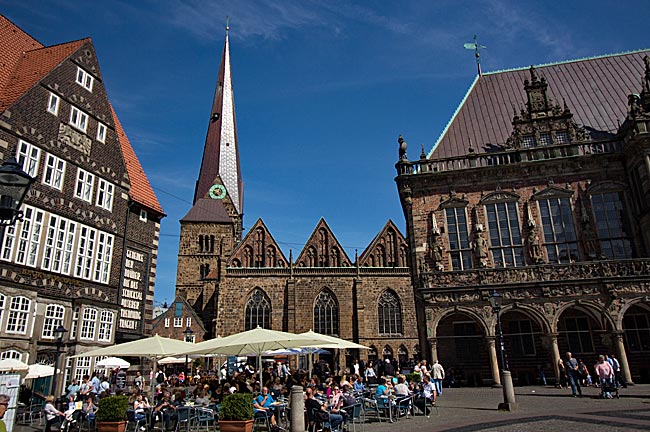
Stephani district
The Stephani district forms the western end of Bremen's Old Town and is considered the birthplace of the city, making it one of its oldest districts. As early as 1050, Archbishop Adalbert I founded a priory in honor of Saint Stephen. The priory, located on a dune, was called Steffensberg (mons sancti Stephani) in German translation. Adalbert's episcopal successors established a parish and built the first church in what was then also known as Steffensstadt (Stephen’s City).
read more ...
Überseestadt
When the overseas port (Überseehafen) needed to be renovated, it was decided in 1991 in the Hanseatic city to simply close the basin. In 1998, the overseas port was finally filled with sand that resulted from dredging operations in the outer Weser. Together with the also decommissioned but still existing Europa Harbor as a harbor basin, this formed the basis for the conceptual development and creation of today's Überseestadt.
read more ...
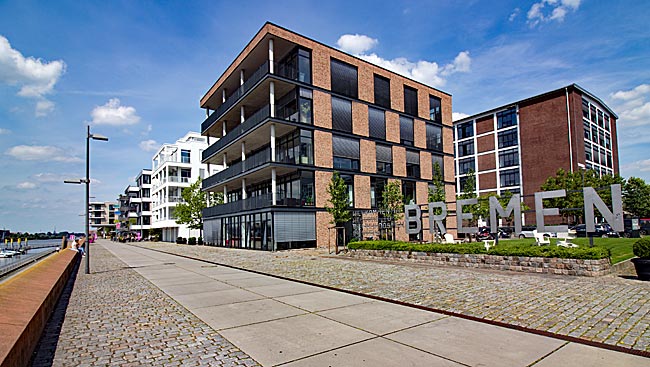
St. Peter's Cathedral
The history of the cathedral, Bremen's oldest church, begins with the Christianization of the region - originally settled by the Saxons - by Charlemagne in the 8th century. While it is uncertain exactly when the first cathedral was built on the highest point of the so-called Bremer Düne (Bremen Sandhill), it was likely destroyed by invading Vikings from Denmark in 858. The subsequent Romanesque structure, begun in 1041 and completed with its two towers in the 13th century, was later remodeled in the Gothic style during the 16th century.
read more
...
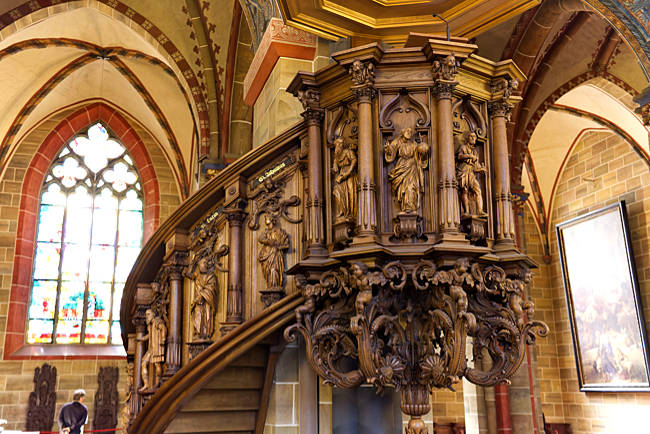
Wallanlagen
Almost entirely surrounding the old town is a zigzagging park landscape with a moat. This represents the last visible remnants of the fortifications that once encircled the old town and parts of the new town until the early 19th century. The transformation into a garden landscape began in 1802 with the first section between the Weser River and the Herdentor gate.
read more ...
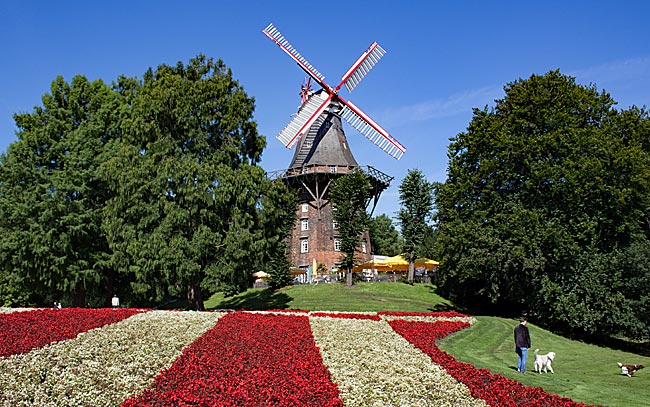
Town Hall
The original Old Town Hall on the market square was built between 1405 and 1412. Little remains today of this rather plain late Gothic brick building. The Renaissance façade that gives the UNESCO-protected structure its distinctive appearance was erected by Lüder von Bentheim between 1608 and 1614. Particularly above the arcades, it is lavishly adorned with various depictions from ancient mythology, which uniquely blend with Christian symbolism, Bremen city symbols, and other representations.
read more ...
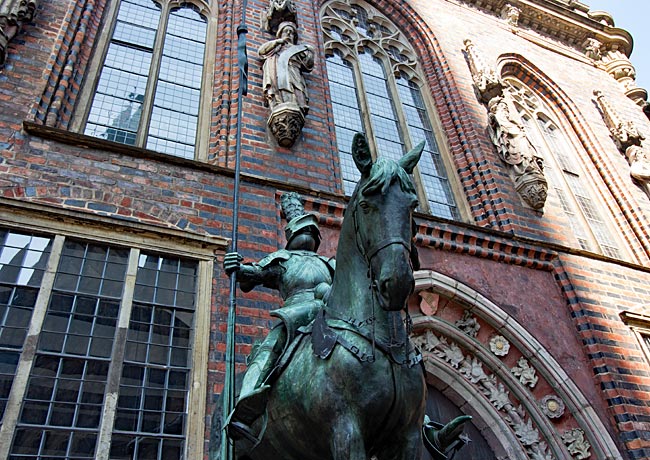
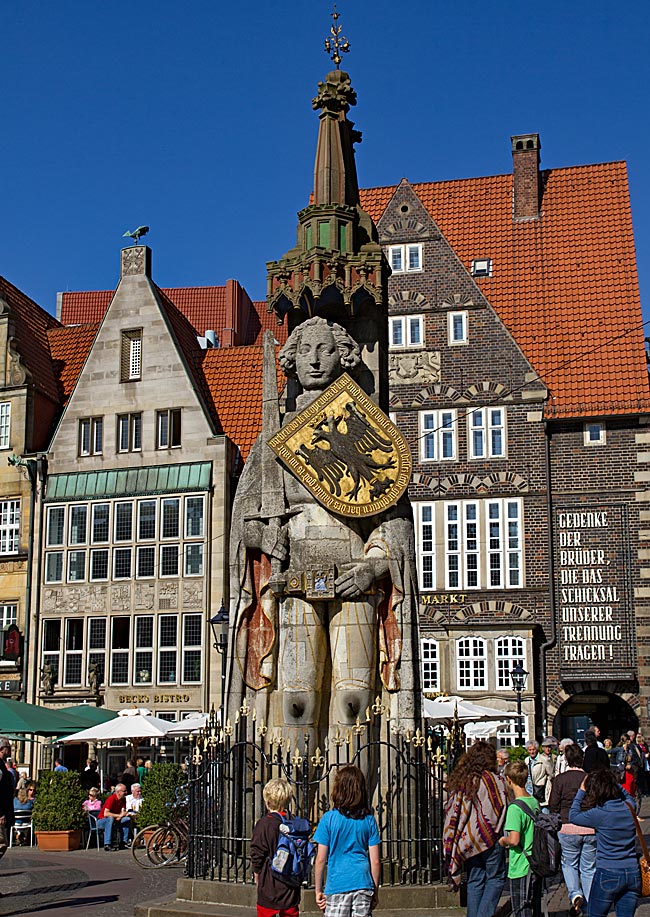
Roland statue
The Roland statue stands on the market square in front of the town hall and has been there since 1404. It is a 5.55-meter (10.21-meter total) tall sandstone figure of a knight with a drawn sword and shield in front of his chest. Like in many other European cities, the Roland in Bremen symbolizes the city's freedom, which historically stemmed from market rights and its own jurisdiction.
read more ...
The Bremen Town Musicians
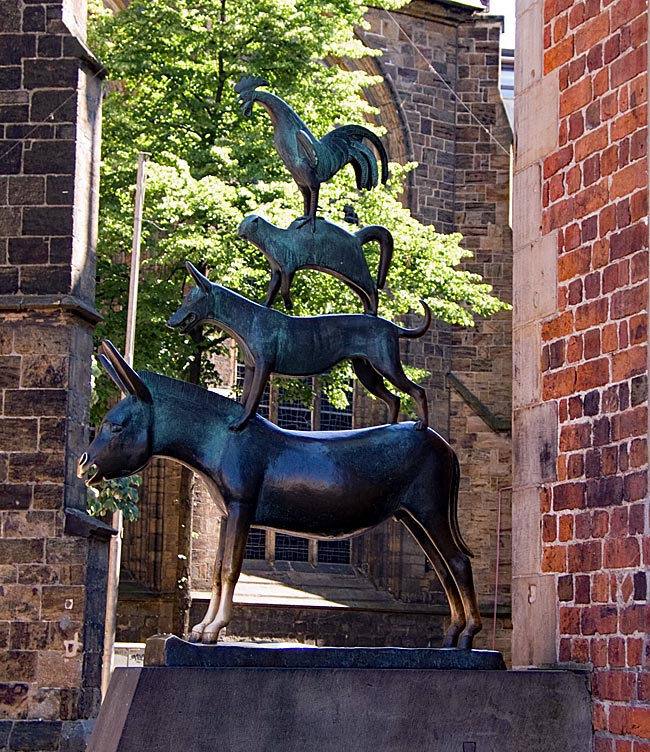
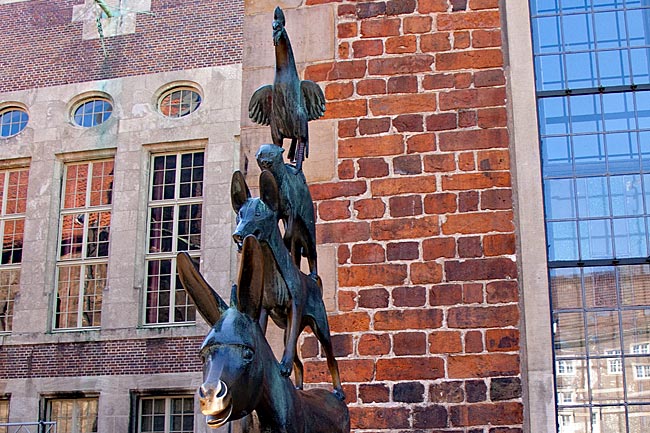
On the left broad side of the Old Town Hall, next to the entrance to the lower town hall hall, stand four bronze-cast heroes of a world-famous fairy tale - the Bremen Town Musicians. However, it remains a contentious point whether these mismatched four - donkey, dog, cat, and rooster - actually made it all the way to Bremen, as the fairy tale does not provide a clear answer on this matter. But perhaps that is not so important, for what truly matters is the message conveyed in the fairy tale.
read more ...