

DISTANT PLACES
Travel tips by Bremen sehenswert far from the Hanseatic City of Bremen
Hanseatic City of Rostock - A Travel Guide
Along the Old City Wall from Kröpeliner Tor to St. Peter's Church
After the three city settlements - Altstadt (Old Town), Mittelstadt (Middle Town), and Neustadt (New Town) - had united between 1262 and 1265, the people of Rostock began fortifying their new city. By 1350, a roughly three-kilometer-long defensive wall had been built, reaching up to 1.2 meters in thickness. It featured 22 gates (most on the water side), six watchtowers, and several semicircular Wiekhäusern (defensive protrusions) along the field side of the wall.
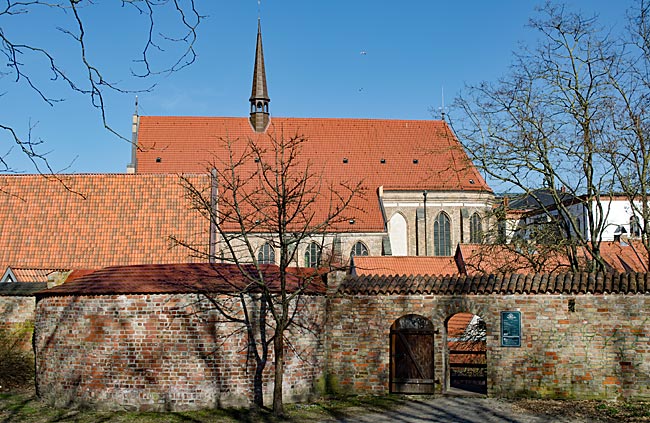
From the outside, the full height of the city wall (with its Wiekhaus) is no longer visible
After completion, the predominantly brick-built defensive wall enclosed a city area of about one square kilometer - the roughly equivalent of today’s Old Town. In times of danger, a wooden walkway could be installed at a height of around three meters along what was originally a seven-meter-high wall. Today, however, a reconstructed walkway exists at only one location: near the Abbey of the Holy Cross (Kloster zum Heiligen Kreuz).
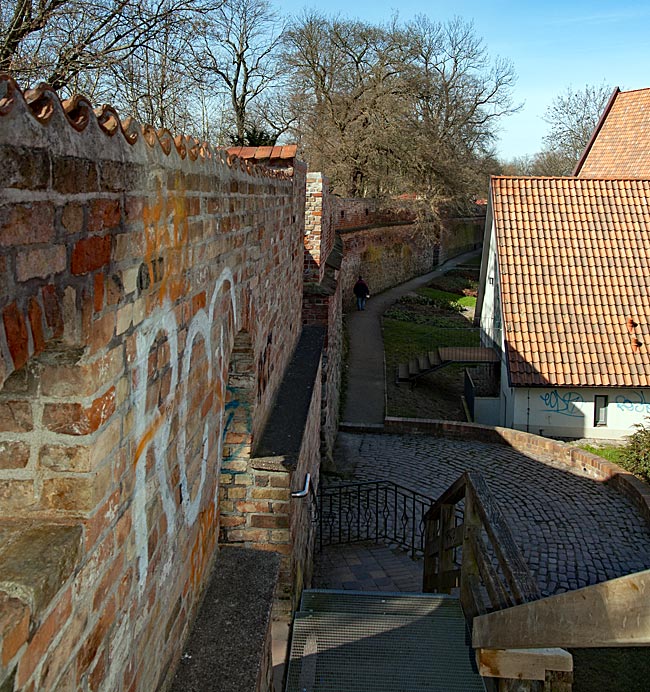
View from the walkway along the city wall near the Abbey of the Holy Cross
The tour begins at the most impressive of the four preserved gates - the mighty Kröpeliner Tor. Instead of continuing down Kröpeliner Straße, the route follows along to the right. The remaining section of the wall is visible in its full height only from the city side. The first stretch leads to the Abbey of the Holy Cross, a former 13th-century Cistercian convent that remains largely intact. Here, this part of the old city wall ends.
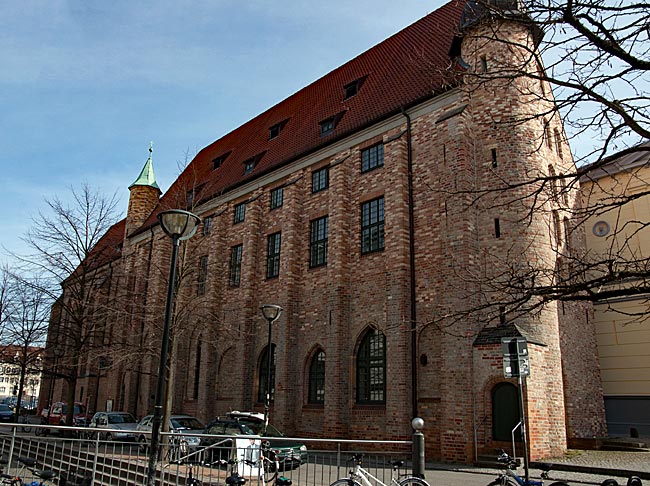
Michael’s Monastery (Michaeliskloster)
Passing through the monastery grounds, visitors walk by the charming Klostercafé and the Kempowski-Archiv before reaching Universitätsplatz. The path continues past former ducal buildings until it reaches Schwaansche Straße (to the right). This street passes Altbettelmönchstraße, where St. Michael's Convent (Michaeliskloster) stands on the left. At Wallstraße, the route turns left, running alongside the Rosengarten - a small green oasis established in 1860 near the busy August-Bebel-Straße. After a short walk, the neogothic Ständehaus catches the eye; it was built between 1889 and 1893.
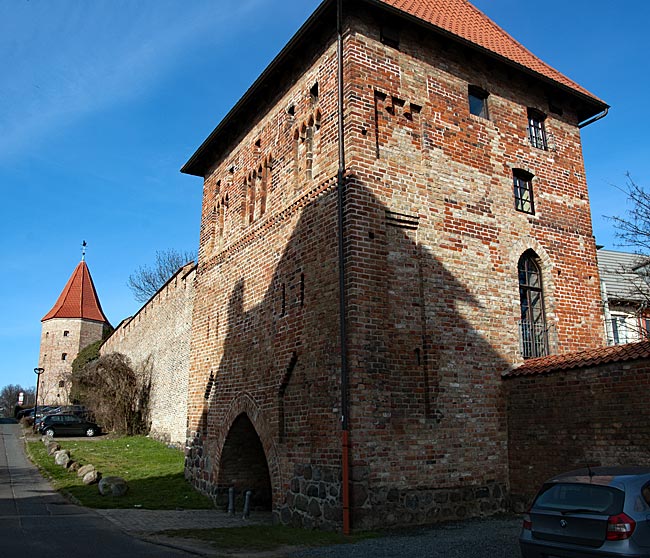
Kuhtor and Lagebuschturm
The adjacent Steintor (Stone Gate), dating to the Renaissance period, replaced an earlier gate demolished by Schwerin troops in 1577. Here begins another section of the city wall, featuring the Lagebuschturm (built in the 16th century) and ending at the oldest preserved city gate in Rostock - the Kuhtor, first mentioned in 1262.
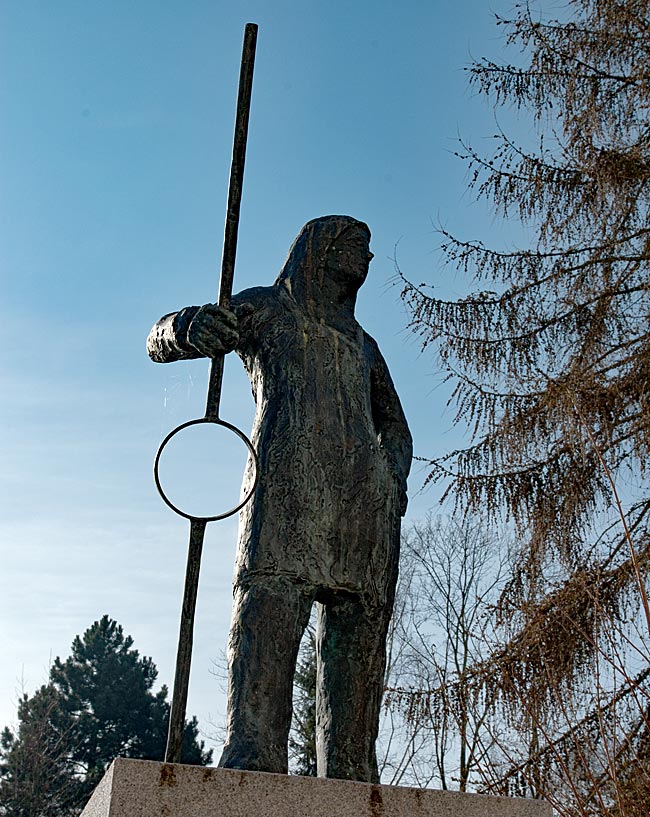
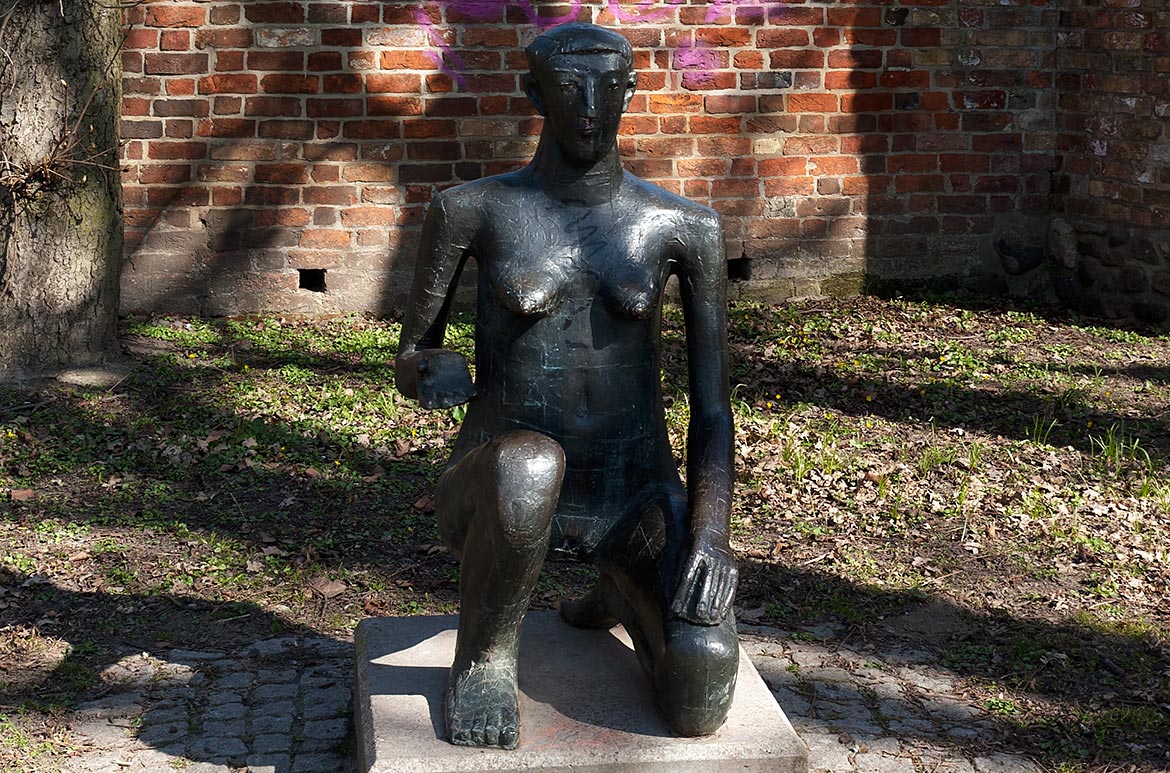
Statue at Glockengießerhof (bellfounder's courtyard)
Between the tower and the gate stood a foundry courtyard behind the Ratsschmiede (Council Blacksmith’s Workshop) on Beginenberg Street. Founders were among the oldest guilds in the Hanseatic city, already documented around 1250. In honor of these craftsmen, a bronze statue by Rostock-born artist Thomas Jastram (2009) stands on Glockengießerhof (bellfounder's courtyard).
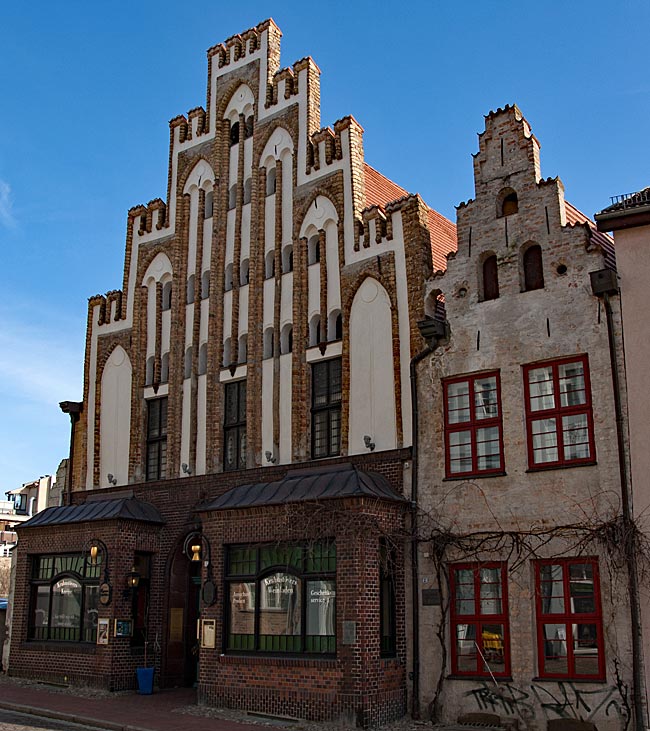
Krahnstöverhaus
From here, the towering spire of St. Nicolas' Church (Nikolaikirche) is visible. However, before reaching it, there’s a detour to Große Wasserstraße, where Krahnstöverhaus - one of the last surviving secular buildings with a Gothic brick façade and among the city’s oldest houses (first documented in 1376) - can be found.
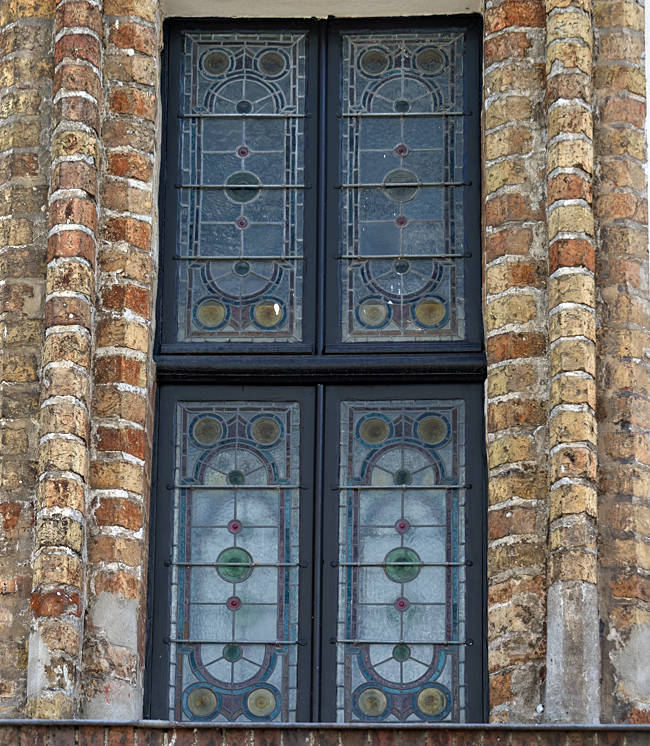
Details at Krahnstöverhaus
Originally a merchant’s house with an ornate stepped gable, it now hosts gastronomy. In 1874, it was purchased by Julius Krahnstöver’s nearby liqueur factory, giving the building its name. The existing entrance extension dates to the late 1930s.
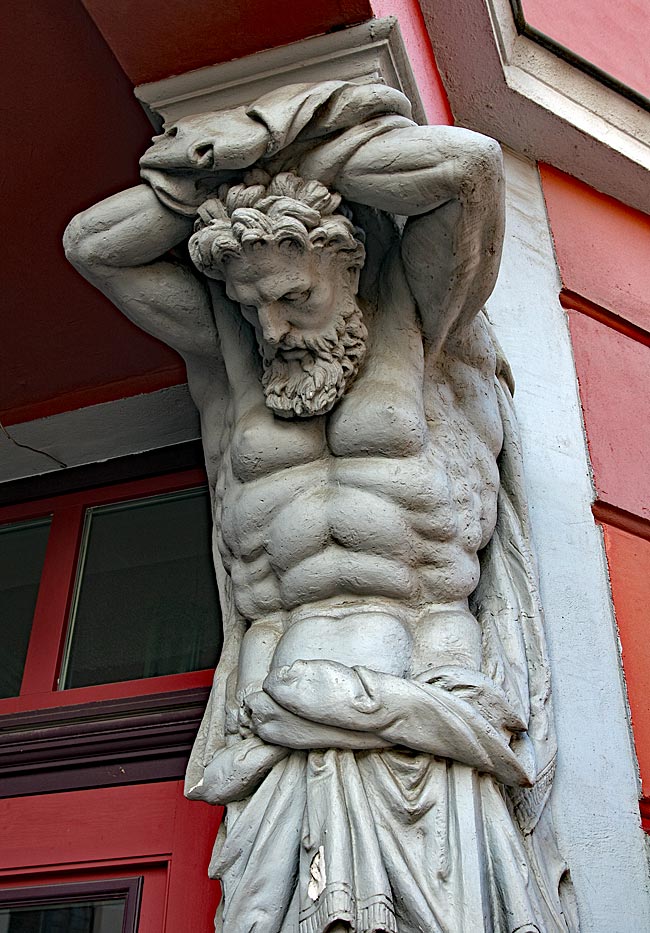
Detail at the corner of Große Wasserstraße and Beginenberg
Back at the intersection “An der Viergelindenbrücke,” the tour ascends toward St. Nicolas' Church. Though no longer used as a parish church, this sacred building now serves as a cultural venue. Several protected historic houses line nearby Lohgerberstraße, leading to the elevated market square of Rostock’s oldest settlement - the Alten Markt (Old Market) near St. Peter's Church (Petrikirche).
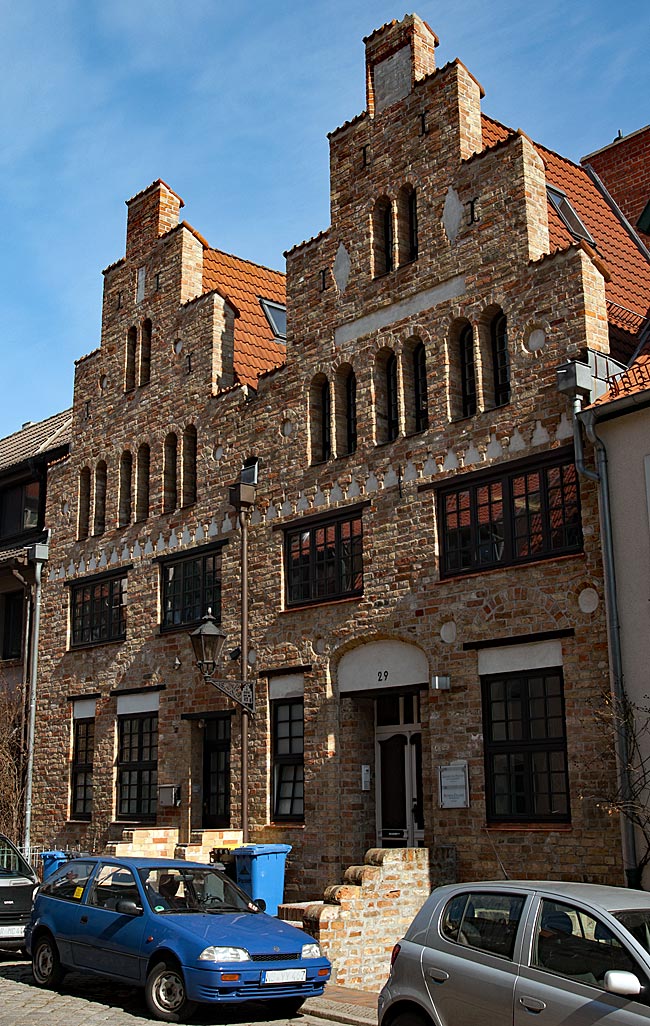
Protected historic house on Lohgerberstraße
In the early 13th century, german merchants settled here, laying the foundation for the city of Rostock. Behind the right row of houses runs the longest stretch of the city wall - from St. Nicolas' Church to beyond St. Peter's Church, where this final section of the old fortifications ends.
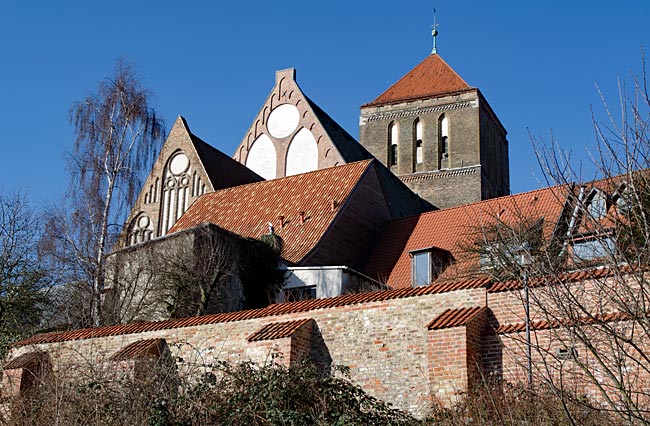
Beyond the wall: view of St. Nicolas' Church
However, via Karl-Planeth-Weg, one can walk parallel to the residential street between the two churches on the opposite (outward-facing) side. This route is far more pleasant as it’s free from traffic. At various points along the wall, small ceramic boxes are attached to provide shelter for bats.
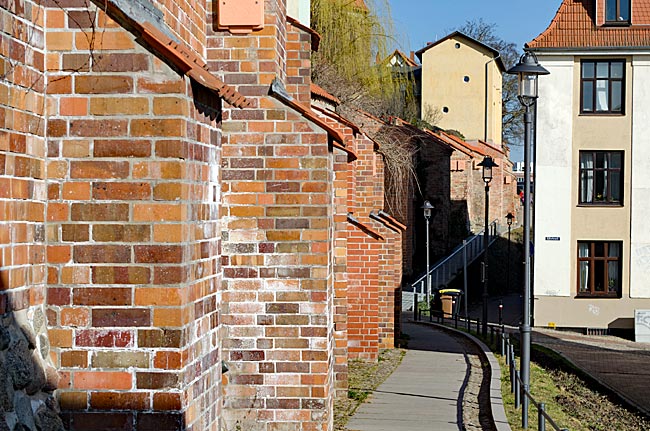
Along Karl-Planeth-Weg by the old city wall
From the grave of Joachim Slüter, the Petri preacher who played a key role in introducing the Reformation to Rostock, one’s gaze at the end of the old city wall near St. Peter's Church (Petrikirche) extends over “Am Strande” Street toward the city harbor.
previous page
 next page
Read more about Rostock: The table of contents
Map
Rügen by the Baltic Sea
Active holiday featuring cycling and hiking
Enjoy an active holiday featuring cycling and hiking along the Baltic coast in Mönchgut on the island of Rügen. Long sandy beaches, rolling hills, and lush forests provide a varied and beautiful setting for your getaway. Often, the only thing breaking the peace is the distant whistle of the historic 'Rasender Roland' steam train. Despite its name (which suggests something "racing" or fast), it’s actually quite the opposite. A journey by train is simply part of the holiday experience.
read more about Rügen ...
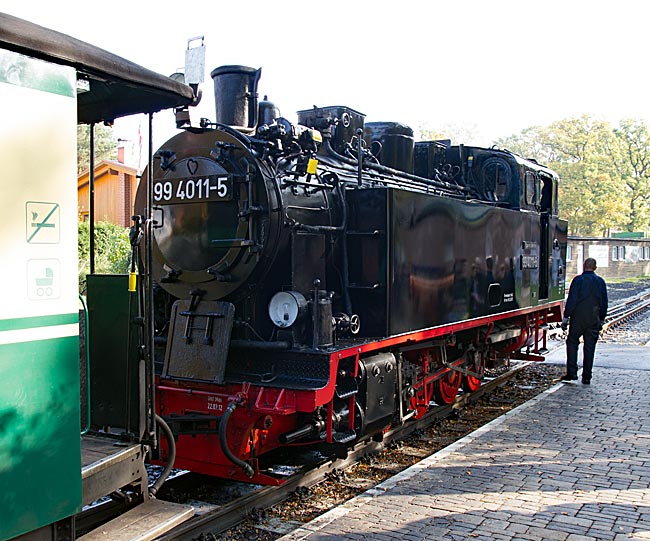
In the Probstei in late summer
Schönberger Strand and sea and more
Can you walk or ride a bike from Brasilien (Brazil) to Kalifornien (California) in just a few minutes, always with a view of the water? No, not with your finger on the globe or map, but in person. You’ll have to forgo Copacabana and the Sunset Strip with the Angels in Los Angeles (Spanish for "The Angels"). Instead, you get Germany’s "True North" with all its bright sides. Of course, there are sometimes shadows here too, but they belong only on the margins of this story.
read more about Schönberger Strand ...
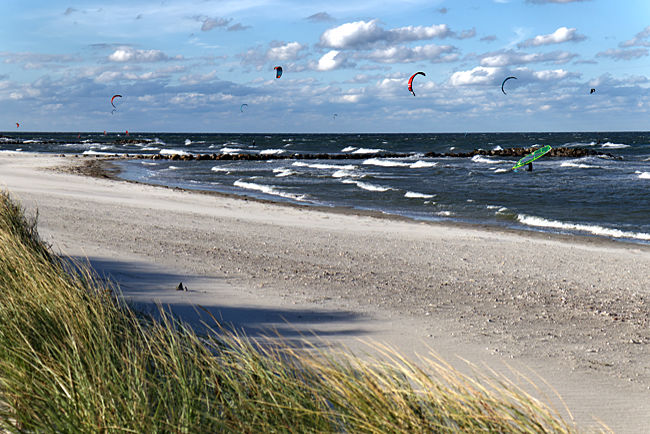
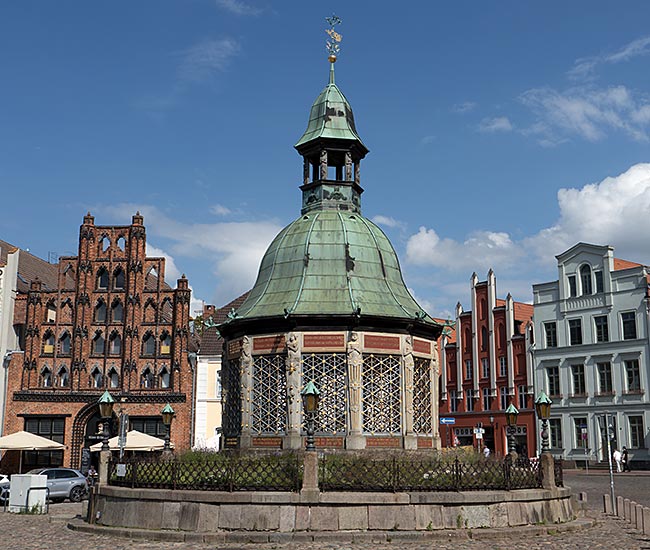
Wismar
The Hanseatic City on the Baltic Sea and its UNESCO World Heritage
The World Heritage House is a building with a stone front house and an attached timber-framed Kemladen on a foundation of loose fieldstones from a medieval predecessor building. This beautifully restored small building complex visually illustrates and provides information via text panels about the lives of past generations in the hall houses typical for Wismar, along with their outbuildings. Additionally, there is extensive information about the city’s history and numerous protected buildings in the old town - there are 1,754 in total, with 306 designated as individual monuments. In the old town, one is right in the middle of Wismar’s UNESCO World Heritage Site.
read more about Wismar ...
Crabs, dikes and the Wadden Sea
The North Sea spa town of Büsum
Once an island, Büsum was repeatedly threatened by the "Blanken Hans". When the greatest flood of the last century struck in 1962, Büsum was already long connected to the mainland - since 1585. Today, this town of around 5,000 residents, part of the Dithmarschen district, is one of the most important holiday destinations along Schleswig-Holstein's North Sea coast. Since 1985, the sea in front of Büsum has been protected as the Schleswig-Holstein Wadden Sea National Park, and since 2009, it has also been listed as a UNESCO World Heritage Site.
read more about Büsum ...
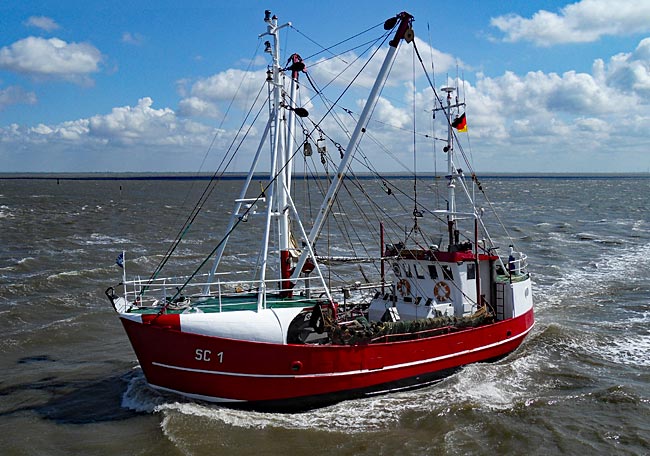
A stroll through Kiel
Sights in the fjord city and a visit to Laboe
A good starting point for exploring the city today, decades after the end of the war, is the centrally located main train station. On Sophienblatt, the main street running in front of the building, all major bus lines converge, and many sights can also be easily reached on foot during a multi-hour stroll.
read more about Kiel ...

Emden in East Frisia
Where East Frisians make jokes and serious art thrives
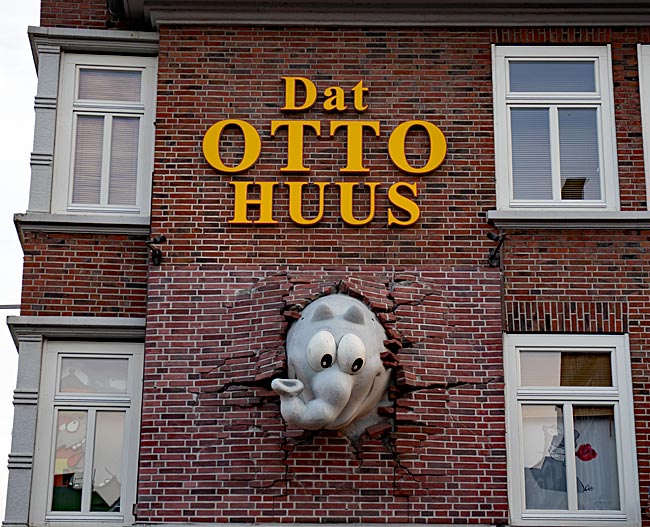
What do Henri Nannen, the journalist and founder of the print magazine STERN, director Wolfgang Petersen (e.g., Das Boot), and comedians Karl Dall and Otto Waalkes have in common? They were all born in Emden. "The Men of the Emden" (a film) not necessarily, but that's a different story. And of course, women have also been born in this city of around 50,000 inhabitants, the largest in East Frisia, such as former boxing world champion Heidi Hartmann - naturally mentioned only as a representative of all others.
read more about Emden ...
Norden-Norddeich in East Frisia
At the north Sea
At first glance, one might get the impression that this North Sea resort is merely a transfer station for vacationers heading in droves to the islands. Not only do several ferry docks dominate the harbor, but large parking lots and multi-story garages belonging to the Frisia shipping company right behind the dike offer hundreds of parking spaces for island visitors who don’t want or can’t take their cars with them - Juist is car-free after all. But beyond that, Norddeich reveals itself as a far less hectic and manageably small coastal resort. In this state-recognized North Sea spa, tourism has only been promoted since the second half of the last century, apparently with success, as more than 1 million overnight stays per year show.
read more about Norden-Norddeich ...
A short visit to the historic old town of Heppenheim
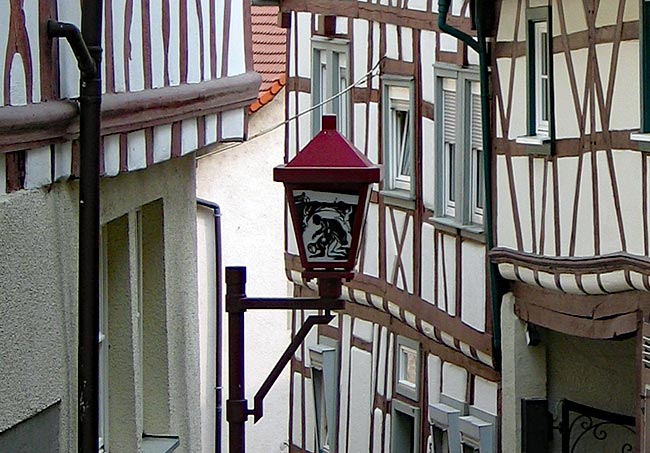
Half-timbering, a false dome, and legendary lanterns
The skyline of Frankfurt, Germany's financial capital with its office towers in the banking district, is still within sight when the train to Darmstadt and Bensheim pulls into the small station of Heppenheim. In 2010, the city was on everyone’s lips after native son Sebastian Vettel left all competition behind in his Red Bull car and became the youngest Formula 1 double world champion of all time. In 2011, he added another title to his collection, as did he in 2012 and finally in 2013 for a fourth time. However, we are not following in Vettel’s footsteps but rather those of history in the picturesque old town with its timber-framed houses.
read more about Heppenheim ...