

DISTANT PLACES
Travel tips by Bremen sehenswert far from the Hanseatic City of Bremen
Hanseatic City of Rostock - A Travel Guide
University (Main Building)
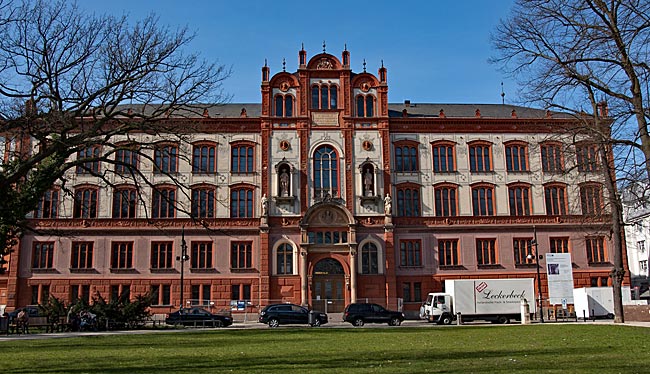
Main building of the university
When walking through Kröpeliner Straße, you will also pass by Universitätsplatz, formerly Hopfenmarkt, which was the market square of the last of the three city settlements (Neustadt) that merged to form Rostock in 1265. When it was founded in 1419, it was the first university in Northern Germany and the Baltic Sea region and is one of the oldest universities in Germany. It was established by the city council and the Dukes of Mecklenburg, Johann IV (1370-1422) and Albrecht V (1397-1423), a son of Johann’s cousin, with a papal bull from Pope Martin V..
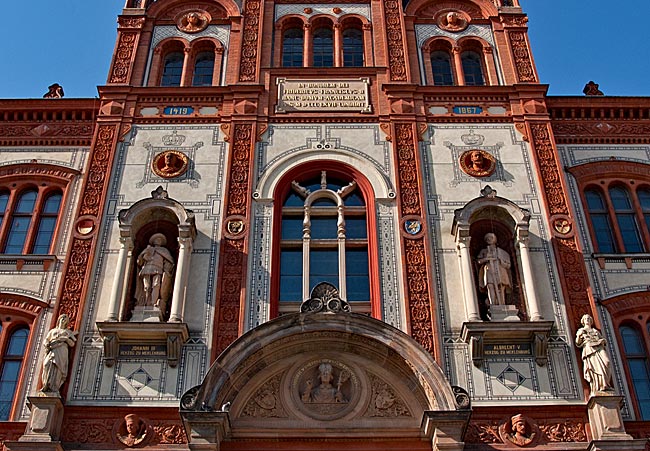
The university founders above the entrance portal
The Neorenaissance-style main building at Universitätsplatz was constructed between 1866 and 1870 based on designs by the architect Hermann Willebrand (1816-1899) from Schwerin. The southern wing was already built in 1844 according to plans by the Schwerin architect Georg Adolph Demmler (1804-1886). Notable are the numerous figures adorning the façade. The statues on the four columns of the main building - two at the corners and two above the entrance - symbolize the original four faculties: Law, Medicine, Philosophy, and Theology. Embedded in the frieze below the second-floor windows are portraits of representatives from each faculty who taught at Rostock University in the 16th and 17th centuries, such as the theologian David Chytraeus.
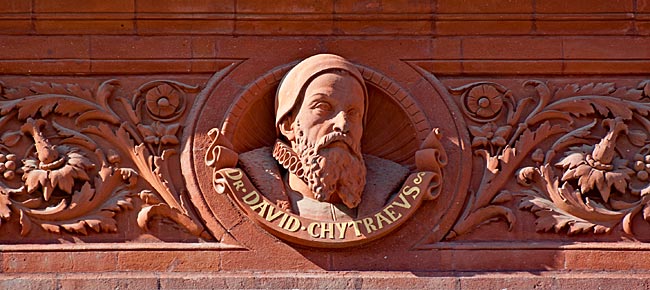
The theologian David Chytraeus
Finally, the two ducal founders also received a place above the entrance portal. Although they were not featured on the façade, the university honored additional personalities during its 500th anniversary in 1919 - namely Albert Einstein and Max Planck. These two physicists were awarded honorary doctorates for their contributions to their fields.
In the 1990s, the roof and façade of this historically significant and architecturally important building underwent restoration.
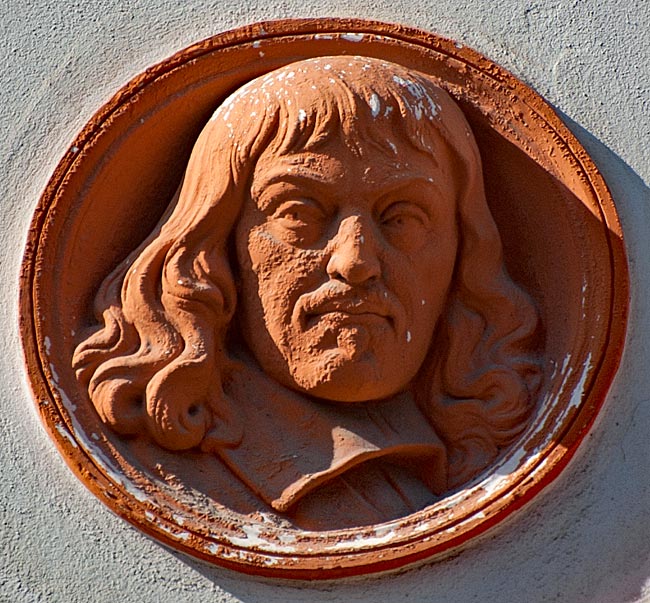
Detail on the façade
previous page
 next page
Read more about Rostock: The table of contents
Map
Rügen by the Baltic Sea
Active holiday featuring cycling and hiking
Enjoy an active holiday featuring cycling and hiking along the Baltic coast in Mönchgut on the island of Rügen. Long sandy beaches, rolling hills, and lush forests provide a varied and beautiful setting for your getaway. Often, the only thing breaking the peace is the distant whistle of the historic 'Rasender Roland' steam train. Despite its name (which suggests something "racing" or fast), it’s actually quite the opposite. A journey by train is simply part of the holiday experience.
read more about Rügen ...
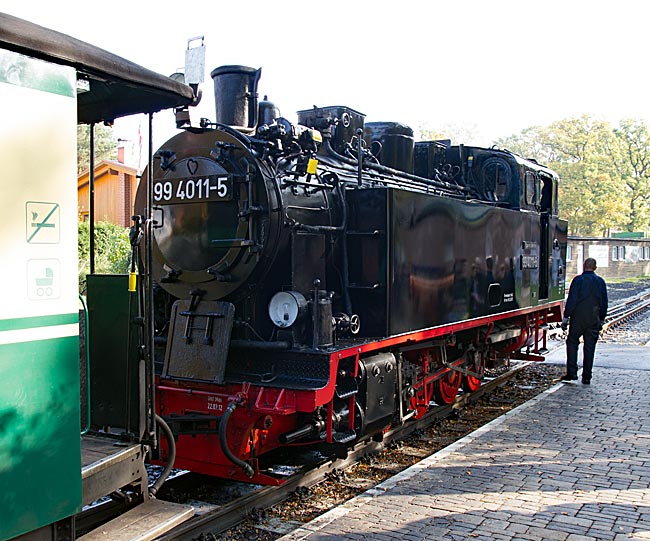
In the Probstei in late summer
Schönberger Strand and sea and more
Can you walk or ride a bike from Brasilien (Brazil) to Kalifornien (California) in just a few minutes, always with a view of the water? No, not with your finger on the globe or map, but in person. You’ll have to forgo Copacabana and the Sunset Strip with the Angels in Los Angeles (Spanish for "The Angels"). Instead, you get Germany’s "True North" with all its bright sides. Of course, there are sometimes shadows here too, but they belong only on the margins of this story.
read more about Schönberger Strand ...
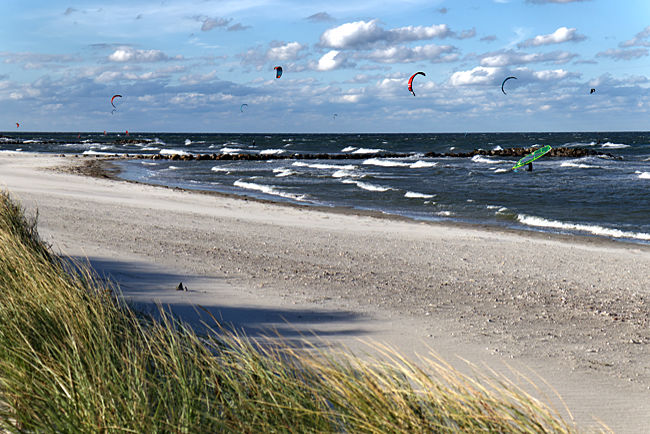
Wismar
The Hanseatic City on the Baltic Sea and its UNESCO World Heritage
The World Heritage House is a building with a stone front house and an attached timber-framed Kemladen on a foundation of loose fieldstones from a medieval predecessor building. This beautifully restored small building complex visually illustrates and provides information via text panels about the lives of past generations in the hall houses typical for Wismar, along with their outbuildings. Additionally, there is extensive information about the city’s history and numerous protected buildings in the old town - there are 1,754 in total, with 306 designated as individual monuments. In the old town, one is right in the middle of Wismar’s UNESCO World Heritage Site.
read more about Wismar ...