

DISTANT PLACES
Travel tips by Bremen sehenswert far from the Hanseatic City of Bremen
Hanseatic City of Rostock - A Travel Guide
Vicke Schorler's Panorama

Image: Artist: Vicke Schorler; Scan/Editing: de:User:N3MO; Panorama: de:User:Schiwago
Between 1578 and 1586, the merchant apprentice or journeyman Vicke Schorler created a unique cultural-historical work for the Hanseatic city of Rostock with his so-called "Wahrhaftige Abcontrafactur der hochloblichen und weitberuhmten alten See und Hense Stadt Rostock - Heuptstadt im Lande zu Meckelnburgk." At that time, Rostock was not a political capital but the largest city in the region. Vicke, a short form for Friedrich, began his colored ink drawing at around 18 years old. Over the next seven years, he created an intricate depiction of Rostock in the late Middle Ages on a scroll measuring 18.68 meters long and 60 centimeters high. Due to its unusual size, the document was preserved as a roll, hence the name in german Vicke-Schorler-Rolle. Apart from the roughly 2 meters of the roll where he also depicted parts of the surrounding area such as Warnemünde, the ducal residence city of Güstrow, and Bützow (the old bishopric), the self-taught artist presented an impressive view of Rostock's architecture with equally remarkable detail. From an artistic perspective, his depiction lacks spatial depth and correct perspective, which was partly common at the time but also due to his lack of formal training; the scales are not proportional either. Nevertheless, the fascinating ink drawing brings to life a vibrant and flourishing city from the Hanseatic era. This cityscape consists of 127 individual sheets of paper, each approximately 30x40 centimeters in size, likely assembled into the current roll only after the entire drawing was completed.
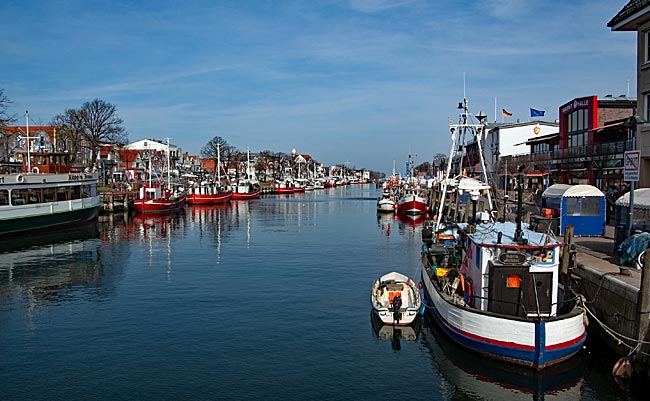
Warnemünde
Using an ink made from burned and finely ground clay and soot, bound with honey or resin, Vicke Schorler drew around 315 buildings, including key structures like the town hall, university, hospitals, churches, monasteries, mills, and many residential houses, as well as markets, streets, and people. For better identification, he labeled many buildings with small flags indicating their names. Today, we know that while the topography is accurate, the number of depicted houses was less than half of the actual stock at the time. The lower edge of the image serves as a base for the entire city panorama, where the Warnow River flows - along whose banks Rostock lies. Bulbous ships resembling Hanseatic cogs with a single mast are moored at the quay or sail past on the river with billowing sails. The city fortifications, including walls and gatehouses, are also depicted; notably, he drew the gates from the inside, an unusual perspective choice but aesthetically justified since the gate buildings looked more ornate and welcoming from the city side, such as the Steintor. Schorler used the Kröpeliner Tor as a starting point to guide viewers through the prosperous Hanseatic city with its characteristic brick buildings featuring various late Gothic gables. He finally colored his drawings with watercolors and signed the completed work: "Anno Domini 1586 on the day of Saint John the Evangelist, I, Vicke Schorler, have completely finished this aforementioned work."
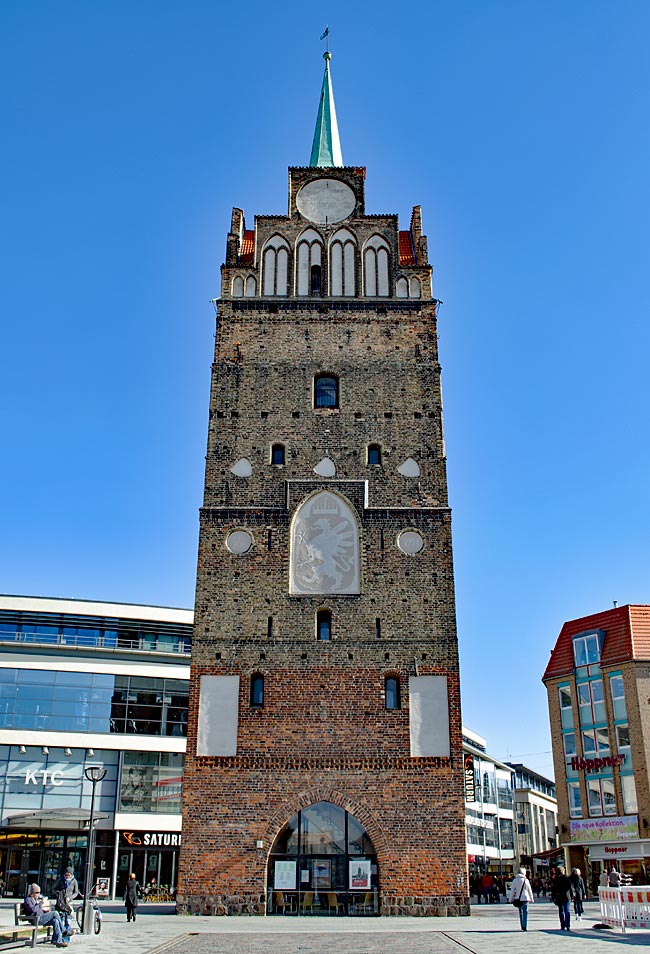
Behind the Kröpeliner Tor begins the pedestrian shopping street of the city center
It is almost miraculous that this work survived the centuries unharmed. After initially remaining in the possession of Schorler’s family and descendants, it passed to the Nettelbladt family (mayors of Rostock) before being sold to the city of Rostock in 1792. While the roll was always appreciated as an artistic work, its cultural-historical significance was only recognized in the 19th century. The depiction on the roll shows Rostock with its old late Gothic Hanseatic cityscape, which already looked different after the devastating city fire of 1677. It also features the protected Gothic town hall in its original appearance before 1729. After the destruction in 1942 by Royal Air Force bombs, Schorler’s depiction served as an architectural model for rebuilding some houses in their historical style (e.g., Wokrenterstraße) or inspired designs like the Fünf-Giebel-Haus.
Very little is known about Vicke Schorler himself. By chance, it was discovered that he was also the author of the anonymous Rostocker Chronik, which ends in 1625 - likely with his death, as he no longer appears in the city’s tax records after 1626. It is known that after his apprenticeship, he became a member of the Krämerkompanie on February 3, 1589. In the same year, he married a widow with two children and owned a house with its own gable. Over his career, he rose to represent his guild in the city council. In his later years, he worked on the aforementioned chronicle, which he took over from the bookbinder Dietrich vam Lohe after his death in 1590, translated into High German, slightly modified, and continued until his passing.
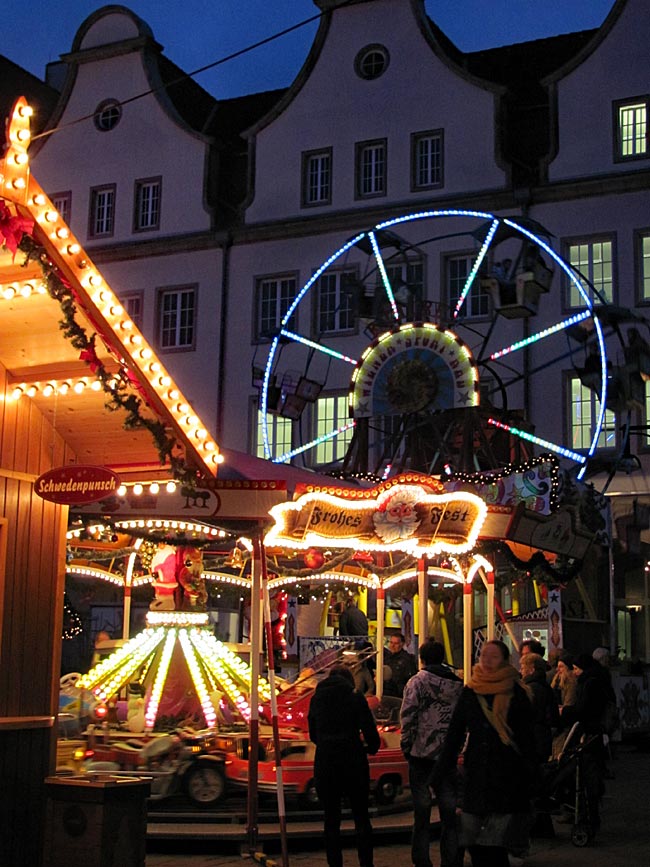
Perhaps there was already a Christmas market on the marketplace in front of the Gothic town hall at that time. © Marc Poels
previous page
 next page
Read more about Rostock: The table of contents
Map
Rügen by the Baltic Sea
Active holiday featuring cycling and hiking
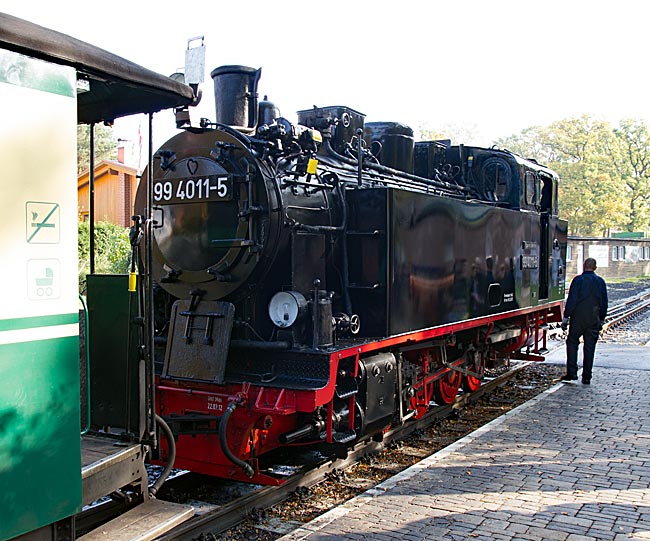
Enjoy an active holiday featuring cycling and hiking along the Baltic coast in Mönchgut on the island of Rügen. Long sandy beaches, rolling hills, and lush forests provide a varied and beautiful setting for your getaway. Often, the only thing breaking the peace is the distant whistle of the historic 'Rasender Roland' steam train. Despite its name (which suggests something "racing" or fast), it’s actually quite the opposite. A journey by train is simply part of the holiday experience.
read more about Rügen ...
In the Probstei in late summer
Schönberger Strand and sea and more
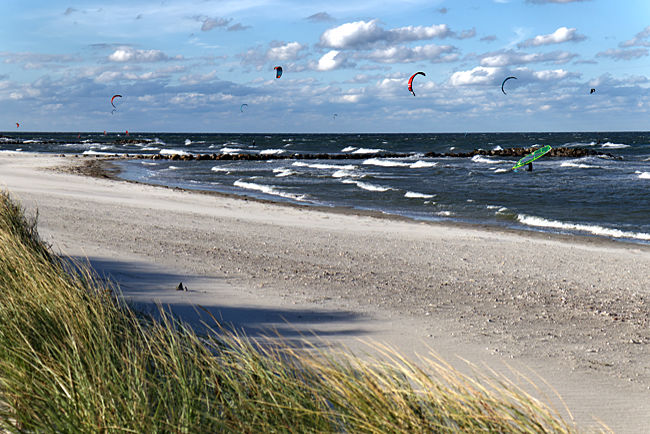
Can you walk or ride a bike from Brasilien (Brazil) to Kalifornien (California) in just a few minutes, always with a view of the water? No, not with your finger on the globe or map, but in person. You’ll have to forgo Copacabana and the Sunset Strip with the Angels in Los Angeles (Spanish for "The Angels"). Instead, you get Germany’s "True North" with all its bright sides. Of course, there are sometimes shadows here too, but they belong only on the margins of this story.
read more about Schönberger Strand ...
Wismar
The Hanseatic City on the Baltic Sea and its UNESCO World Heritage
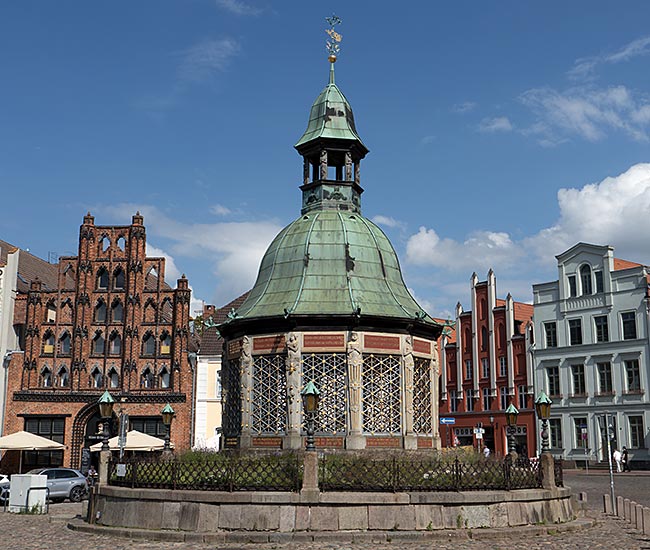
The World Heritage House is a building with a stone front house and an attached timber-framed Kemladen on a foundation of loose fieldstones from a medieval predecessor building. This beautifully restored small building complex visually illustrates and provides information via text panels about the lives of past generations in the hall houses typical for Wismar, along with their outbuildings. Additionally, there is extensive information about the city’s history and numerous protected buildings in the old town - there are 1,754 in total, with 306 designated as individual monuments. In the old town, one is right in the middle of Wismar’s UNESCO World Heritage Site.
read more about Wismar ...
Crabs, dikes and the Wadden Sea
The North Sea spa town of Büsum
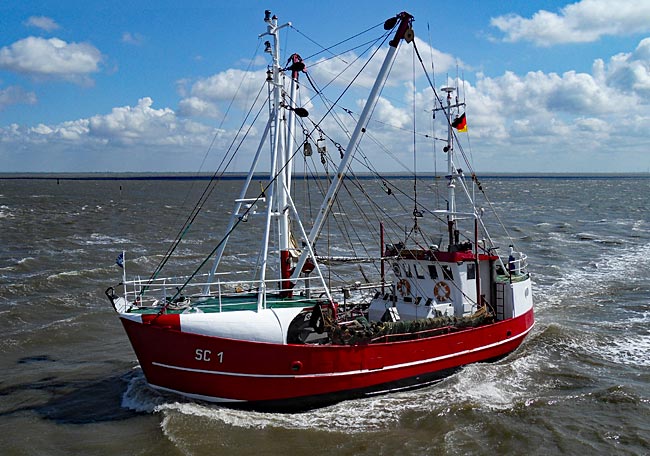
Once an island, Büsum was repeatedly threatened by the "Blanken Hans". When the greatest flood of the last century struck in 1962, Büsum was already long connected to the mainland - since 1585. Today, this town of around 5,000 residents, part of the Dithmarschen district, is one of the most important holiday destinations along Schleswig-Holstein's North Sea coast. Since 1985, the sea in front of Büsum has been protected as the Schleswig-Holstein Wadden Sea National Park, and since 2009, it has also been listed as a UNESCO World Heritage Site.
read more about Büsum ...
A stroll through Kiel
Sights in the fjord city and a visit to Laboe
A good starting point for exploring the city today, decades after the end of the war, is the centrally located main train station. On Sophienblatt, the main street running in front of the building, all major bus lines converge, and many sights can also be easily reached on foot during a multi-hour stroll.
read more about Kiel ...