

DISTANT PLACES
Travel tips by Bremen sehenswert far from the Hanseatic City of Bremen
Hanseatic City of Rostock - A Travel Guide
From Kröpeliner Tor to the New Market and on to the City Harbor
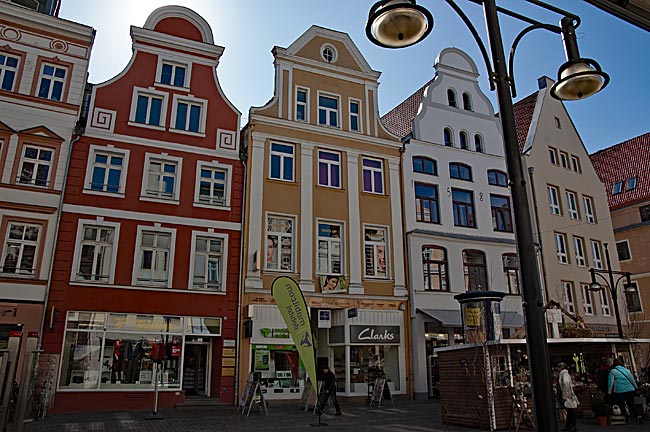
Gabled houses in Kröpeliner Straße
The Kröpeliner Tor, the most magnificent preserved city gate in the old city fortifications, is an excellent starting point for exploring the city, especially due to the underground parking garage right next door where you can conveniently park your car beforehand. From the gate, the path first leads through Rostock’s pedestrian street, Kröpeliner Straße. Despite the destruction caused by the British Royal Air Force’s four-day bombing in 1942 during the war - both in the Hanseatic city and along Kröpeliner Straße - the car-free street has since the 1960s presented a mix of modern present-day life with shops, restaurants, and cafés alongside impressive historical architecture.
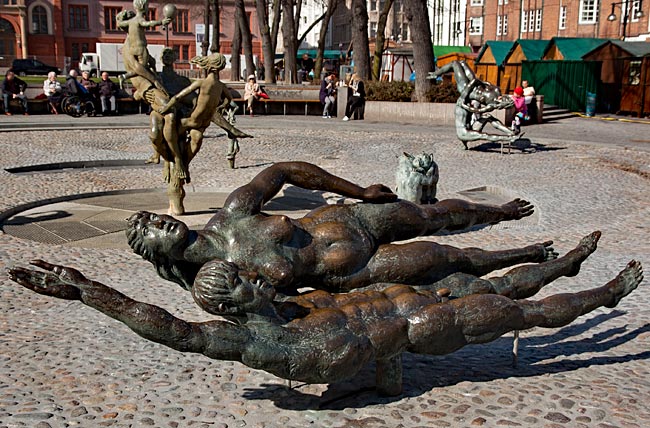
The Fountain of Joy – without bubbling water in the cold season
Since reunification, significant funds have been invested in restoring the preserved bourgeois houses with their Gothic gabled roofs or equally remarkable facades from later periods. Particularly at Universitätsplatz, home to the "Fountain of Joy" (locally nicknamed the "Pornobrunnen"), the long Hanseatic history of the city - where the Mecklenburg dukes would have preferred more power than the Rostockers granted them, despite the princely palaces on the square - blends with the modern lifestyle of the 21st century.
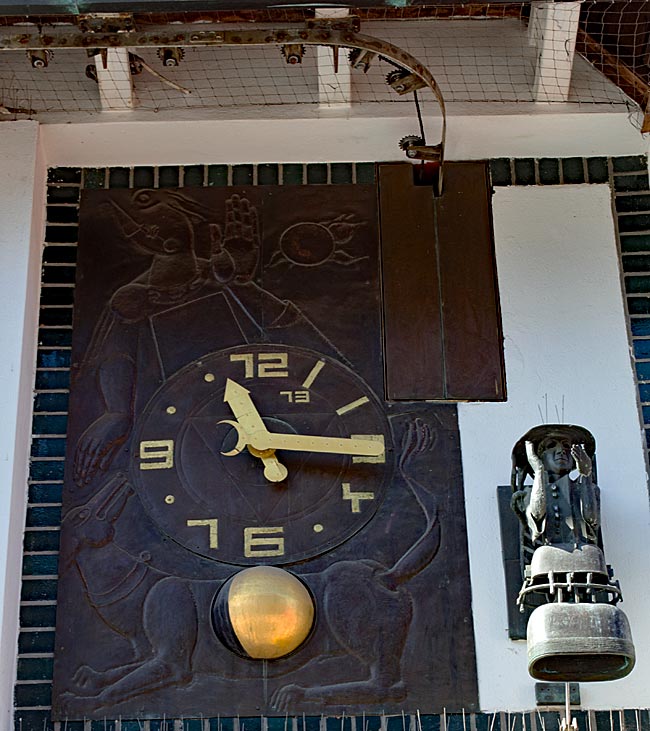
The partially gilded "Rostocker Stundenuhr" by Lutz Holland (1986) at the Five-Gabled House
The street then leads directly to the New Market, the old central market square that became the city’s focal point after the merger of the three original settlements into Rostock in 1265 and has remained so ever since. Dominating the scene is the old Gothic town hall from the 13th century with its Baroque pink facade added in the 18th century - a prime example of the impressive North German Brick Gothic architecture found in this Hanseatic city. The market square in front of the town hall hosts a weekly market (www.rostocker-wochenmarkt.de) from Tuesday to Saturday, where stalls are set up and carousel rides spin during festivals, or tourists and locals dine in restaurants and cafés with views over the square. Walking around the town hall reveals further architectural landmarks of Rostock’s history, such as the Kerkhoffhaus or Walldienerhaus. Following the tram tracks that run past the town hall to the right (when facing the town hall) leads you to another former city gate, the Steintor, which is a stop on a second tour through the city.
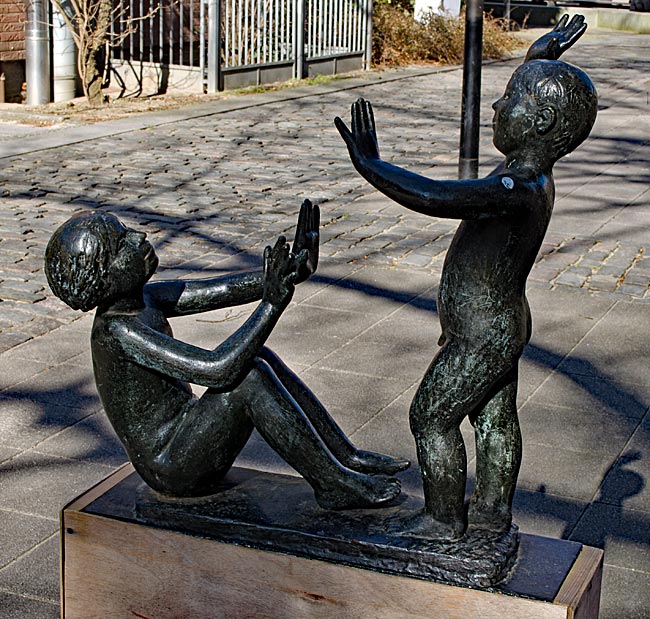
Bronze sculpture "Playing Children" by Lore Plietzsch (1979) near St. Mary's Church (Marienkirche)
However, the path to the city harbor goes in the opposite direction, and here your gaze falls upon St. Mary's Church, Rostock’s largest church, whose construction took over 160 years to complete - a visit is absolutely worth it, including a small donation for maintenance. Passing by the fountain in front of the church entrance, the route continues along the west facade of the basilica onto Lange Straße, where on the left side you can feel the old town in miniature bronze.
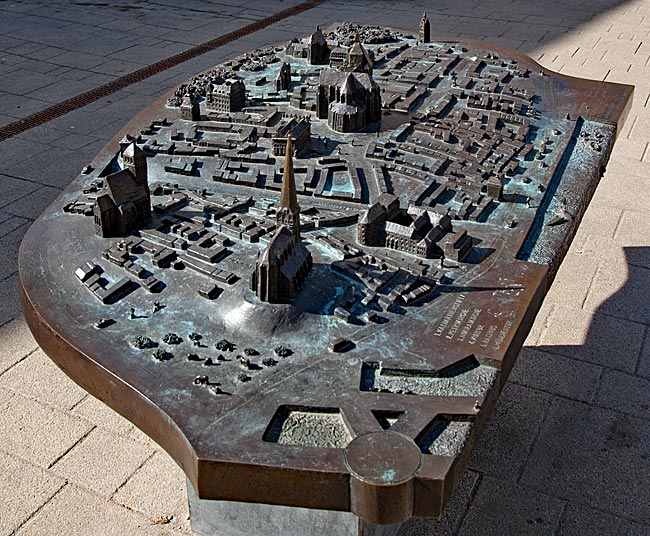
The old town of Rostock in bronze on Lange Straße
Despite the significant car traffic and tram tracks, the broad street does not give the impression of being a protected monument. Nevertheless, Lange Straße as a whole is designated as a heritage site due to its massive brick buildings from the 1950s, which were architecturally inspired by North German Brick Gothic. Passing on the left side of the tallest building in the row, stairs lead up to Schnickmannstraße, where at the corner stands the Wittesche Speicher, a half-timbered house built in 1795 that owes its name to its user, a manufacturer of pharmaceutical products. In the parallel street to the right stands another gem of North German brick culture and architectural design: the Hausbaumhaus, which hides behind its charming facade a warehouse with an oak tree trunk in the center supporting the building - hence its name (in german: Haus = House, Baum = Tree).
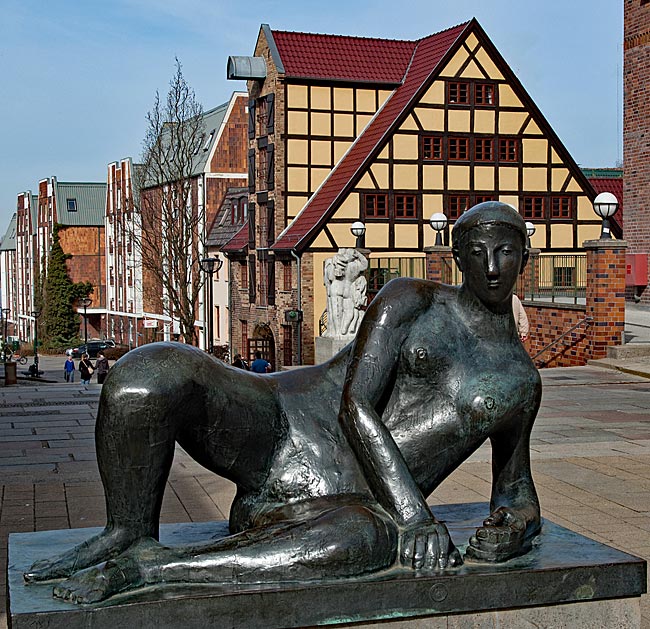
Statue with Wittesche Speicher in the background
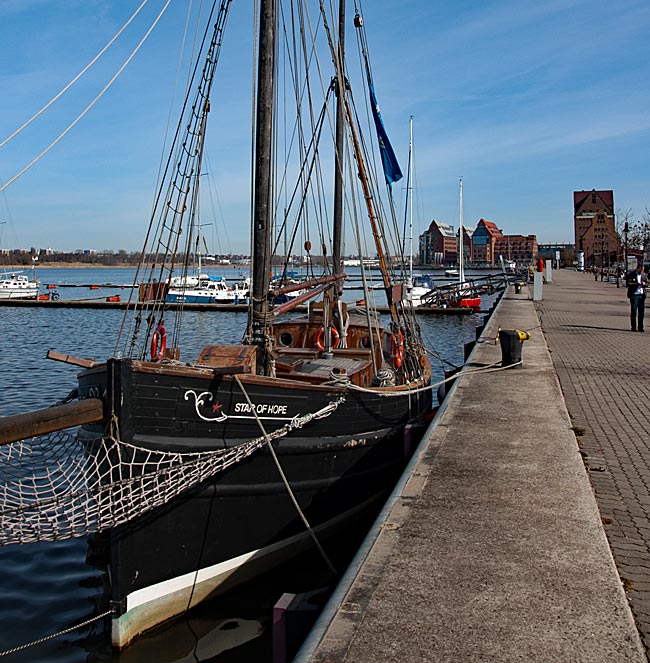
At the end of the otherwise also picturesque Wokrenterstraße, you must cross the busy bypass Am Strande to explore the expansive city harbor.
Exploring the city harbor
previous page
 next page
Read more about Rostock: The table of contents
Map
Rügen by the Baltic Sea
Active holiday featuring cycling and hiking
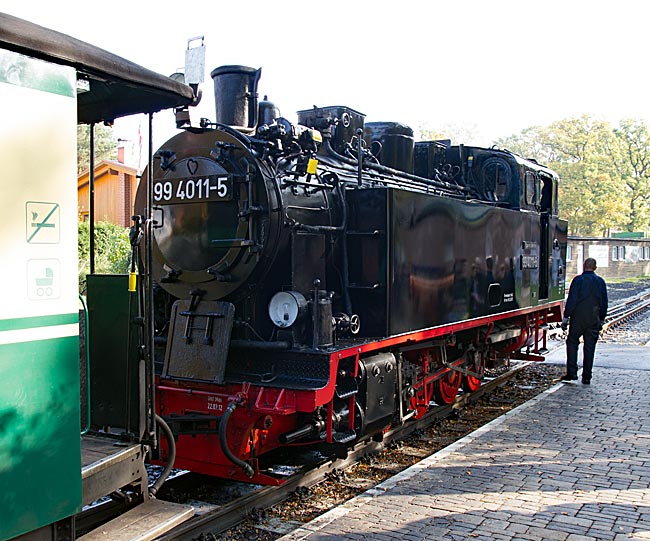
Enjoy an active holiday featuring cycling and hiking along the Baltic coast in Mönchgut on the island of Rügen. Long sandy beaches, rolling hills, and lush forests provide a varied and beautiful setting for your getaway. Often, the only thing breaking the peace is the distant whistle of the historic 'Rasender Roland' steam train. Despite its name (which suggests something "racing" or fast), it’s actually quite the opposite. A journey by train is simply part of the holiday experience.
read more about Rügen ...
In the Probstei in late summer
Schönberger Strand and sea and more
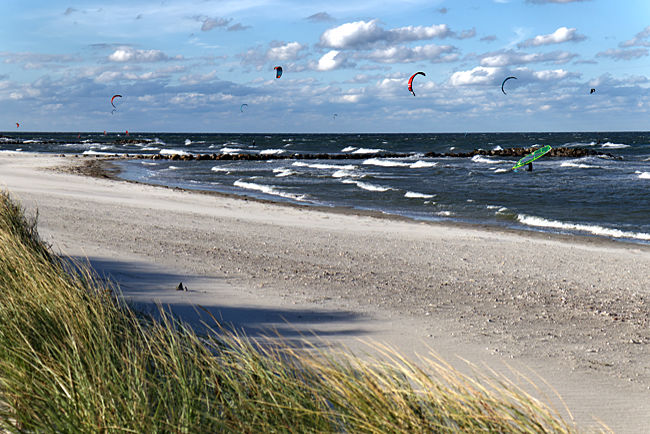
Can you walk or ride a bike from Brasilien (Brazil) to Kalifornien (California) in just a few minutes, always with a view of the water? No, not with your finger on the globe or map, but in person. You’ll have to forgo Copacabana and the Sunset Strip with the Angels in Los Angeles (Spanish for "The Angels"). Instead, you get Germany’s "True North" with all its bright sides. Of course, there are sometimes shadows here too, but they belong only on the margins of this story.
read more about Schönberger Strand ...
Wismar
The Hanseatic City on the Baltic Sea and its UNESCO World Heritage
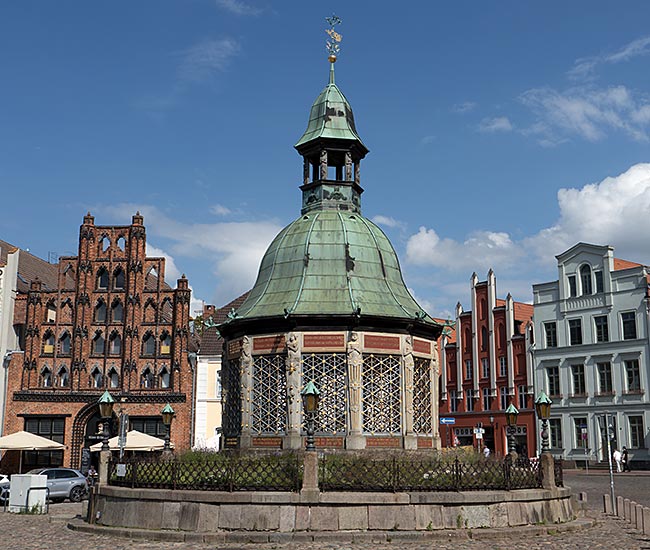
The World Heritage House is a building with a stone front house and an attached timber-framed Kemladen on a foundation of loose fieldstones from a medieval predecessor building. This beautifully restored small building complex visually illustrates and provides information via text panels about the lives of past generations in the hall houses typical for Wismar, along with their outbuildings. Additionally, there is extensive information about the city’s history and numerous protected buildings in the old town - there are 1,754 in total, with 306 designated as individual monuments. In the old town, one is right in the middle of Wismar’s UNESCO World Heritage Site.
read more about Wismar ...
Crabs, dikes and the Wadden Sea
The North Sea spa town of Büsum
Once an island, Büsum was repeatedly threatened by the "Blanken Hans". When the greatest flood of the last century struck in 1962, Büsum was already long connected to the mainland - since 1585. Today, this town of around 5,000 residents, part of the Dithmarschen district, is one of the most important holiday destinations along Schleswig-Holstein's North Sea coast. Since 1985, the sea in front of Büsum has been protected as the Schleswig-Holstein Wadden Sea National Park, and since 2009, it has also been listed as a UNESCO World Heritage Site.
read more about Büsum ...
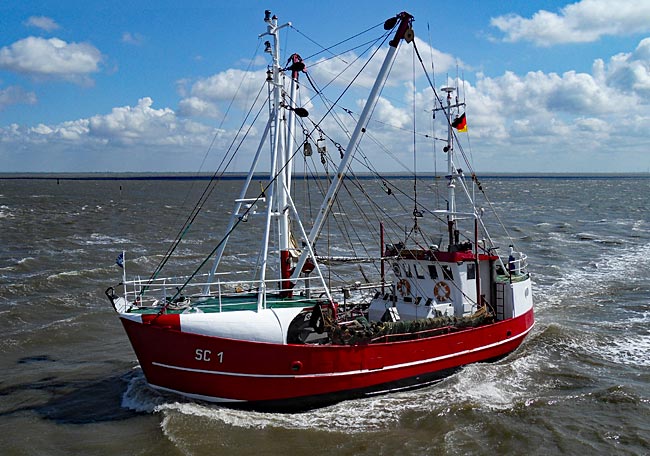
A stroll through Kiel
Sights in the fjord city and a visit to Laboe
A good starting point for exploring the city today, decades after the end of the war, is the centrally located main train station. On Sophienblatt, the main street running in front of the building, all major bus lines converge, and many sights can also be easily reached on foot during a multi-hour stroll.
read more about Kiel ...
Emden in East Frisia
Where East Frisians make jokes and serious art thrives
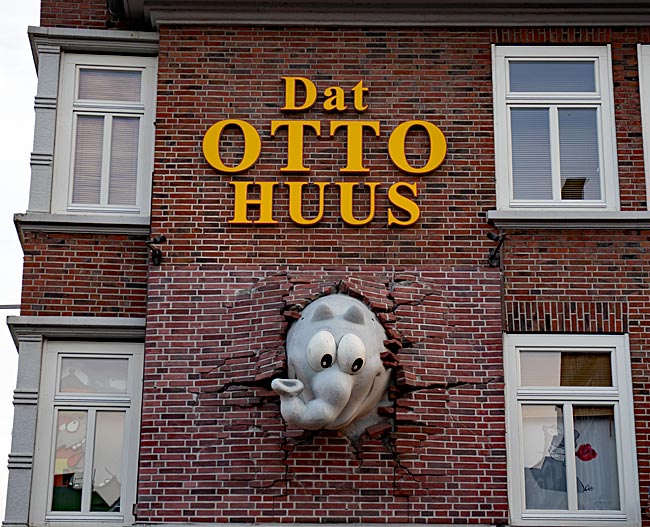
What do Henri Nannen, the journalist and founder of the print magazine STERN, director Wolfgang Petersen (e.g., Das Boot), and comedians Karl Dall and Otto Waalkes have in common? They were all born in Emden. "The Men of the Emden" (a film) not necessarily, but that's a different story. And of course, women have also been born in this city of around 50,000 inhabitants, the largest in East Frisia, such as former boxing world champion Heidi Hartmann - naturally mentioned only as a representative of all others.
read more about Emden ...
Norden-Norddeich in East Frisia
At the north Sea
At first glance, one might get the impression that this North Sea resort is merely a transfer station for vacationers heading in droves to the islands. Not only do several ferry docks dominate the harbor, but large parking lots and multi-story garages belonging to the Frisia shipping company right behind the dike offer hundreds of parking spaces for island visitors who don’t want or can’t take their cars with them - Juist is car-free after all. But beyond that, Norddeich reveals itself as a far less hectic and manageably small coastal resort. In this state-recognized North Sea spa, tourism has only been promoted since the second half of the last century, apparently with success, as more than 1 million overnight stays per year show.
read more about Norden-Norddeich ...