


DISTANT PLACES
Travel tips by Bremen sehenswert far from the Hanseatic City of Bremen
Hanseatic City of Rostock - A Travel Guide
What is Brick Gothic?
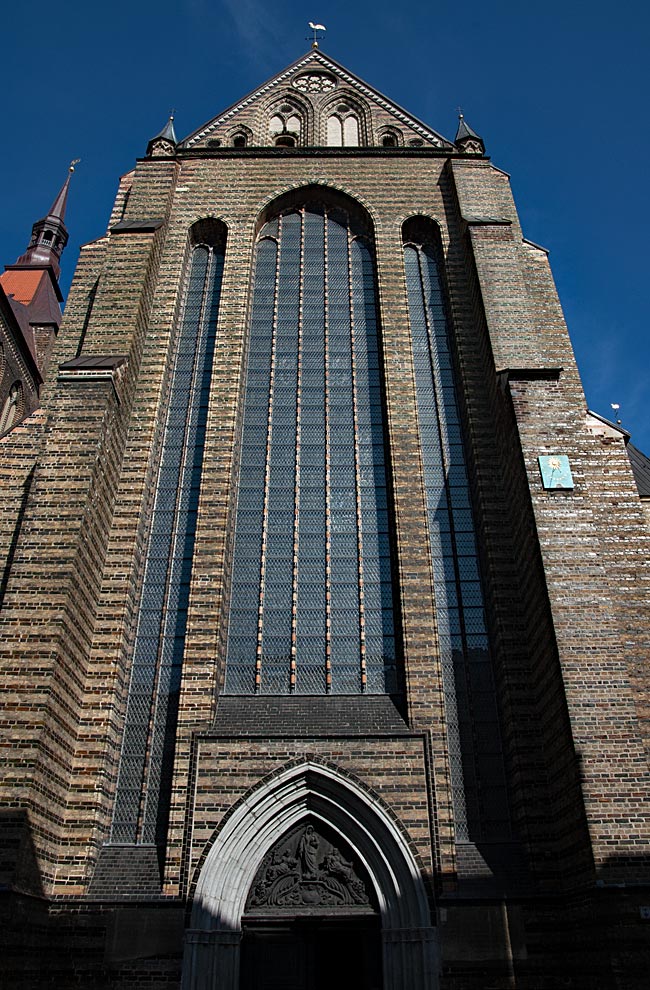
The south side of the transept of St. Mary's Church
The Gothic architectural style emerged in the mid-12th century, spreading from France through the neighboring Rhineland to northern Germany. Due to a scarcity of natural stone deposits in the northern German lowlands - where sufficient stones could have been quarried - the new style was realized using artificially produced fired bricks, known as brick.
Unlike fieldstones or imported dressed stones used in earlier constructions, these red bricks could be mass-produced. This led to greater reliability and higher availability by volume, resulting in increased efficiency and more accurate cost estimation for construction projects - a combination highly favorable to the Hanseatic merchants. It was they who helped popularize this modern brick Gothic style across many northern German cities during the Middle Ages.
The economic success of the Hanseatic League, a powerful trade alliance that conducted thriving maritime commerce with nearby and distant lands from the 13th century onward, made many merchants in Hanseatic cities wealthy or even rich. This prosperity significantly impacted the economic and cultural development of these urban centers. The monumental secular and religious buildings constructed during this period reflected this economic success and the accompanying sense of civic pride that citizens wished to display outwardly. These structures also often embodied the rational thinking of merchants, characterized by strict forms and practical construction.
The compact layout of medieval cities, with short distances due to initial defensive walls featuring ramparts, towers, and gates, contributed to a distinctively northern German urban landscape in various shades of red. Outside the cities, in rural areas, monasteries primarily built their structures using bricks, while farmhouses continued to be constructed as timber-framed houses.
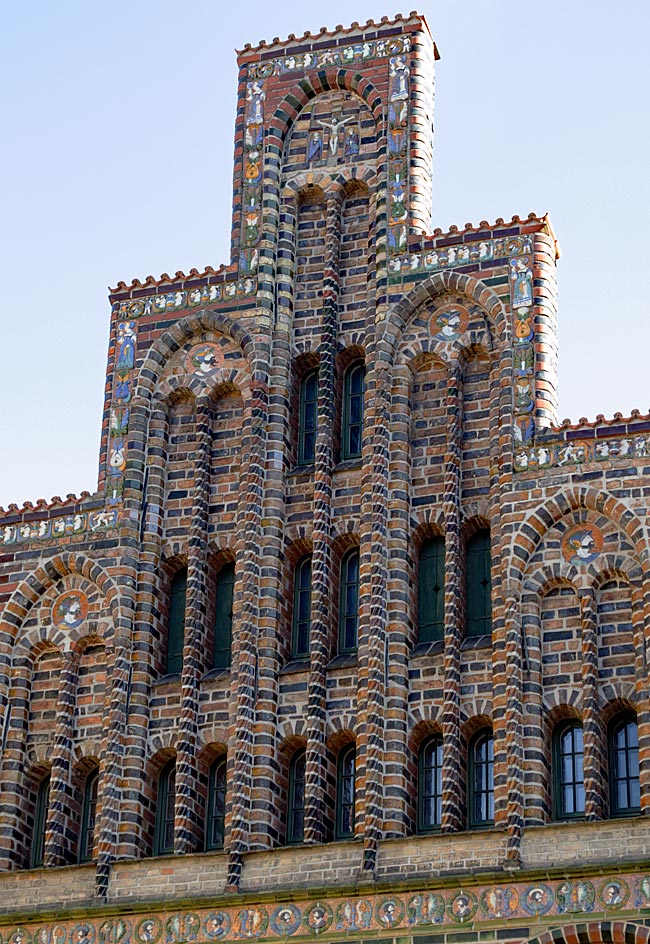
Gable of the Kerkhoff House
A vivid depiction of the architectural cityscape of the Hanseatic city of Rostock in the 16th century is provided by the ink drawing known as the Vicke-Schorler-Rolle, created between 1578 and 1586 by Vicke Schorler, a later merchant. Brick houses dominate this scene, including many gabled homes with various Gothic decorative gables such as the so-called Rostock Gable, simple triangular gables with finials at the ridge, or crenellated step gables.
Not only this drawing but numerous buildings in Rostock - such as the Kerkhoff House and Marienkirche (St. Mary's Church) - as well as structures in other northern German cities demonstrate that Brick Gothic was far from a monotonous uniform style. Instead, it featured many variations and ornamental elements. For example, arch fields above doorways were often adorned with ornaments and figurative designs, as were the lateral frames of portals. Ornamental friezes embellished the fronts of many gables, while alternating between brick masonry and plastered whitewashed surfaces was also typical. The Gothic architecture frequently incorporated slender, pointed turrets on gables known as fialen. Facades were decorated with lavishly ornate friezes and ornament rows, and even flat brick facades were patterned using differently colored bricks or glazed tiles for decoration. With the Late Gothic period from the mid-14th century onward, additional elements such as star vaults and figurative terracotta decorations were introduced. The south side of the transept of Marienkirche exemplifies all these features.
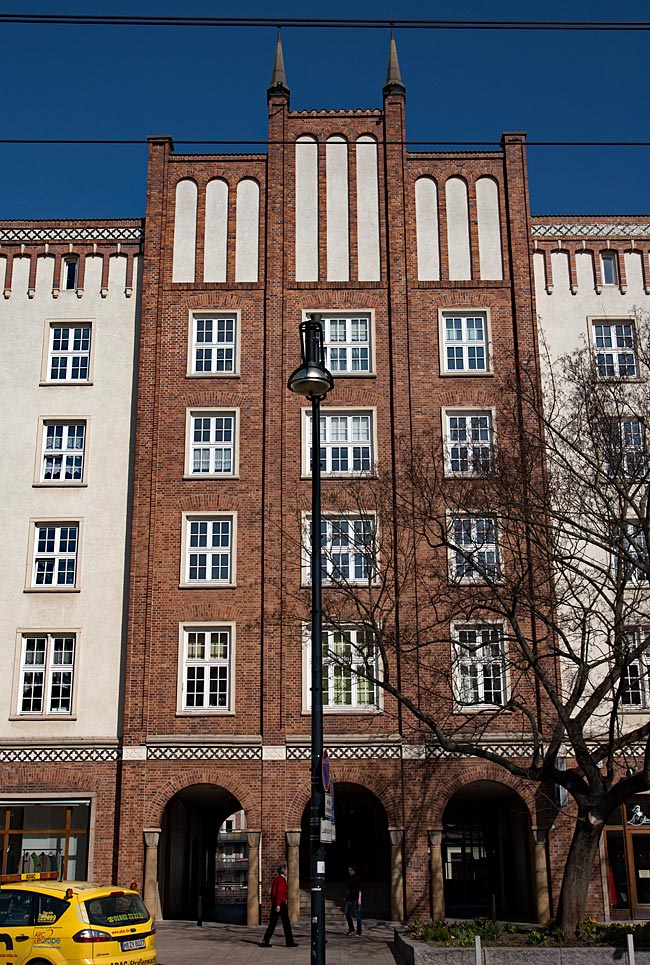
Building from the 1950s with references to Brick Gothic in Lange Straße
Brick Gothic is by no means limited to the period between the 12th and 15th centuries but continued to influence architects in the 19th and 20th centuries, as evidenced by structures like the Ständehaus designed by Gotthilf Ludwig Möckel and the imposing brick buildings constructed in Lange Straße during the 1950s under state direction. These later works revived Gothic stepped gables, combined red bricks with white plastered surfaces, and incorporated finials on gables.
previous page
 next page
Read more about Rostock: The table of contents
Map
Rügen by the Baltic Sea
Active holiday featuring cycling and hiking
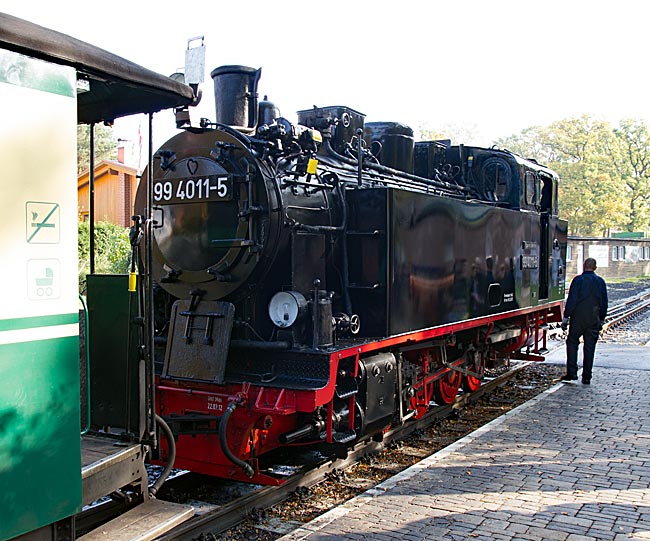
Enjoy an active holiday featuring cycling and hiking along the Baltic coast in Mönchgut on the island of Rügen. Long sandy beaches, rolling hills, and lush forests provide a varied and beautiful setting for your getaway. Often, the only thing breaking the peace is the distant whistle of the historic 'Rasender Roland' steam train. Despite its name (which suggests something "racing" or fast), it’s actually quite the opposite. A journey by train is simply part of the holiday experience.
read more about Rügen ...
In the Probstei in late summer
Schönberger Strand and sea and more
Can you walk or ride a bike from Brasilien (Brazil) to Kalifornien (California) in just a few minutes, always with a view of the water? No, not with your finger on the globe or map, but in person. You’ll have to forgo Copacabana and the Sunset Strip with the Angels in Los Angeles (Spanish for "The Angels"). Instead, you get Germany’s "True North" with all its bright sides. Of course, there are sometimes shadows here too, but they belong only on the margins of this story.
read more about Schönberger Strand ...
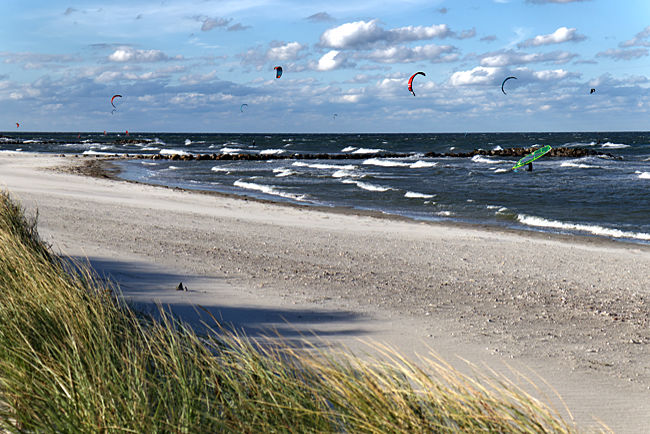
Wismar
The Hanseatic City on the Baltic Sea and its UNESCO World Heritage
The World Heritage House is a building with a stone front house and an attached timber-framed Kemladen on a foundation of loose fieldstones from a medieval predecessor building. This beautifully restored small building complex visually illustrates and provides information via text panels about the lives of past generations in the hall houses typical for Wismar, along with their outbuildings. Additionally, there is extensive information about the city’s history and numerous protected buildings in the old town - there are 1,754 in total, with 306 designated as individual monuments. In the old town, one is right in the middle of Wismar’s UNESCO World Heritage Site.
read more about Wismar ...
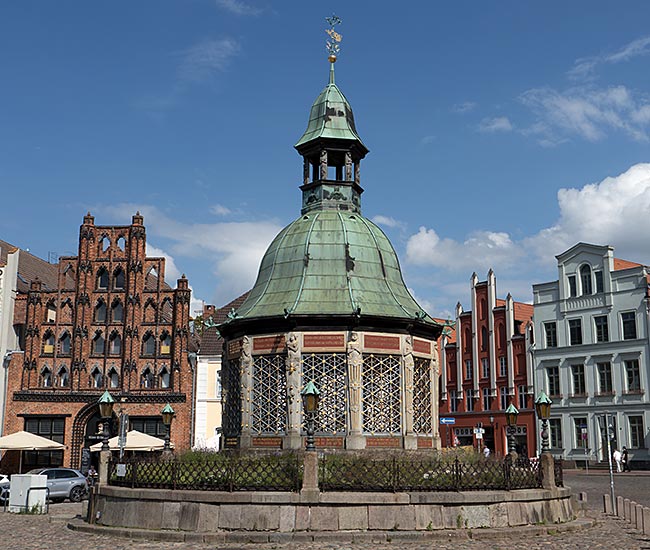
Crabs, dikes and the Wadden Sea
The North Sea spa town of Büsum
Once an island, Büsum was repeatedly threatened by the "Blanken Hans". When the greatest flood of the last century struck in 1962, Büsum was already long connected to the mainland - since 1585. Today, this town of around 5,000 residents, part of the Dithmarschen district, is one of the most important holiday destinations along Schleswig-Holstein's North Sea coast. Since 1985, the sea in front of Büsum has been protected as the Schleswig-Holstein Wadden Sea National Park, and since 2009, it has also been listed as a UNESCO World Heritage Site.
read more about Büsum ...
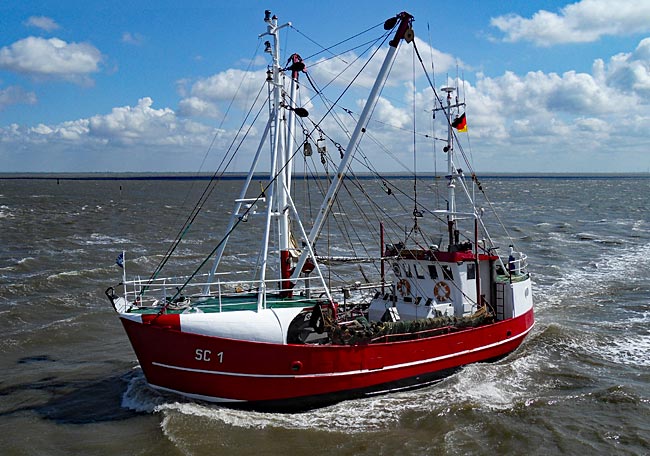
A stroll through Kiel
Sights in the fjord city and a visit to Laboe
A good starting point for exploring the city today, decades after the end of the war, is the centrally located main train station. On Sophienblatt, the main street running in front of the building, all major bus lines converge, and many sights can also be easily reached on foot during a multi-hour stroll.
read more about Kiel ...