

DISTANT PLACES
Travel tips by Bremen sehenswert far from the Hanseatic City of Bremen
Hanseatic City of Rostock - A Travel Guide
Steintor (Stone Gate)
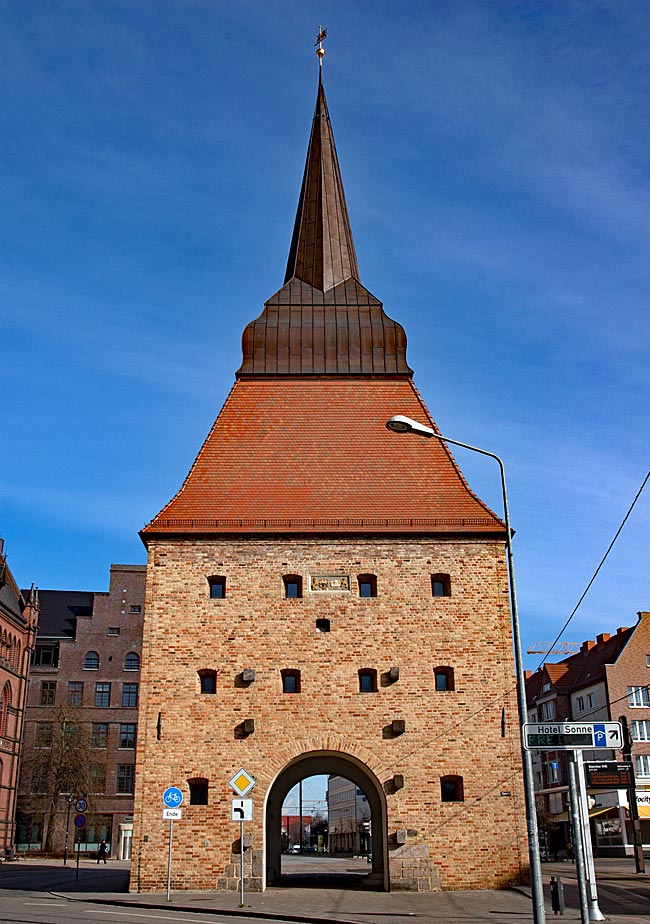
The side facing away from the city
Once, the Steintor was likely as imposing in size as the well-known Kröpeliner Tor. In the Middle Ages, it served as the main southern gateway into the city, with the path leading - just as today - through Steinstraße directly to the New Market, where the town hall and St. Mary's Church are located.
After its construction in 1279, it replaced the older Kuhtor (Cow Gate), the oldest of the four remaining gates out of the original 22 in Rostock’s old city wall, located a few hundred meters to the east. While the Kuhtor - possibly the oldest surviving city gate in Northern Germany - still stands, the original Steintor was demolished in 1565 during military conflicts with Schwerin, along with parts of the city wall and the predecessor of today’s Lagebuschturm. The materials were repurposed - a common practice at the time to humiliate defeated opponents.
Only after contractual agreements were reached did the reconstruction of the Steintor, the current Lagebuschturm, and the missing sections of the city wall take place between 1574 and 1577.
Instead of being built in the Gothic style, the new structure was designed in the Dutch Renaissance style. The side facing away from the city appears plain and somewhat forbidding, with its small, low-set openings in the thick wall - almost as if meant to discourage any would-be attackers at first glance. A small inset rectangle displays both the city and state coats of arms.
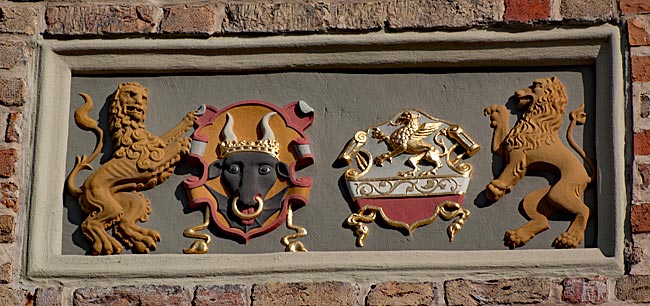
A small inset rectangle displays both the city and state coats of arms
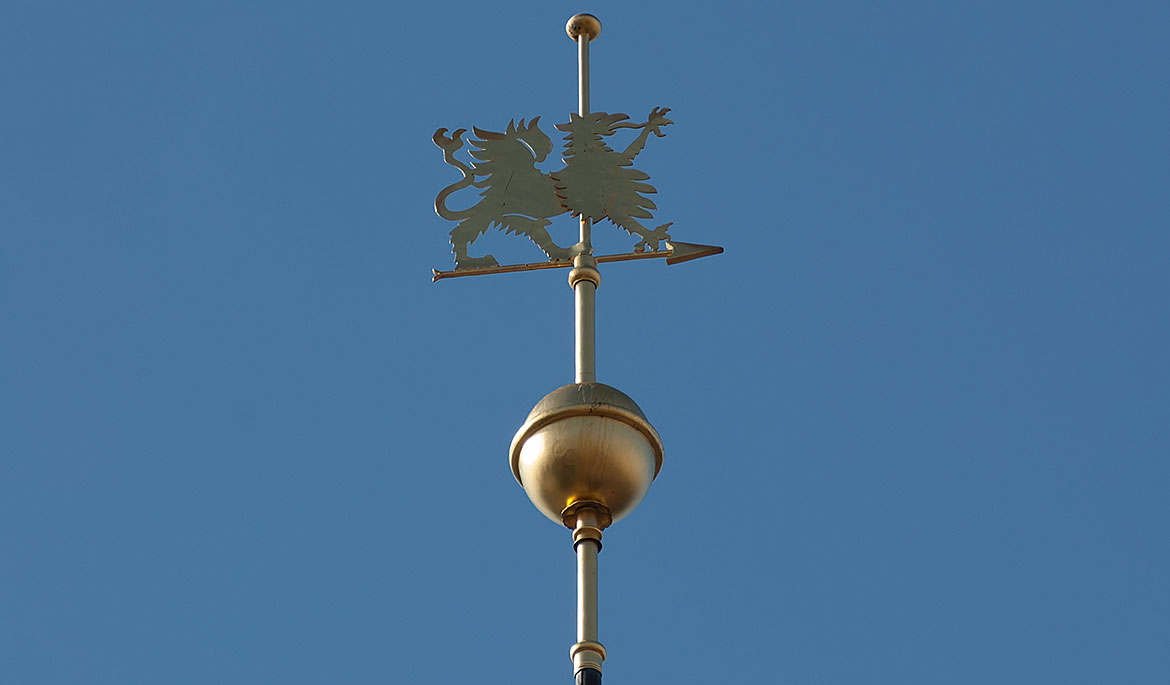
In contrast, the side facing the city features a more representative portal rather than a simple, unadorned archway. Above the passage, lions hold shields: on the left, the coat of arms of the prince; on the right, the tricolor Hanseatic city coat of arms, each with a griffin - the mythical protective animal of the city - and in the center, a bull’s head, representing the city’s great seal. Below them, golden letters display Rostock’s motto: "Sit intra te concordia et publica felicias." ("Within your walls, may there be harmony and public prosperity.")
The variations in both the building’s appearance and its inscription over time are documented in the colored ink drawing by Vicke Schorler, a merchant’s apprentice or journeyman, created between 1578 and 1586 - shortly after the completion of the new gate.
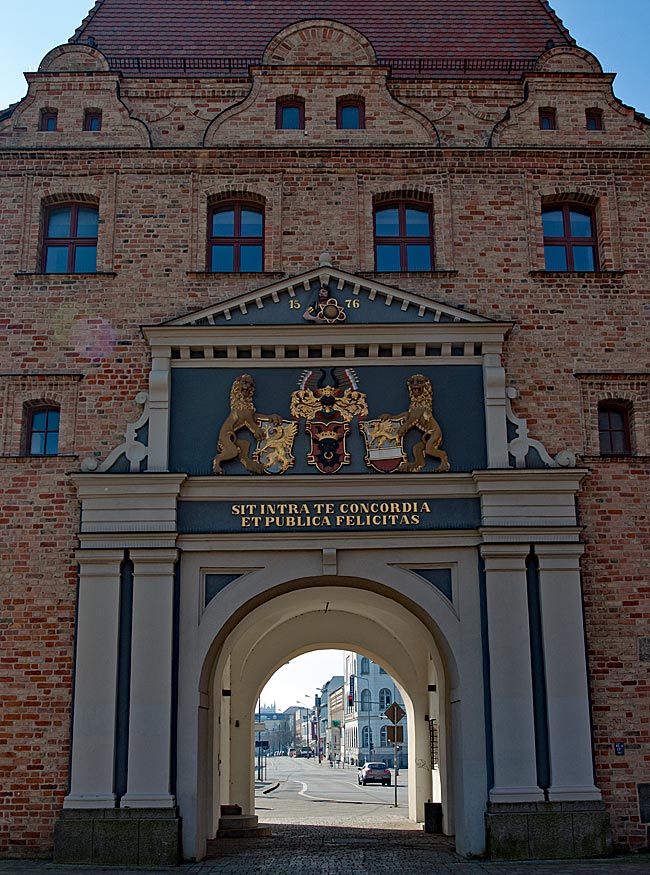
Golden letters display Rostock’s motto: "Sit intra te concordia et publica felicias." ("Within your walls, may there be harmony and public prosperity.")
The Steintor was severely damaged during the bombing raids of 1942 and was rebuilt starting in the early 1950s. Today, without direct connection to the city wall, it stands somewhat isolated between a street on one side and tram tracks on the other.
previous page
 next page
Read more about Rostock: The table of contents
Map
Rügen by the Baltic Sea
Active holiday featuring cycling and hiking
Enjoy an active holiday featuring cycling and hiking along the Baltic coast in Mönchgut on the island of Rügen. Long sandy beaches, rolling hills, and lush forests provide a varied and beautiful setting for your getaway. Often, the only thing breaking the peace is the distant whistle of the historic 'Rasender Roland' steam train. Despite its name (which suggests something "racing" or fast), it’s actually quite the opposite. A journey by train is simply part of the holiday experience.
read more about Rügen ...
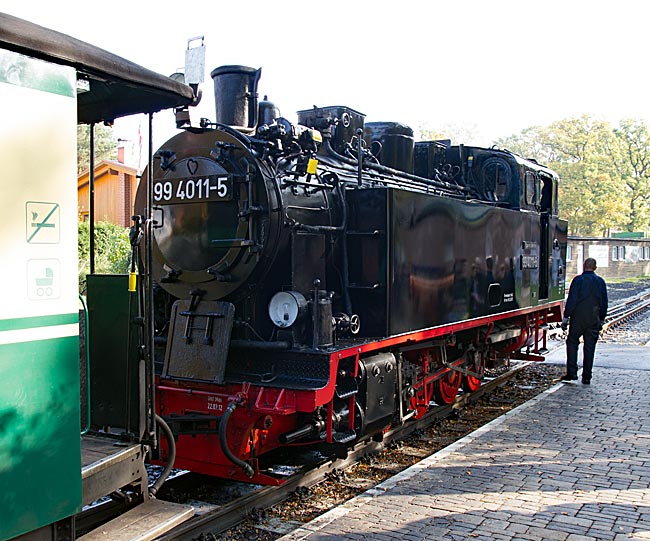
In the Probstei in late summer
Schönberger Strand and sea and more
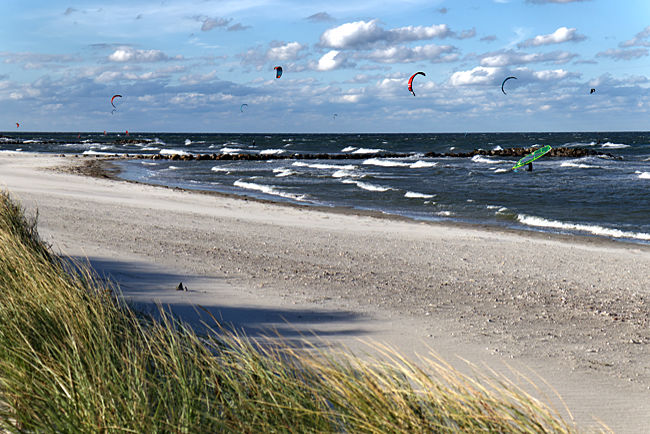
Can you walk or ride a bike from Brasilien (Brazil) to Kalifornien (California) in just a few minutes, always with a view of the water? No, not with your finger on the globe or map, but in person. You’ll have to forgo Copacabana and the Sunset Strip with the Angels in Los Angeles (Spanish for "The Angels"). Instead, you get Germany’s "True North" with all its bright sides. Of course, there are sometimes shadows here too, but they belong only on the margins of this story.
read more about Schönberger Strand ...
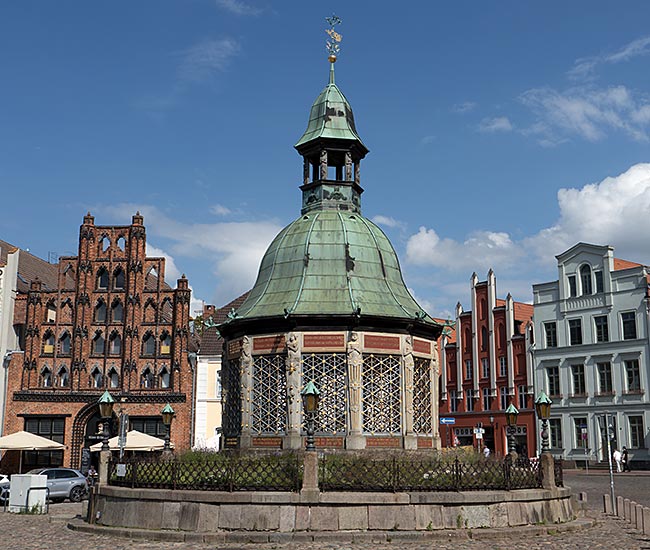
Wismar
The Hanseatic City on the Baltic Sea and its UNESCO World Heritage
The World Heritage House is a building with a stone front house and an attached timber-framed Kemladen on a foundation of loose fieldstones from a medieval predecessor building. This beautifully restored small building complex visually illustrates and provides information via text panels about the lives of past generations in the hall houses typical for Wismar, along with their outbuildings. Additionally, there is extensive information about the city’s history and numerous protected buildings in the old town - there are 1,754 in total, with 306 designated as individual monuments. In the old town, one is right in the middle of Wismar’s UNESCO World Heritage Site.
read more about Wismar ...
Crabs, dikes and the Wadden Sea
The North Sea spa town of Büsum
Once an island, Büsum was repeatedly threatened by the "Blanken Hans". When the greatest flood of the last century struck in 1962, Büsum was already long connected to the mainland - since 1585. Today, this town of around 5,000 residents, part of the Dithmarschen district, is one of the most important holiday destinations along Schleswig-Holstein's North Sea coast. Since 1985, the sea in front of Büsum has been protected as the Schleswig-Holstein Wadden Sea National Park, and since 2009, it has also been listed as a UNESCO World Heritage Site.
read more about Büsum ...