

DISTANT PLACES
Travel tips by Bremen sehenswert far from the Hanseatic City of Bremen
Hanseatic City of Rostock - A Travel Guide
Kuhtor and Lagebuschturm
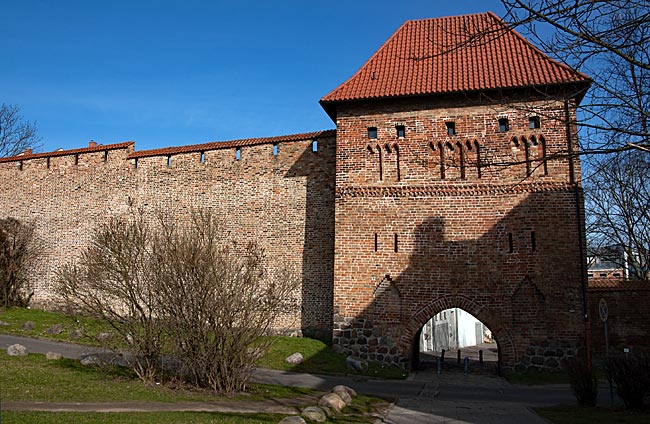
The Kuhtor with its defensive wall from the side facing away from the city
The Kuhtor, mentioned in a document as early as 1262, is the oldest surviving of the four (originally 22) gates through the city wall into the Hanseatic city. Until 1279, it was an important entrance from the south but lost significance after the construction of the Steintor slightly further west, as the new larger gate led directly to the New Market, the center of Rostock, with its town hall, market square, and St. Mary's Church. The Kuhtor (Cow Gate) - perhaps the oldest surviving city gate in Northern Germany - owes its name to its decline in importance. After the Steintor was put into operation, livestock was driven through the passage to the meadows along the Warnow River; in the 14th century, it was even walled up. After the Steintor was demolished by Schwerin's troops in a conflict (having stood for less than 300 years), the early Gothic Kuhtor was temporarily reactivated as a city gate until the Steintor and the adjacent part of the city fortifications were rebuilt between 1574 and 1577.
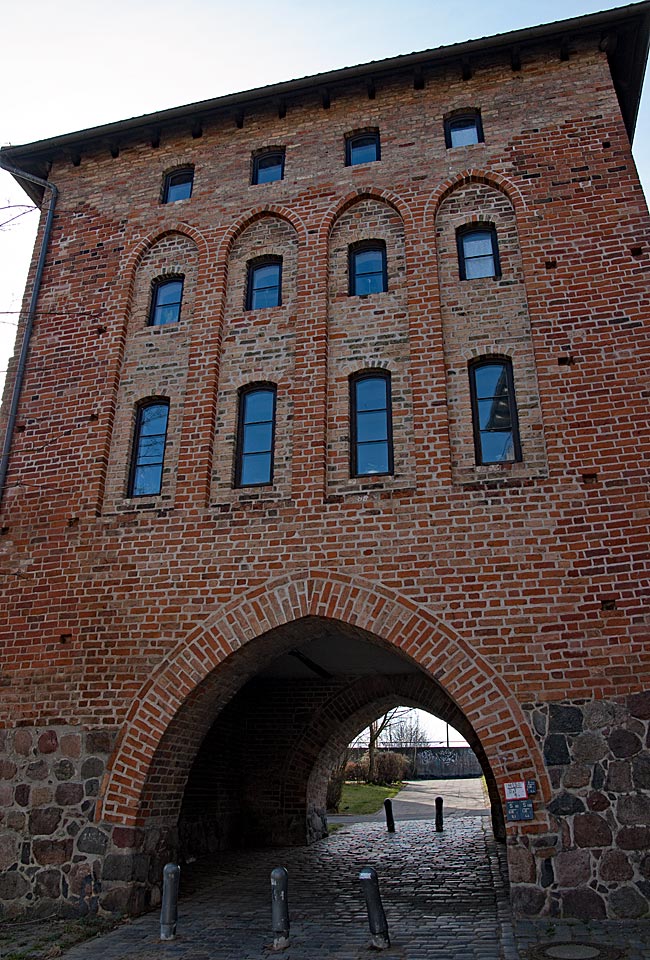
Kuhtor with windows
The four-story, nearly square defensive tower (8 x 9 meters) has a turbulent history. In 1608, its thick walls were temporarily converted into an easy prison by the city council before being turned into a residence for a gunsmith later that same century. In 1825, the building was completely renovated into living quarters and has since housed various residents and organizations within its walls, most recently, since 2010, the Rostock Mediation Center. However, this occupancy was not uninterrupted: the tower suffered severe damage during British air raids in 1942. It wasn't until between 1962 and 1964 that it received a new roof, and in 1984, it was fully reconstructed. Incidentally, the stones at the base of the pointed arch of the defensive tower (rather than fired bricks) are a typical architectural feature of late medieval fortifications found elsewhere as well.
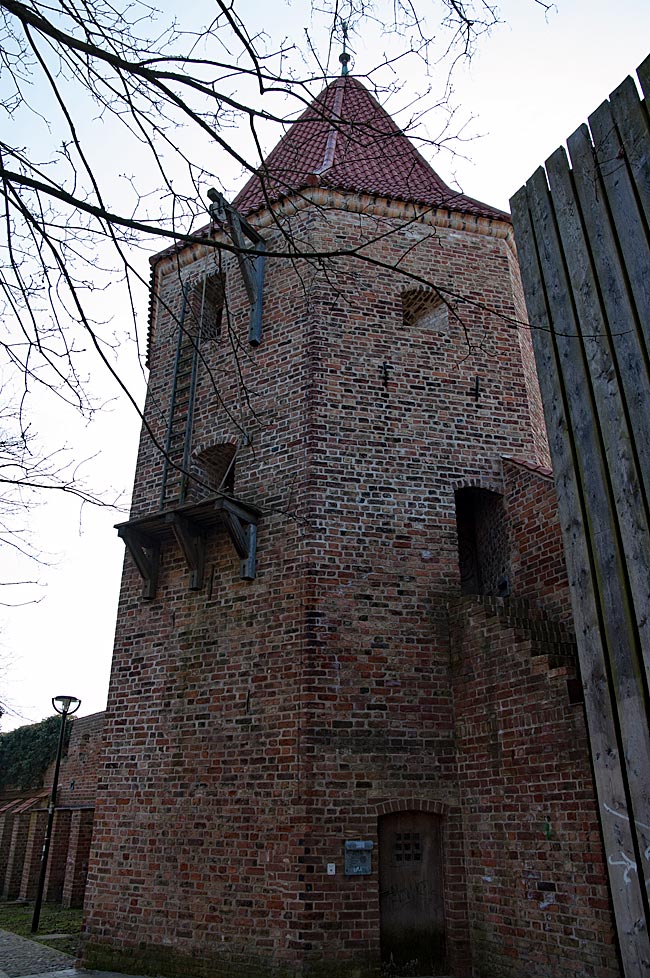
The Lagebuschturm
Today, the Kuhtor is the endpoint of a reconstructed section of the old city fortifications, including the Lagebuschturm in the city wall leading to the Steintor. After the demolition of the "Turm von Rammelsberg" by Schwerin's troops, the four-story octagonal Lagebuschturm was built around 1577 in the style of Dutch Renaissance on the foundation of its predecessor. It was also called the Fangelturm because it served partly as a prison until the 19th century; it is the last of six original towers in the city wall. Structures like this were used for defense and stored military materials such as cannons and ammunition.
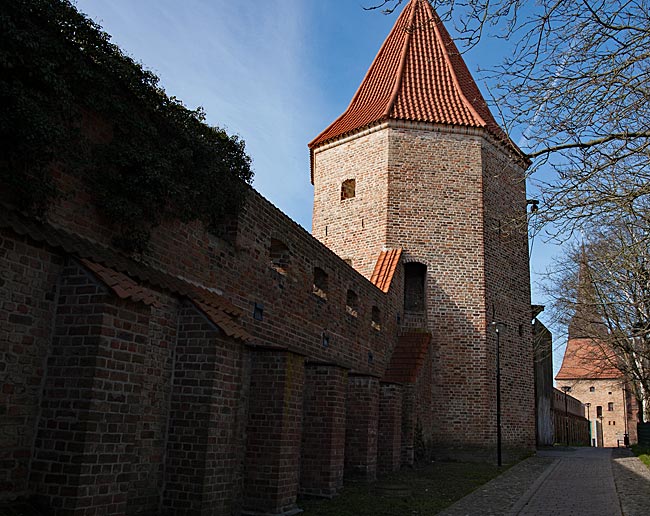
The Lagebuschturm, with the Steintor in the background
previous page
 next page
Read more about Rostock: The table of contents
Map
Rügen by the Baltic Sea
Active holiday featuring cycling and hiking
Enjoy an active holiday featuring cycling and hiking along the Baltic coast in Mönchgut on the island of Rügen. Long sandy beaches, rolling hills, and lush forests provide a varied and beautiful setting for your getaway. Often, the only thing breaking the peace is the distant whistle of the historic 'Rasender Roland' steam train. Despite its name (which suggests something "racing" or fast), it’s actually quite the opposite. A journey by train is simply part of the holiday experience.
read more about Rügen ...
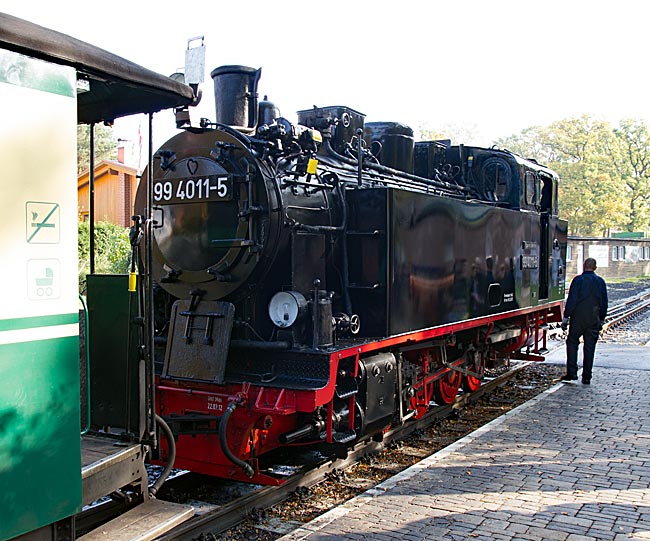
In the Probstei in late summer
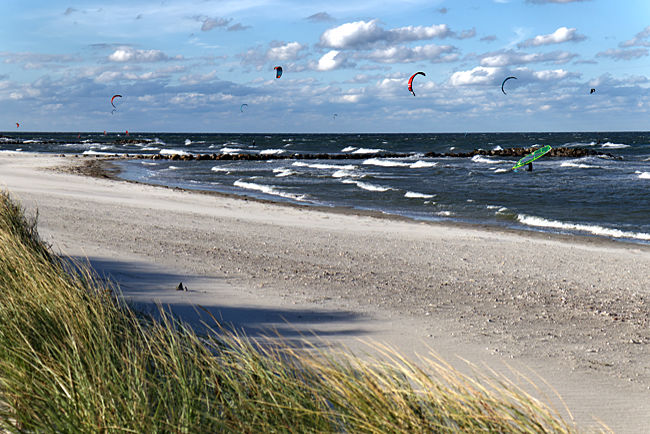
Schönberger Strand and sea and more
Can you walk or ride a bike from Brasilien (Brazil) to Kalifornien (California) in just a few minutes, always with a view of the water? No, not with your finger on the globe or map, but in person. You’ll have to forgo Copacabana and the Sunset Strip with the Angels in Los Angeles (Spanish for "The Angels"). Instead, you get Germany’s "True North" with all its bright sides. Of course, there are sometimes shadows here too, but they belong only on the margins of this story.
read more about Schönberger Strand ...
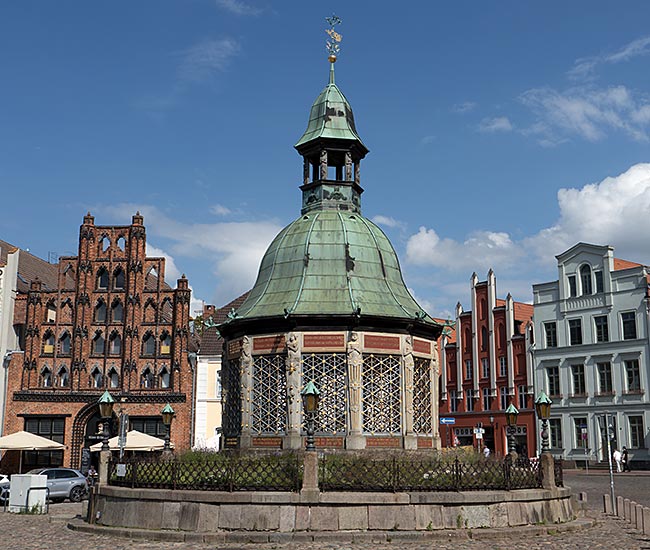
Wismar
The Hanseatic City on the Baltic Sea and its UNESCO World Heritage
The World Heritage House is a building with a stone front house and an attached timber-framed Kemladen on a foundation of loose fieldstones from a medieval predecessor building. This beautifully restored small building complex visually illustrates and provides information via text panels about the lives of past generations in the hall houses typical for Wismar, along with their outbuildings. Additionally, there is extensive information about the city’s history and numerous protected buildings in the old town - there are 1,754 in total, with 306 designated as individual monuments. In the old town, one is right in the middle of Wismar’s UNESCO World Heritage Site.
read more about Wismar ...
Crabs, dikes and the Wadden Sea
The North Sea spa town of Büsum
Once an island, Büsum was repeatedly threatened by the "Blanken Hans". When the greatest flood of the last century struck in 1962, Büsum was already long connected to the mainland - since 1585. Today, this town of around 5,000 residents, part of the Dithmarschen district, is one of the most important holiday destinations along Schleswig-Holstein's North Sea coast. Since 1985, the sea in front of Büsum has been protected as the Schleswig-Holstein Wadden Sea National Park, and since 2009, it has also been listed as a UNESCO World Heritage Site.
read more about Büsum ...
A stroll through Kiel
Sights in the fjord city and a visit to Laboe
A good starting point for exploring the city today, decades after the end of the war, is the centrally located main train station. On Sophienblatt, the main street running in front of the building, all major bus lines converge, and many sights can also be easily reached on foot during a multi-hour stroll.
read more about Kiel ...