

DISTANT PLACES
Travel tips for destinations far from the Hanseatic City of Bremen
In the Probstei in late summer
Schönberger Strand and sea and more
Page 1 of 2
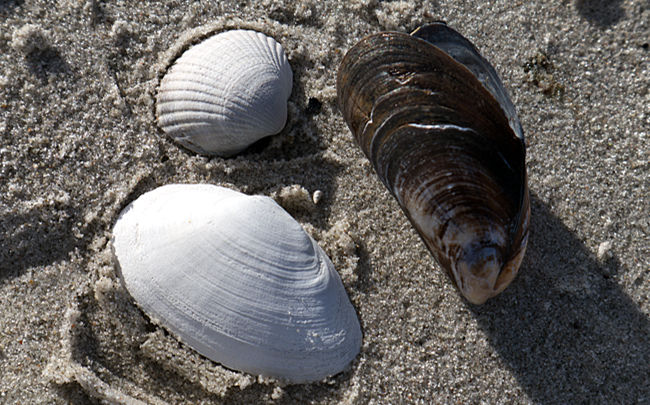
Sandclam, heart clam and mussel - the last both common - and all uninhabited
Can you walk or ride a bike from Brasilien (Brazil) to Kalifornien (California) in just a few minutes, always with a view of the water? No, not with your finger on the globe or map, but in person. You’ll have to forgo Copacabana and the Sunset Strip with the Angels in Los Angeles (Spanish for "The Angels"). Instead, you get Germany’s "True North" with all its bright sides. Of course, there are sometimes shadows here too, but they belong only on the margins of this story.
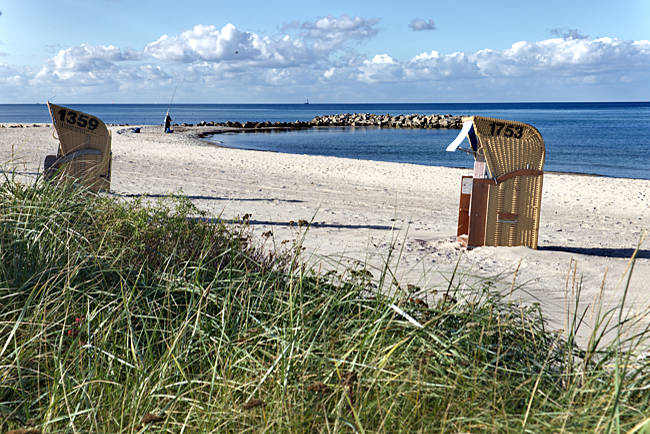
Such a beach chair has a bit of "My home is my castle"
We’re exploring the Probstei, a region in Plön district near Kiel, the state capital of Schleswig-Holstein. More precisely, we’re drawn to the coast at Schönberger Strand in the municipality of Schönberg, with its namesake main town just a few kilometers inland. The municipality has only slightly more than 6,000 inhabitants, so it’s no surprise that Brasilien (Brazil) isn’t even a district due to lack of population. Such administrative nuances are probably completely irrelevant to visitors and locals alike. Even the official tourism office makes jokes about the name in its brochures, which is quite refreshing.
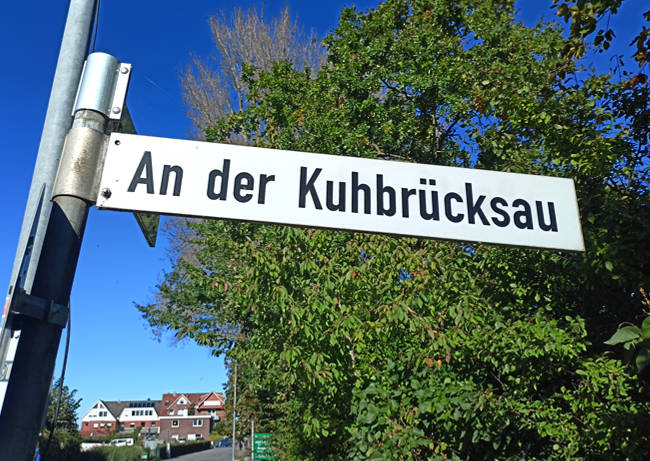
There are also some bizarre street names (translated maybe "At the cowbridgesow") in Kalifornien (California). In the background: the beach hotel
Whether the names Kalifornien (California) and Brasilien (Brazil) actually trace back to fishermen’s tall tales about a found ship’s plank with the inscription "California," which was publicly displayed and countered with "Brazil," or not - well, who knows? But for older music lovers, something quite real might spontaneously ring in their inner ear when they see the sign of the hotel located there: "Beach Hotel California." Spling? Yes, perhaps a 1976 earworm has crawled into the present from the past - the song "Hotel California" by the Eagles. Long ago, and strange stories swirl around the tale told in the lyrics, but that’s just mentioned in passing.
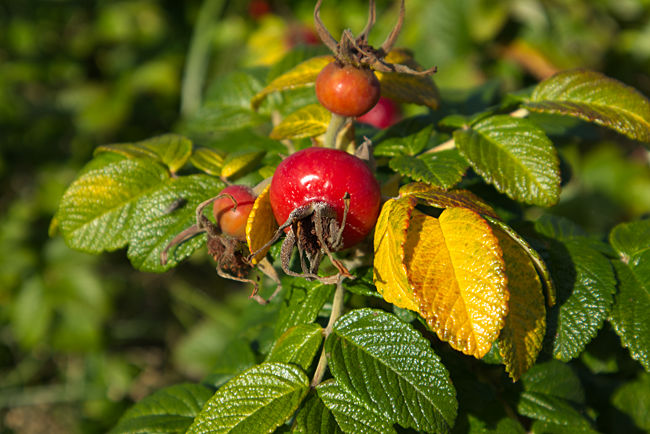
Somehow also from yesterday: withered beach rose / wild rose (Rosa ragusa)
The name Probstei for the region actually goes back to the Benedictine convent in Preetz. The convent was founded at the beginning of the 13th century and found its permanent home after several moves in 1261 in Preetz. For over 450 years, the lands as the sole estate of the convent were managed by the respective provost, hence the name that still exists today and is also borne by the current district. The people who inhabited the Probstei region were personally free, which was quite special in times of widespread serfdom. The Reformation ended the convent’s activities in 1542, but the complex continued as a noble ladies' foundation of the Schleswig-Holsteinian knightly order and was expanded over time with buildings that today, in their entirety, are under monument protection and a tourist attraction in the Probstei.
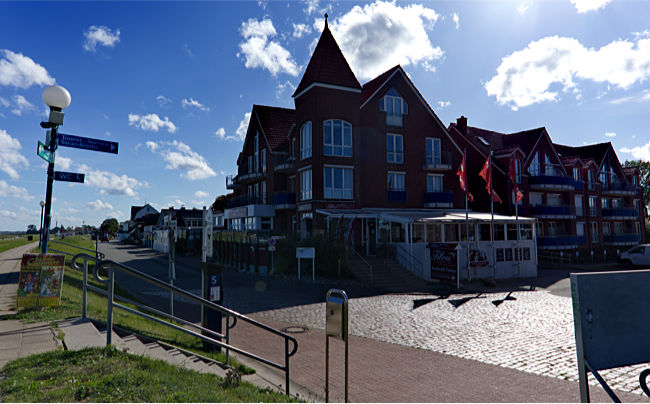
An optical focal point against the light
Such an attraction is also Schönberger Strand, within walking distance of Brasilien (Brazil) and Kalifornien (California) - but for different reasons. If you search for images on the internet, you often come across photographs of a building. Its appearance isn’t particularly outstanding; rather, its corner turret simply forms a widely visible optical center of the district, which, with a handful of retail shops, a restaurant, and in the second row with a supermarket and the tourism information office, gives the impression of a small center. In that sense, at least part of the structure is "outstanding."
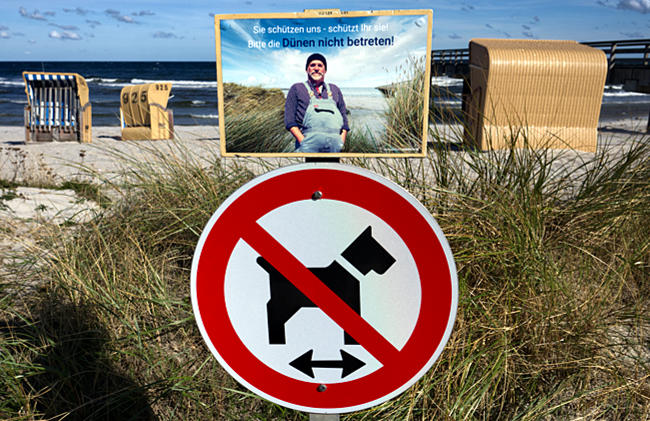
Just do it (Please do not enter the dunes and dogs are not allowed in this section)
But the real charm lies on and along the green dike. When I looked out over several days with changeable weather, a line from the song "Love Reign O’er Me" from The Who’s 1973 concept album Quadrophenia came to mind: The way the beach is kissed by the sea. And the beach stretches for many kilometers, and the Baltic Sea in its "way" is always very different - sometimes smooth like a garden pond, sometimes the spray sprays in the gusty wind, and the Baltic Sea gnaws at the coast it meets with little tenderness.
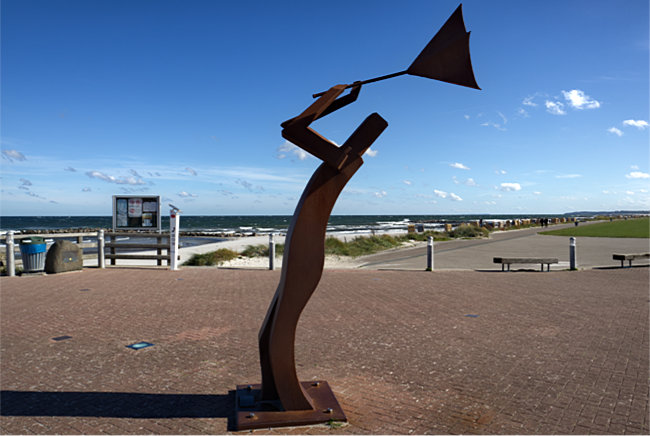
"Man in the Storm," this loan from "Metallgestaltung Heiko Voss" from Schönberg
While some people might tighten their windjackets a bit more on such a windy day - perhaps after a beach walk or building sandcastles the day before under sunny skies and calm winds - and retreat to the dike, others head into the water. Now more than ever! For example, in Brasilien, where a watersports school offers activities that only experts dare to attempt on such days: surfing, but even more so kitesurfing. At breathtaking speeds, with sometimes long jumps and abrupt direction changes performed seemingly perfectly - at least according to the admiring laypeople watching from the drying shore.
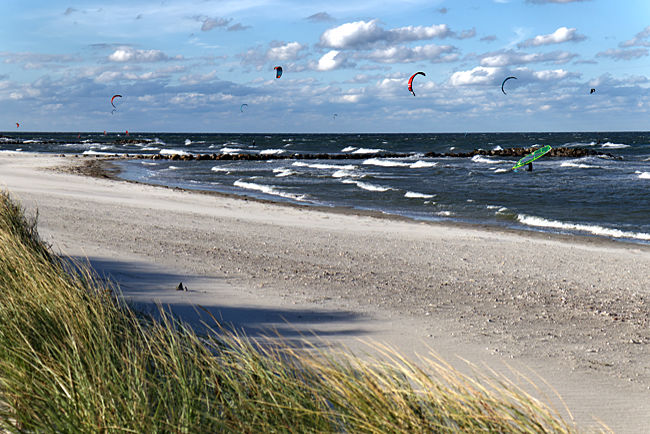
Kitesurfers at the watersports section in Brasilien
Generally speaking, the sheep grazing nearby are hardly interested in what’s happening around them. Enclosed by mobile electric fences, they keep the grass short and compact the dike here or there. The thick, densely furred natural coastal protection on four legs is far less bothered by low temperatures and wind than we two-legged creatures are. After all, up north, people believe that real wind only starts when the sheep lose their curls.
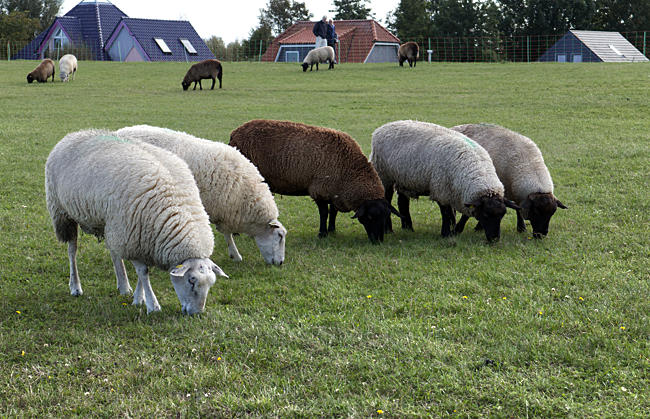
So, who exactly is the black sheep in the family?
By then, you might be approaching wind force 12, but in the north, that’s when the Schietwetter (literally "shit weather," used humorously) really begins. Of course, with a wink. That North Germans keel over at anything below wind force 5 and therefore always need a good gust of wind belongs to the realm of unproven theories. Still, some people do stumble - locals and visitors alike.
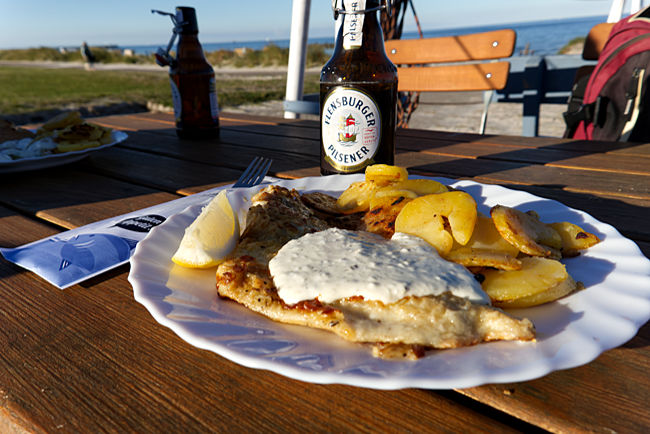
Freshly fried and freshly popped open
But that’s due to other reasons, such as indulging too much in "Flens," the barley juice from the brewery in Flensburg in its iconic pop-top bottle. Often enjoyed alongside fresh fish at the rustic fisherman’s shacks along the Waterkant (coastal area) in Schönberger Strand, with a view of the beach and sea.
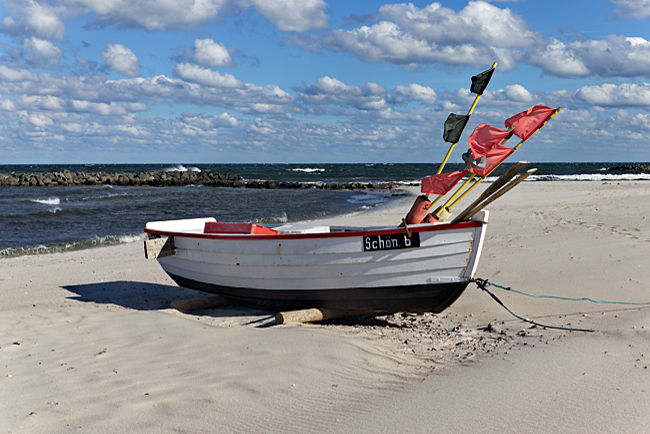
Picturesque sight for landlubbers, hard work on the water
Even though the few small fishing boats and gear lying on the beach in front of the shacks create an authentic and visually appealing scene, it must be noted that the era of large-scale fishing - begun around 1900 as a reliable livelihood for entire generations of families - has passed. Like elsewhere, the kitchens here supplement their offerings with imported seafood.
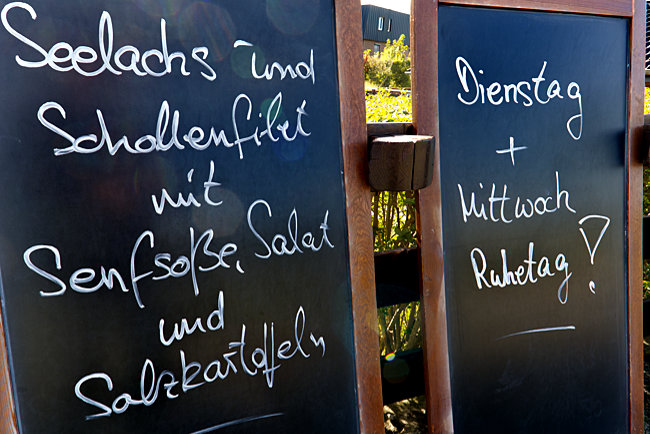
Sounds delicious: Pollock and plaice fillet with mustard sauce, salad and boiled potatoes
Still, fish remains a staple of traditional coastal cuisine in both the North and Baltic Seas, often served in fitting surroundings. This helps preserve part of northern German identity, shaped by life on and with the sea. A good dose of seafaring romance is always included.
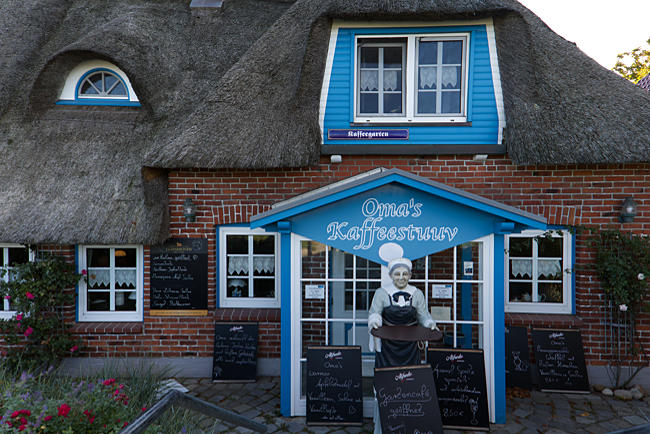
Café behind the dike in Schönberger Strand
Many who stop at these shacks or other spots along the dike arrive with quite an appetite. After all, cycling is popular here - and even though far more e-bikes (pedelecs) than non-motorized bicycles are used, you still have to pedal hard to get from A to B. On the Baltic Sea Cycle Route, A and B can be quite far apart: it stretches from Flensburg via Kiel, Laboe, and Lübeck to Stralsund and further across Rügen to Usedom on the Polish border - about 1,100 kilometers in total.
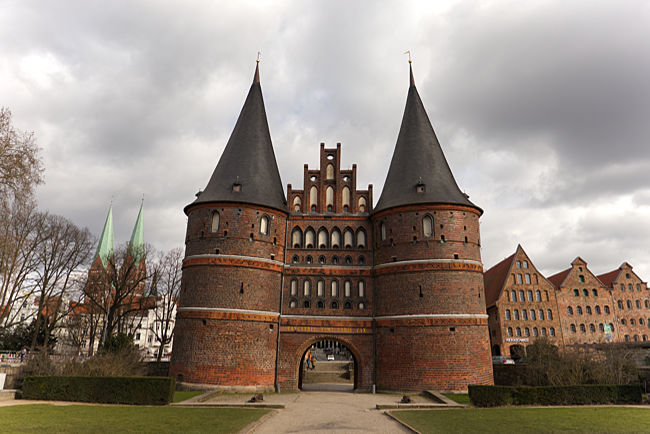
Withstanding centuries of northern German "shit weather": the Holstentor in Lübeck with the salt storage buildings (right in the image)
Along many sections of the route, the cycle path actually runs right along the Baltic Sea, as it does around Schönberger Strand. Here, the path is wide and well-paved between the beach and the dike. However, during peak summer vacation season, cyclists must share the way with far more pedestrians than in late summer after the nationwide school holidays - when this report was written.
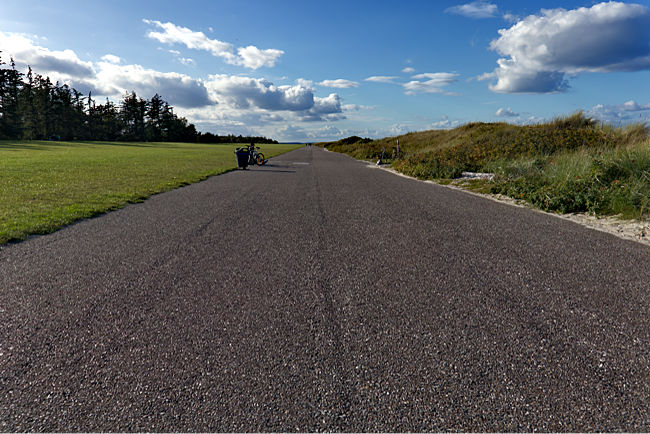
Dream conditions on the Baltic Sea Cycle Route near Schönberger Strand, Brasilien, and Kalifornien
Additionally, some sections are designated as dog beaches, so many two-legged friends are out with their four-legged companions.
Long before human-made climate change was discussed, Germany’s coasts were protected by dikes after devastating experiences. The catastrophic storm surges of 1362 and 1634 claimed so many lives and livestock along the North Sea coast that they entered history as the Grote Mandränke (the great drowning). So much land was washed away from the mainland coast that only small parts remained as islands, such as today’s North Frisian Islands like Sylt, Amrum and Föhr.
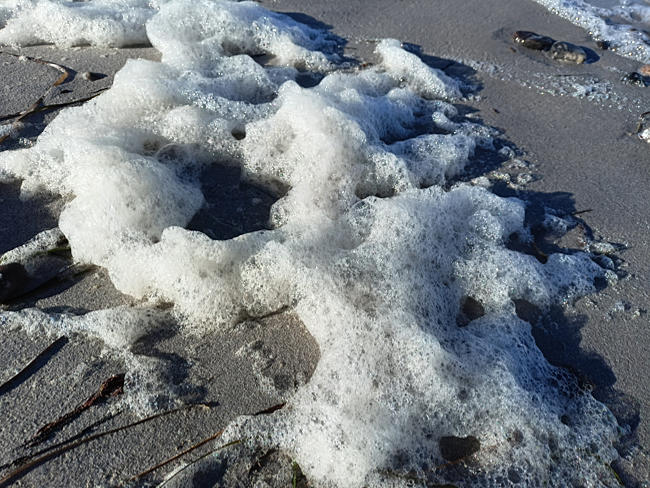
At times, the churning sea becomes a frother: washed-up mucus sheaths of dead single-celled algae (Phaeocystis globosa) are whipped into foam by the surf like egg whites with a whisk
Even though the Baltic Sea usually appears less rough than the North Sea under its oceanic influence from the Atlantic, weather can still get really wild here. Then, even kitesurfers stay off the water because the risk to life and limb is too great. The waves often take parts of the sandy beach with them - a scenario coastal communities naturally want to avoid.
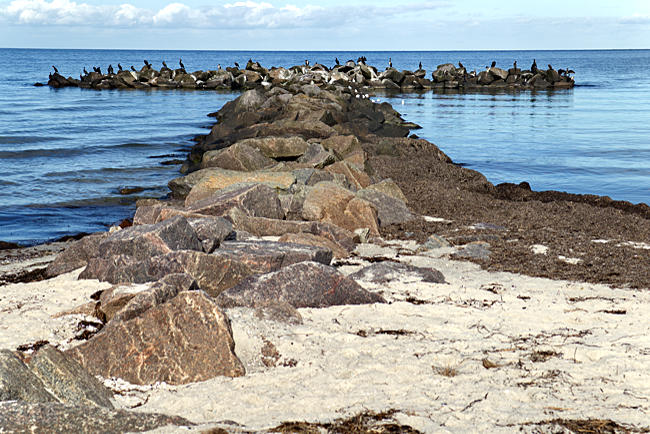
Proven measure to break the power of the waves
Since placing prohibition signs has proven ineffective, heavy rocks have been used in the past, piled up in the water. There are still prohibition signs for people: Please keep your feet on the beach, thank you. The seabirds - especially gulls and cormorants - are happy about that.
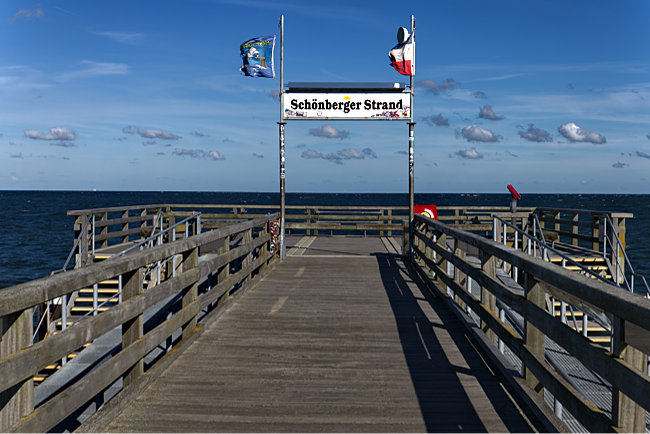
The pierhead; beyond lies only the vastness of the Baltic Sea. In the other direction, from over 200 meters away, you have a wide view along the coast
You can see the success of these coastal measures from the pier in Schönberger Strand - if you’re interested, which most people probably aren’t. You don’t have to be. Because aside from that, the pier is truly a "nice place." Especially along the Baltic Sea, there are many such long, sturdy piers jutting into the water, perhaps inspired by examples like those in Heringsdorf on Usedom or Sellin on Rügen, where they feature restaurants on stilts over the water. Mostly, they also serve as docking points for ships without needing a separate harbor. And they’re popular everywhere, with various seating areas inviting you to linger - complete with the sound of the sea and seagull cries.
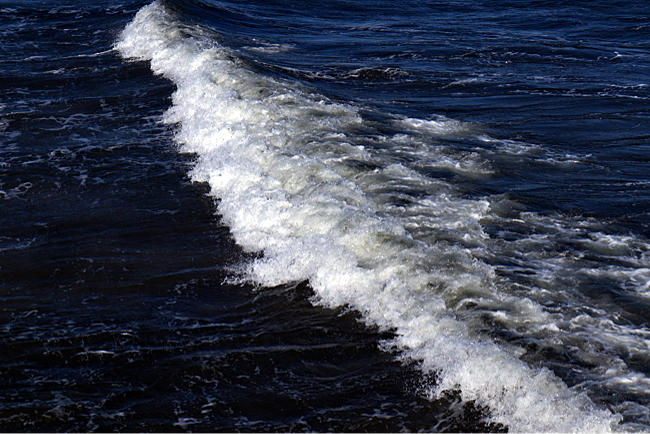
The Baltic Sea in motion
previous page
 next page
Map
Information
Tourist-Info
Schönberger Strand
Käptn's Gang 1
24217 Schönberger Strand
Phone: +49 (0)4344 / 4141-0
Email: info@schoenberg.de
www.schoenberg.de/tourist-service
Museum Railways Schönberger Strand
www.vvm-museumsbahn.de
Probstei Museum
Ostseestraße 8-10
24217 Schönberg
Phone: +49 (0)4344 3174 / (0)4344 3838577
Email: info@probstei-museum.de
www.probstei-museum.de
Kindheitsmuseum Schönberg e.V.
Knüllgasse 16
24217 Schönberg
Phone: +49 (0)4344 / 68 65
Email: info@kindheitsmuseum.de
https://kindheitsmuseum.de
A little maritime flair can be found in many shops through images like this
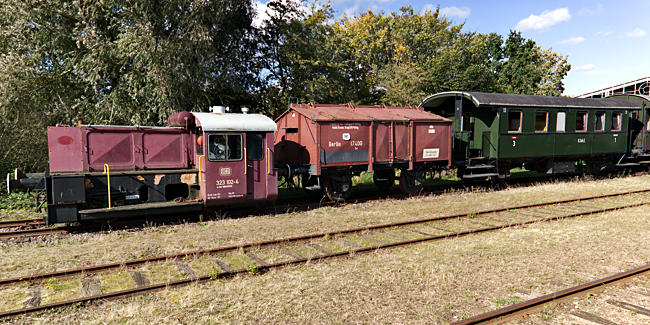
Of the type 323 small locomotive, 892 units were built; this example on the Schönberger Strand museum station was put into operation by the DB after completion by Deutz in 1959. The maximum speed of the locomotive is 45 km/h.
Rügen by the Baltic Sea
Active holiday featuring cycling and hiking
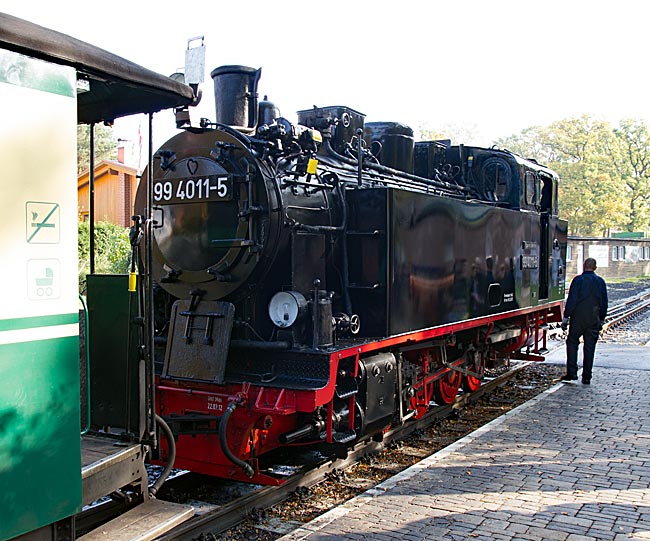
Enjoy an active holiday featuring cycling and hiking along the Baltic coast in Mönchgut on the island of Rügen. Long sandy beaches, rolling hills, and lush forests provide a varied and beautiful setting for your getaway. Often, the only thing breaking the peace is the distant whistle of the historic 'Rasender Roland' steam train. Despite its name (which suggests something "racing" or fast), it’s actually quite the opposite. A journey by train is simply part of the holiday experience.
read more about Rügen ...
Rostock and Warnemünde by the Baltic Sea
A travel guide
A mini-guide through the Hanseatic city of Rostock and its beautiful beach destination, Warnemünde. Home to one of the oldest universities in the Baltic region, the city boasts a rich history. Join us on a tour of discovery.
read more about Rostock ...
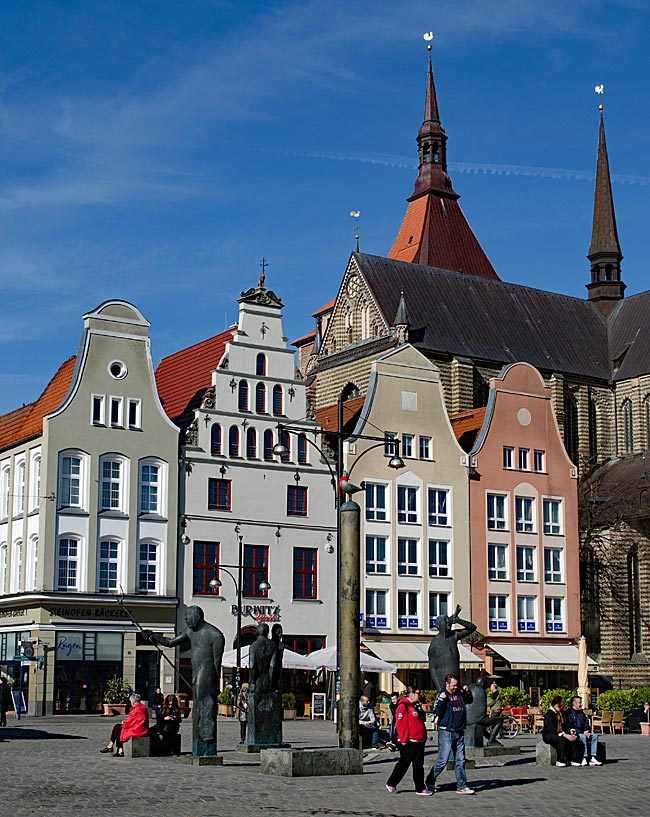
Wismar
The Hanseatic City on the Baltic Sea and its UNESCO World Heritage
The World Heritage House is a building with a stone front house and an attached timber-framed Kemladen on a foundation of loose fieldstones from a medieval predecessor building. This beautifully restored small building complex visually illustrates and provides information via text panels about the lives of past generations in the hall houses typical for Wismar, along with their outbuildings. Additionally, there is extensive information about the city’s history and numerous protected buildings in the old town - there are 1,754 in total, with 306 designated as individual monuments. In the old town, one is right in the middle of Wismar’s UNESCO World Heritage Site.
read more about Wismar ...
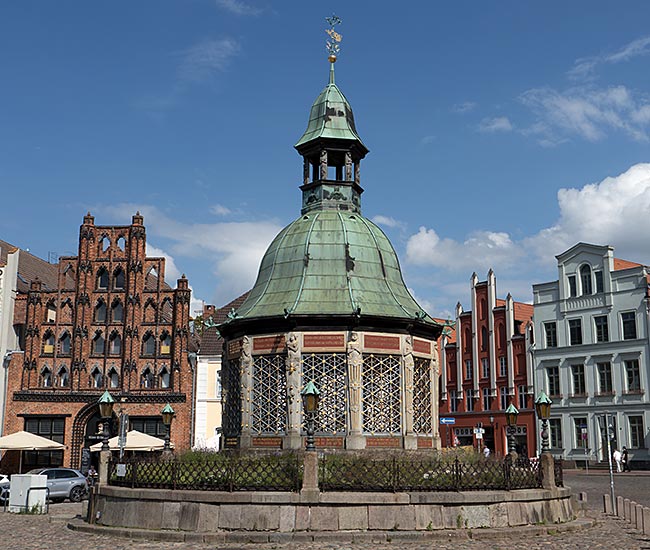
Crabs, dikes and the Wadden Sea
The North Sea spa town of Büsum
Once an island, Büsum was repeatedly threatened by the "Blanken Hans". When the greatest flood of the last century struck in 1962, Büsum was already long connected to the mainland - since 1585. Today, this town of around 5,000 residents, part of the Dithmarschen district, is one of the most important holiday destinations along Schleswig-Holstein's North Sea coast. Since 1985, the sea in front of Büsum has been protected as the Schleswig-Holstein Wadden Sea National Park, and since 2009, it has also been listed as a UNESCO World Heritage Site.
read more about Büsum ...
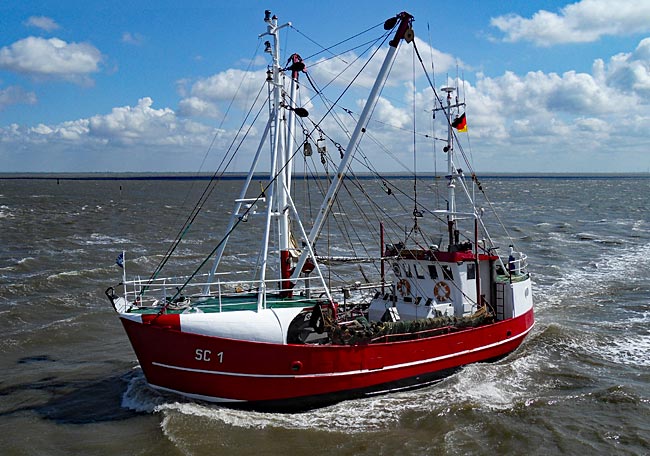
A stroll through Kiel
Sights in the fjord city and a visit to Laboe
A good starting point for exploring the city today, decades after the end of the war, is the centrally located main train station. On Sophienblatt, the main street running in front of the building, all major bus lines converge, and many sights can also be easily reached on foot during a multi-hour stroll.
read more about Kiel ...
Emden in East Frisia
Where East Frisians make jokes and serious art thrives
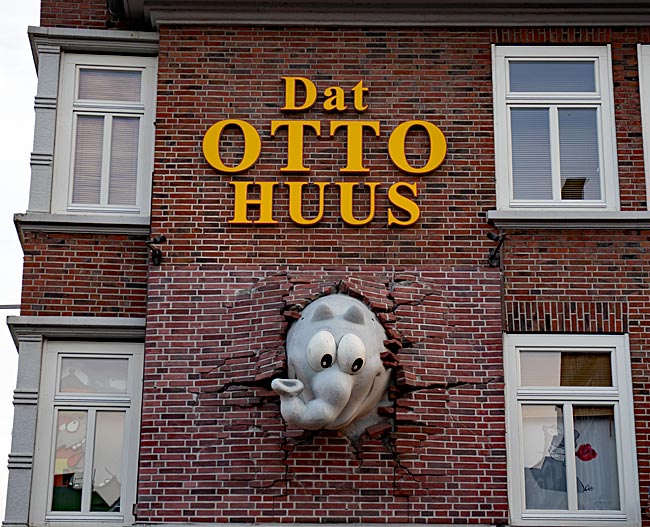
What do Henri Nannen, the journalist and founder of the print magazine STERN, director Wolfgang Petersen (e.g., Das Boot), and comedians Karl Dall and Otto Waalkes have in common? They were all born in Emden. "The Men of the Emden" (a film) not necessarily, but that's a different story. And of course, women have also been born in this city of around 50,000 inhabitants, the largest in East Frisia, such as former boxing world champion Heidi Hartmann - naturally mentioned only as a representative of all others.
read more about Emden ...
Norden-Norddeich in East Frisia
At the north Sea
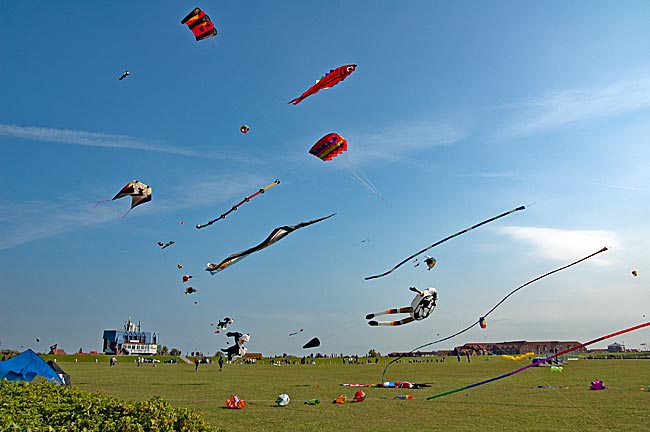
At first glance, one might get the impression that this North Sea resort is merely a transfer station for vacationers heading in droves to the islands. Not only do several ferry docks dominate the harbor, but large parking lots and multi-story garages belonging to the Frisia shipping company right behind the dike offer hundreds of parking spaces for island visitors who don’t want or can’t take their cars with them - Juist is car-free after all. But beyond that, Norddeich reveals itself as a far less hectic and manageably small coastal resort. In this state-recognized North Sea spa, tourism has only been promoted since the second half of the last century, apparently with success, as more than 1 million overnight stays per year show.
read more about Norden-Norddeich ...
A short visit to the historic old town of Heppenheim
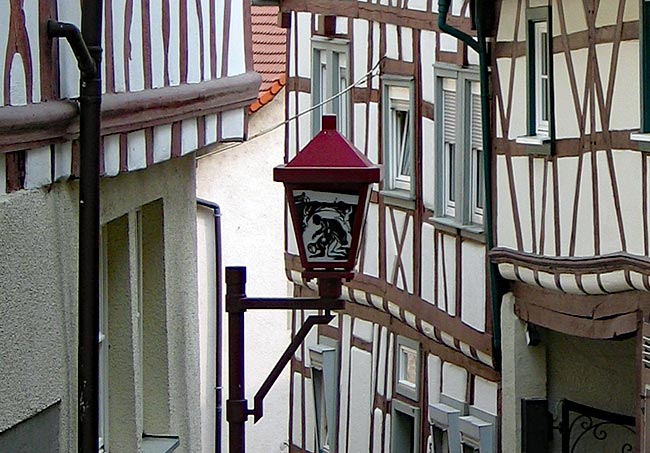
Half-timbering, a false dome, and legendary lanterns
The skyline of Frankfurt, Germany's financial capital with its office towers in the banking district, is still within sight when the train to Darmstadt and Bensheim pulls into the small station of Heppenheim. In 2010, the city was on everyone’s lips after native son Sebastian Vettel left all competition behind in his Red Bull car and became the youngest Formula 1 double world champion of all time. In 2011, he added another title to his collection, as did he in 2012 and finally in 2013 for a fourth time. However, we are not following in Vettel’s footsteps but rather those of history in the picturesque old town with its timber-framed houses.
read more about Heppenheim ...
Flensburg on the Baltic Sea
On the Förde at the border to Denmark
"The True North" - that is how the northernmost federal state rightfully markets its unique charms. When "fresh air" is promoted as "the best thing about the North," it is hard to disagree once you are actually here. Fresh breezes blow across the Baltic on the east coast and the North Sea on the west, with roughly 70 kilometers of flat, sparsely populated land stretched between them. With just under 100,000 residents, Flensburg is the third-largest city in Schleswig-Holstein, following the state capital Kiel and the "Pearl of the Hanseatic League," Lübeck.
read more about Flensburg ...