

DISTANT PLACES
Travel tips for destinations far from the Hanseatic City of Bremen
In the Probstei in late summer
Schönberger Strand and sea and more
Page 2 of 2
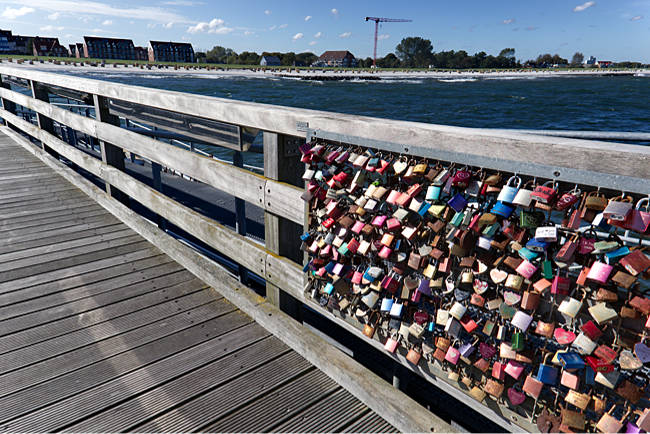
Many signs of love
The simple 250-meter-long bridge, which was inaugurated on June 30, 2021 and also includes a ship landing in Schöndorfer Strand after 1941, offers more than just the wonderful feeling of being surrounded by water without getting wet feet. It is especially a place to enjoy the sun when the day ends and the Earth's rotation allows the life-giving planet to leave the horizon behind towards the west. The last warm and bright rays can be enjoyed here at the bridgehead, where many people - or whoever they may be - have immortalized their promises of eternal love in metal.
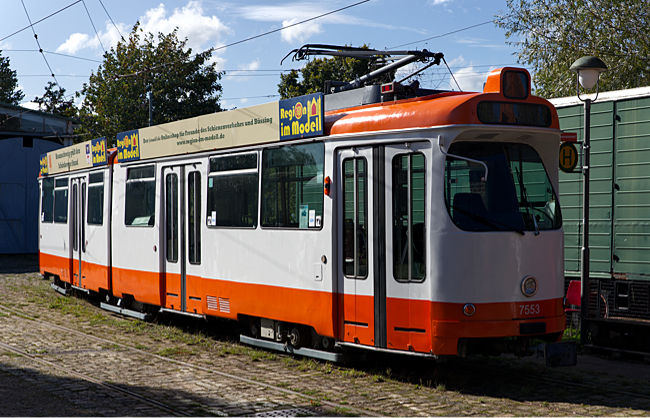
Historic tramway at the museum station
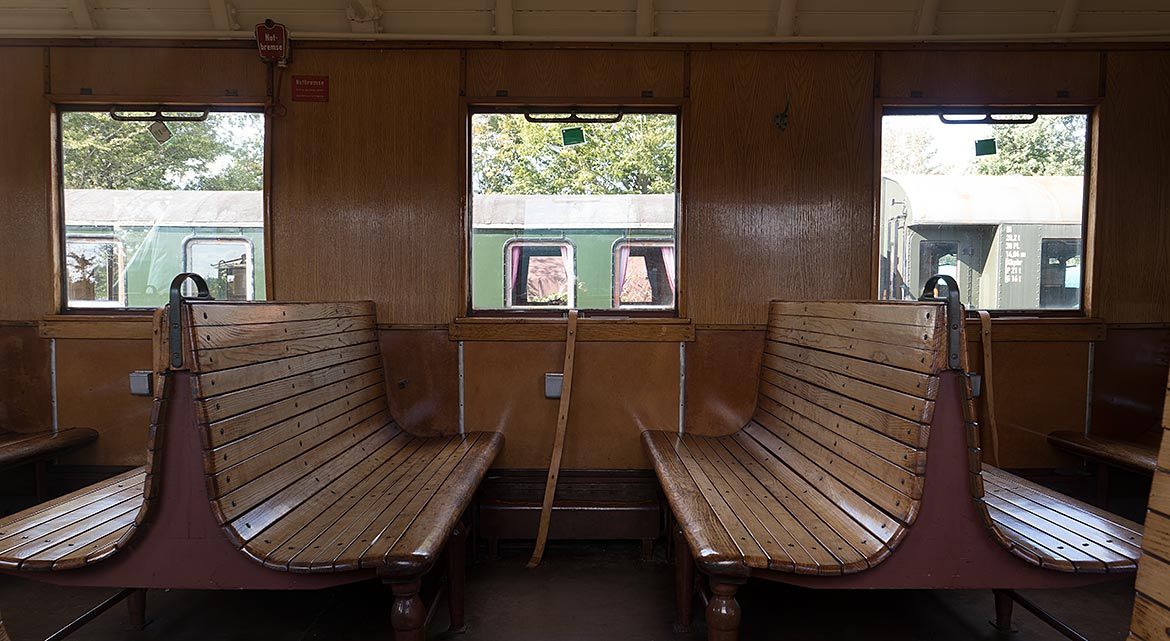
Speaking of fleeting yet enduring love: Perhaps the main attraction behind the dike on the landward side is the museum station with historic trams, train carriages, and locomotives. Not everything there still runs actively, but seasonal rides do take place. While the station area is freely accessible, the volunteers appreciate donations, as alongside the already beautifully and absolutely worth-seeing restored carriages, much valuable work remains to be done on the tracks. Definitely a tip not just for train enthusiasts.
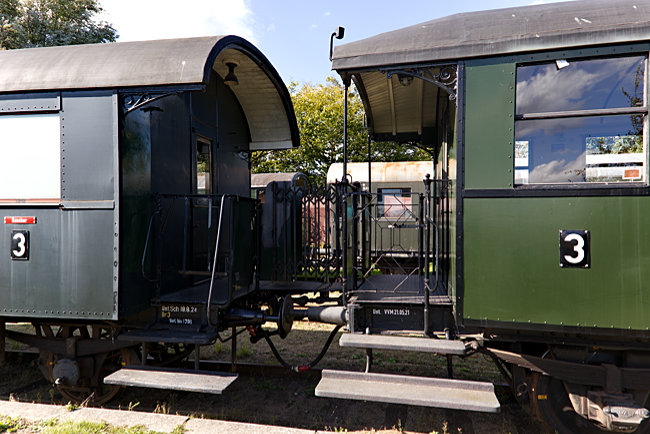
Restored train carriages from bygone times at the museum station
Schönberg
For others, a visit to the town of Schönberg provides a change of pace. Those who don’t drive the short distance from the coast in their own car can take the bus and, after getting off at Bahnhofstraße, are quickly in the heart of things with just a ten-minute walk.
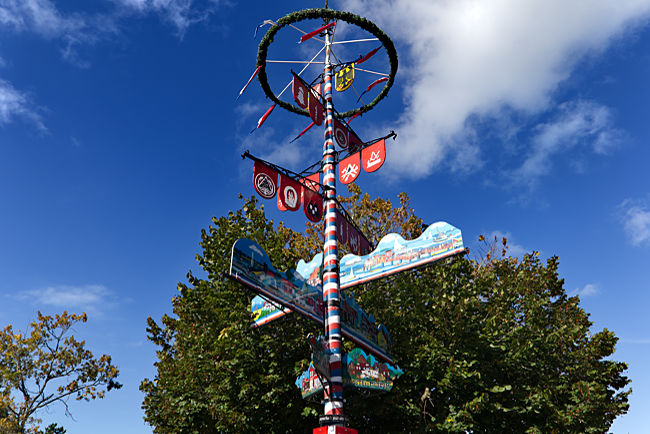
Coat of arms pole and signpost
Right in the center is "Knüll," a pedestrian zone characterized by red brick architecture, featuring numerous shops, offerings for the palate from sweet to savory, as well as the town hall and the Probstei office. On Mondays and Thursdays, a market takes place there. Information boards along a historic walking route allow visitors - especially - to immerse themselves in the history of the town, although much of the historical architecture is no longer visible in this particular building line, making references to formerly existing structures seem somewhat forced. However, it fits much better right next door, in Knüllgasse.
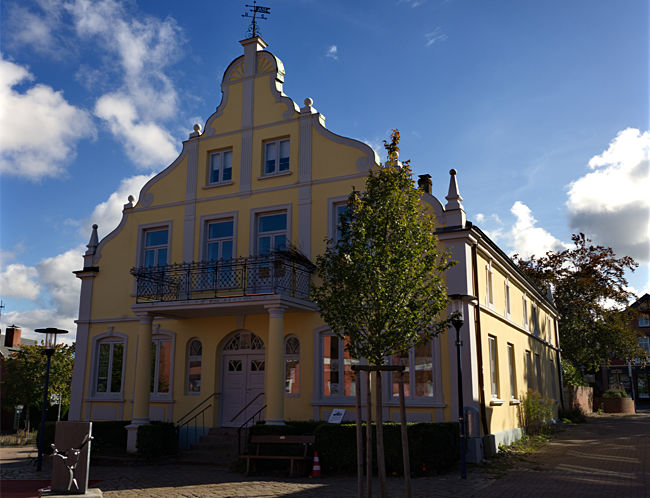
Old pharmacy on Knüllgasse
Branching off from Knüll is Knüllgasse, which, though interrupted by Ostseestraße, continues on the other side of the street and there represents the historic town center. Among other things, it includes the old pharmacy (house no. 8) from the 19th century. The building, which has undergone multiple structural changes, now belongs to the municipality. Also dating back to the 19th century is the old courthouse (house no. 16). Today, the brick building houses the Childhood Museum.
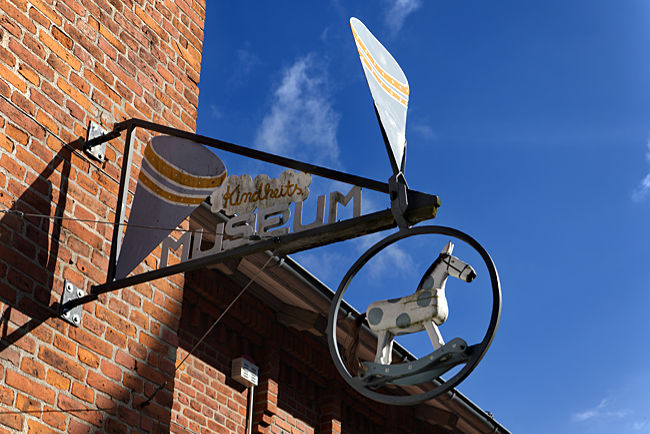
From rocking horse to school cone and more: above the entrance of the childhood museum
From there, it’s just a few more meters to the market square. On the edge of the square stands the Stendersche Haus, a former farmhouse that, according to an inscription on the beam above the double-winged Grootdör, was built in 1779 by Jochim Lag and Gretje Lagen. The building, beautifully renovated today, got its current name from Dr. Stender, who owned the property until the end of the 19th century.
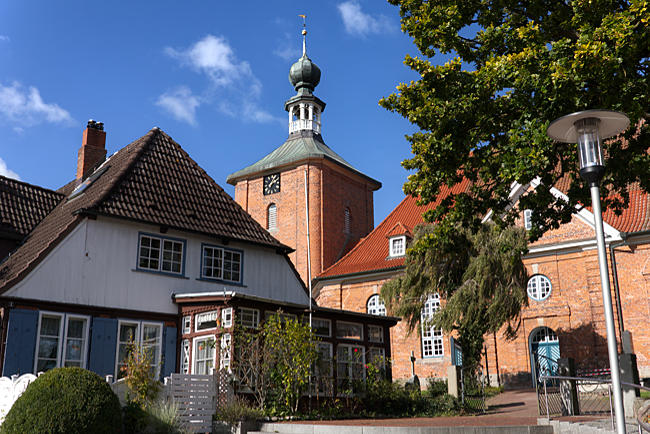
View from the market square onto the evangelical lutheran church in Schönberg with almost 1000 Seats
New construction on one side, much ash on the opposite side. Just a few months earlier, during the night from August 2 to 3 of the same year, the village church had fallen victim to a conflagration, as had numerous farms and houses in the vicinity. However, it took only three years until the protected monument, inaugurated in 1782, could be consecrated. Inside the brick-built hall church, the prospect of the organ - multiple times altered over time - as well as the pulpit altar opposite still date back to that era.
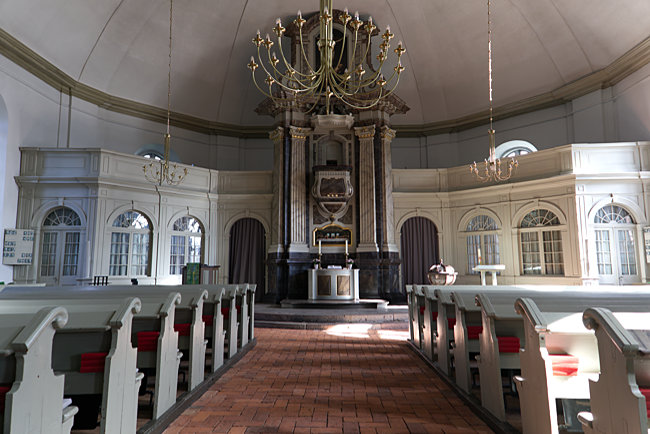
Often a haven of peace and perhaps introspection
Those who look up at the church steeple from outside discover there on the helm bar a weather vane in the shape of a perch. It is Schönberg’s emblem and, along with the church spire, also appears on the coat of arms alongside a bull’s head and ears of grain. The fish as a symbol dates back to the first settlers, the lords of Barsebeke and their successors. The town of Barsbek, mentioned for the first time in 1281 in today’s Probstei, derives its name from the noble knight Marquad Barsbek, who belonged to the Barsebeke family. To this day, a perch - frequently found in the so-called beken, the waters around Barsbek - adorns the community’s coat of arms on a red background. Incidentally, said knight sold half of the village mentioned above to Preetz Monastery in 1379.
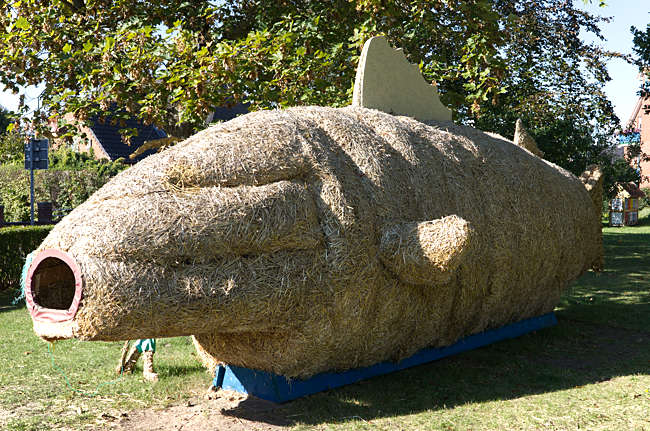
A perch made of straw
A large straw perch was found on the grounds of the Probstei Museum in the center of Schönberg at the time of our visit. The restored buildings of the former Göttsch estate now serve as museum premises, offering visitors insights into the lifestyle and living conditions of people in the region during the 19th century.
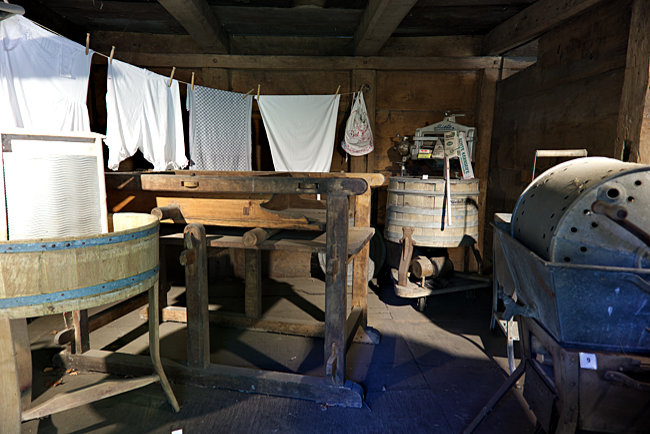
Forget washing machines: Laundry was a tough job back then - usually for women
The exhibits are based on the collection of Robert Lesky, who, along with Walter Muhs and other citizens, founded the "Verein Probsteier Heimatmuseum" in 1983. Muhs remained the first chairman of the association for 17 years and was awarded the Federal Cross of Merit on Ribbon in 1995 for his services to the museum.
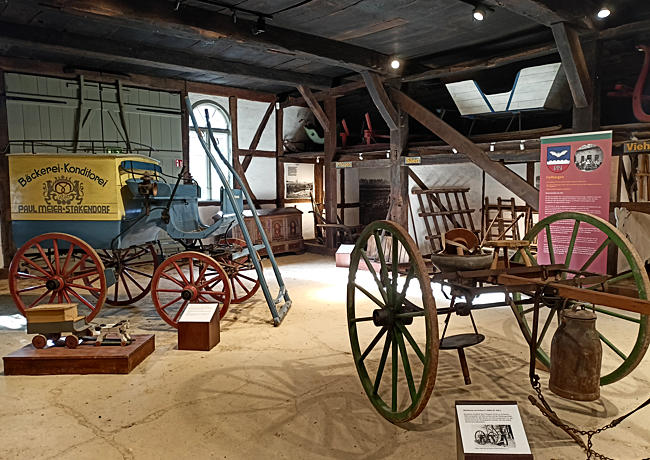
A beautifully crafted exhibition with attention to detail
The exhibitions are also predominantly excellent. One thematic area is the agricultural cycle of plowing, sowing, and harvesting, as well as livestock farming. This is supplemented by the artisanal processing of raw materials obtained. Through various trades, it becomes clear how dependent people were on their manual skills and muscle power to produce goods for work and daily life, whether with fire and forge or a sharp needle and thread, or the fine tools of the craft blacksmiths. That people also celebrated, loved, and married is shown, for example, by traditional regional costumes for various occasions. And for restful relaxation, a bed is provided - of course, only for display. The tour itself is not tiring.
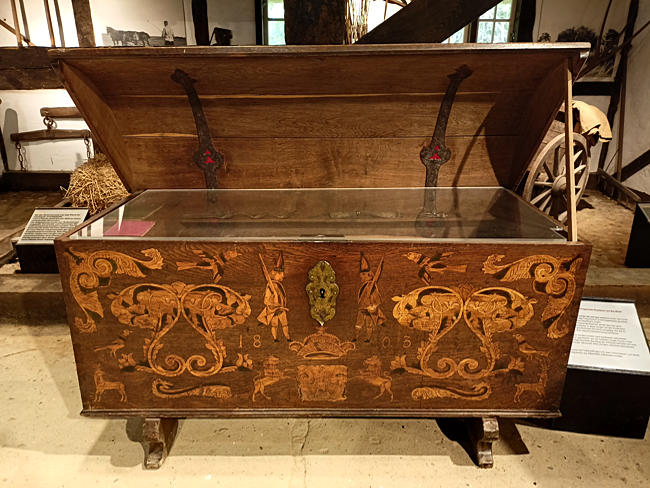
Beautiful woodwork: A probstei chest with typical dowry from the year 1803
Conclusion
Tourism as a seaside resort in Schönberg has taken place since the turn of the 20th century, with the opening of the former railway connection from Kiel in 1897. Today, business with holiday guests is an important economic factor, and accordingly, the local area has adapted to it without overloading the infrastructure. Nevertheless, there’s plenty going on during peak season, and not everyone finds their expectations fully met here. But where does that always fit? One should clarify this in advance for oneself.
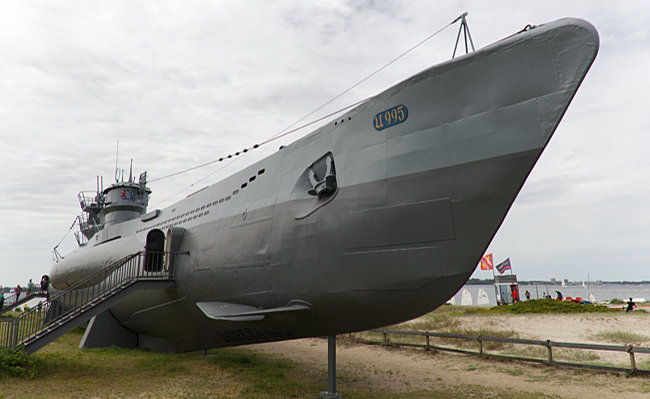
U995 without water under its keel in Laboe near Kiel
For those seeking further inspiration in Probstei, I recommend visiting Laboe on the Kieler Förde. Particularly noteworthy are the 1943-completed U-boat, which has been displayed ashore since 1972, and the 85-meter-high Naval Memorial with an observation platform, alongside the marina and promenade - absolutely worth a visit. Those who take on the 341 steps or prefer to use the elevator will enjoy a wide view over Probstei and Kiel from the memorial.
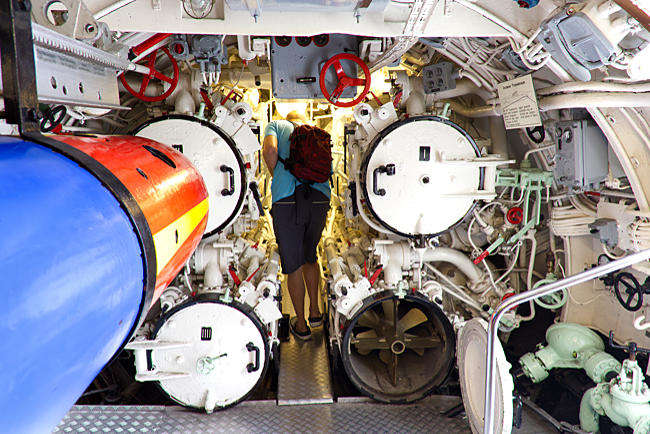
Cramped, even more cramped, but at least the interior (here the torpedo room) of the U-boat is well lit. From a personal perspective, absolutely worth seeing and worth the admission price; however, people with claustrophobia should reconsider visiting
Again and again, holiday guests in coastal regions complain about the spa or guest fees that must be paid as permanent guests upon booking accommodation or upon arrival at the official tourism office on-site - or alternatively, as day visitors, at the machine per day. Understandable when one gets the impression that nothing meaningful is being done with the additional funds collected for those very guests (though there are also areas without spa fees).
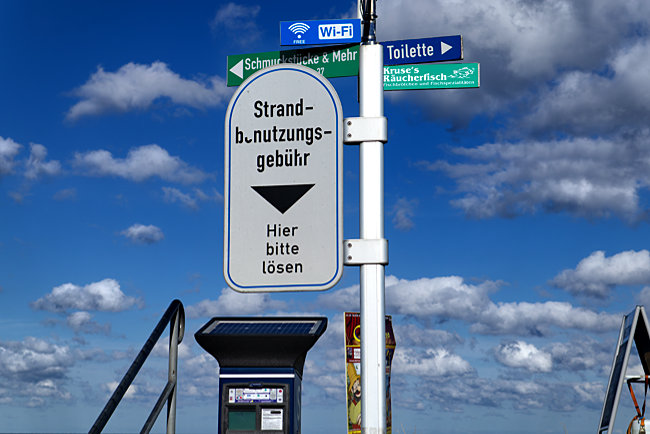
Well signed
This is definitely not the case in Schönberger Strand. Many regularly emptied waste containers line the main paths, keeping the area clean. Additionally, there are various toilet facilities directly behind the dike, which are also regularly cleaned and freely accessible, as well as free Wi-Fi - just to name a few examples. Much of what is realized from this financial pool may not be immediately visible but still makes guests' stays more pleasant.
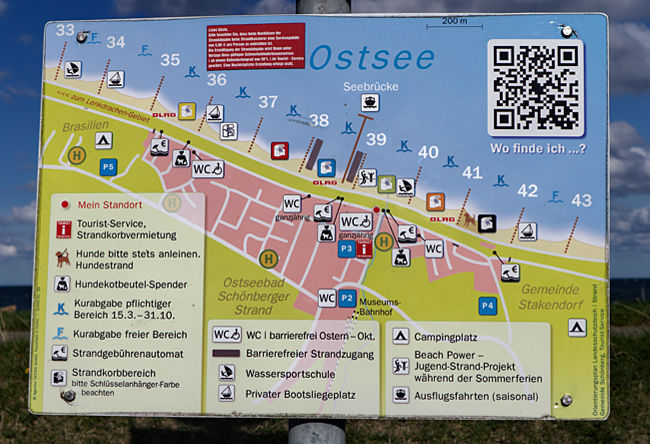
Well oriented
Furthermore, coastal protection in times of climate change is an issue, both in the past and today (see above). If the coast is not sufficiently protected, the next storm or spring tide might flood the flat hinterland. In a pavilion on the landward side of the dike, information boards document the construction and financial effort required to keep the sea at bay.
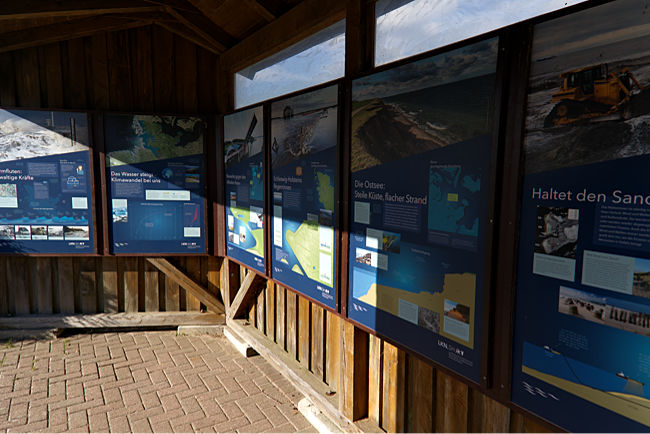
Well informed
Have a pleasant stay.
previous page
 next page
Map
Information
Tourist-Info
Schönberger Strand
Käptn's Gang 1
24217 Schönberger Strand
Phone: +49 (0)4344 / 4141-0
Email: info@schoenberg.de
www.schoenberg.de/tourist-service
Museum Railways Schönberger Strand
www.vvm-museumsbahn.de
Probstei Museum
Ostseestraße 8-10
24217 Schönberg
Phone: +49 (0)4344 3174 / (0)4344 3838577
Email: info@probstei-museum.de
www.probstei-museum.de
Kindheitsmuseum Schönberg e.V.
Knüllgasse 16
24217 Schönberg
Phone: +49 (0)4344 / 68 65
Email: info@kindheitsmuseum.de
https://kindheitsmuseum.de
Rügen by the Baltic Sea
Active holiday featuring cycling and hiking
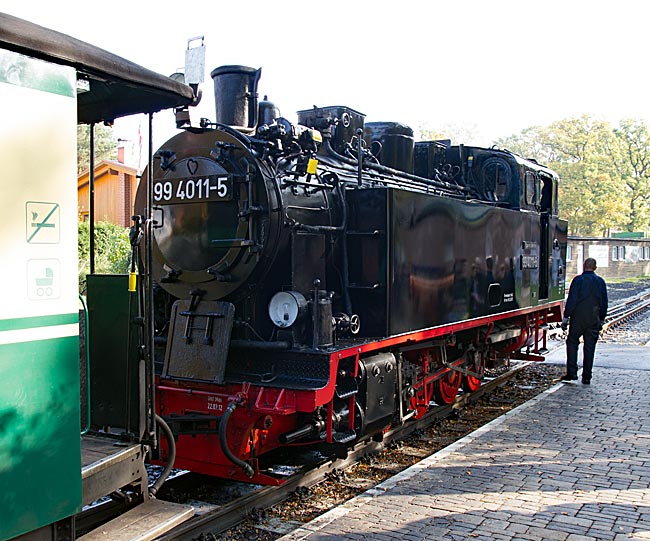
Enjoy an active holiday featuring cycling and hiking along the Baltic coast in Mönchgut on the island of Rügen. Long sandy beaches, rolling hills, and lush forests provide a varied and beautiful setting for your getaway. Often, the only thing breaking the peace is the distant whistle of the historic 'Rasender Roland' steam train. Despite its name (which suggests something "racing" or fast), it’s actually quite the opposite. A journey by train is simply part of the holiday experience.
read more about Rügen ...
Rostock and Warnemünde by the Baltic Sea
A travel guide
A mini-guide through the Hanseatic city of Rostock and its beautiful beach destination, Warnemünde. Home to one of the oldest universities in the Baltic region, the city boasts a rich history. Join us on a tour of discovery.
read more about Rostock ...
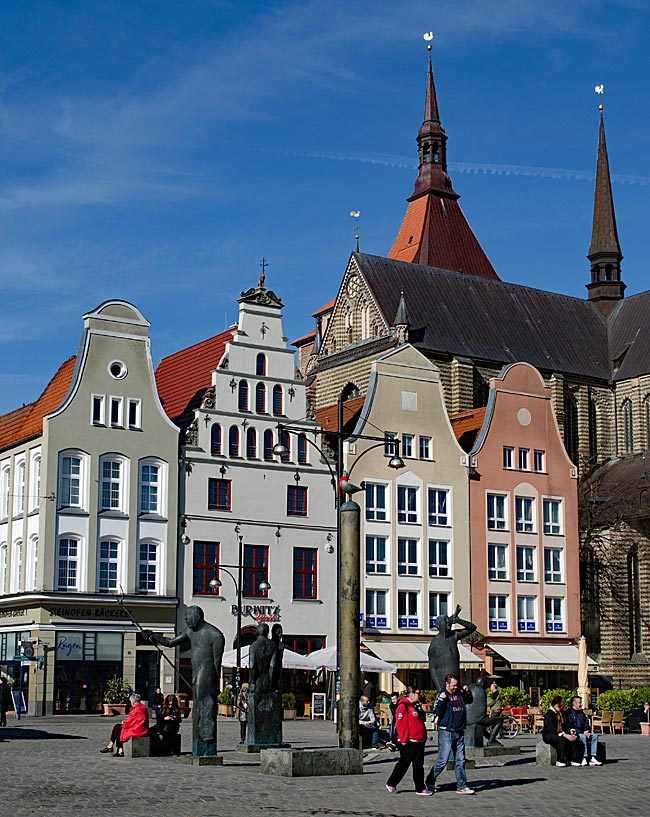
Wismar
The Hanseatic City on the Baltic Sea and its UNESCO World Heritage
The World Heritage House is a building with a stone front house and an attached timber-framed Kemladen on a foundation of loose fieldstones from a medieval predecessor building. This beautifully restored small building complex visually illustrates and provides information via text panels about the lives of past generations in the hall houses typical for Wismar, along with their outbuildings. Additionally, there is extensive information about the city’s history and numerous protected buildings in the old town - there are 1,754 in total, with 306 designated as individual monuments. In the old town, one is right in the middle of Wismar’s UNESCO World Heritage Site.
read more about Wismar ...
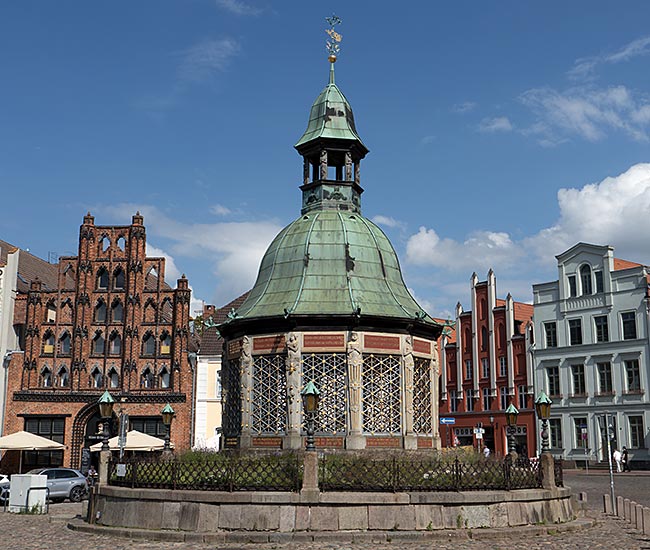
Crabs, dikes and the Wadden Sea
The North Sea spa town of Büsum
Once an island, Büsum was repeatedly threatened by the "Blanken Hans". When the greatest flood of the last century struck in 1962, Büsum was already long connected to the mainland - since 1585. Today, this town of around 5,000 residents, part of the Dithmarschen district, is one of the most important holiday destinations along Schleswig-Holstein's North Sea coast. Since 1985, the sea in front of Büsum has been protected as the Schleswig-Holstein Wadden Sea National Park, and since 2009, it has also been listed as a UNESCO World Heritage Site.
read more about Büsum ...
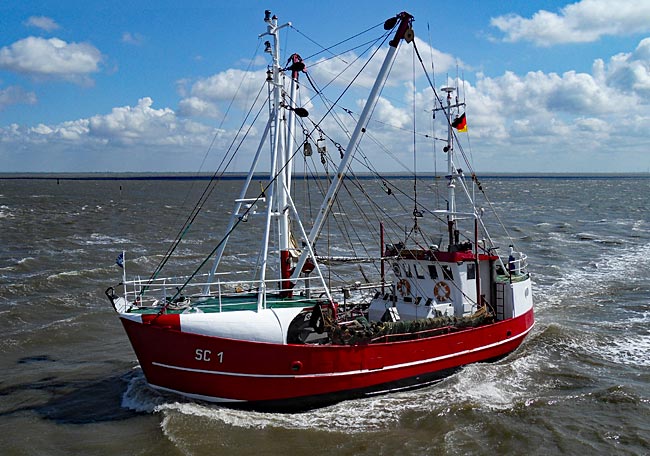
A stroll through Kiel
Sights in the fjord city and a visit to Laboe
A good starting point for exploring the city today, decades after the end of the war, is the centrally located main train station. On Sophienblatt, the main street running in front of the building, all major bus lines converge, and many sights can also be easily reached on foot during a multi-hour stroll.
read more about Kiel ...
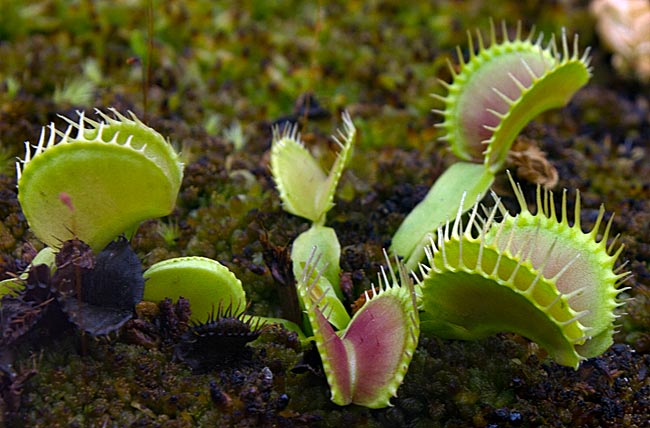
Emden in East Frisia
Where East Frisians make jokes and serious art thrives
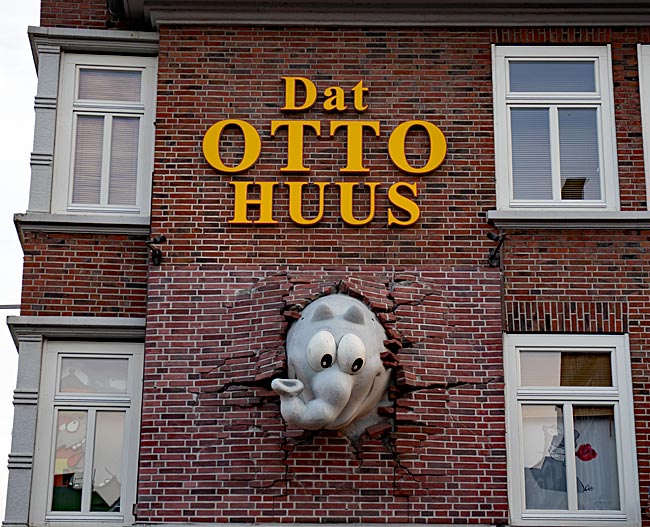
What do Henri Nannen, the journalist and founder of the print magazine STERN, director Wolfgang Petersen (e.g., Das Boot), and comedians Karl Dall and Otto Waalkes have in common? They were all born in Emden. "The Men of the Emden" (a film) not necessarily, but that's a different story. And of course, women have also been born in this city of around 50,000 inhabitants, the largest in East Frisia, such as former boxing world champion Heidi Hartmann - naturally mentioned only as a representative of all others.
read more about Emden ...
Norden-Norddeich in East Frisia
At the north Sea
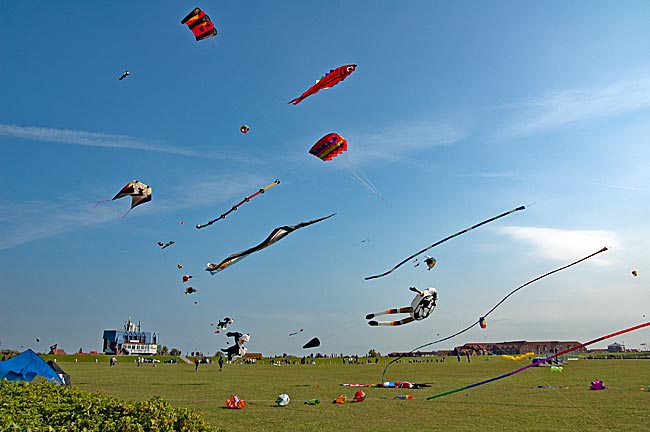
At first glance, one might get the impression that this North Sea resort is merely a transfer station for vacationers heading in droves to the islands. Not only do several ferry docks dominate the harbor, but large parking lots and multi-story garages belonging to the Frisia shipping company right behind the dike offer hundreds of parking spaces for island visitors who don’t want or can’t take their cars with them - Juist is car-free after all. But beyond that, Norddeich reveals itself as a far less hectic and manageably small coastal resort. In this state-recognized North Sea spa, tourism has only been promoted since the second half of the last century, apparently with success, as more than 1 million overnight stays per year show.
read more about Norden-Norddeich ...
A short visit to the historic old town of Heppenheim
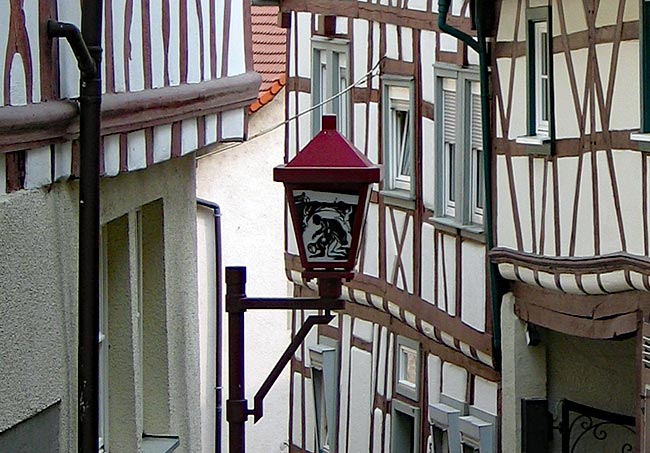
Half-timbering, a false dome, and legendary lanterns
The skyline of Frankfurt, Germany's financial capital with its office towers in the banking district, is still within sight when the train to Darmstadt and Bensheim pulls into the small station of Heppenheim. In 2010, the city was on everyone’s lips after native son Sebastian Vettel left all competition behind in his Red Bull car and became the youngest Formula 1 double world champion of all time. In 2011, he added another title to his collection, as did he in 2012 and finally in 2013 for a fourth time. However, we are not following in Vettel’s footsteps but rather those of history in the picturesque old town with its timber-framed houses.
read more about Heppenheim ...
Flensburg on the Baltic Sea
On the Förde at the border to Denmark
"The True North" - that is how the northernmost federal state rightfully markets its unique charms. When "fresh air" is promoted as "the best thing about the North," it is hard to disagree once you are actually here. Fresh breezes blow across the Baltic on the east coast and the North Sea on the west, with roughly 70 kilometers of flat, sparsely populated land stretched between them. With just under 100,000 residents, Flensburg is the third-largest city in Schleswig-Holstein, following the state capital Kiel and the "Pearl of the Hanseatic League," Lübeck.
read more about Flensburg ...