

DISTANT PLACES
Travel tips for destinations far from the Hanseatic City of Bremen
Rügen by the Baltic Sea
Hiking, cycling & more in the southeast of the island
Page 1 of 8
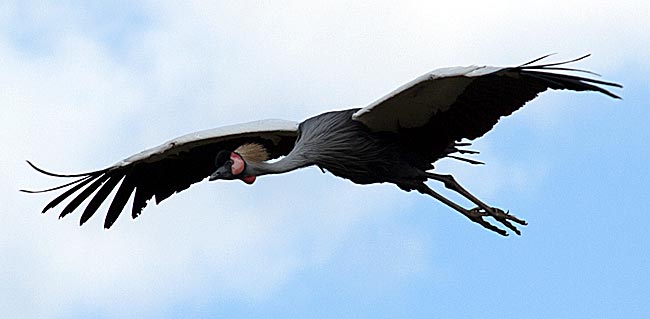
Flying crane
The Intercity train rolls over the steel railway bridge past the enormous shipbuilding hall of the former Volkswerft in Stralsund, connecting the mainland to the island of Rügen through the small island of Dänholm. The Strelasund is so narrow here that the otherwise mighty Baltic Sea seems like a large inland lake, filled with anglers in their small boats and recreational sailors with their dinghies. On the other side, the tracks lead through a largely deserted cultural landscape of fields and meadows into the heart of the island. In spring and autumn, you can often see huge flocks of cranes on the green spaces from the train window, as Germany’s largest island is Europe’s biggest crane resting place before these up-to-125-centimeter-tall birds continue their journey southward. It’s an impressive sight when many of them take flight at the same time and circle in the air.
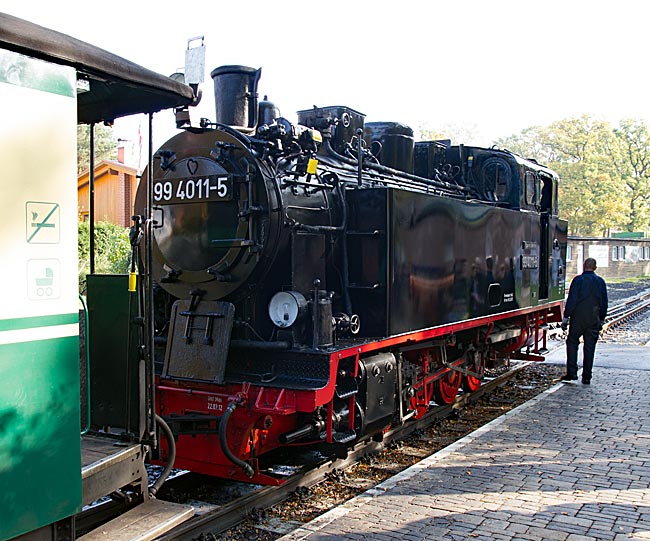
The Rasende Roland at Göhren station
We are on our way to Göhren, where Nordperd, a forested cape with steep cliffs belonging to the eponymous municipality, marks the easternmost point of the island. The Intercity terminates in Binz, Rügen’s largest seaside resort, and from there you can continue by bus - but it’s more attractive to take the Rasende Roland all the way to Göhren. “Rasend” (racing) is not to be taken literally here but rather means the opposite. The Roland is a narrow-gauge railway with a track width of 750 mm that runs between Putbus and Göhren. What makes it special, however, is that it is powered by historic steam locomotives, naturally accompanied by matching passenger carriages, some nearly a century old, as the railway has existed since 1899. You usually hear the coal-fired trains long before you see them gently rattling along the 24.1-kilometer route, trailing a cloud of smoke behind them.
Seaside Resort Göhren
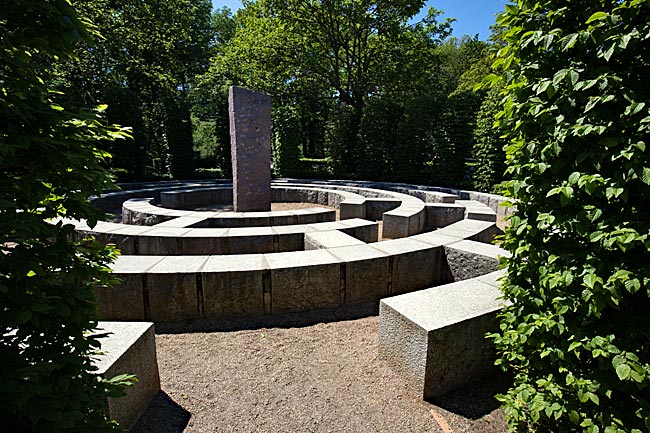
Themed Garden on the Amber Promenade
At the final stop, you are already right in the middle of Göhren. From here, it’s just a short walk to the town’s promenade. The wide “Amber Promenade,” renovated in 2003 for the International Horticultural Exhibition, is one of the resort’s main meeting points with its cafés, restaurants, shops, mini-golf course, themed gardens, and play areas for children. Naturally, this is also because the long north beach, Göhren’s actual bathing beach, lies just behind it.
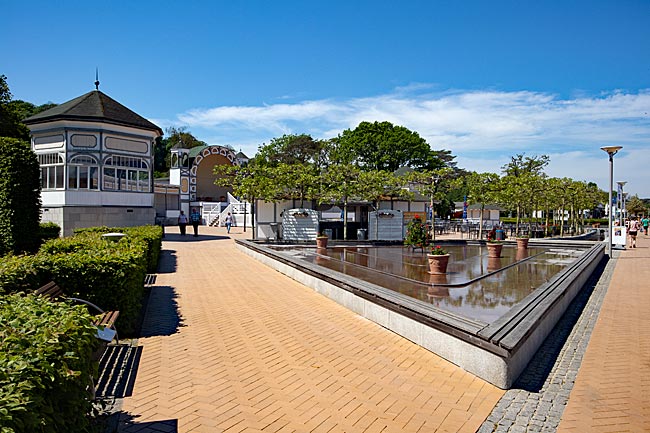
Kurplatz on the Amber Promenade
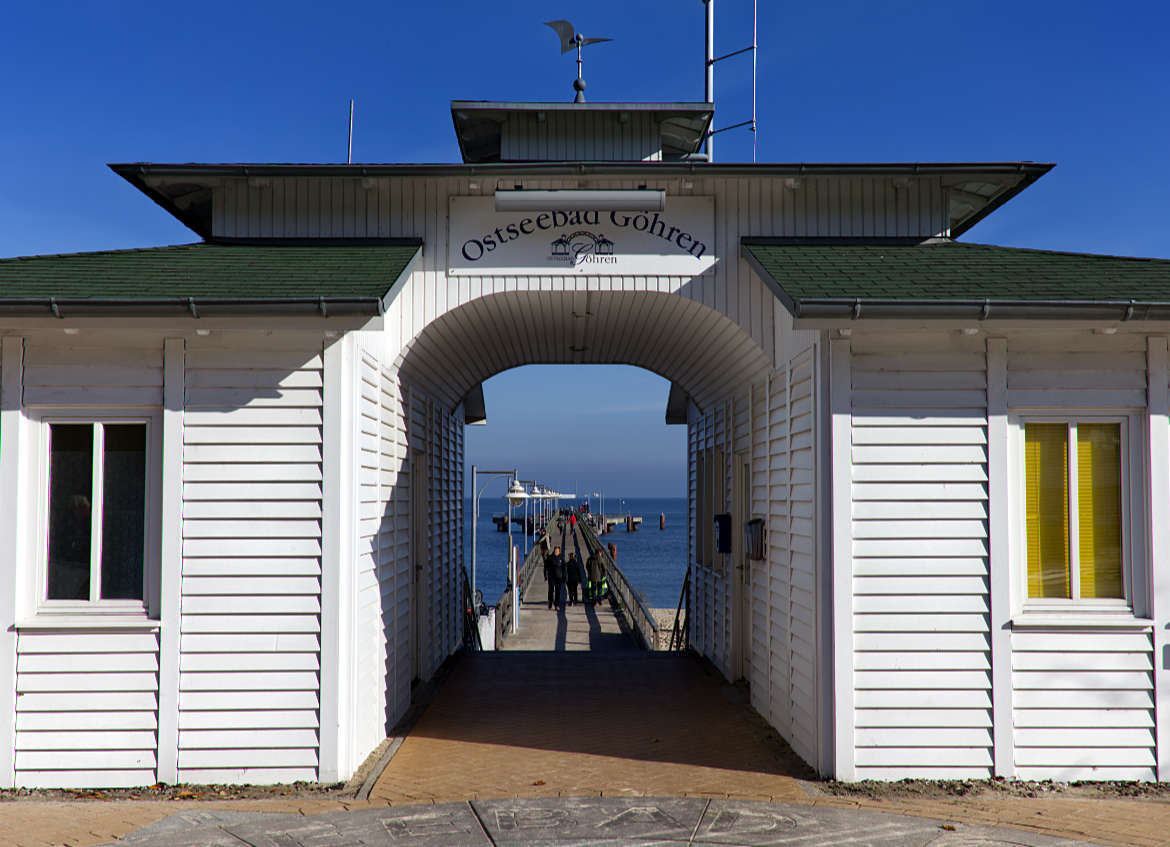
Since 1992, the newly reconstructed Seebrücke (pier) has extended 270 meters from the promenade into the Baltic Sea, where excursion boats dock. From here, you have a good view of the elevated part of town. If you don’t take the bus or the paid inclined elevator completed in 2015 but instead choose the stairs to the high cliff, your active holiday begins at the latest as you make your way up.
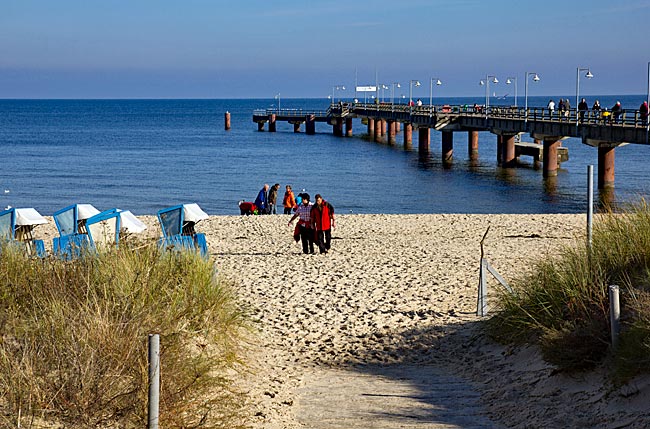
View from the Amber Promenade onto the north beach and Göhren’s pier
Even in the off-season, there is bustling activity in the two main shopping streets, Poststraße and Strandstraße, which also accommodate bus traffic. Those who don’t want to leave without some “Baltic gold” (amber) and haven’t found any in the sand can purchase it in one of the many shops.
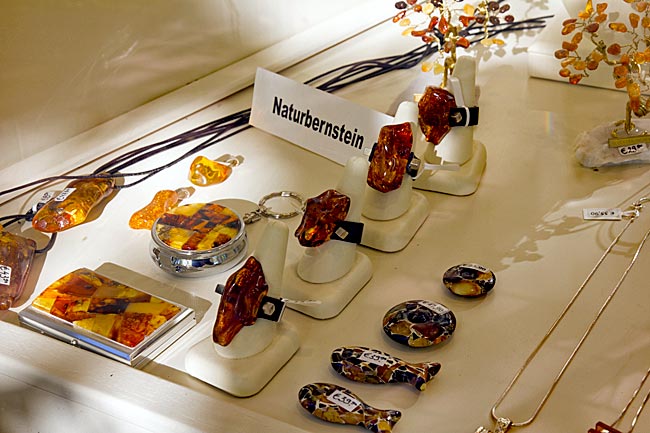
Amber jewelry in a shop window
In Strandstraße, between all the cafés and restaurants, the Museumshof (museum farmyard) and the thatched-roof Heimatmuseum (local history museum), which was renovated and expanded in 2016/17 and dates back to the mid-19th century, both contribute to a lingering village atmosphere. Both are protected monuments and belong to the Mönchguter Museums.
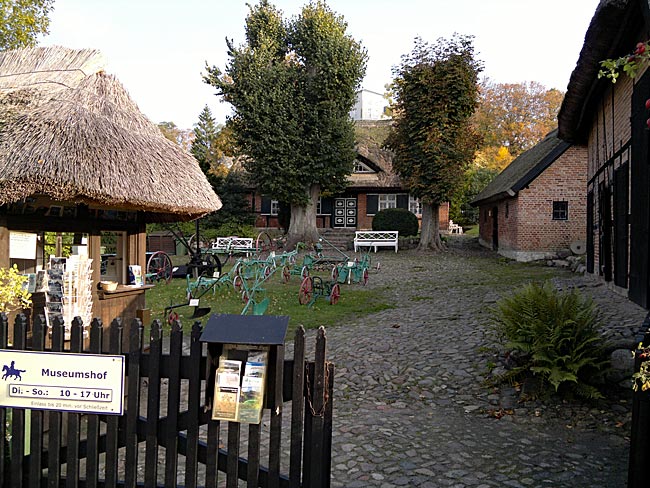
Museum farmyard on Strandstraße
The Heimatmuseum, a timber-framed building, was established in 1963 at the initiative of Ruth Bahls, who was born in Göhren and died here four days before her 85th birthday in 1994. The enterprising educator initiated further museums in the area, such as the “Dat Rookhus” museum opened in 1977, the museum ship Luise, a 19.42-meter-long Dutch coastal motor-sailer with a flat bottom (Ewer) from 1906 near the south beach, opened five years later, and the school museum in the neighboring town of Middelhagen.
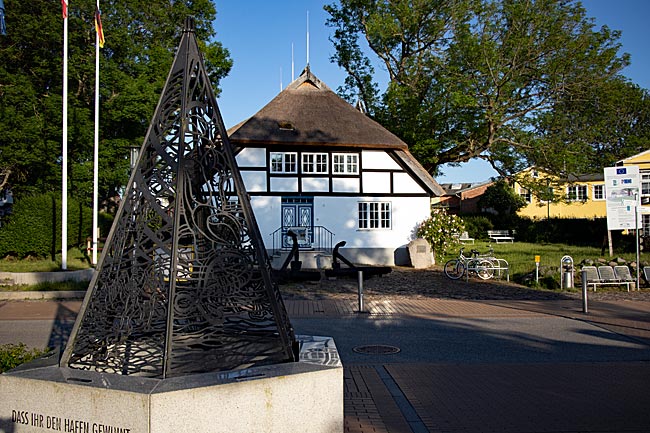
In the background: the Heimatmuseum; in the foreground: the Sagenbrunnen (legendary fountain) inaugurated on July 19, 2007, featuring a quote from Johannes Kienau in its base, who wrote under the pseudonym Gorch Fock and perished as a sailor of the torpedo boat "Wiesbaden" during the Skagerrak Sea Battle on May 31/June 1, 1916.
Despite years of construction to create more apartments and hotels for tourists, the authorities have managed not to completely destroy the character of this 1,300-inhabitant town. Many newer buildings are stylistically inspired by the resort architecture prevalent along the Baltic coast until the end of World War I, with their often intricately carved wooden balconies and verandas. Naturally, construction costs must also be considered here; the fine "art in architecture" has given way to simpler, more robust designs. However, at least they continue to build more horizontally than vertically.
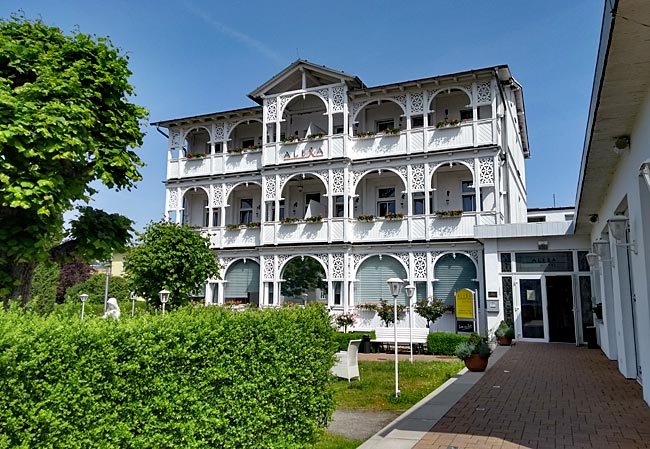
Resort Architecture on Poststraße: the hotel Alexa, one example among many
The relatively few sights and the architecture are probably less of a reason for the great tourist appeal beyond Germany’s borders. Instead, Göhren - and further afield, the 29.44-square-kilometer peninsula of Mönchgut in southeastern Rügen, where the town is located - invites visitors to hike, cycle, swim, or simply lounge on the beach. Mönchgut belonged for a long time after 1360 to the Cistercian monastery Eldena near Greifswald, and through the people who settled here, different customs, traditions, costumes, and building styles developed over time compared to the rest of Rügen.
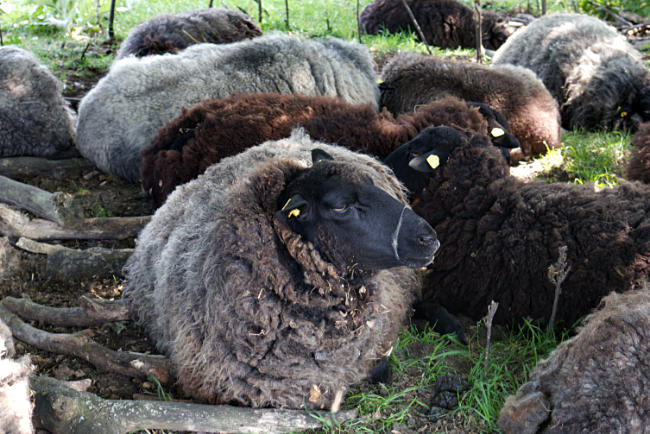
Also living here are rough-coated Pomeranian land sheep
The name Göhren contains the Slavic word "Gora" for "mountain," and the Slavs who also settled on Rügen in the past were indeed right - some paths through town can make you sweat, as steeply do the streets ascend. For example, up to the old water tower, which is a good starting point for an extended hike through the nearby approximately 69-hectare Nordperd.
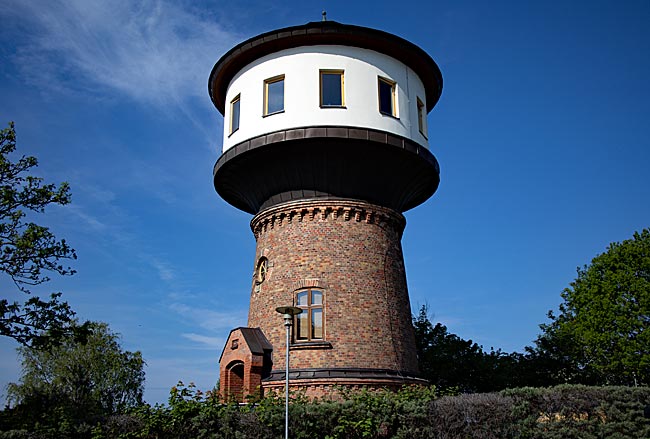
Old water tower in Göhren
previous page
 next page
Map
1. Rügen by the Baltic Sea
actual page
2. Rügen by the Baltic Sea
Nordperd: hiking through the forest to the cliff
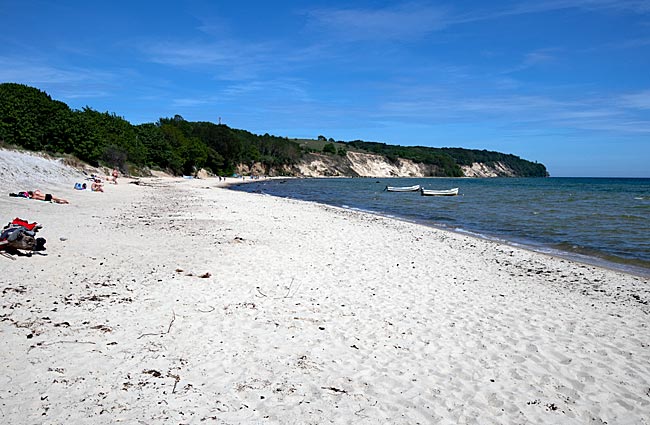
The mostly forested promontory - this is what the word Perd means in Slavic - is part of the Mönchgut Biosphere Reserve. And indeed, from the air, the area juts out like a green pointed triangle into the sea.
Along the beach to Thiessow and Klein Zicker
After a short museum visit, our path leads us through the sand of the Baltic Sea past the village of Lobbe to the end of the beach in Thiessow - a considerable distance for persistent hikers coming from Göhren, always with a salty breeze in their noses.
read more about Rügen ...
3. Rügen by the Baltic Sea
Cycling from Göhren to Reddevitzer Höft
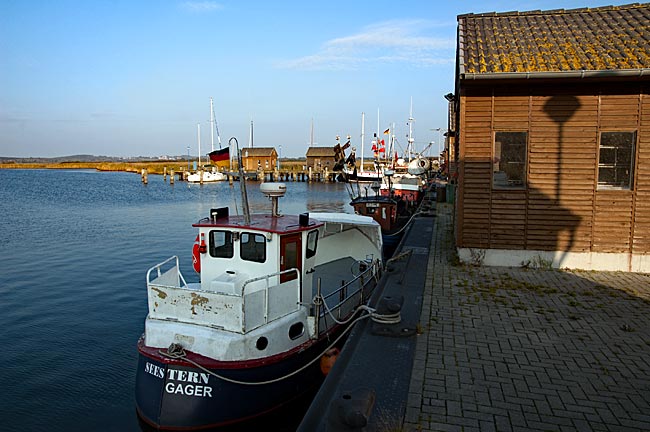
The farther you cycle along Reddevitzer Höft, the sparser the settlements become. Where no houses or trees obstruct the view, you can see the Rügischer Bodden with Having Bay on one side and Hagensche Wiek Bay on the other. This is especially true when you reach the 33-meter-high elevation at the end of the peninsula. From the cliff, you have a wide view across the water toward Vilm Island or the village of Gager with its small harbor.
read more about Rügen ...
4. Rügen by the Baltic Sea
Seaside resort tour on foot or by bike
From the north beach in Göhren, the next seaside resort in the other direction is already within sight: Baabe. So you can simply stroll barefoot along the water or use the Amber Promenade as an equally direct route, though with a solid surface. Cyclists can also make good use of this and find it well-developed parallel to the promenade. A slightly bumpy and longer option is the combined cycling and hiking trail through the forest, connecting the two seaside resorts over 2.5 kilometers.
A bike trip form Baabe to Seedorf and to the seven megalithic tombs from the Stone Age near Lancken-Granitz
The charm of Seedorf lies primarily in its harbor: docks with moorings for many recreational boats along both shores of the inlet to Neuensiener See. Here, sailboats and motor yachts are safely anchored away from the sometimes rough seas of the Baltic Sea, yet their skippers can quickly reach it if needed.
A seabridge and spa architecture in Sellin
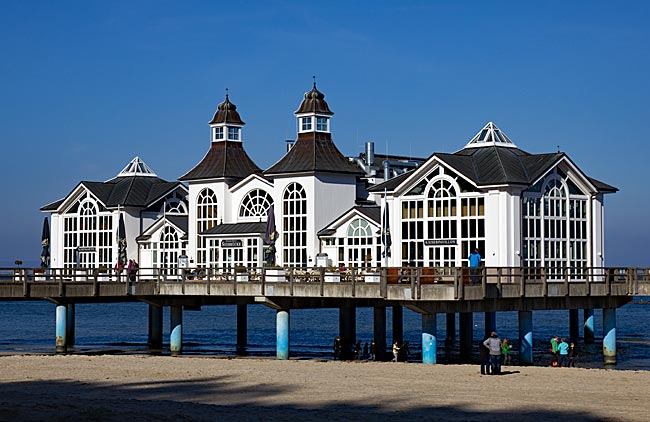
Long before reaching Sellin along the beach, you’ll spot the impressive 394-meter-long pier, which has a turbulent history dating back to the early 20th century.But Sellin has more to offer than just the magnificent structure right on the beach. The so-called "Stairway to Heaven" leads up many steps to the high bluff, connecting the pier with Wilhelmstraße promenade.
read more about Rügen ...
5. Rügen by the Baltic Sea
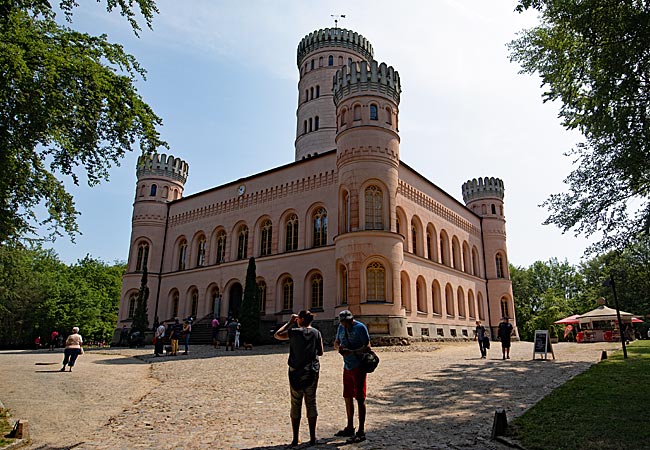
Through the forest to Jagdschloss Granitz
It's about 5 kilometers from Sellin through forest paths up to Jagdschloss Granitz. If you're on foot, you can initially take the cliff path through rough terrain at your own risk; by bike, there are additional better-developed paths. All paths eventually converge and lead well-signposted to the hunting lodge and Binz. The castle is also located along the route of the Rasender Roland, about one kilometer downhill to the station. In the other direction, it's about 3 kilometers through the forest to Binz.
Art and more in Binz, the largest seaside resort on Rügen
If you arrive as a visitor from the sea side, on the one hand, the size of the place in general and the 1890-opened Kurhaus as the unmistakably largest and most impressive building in particular catch your eye. Even in the off-season, Binz is much livelier and busier than the places in its immediate vicinity. Historical houses in the style of spa architecture can also be found here, whether directly on the beach promenade or in the shopping streets of the town. And regardless of whether you arrive by ship or by bus, you are immediately in the midst of the action.
read more about Rügen ...
6. Rügen by the Baltic Sea
From Binz to Sassnitz
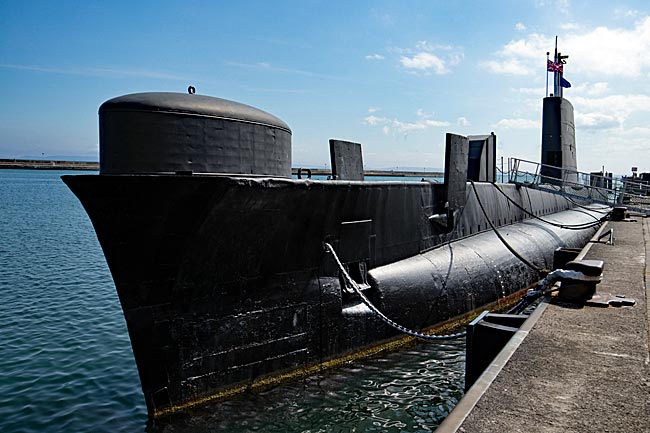
Since 2007, a 250-meter-long suspension bridge has allowed pedestrians to quickly reach the city harbor from the city center - offering a wide view of the harbor and the Baltic Sea. If you use the suspension bridge, you will immediately encounter the most unusual ship in the harbor: the H.M.S. Otus. This 90-meter-long British submarine of the Oberon class, built in 1962, has been decommissioned and is now a walkable museum.
To the chalk cliffs with the 118-meter-high Königsstuhl in Jasmund National Park
From Göhren, Sellin, Bilz, or Sassnitz, you can also book a trip to the chalk cliffs with the ships of Adler-Reederei, offering a view from below of the relics from the Cretaceous period, which began approximately 145 million years ago and ended around 66 million years ago, instead of the panoramic view from above.
read more about Rügen ...
7. Rügen by the Baltic Sea
By water to Lauterbach and Putbus
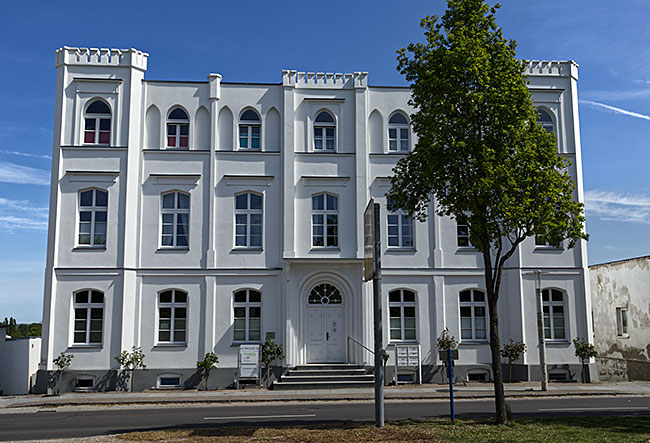
Sellin. The open Baltic Sea on one side, a lake, a bay, and a "shallow bay-like coastal water body" - the Bodden - on the other. This is where the ships of the White Fleet sail. From Lauterbach, a two-lane main road leads about two kilometers into the center of Putbus - getting lost on the green avenue is practically impossible. Thus, after the described walk, you first encounter the Circus. The model for the facility built between 1828 and ’45 was the Circus constructed a century earlier in the English spa town of Bath.
read more about Rügen ...
8. Rügen by the Baltic Sea
Travel Information
Many hopefully helpful pieces of information for the described part of Rügen. Unfortunately, not all websites are available in English yet. Nevertheless, I am sure you will have a wonderful time on Germany's largest island. Take care.
read more about Rügen ...
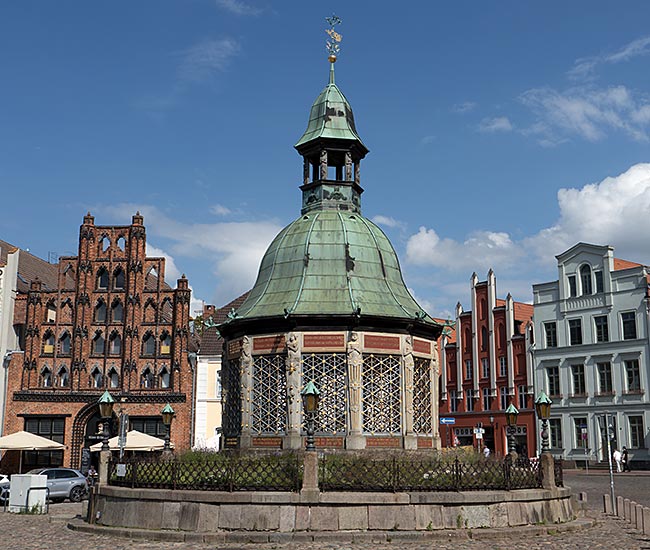
Wismar
The Hanseatic City on the Baltic Sea and its UNESCO World Heritage
The World Heritage House is a building with a stone front house and an attached timber-framed Kemladen on a foundation of loose fieldstones from a medieval predecessor building. This beautifully restored small building complex visually illustrates and provides information via text panels about the lives of past generations in the hall houses typical for Wismar, along with their outbuildings. Additionally, there is extensive information about the city’s history and numerous protected buildings in the old town - there are 1,754 in total, with 306 designated as individual monuments. In the old town, one is right in the middle of Wismar’s UNESCO World Heritage Site.
read more about Wismar ...