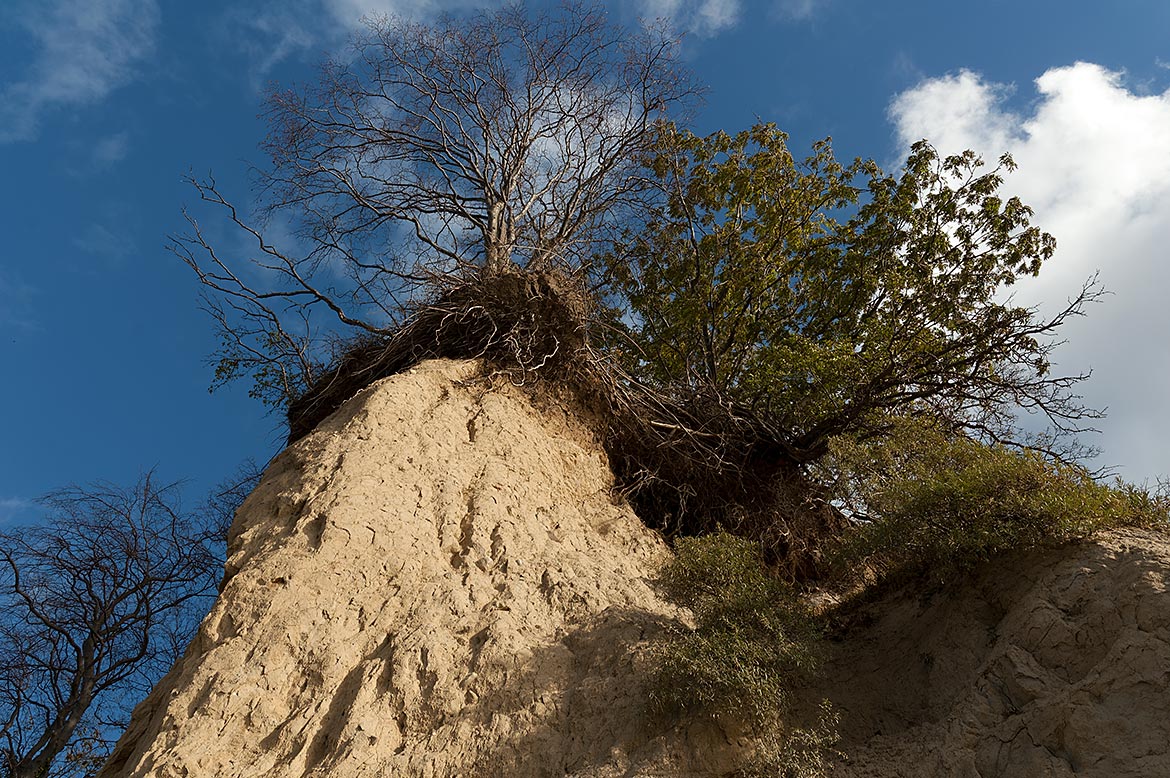


DISTANT PLACES
Travel tips for destinations far from the Hanseatic City of Bremen
Rügen by the Baltic Sea
Hiking, cycling & more in the southeast of the island
Page 3 of 8
Cycling from Göhren to Reddevitzer Höft
Those who prefer cycling over walking will find excellent conditions on Mönchgut. Unlike Verleihnix (rental nothing, his name in german books; in english: Unhygienix) in the famous Gallic village from the cult comic Asterix, people in Göhren are happy to rent out bicycles - of course for a fee. This way, train travelers can avoid the hassle of transporting bulky bikes.
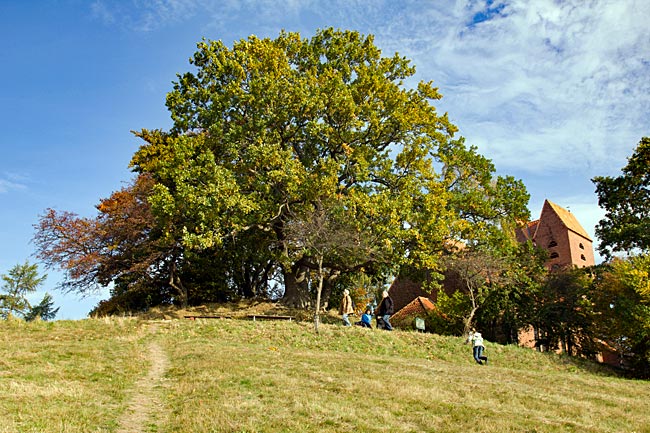
Church and Speckbusch burial mound
Not only for curious cyclists is the trip up to the church in Göhren recommended. The brick building completed in 1930 is pleasant to look at but certainly no architectural revelation. Similarly, the Speckbusch mound directly behind it is not particularly spectacular. However, this overgrown, stone-reinforced hill - 3 meters high and 15 meters in diameter - is a Bronze Age burial mound and protected as an archaeological site.
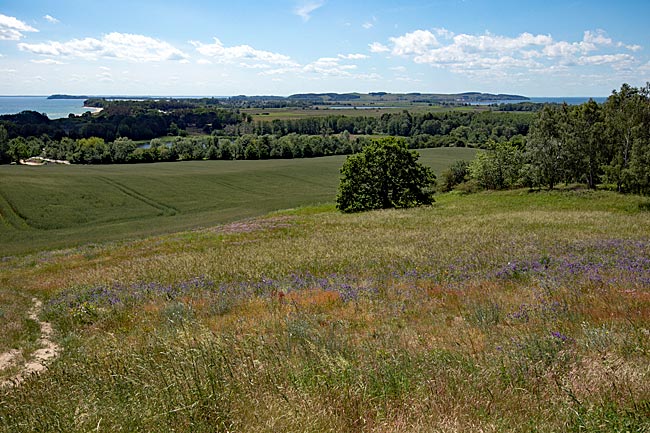
View from Speckbusch over Mönchgut
The entire hill on which the church and grave were built consists of glacial deposits from an ice age. The ice age is long gone, the glacier has disappeared, but what remains is a viewpoint from which, on clear days, you can see far across Mönchgut to the south and southwest. There lies Reddevitzer Höft, a peninsula about 5 kilometers long and only around 500 meters wide.
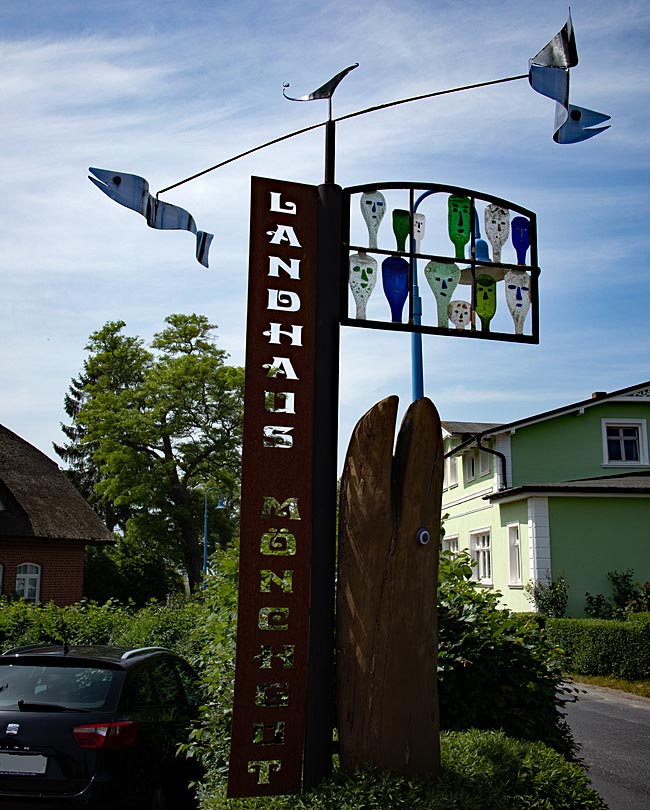
Middelhagen is located along a section of the "Silber des Meeres" (Silver of the Sea) themed trail. Here, you often encounter symbols that point to the long history and significance of fishing on the island of Rügen
From Göhren, cyclists first ride 2.5 kilometers to Middelhagen. Part of the route passes through forested terrain; later, depending on the season, it leads past red poppies and blue cornflowers in meadows and fields. The town’s more recent history dates back to the mid-13th century, but the "Herzogsgrab," one of several megalithic tombs on Rügen, shows that people were already present here during the Neolithic period. About 38–40 individuals likely found their final resting place there.
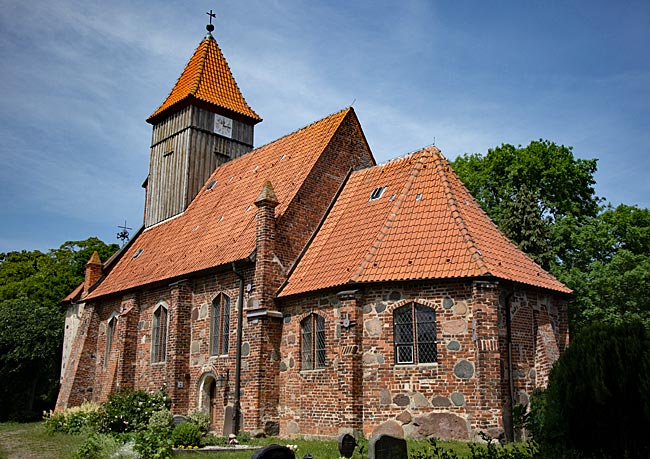
St. Katharinenkirche
Visitors to St. Katharinenkirche will also find tranquility. The brick church, built on a foundation of boulders, is a stop along the "European Route of Brick Gothic" and was constructed around 1455. The oldest piece in the otherwise rather plain church - later fitted with a wooden tower - is the wooden Katharinenaltar. This carving from around 1480 depicts the story of St. Catherine, venerated as a martyr in the Catholic Church, and was likely brought to Middelhagen from Stralsund only after the Thirty Years' War, in the mid-17th century.
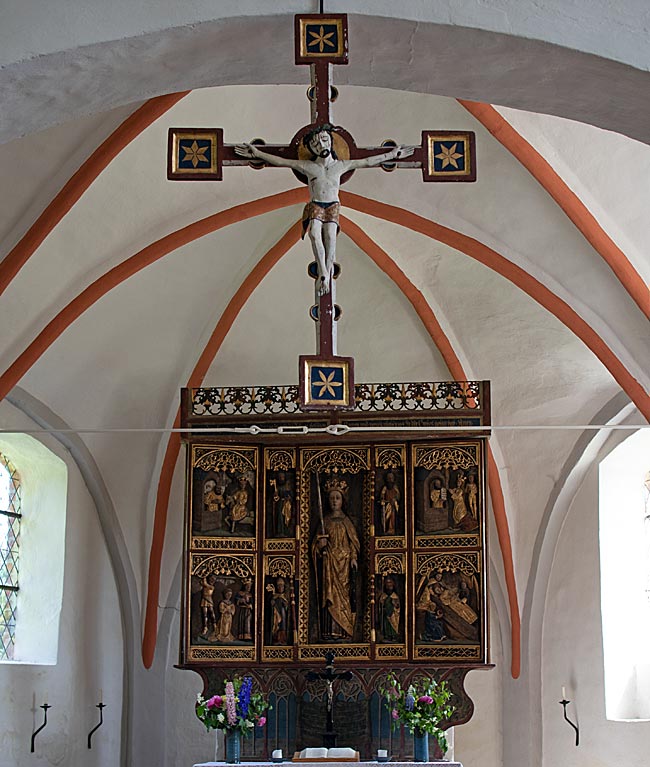
15th-Century Altar in St. Katharinenkirche
Next to the church lies the aforementioned school museum. The timber-framed building forms an attractive ensemble with the church, Rügen’s oldest inn (Gasthof "Zur Linde"), and the pottery workshop across the street at the town’s main intersection on the connecting road over Mönchgut.
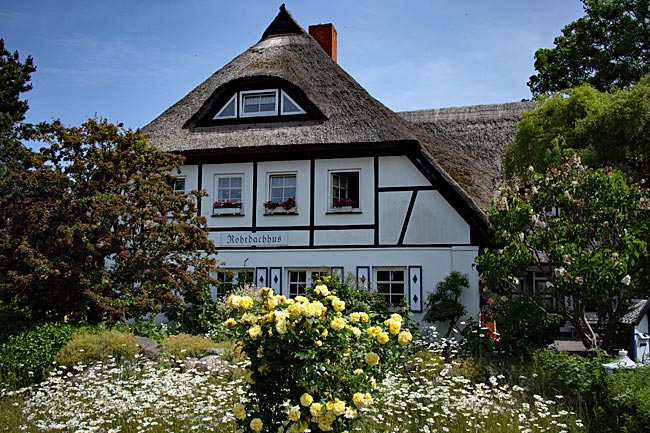
Thatched roof house
The few houses in Mariendorf, 2 kilometers away, are quickly passed, and soon you reach Alt Reddevitz. From Middelhagen to here, an unusually high number of beautiful thatched-roof houses line the route, adding a charming character to the landscape. Reed is a natural material - reed grass - that grows in marshy areas and along shorelines, as it does here in the Bodden region.
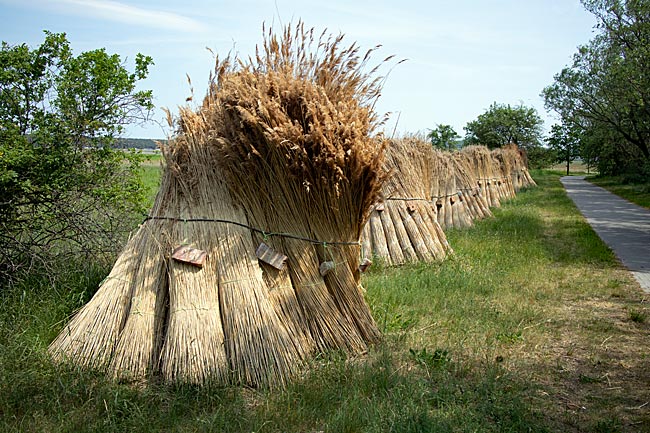
Cut and bundled reed drying
Once the reed has grown tall enough, it is cut and arranged in bundles to dry. The quality of this raw material determines how long a thatched roof will last. Covering a roof with reed is a specialized craft with a long tradition. Since 2014, this craft has been listed by UNESCO as intangible cultural heritage at the request of the state of Mecklenburg-Vorpommern.
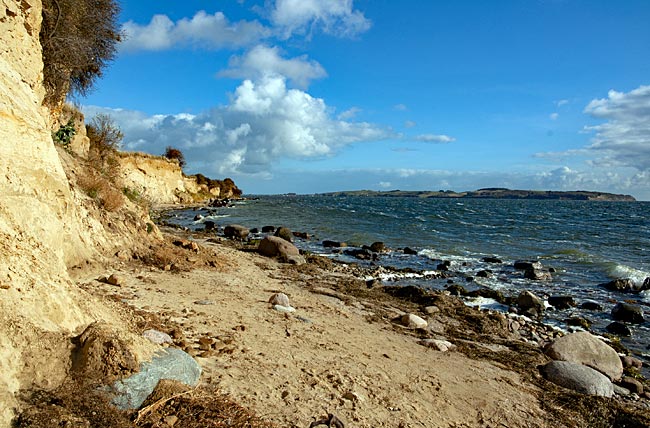
Cliff at the end of Reddevitzer Höft overlooking Hagensche Wiek Bay in the Rügischer Bodden
The farther you cycle along Reddevitzer Höft, the sparser the settlements become. Where no houses or trees obstruct the view, you can see the Rügischer Bodden with Having Bay on one side and Hagensche Wiek Bay on the other. This is especially true when you reach the 33-meter-high elevation at the end of the peninsula. From the cliff, you have a wide view across the water toward Vilm Island or the village of Gager with its small harbor.
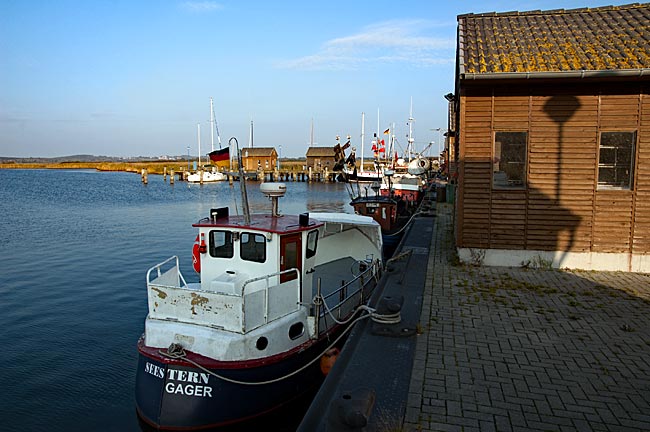
Harbor in Gager


Map
1. Rügen by the Baltic Sea
Start
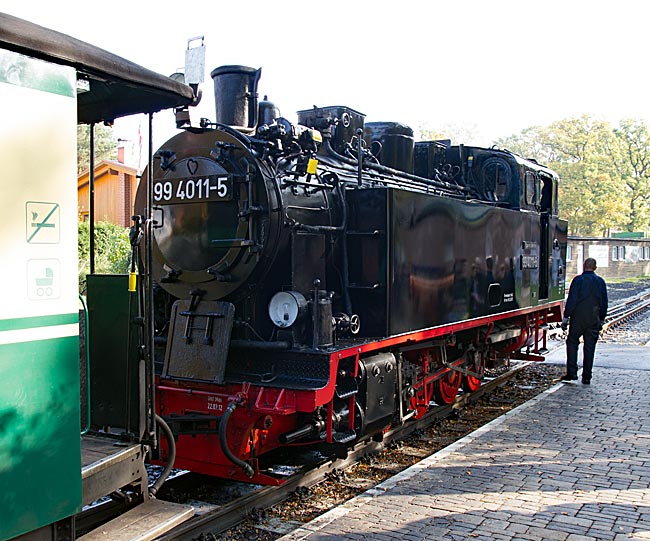
We are on our way to Göhren, where Nordperd, a forested cape with steep cliffs belonging to the eponymous municipality, marks the easternmost point of the island. The Intercity terminates in Binz, Rügen’s largest seaside resort, and from there you can continue by bus - but it’s more attractive to take the Rasende Roland all the way to Göhren.
Seaside Resort Göhren
The wide “Amber Promenade,” renovated in 2003 for the International Horticultural Exhibition, is one of the resort’s main meeting points with its cafés, restaurants, shops, mini-golf course, themed gardens, and play areas for children. Naturally, this is also because the long north beach, Göhren’s actual bathing beach, lies just behind it.
read more about Rügen ...
2. Rügen by the Baltic Sea
Nordperd: hiking through the forest to the cliff
The mostly forested promontory - this is what the word Perd means in Slavic - is part of the Mönchgut Biosphere Reserve. And indeed, from the air, the area juts out like a green pointed triangle into the sea.
Along the beach to Thiessow and Klein Zicker
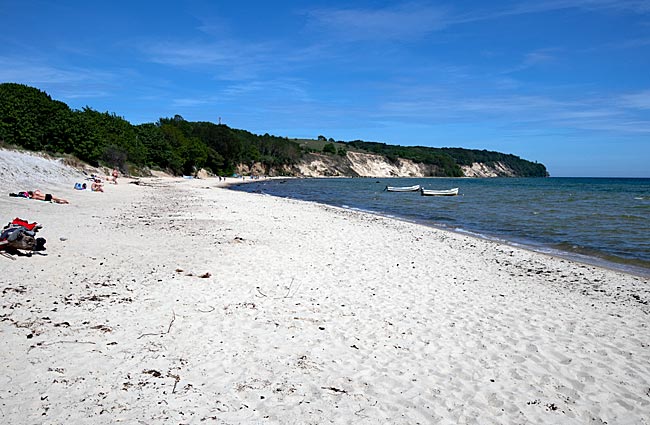
After a short museum visit, our path leads us through the sand of the Baltic Sea past the village of Lobbe to the end of the beach in Thiessow - a considerable distance for persistent hikers coming from Göhren, always with a salty breeze in their noses.
read more about Rügen ...
3. Rügen by the Baltic Sea
actual page
4. Rügen by the Baltic Sea
Seaside resort tour on foot or by bike
From the north beach in Göhren, the next seaside resort in the other direction is already within sight: Baabe. So you can simply stroll barefoot along the water or use the Amber Promenade as an equally direct route, though with a solid surface. Cyclists can also make good use of this and find it well-developed parallel to the promenade. A slightly bumpy and longer option is the combined cycling and hiking trail through the forest, connecting the two seaside resorts over 2.5 kilometers.
A bike trip form Baabe to Seedorf and to the seven megalithic tombs from the Stone Age near Lancken-Granitz
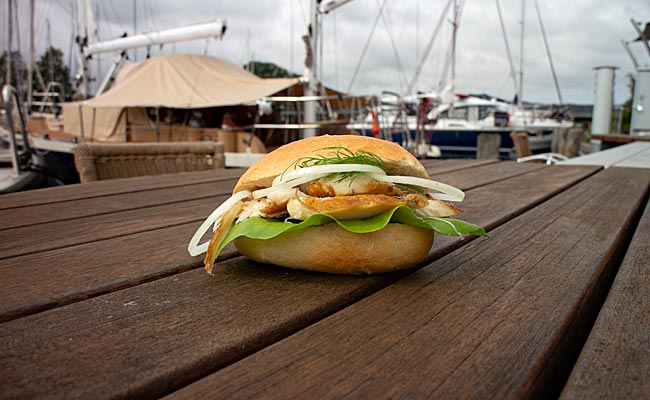
The charm of Seedorf lies primarily in its harbor: docks with moorings for many recreational boats along both shores of the inlet to Neuensiener See. Here, sailboats and motor yachts are safely anchored away from the sometimes rough seas of the Baltic Sea, yet their skippers can quickly reach it if needed.
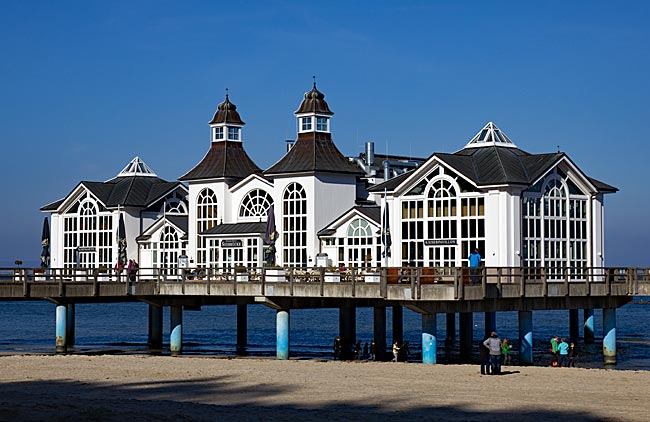
A seabridge and spa architecture in Sellin
Long before reaching Sellin along the beach, you’ll spot the impressive 394-meter-long pier, which has a turbulent history dating back to the early 20th century.But Sellin has more to offer than just the magnificent structure right on the beach. The so-called "Stairway to Heaven" leads up many steps to the high bluff, connecting the pier with Wilhelmstraße promenade.
read more about Rügen ...
5. Rügen by the Baltic Sea
Through the forest to Jagdschloss Granitz
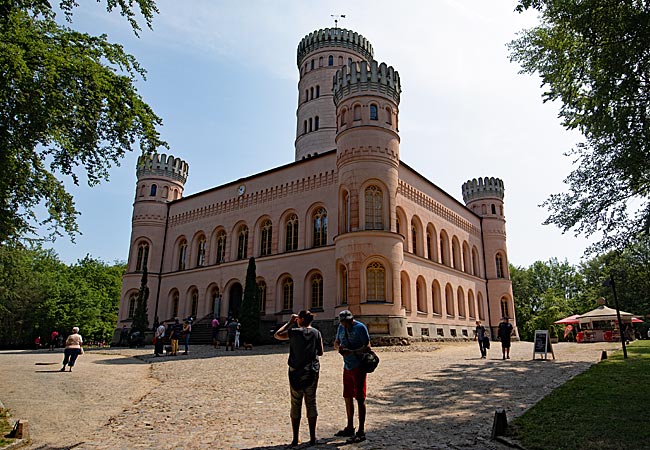
It's about 5 kilometers from Sellin through forest paths up to Jagdschloss Granitz. If you're on foot, you can initially take the cliff path through rough terrain at your own risk; by bike, there are additional better-developed paths. All paths eventually converge and lead well-signposted to the hunting lodge and Binz. The castle is also located along the route of the Rasender Roland, about one kilometer downhill to the station. In the other direction, it's about 3 kilometers through the forest to Binz.
Art and more in Binz, the largest seaside resort on Rügen
If you arrive as a visitor from the sea side, on the one hand, the size of the place in general and the 1890-opened Kurhaus as the unmistakably largest and most impressive building in particular catch your eye. Even in the off-season, Binz is much livelier and busier than the places in its immediate vicinity. Historical houses in the style of spa architecture can also be found here, whether directly on the beach promenade or in the shopping streets of the town. And regardless of whether you arrive by ship or by bus, you are immediately in the midst of the action.
read more about Rügen ...
6. Rügen by the Baltic Sea
From Binz to Sassnitz
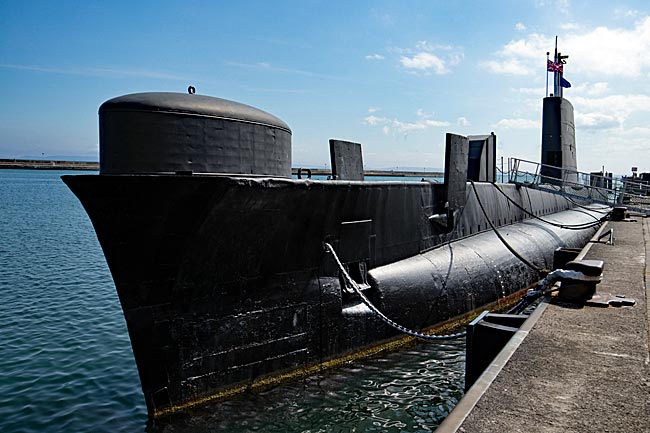
Since 2007, a 250-meter-long suspension bridge has allowed pedestrians to quickly reach the city harbor from the city center - offering a wide view of the harbor and the Baltic Sea. If you use the suspension bridge, you will immediately encounter the most unusual ship in the harbor: the H.M.S. Otus. This 90-meter-long British submarine of the Oberon class, built in 1962, has been decommissioned and is now a walkable museum.
To the chalk cliffs with the 118-meter-high Königsstuhl in Jasmund National Park
From Göhren, Sellin, Bilz, or Sassnitz, you can also book a trip to the chalk cliffs with the ships of Adler-Reederei, offering a view from below of the relics from the Cretaceous period, which began approximately 145 million years ago and ended around 66 million years ago, instead of the panoramic view from above.
read more about Rügen ...
7. Rügen by the Baltic Sea
By water to Lauterbach and Putbus
Sellin. The open Baltic Sea on one side, a lake, a bay, and a "shallow bay-like coastal water body" - the Bodden - on the other. This is where the ships of the White Fleet sail. From Lauterbach, a two-lane main road leads about two kilometers into the center of Putbus - getting lost on the green avenue is practically impossible. Thus, after the described walk, you first encounter the Circus. The model for the facility built between 1828 and ’45 was the Circus constructed a century earlier in the English spa town of Bath.
read more about Rügen ...
8. Rügen by the Baltic Sea
Travel Information
Many hopefully helpful pieces of information for the described part of Rügen. Unfortunately, not all websites are available in English yet. Nevertheless, I am sure you will have a wonderful time on Germany's largest island. Take care.
read more about Rügen ...