

DISTANT PLACES
Travel tips for destinations far from the Hanseatic City of Bremen
Rügen by the Baltic Sea
Hiking, cycling & more in the southeast of the island
Page 6 of 8
From Binz to Sassnitz
The journey takes you past the unique construction project Prora. The five remaining originally identical residential blocks were built between 1936 and 1939 and were intended to form the basis of the KdF-Seebad Rügen, a much larger planned project that was never completed. The complex, stretching 2.5 kilometers along the Prorer Wiek, is now primarily a residential area after renovations. Nearby is the Naturerbe-Zentrum Rügen, opened in 2013, featuring the Forsthaus Prora, a 650-meter-long treetop walkway, and a 40-meter-high observation tower.
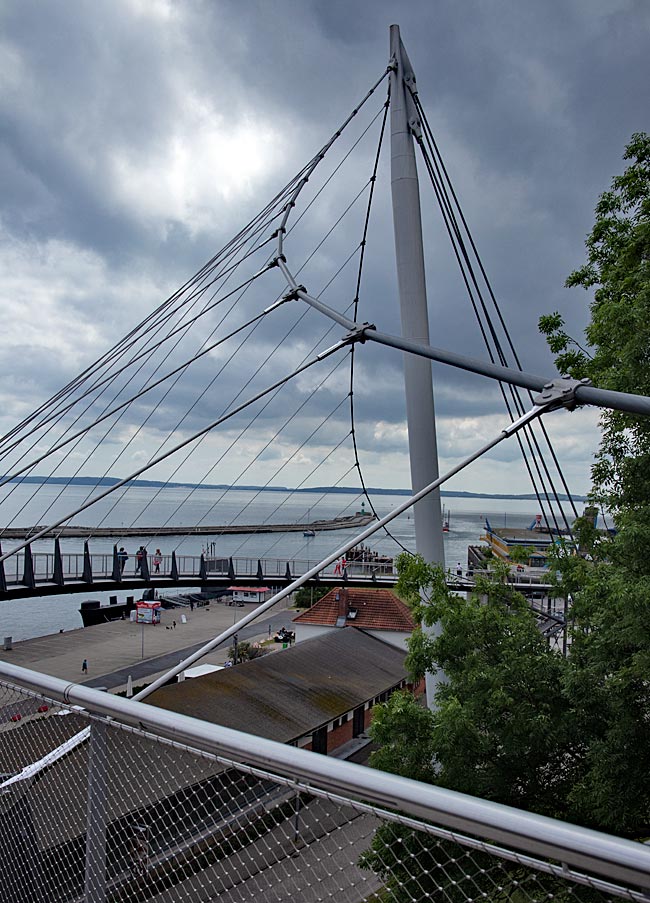
View of the suspension bridge under a cloudy sky
From the ZOB (central bus station) in Sassnitz, the final stop of the bus line, you cross the adjacent parking lot, walk through the short car-free shopping mile Rügen-Galerie, and find yourself just a stone's throw from the city harbor on the square to the right of the unmissable Rügen Hotel. The harbor lies 22 meters below, as a glance reveals. Since 2007, a 250-meter-long suspension bridge has allowed pedestrians to quickly reach the city harbor from the city center - offering a wide view of the harbor and the Baltic Sea. The airy structure noticeably sways when people move on it and may not be for everyone due to its height. Alternatively, a staircase behind the hotel also leads pedestrians into the harbor area.
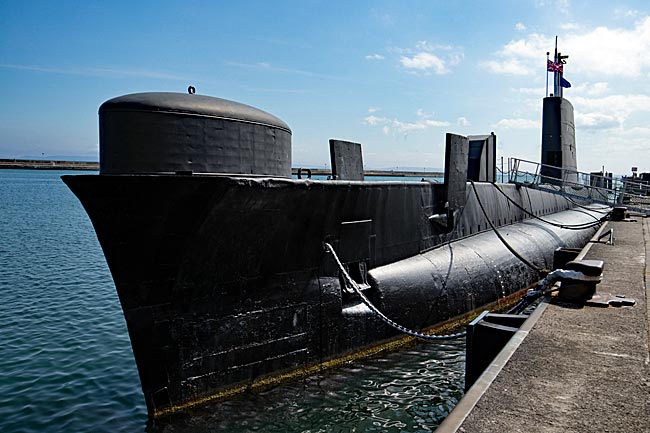
The submarine H.M.S. Otus in the city harbor is now the museum "Erlebniswelt U-Boot"
If you use the suspension bridge, you will immediately encounter the most unusual ship in the harbor: the H.M.S. Otus. This 90-meter-long British submarine of the Oberon class, built in 1962, has been decommissioned and is now a walkable museum. Once, 68 men of the Royal Navy served on board before it was taken out of service in 1991 and later turned into the submarine museum "Erlebniswelt U-Boot." Even from the outside, the sight evokes a sense of claustrophobia that is further intensified - despite all fascination with the technology - by walking through the ship.
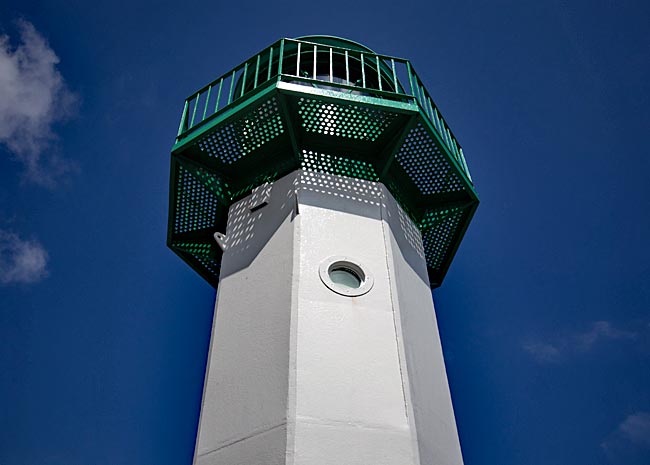
Lighthouse at the entrance to the city harbor
The museum experience continues in the city harbor at the Fishery and Harbor Museum. Founded in 1993 by former fishermen and Sassnitz citizens as a registered association, the museum has been run by the city since 2010. It showcases the city's maritime history, shipping history, fishing history, and fish processing. The museum also includes the former fishing cutter "Havel," moored at the quay in front of the building.
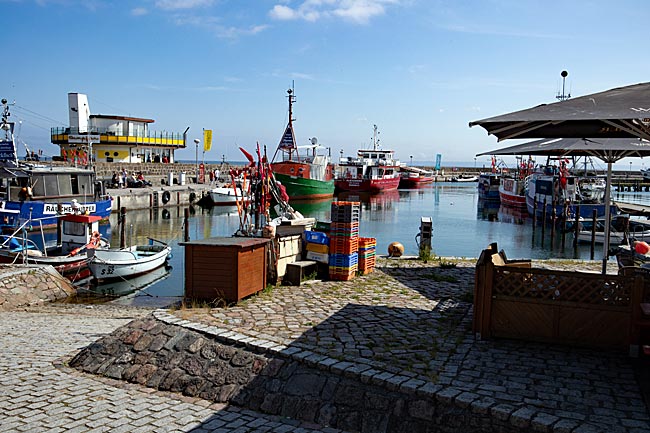
In the rear part of the city harbor, there is food on the cutter
The city harbor is primarily a tourist harbor. Although fish is still landed and processed here, and the DGzRS (German Maritime Search and Rescue Service) has a station, after the ferry traffic to Scandinavia was relocated to the Mukran district, the only watercraft transporting people are the excursion ships to the nearby famous chalk cliffs in Jasmund National Park. Most other ships may have water under their keels, but they don't move - they serve as floating gastronomy.
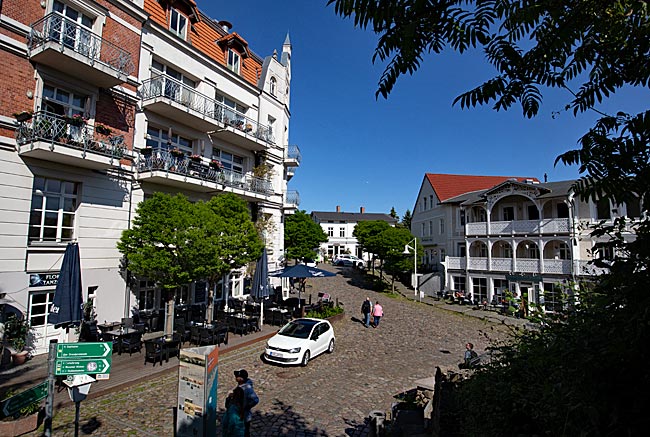
On the way through the old town
You can find gastronomy on solid ground when you turn from Hafenstraße onto the Strandpromenade. Here, you can stroll to the compact old town with its notable buildings in the style of spa architecture in the Kurviertel (spa district).
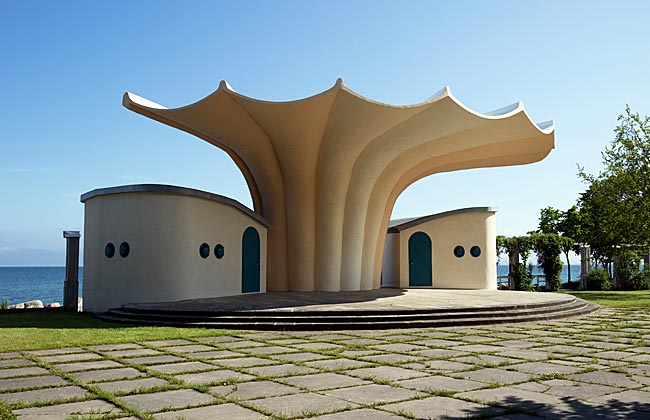
Unusual architecture: the "Kurmuschel" at Kurplatz
A recognized health resort naturally needs a spa park (Kurpark) as well. The small park adjoins the Strandpromenade. A monument on the edge of Kurplatz honors the fishermen who lost their lives at sea over many years while working. The Kurplatz is one of 11 stations along the "Sassnitz Rundweg No. 1" through Altsassnitz (old town). Of interest on the paved square is the "Kurmuschel," built by shell construction master Ulrich Müther between 1986 and 1988. The music pavilion replaced a shell demolished in the early 1980s that served the same purpose for many years.
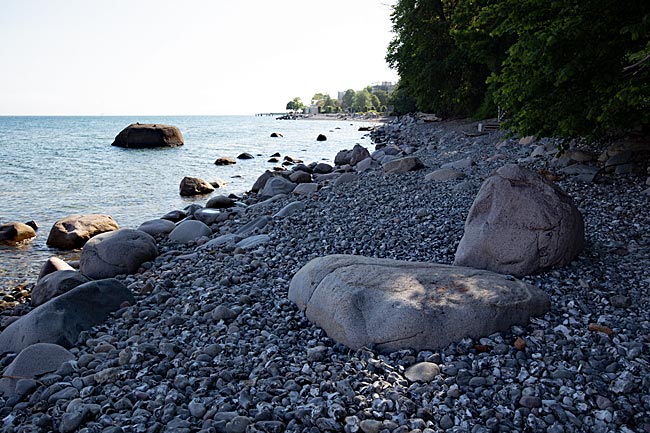
Legacies of the Ice Age
Where the spa park ends, you reach "Klein Helgoland." Bad German? No, the name is the derisive nickname used for centuries for one of the largest boulders on Rügen's coast. The approximately 41 cubic meter "Uskan," its real name, is also a station on the "Sassnitz Rundweg No. 1," as the large stone in shallow water has fascinated people for a long time. Bridges were built from the pebbly beach to it, and benches were placed there, but after the destruction of the last bridge in 2002, nothing remains except an old staircase that reminds us that until 1912, the Herrenbad (men's bath) was located here - naturally separated by gender at the time.
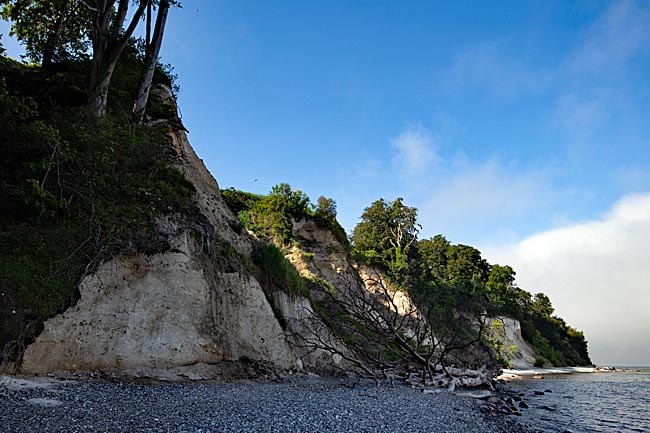
As far as the feet will take you ... and suddenly came the sea fog
You can walk along the steep coast past Uskan. Here begins Jasmund National Park, which has been a UNESCO World Heritage Site since 2012 due to its beech primeval forests. The most famous part of the steep coast with its chalk cliff formation is the 118-meter-high Königsstuhl in the Stubbenkammer. You can hike there along an approximately 11-kilometer-long coastal path, but a shuttle bus also runs.
To the chalk cliffs with the 118-meter-high Königsstuhl in Jasmund National Park
From Göhren, Sellin, Bilz, or Sassnitz, you can also book a trip to the chalk cliffs with the ships of Adler-Reederei, offering a view from below of the relics from the Cretaceous period, which began approximately 145 million years ago and ended around 66 million years ago, instead of the panoramic view from above. From Göhren, you will be on the water for about five hours.
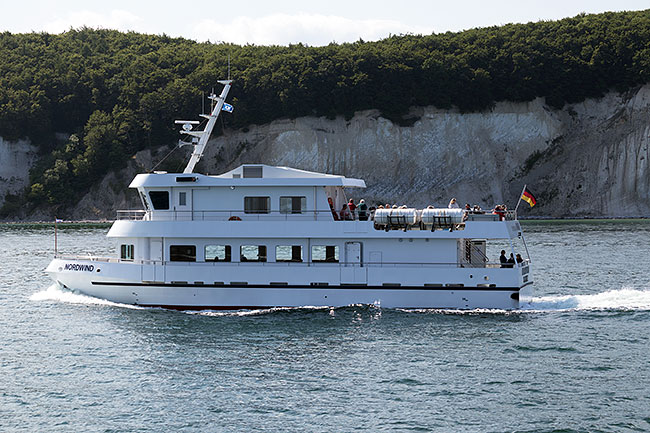
Encounter with a small excursion ship from Sassnitz in front of the chalk cliffs
The journey is uneventful over long stretches; the coast, apart from the mentioned places, is sparsely populated and largely forested. After stopping in Binz, you can see the tip of the already-mentioned treetop walkway at Naturerbe Zentrum Rügen rising above the treetops. Soon after, the coastal forest ends, and the excursion ship approaches Mukran, a district of Sassnitz. More precisely, the ship approaches Mukran Port, the ferry port of Sassnitz. From 1986 to 2016, large ferries shuttled between here and the port city of Klaipeda in Lithuania. The largest railway ferry port on the German Baltic Sea coast is now, among other things, a transshipment point for offshore wind power plants alongside ferry traffic with the Danish island of Bornholm.
How much longer? Gas as an energy source for heat generation
Energy has also played and continues to play a role in this deep-water harbor. Initially, during the construction of the Nord Stream 2 gas pipeline, which was supposed to bring more Russian gas to Germany but never did, and today as the mooring site of a floating LNG terminal for supplying gas from liquefied natural gas sources from other nations.
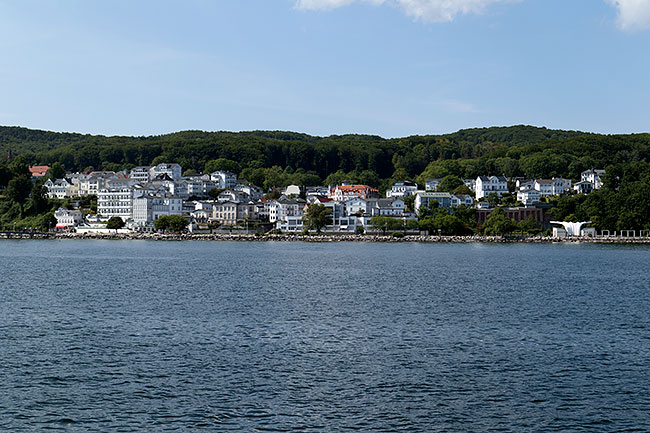
View of Sassnitz's old town from the water
After stopping at the city harbor, the ship passes by Sassnitz's old town on its way to the chalk cliffs. The sheer size of the bright rock formations becomes apparent when you see people at the water's edge. The journey is accompanied by informative explanations over the ship's loudspeakers and ends at Königsstuhl with photo shoots first from portside and then from starboard after turning around.
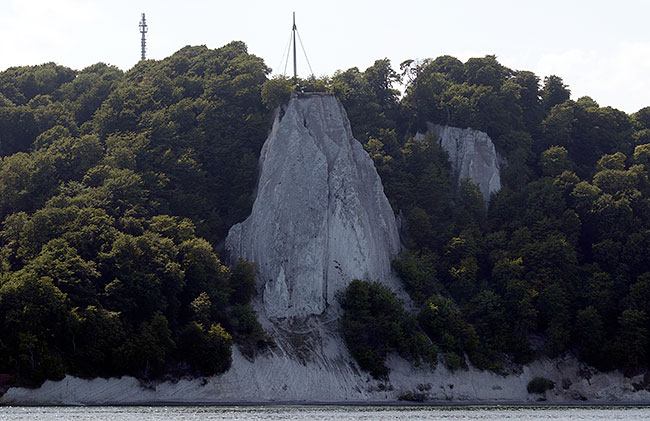
Outstanding: The Königsstuhl
Then it says: "This ride ends here, please disembark." A little joke - nobody is going for a swim. No, of course the ship takes the same route back, unless you get off in Sassnitz and shorten your return trip to other destinations by bus.
Earlier, I mentioned that parts of the journey are uneventful, that wasn’t meant negatively at all. The better the weather conditions, the more enjoyable the journey itself may become. There’s refreshment on board, and with a drink in hand, the constant hum of the ship’s engines and the lapping of the waves might set your thoughts free - just like the vastness of the Baltic Sea.
Sometimes, you just need to let your soul relax


Map
1. Rügen by the Baltic Sea
Start
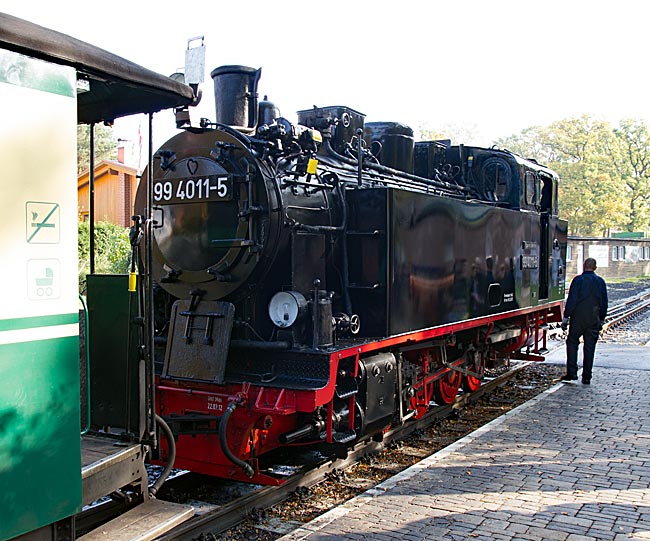
We are on our way to Göhren, where Nordperd, a forested cape with steep cliffs belonging to the eponymous municipality, marks the easternmost point of the island. The Intercity terminates in Binz, Rügen’s largest seaside resort, and from there you can continue by bus - but it’s more attractive to take the Rasende Roland all the way to Göhren.
Seaside Resort Göhren
The wide “Amber Promenade,” renovated in 2003 for the International Horticultural Exhibition, is one of the resort’s main meeting points with its cafés, restaurants, shops, mini-golf course, themed gardens, and play areas for children. Naturally, this is also because the long north beach, Göhren’s actual bathing beach, lies just behind it.
read more about Rügen ...
2. Rügen by the Baltic Sea
Nordperd: hiking through the forest to the cliff
The mostly forested promontory - this is what the word Perd means in Slavic - is part of the Mönchgut Biosphere Reserve. And indeed, from the air, the area juts out like a green pointed triangle into the sea.
Along the beach to Thiessow and Klein Zicker
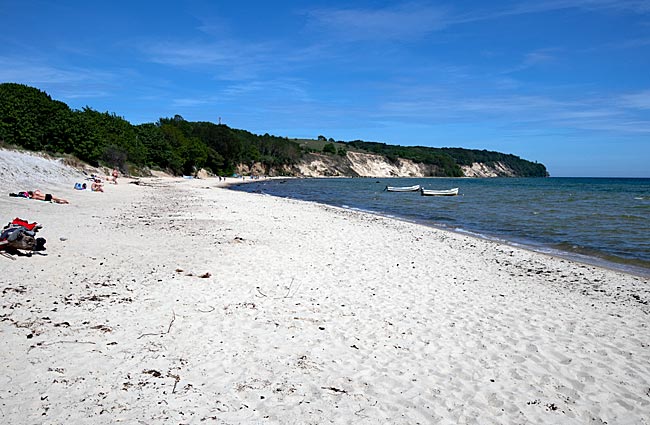
After a short museum visit, our path leads us through the sand of the Baltic Sea past the village of Lobbe to the end of the beach in Thiessow - a considerable distance for persistent hikers coming from Göhren, always with a salty breeze in their noses.
read more about Rügen ...
3. Rügen by the Baltic Sea
Cycling from Göhren to Reddevitzer Höft
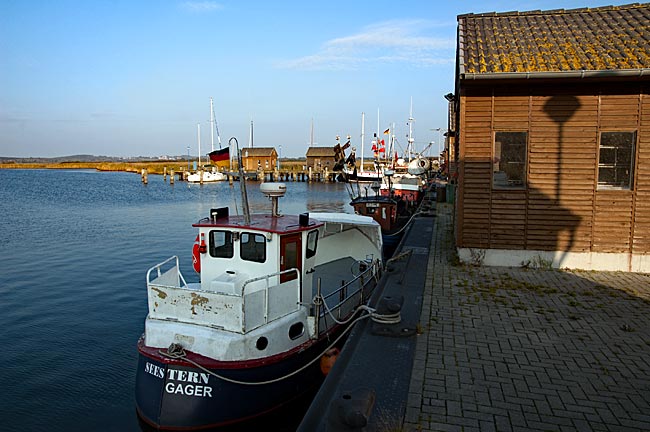
The farther you cycle along Reddevitzer Höft, the sparser the settlements become. Where no houses or trees obstruct the view, you can see the Rügischer Bodden with Having Bay on one side and Hagensche Wiek Bay on the other. This is especially true when you reach the 33-meter-high elevation at the end of the peninsula. From the cliff, you have a wide view across the water toward Vilm Island or the village of Gager with its small harbor.
read more about Rügen ...
4. Rügen by the Baltic Sea
Seaside resort tour on foot or by bike
From the north beach in Göhren, the next seaside resort in the other direction is already within sight: Baabe. So you can simply stroll barefoot along the water or use the Amber Promenade as an equally direct route, though with a solid surface. Cyclists can also make good use of this and find it well-developed parallel to the promenade. A slightly bumpy and longer option is the combined cycling and hiking trail through the forest, connecting the two seaside resorts over 2.5 kilometers.
A bike trip form Baabe to Seedorf and to the seven megalithic tombs from the Stone Age near Lancken-Granitz
The charm of Seedorf lies primarily in its harbor: docks with moorings for many recreational boats along both shores of the inlet to Neuensiener See. Here, sailboats and motor yachts are safely anchored away from the sometimes rough seas of the Baltic Sea, yet their skippers can quickly reach it if needed.
A seabridge and spa architecture in Sellin
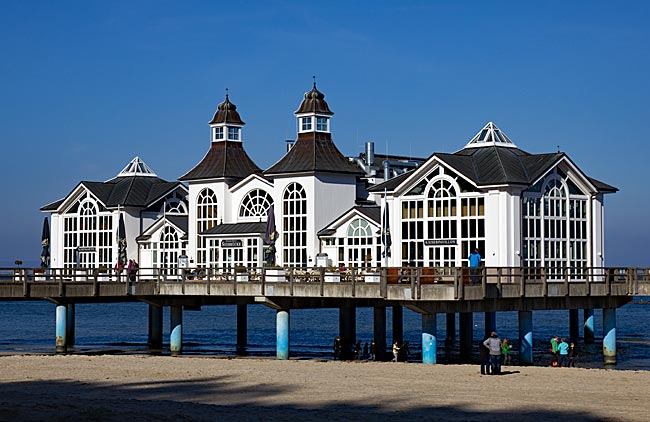
Long before reaching Sellin along the beach, you’ll spot the impressive 394-meter-long pier, which has a turbulent history dating back to the early 20th century.But Sellin has more to offer than just the magnificent structure right on the beach. The so-called "Stairway to Heaven" leads up many steps to the high bluff, connecting the pier with Wilhelmstraße promenade.
read more about Rügen ...
5. Rügen by the Baltic Sea
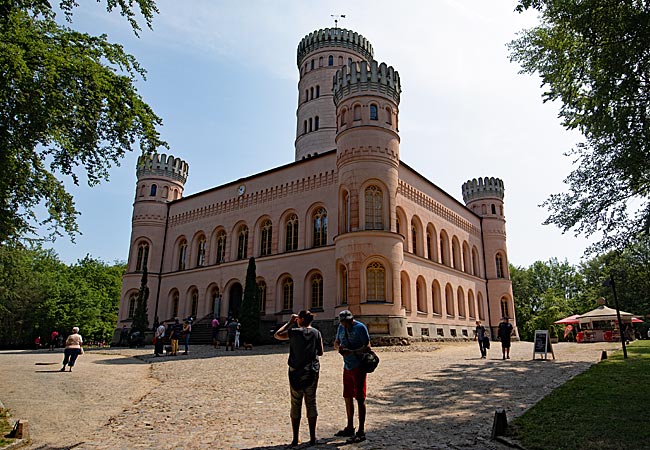
Through the forest to Jagdschloss Granitz
It's about 5 kilometers from Sellin through forest paths up to Jagdschloss Granitz. If you're on foot, you can initially take the cliff path through rough terrain at your own risk; by bike, there are additional better-developed paths. All paths eventually converge and lead well-signposted to the hunting lodge and Binz. The castle is also located along the route of the Rasender Roland, about one kilometer downhill to the station. In the other direction, it's about 3 kilometers through the forest to Binz.
Art and more in Binz, the largest seaside resort on Rügen
If you arrive as a visitor from the sea side, on the one hand, the size of the place in general and the 1890-opened Kurhaus as the unmistakably largest and most impressive building in particular catch your eye. Even in the off-season, Binz is much livelier and busier than the places in its immediate vicinity. Historical houses in the style of spa architecture can also be found here, whether directly on the beach promenade or in the shopping streets of the town. And regardless of whether you arrive by ship or by bus, you are immediately in the midst of the action.
read more about Rügen ...
6. Rügen by the Baltic Sea
actual page
7. Rügen by the Baltic Sea
By water to Lauterbach and Putbus
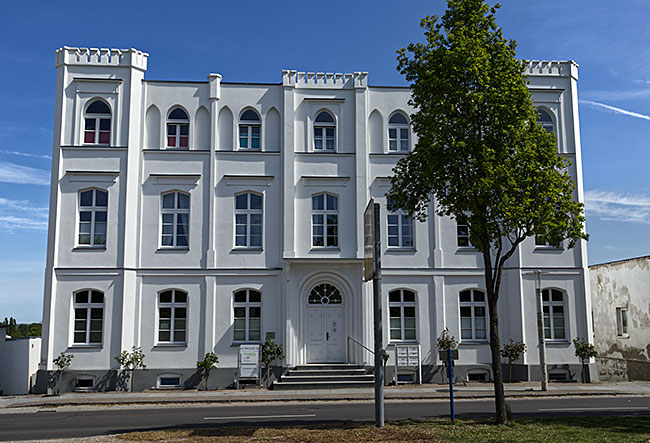
Sellin. The open Baltic Sea on one side, a lake, a bay, and a "shallow bay-like coastal water body" - the Bodden - on the other. This is where the ships of the White Fleet sail. From Lauterbach, a two-lane main road leads about two kilometers into the center of Putbus - getting lost on the green avenue is practically impossible. Thus, after the described walk, you first encounter the Circus. The model for the facility built between 1828 and ’45 was the Circus constructed a century earlier in the English spa town of Bath.
read more about Rügen ...
8. Rügen by the Baltic Sea
Travel Information
Many hopefully helpful pieces of information for the described part of Rügen. Unfortunately, not all websites are available in English yet. Nevertheless, I am sure you will have a wonderful time on Germany's largest island. Take care.
read more about Rügen ...
Wismar
The Hanseatic City on the Baltic Sea and its UNESCO World Heritage
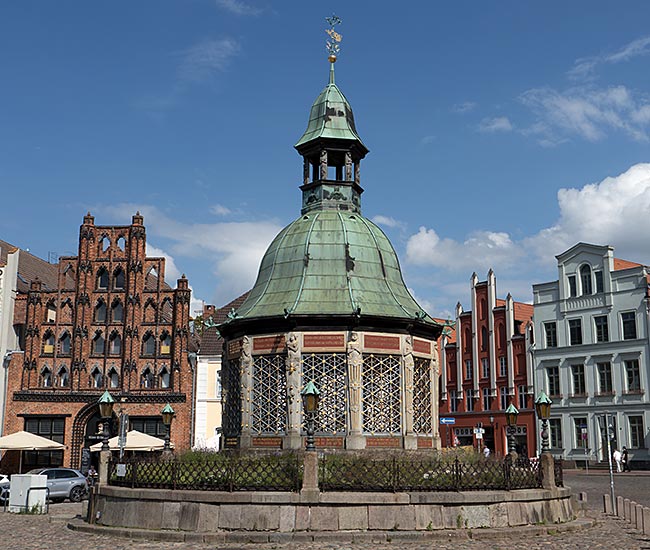
The World Heritage House is a building with a stone front house and an attached timber-framed Kemladen on a foundation of loose fieldstones from a medieval predecessor building. This beautifully restored small building complex visually illustrates and provides information via text panels about the lives of past generations in the hall houses typical for Wismar, along with their outbuildings. Additionally, there is extensive information about the city’s history and numerous protected buildings in the old town - there are 1,754 in total, with 306 designated as individual monuments. In the old town, one is right in the middle of Wismar’s UNESCO World Heritage Site.
read more about Wismar ...
Rostock and Warnemünde by the Baltic Sea
A travel guide
A mini-guide through the Hanseatic city of Rostock and its beautiful beach destination, Warnemünde. Home to one of the oldest universities in the Baltic region, the city boasts a rich history. Join us on a tour of discovery.
read more about Rostock ...
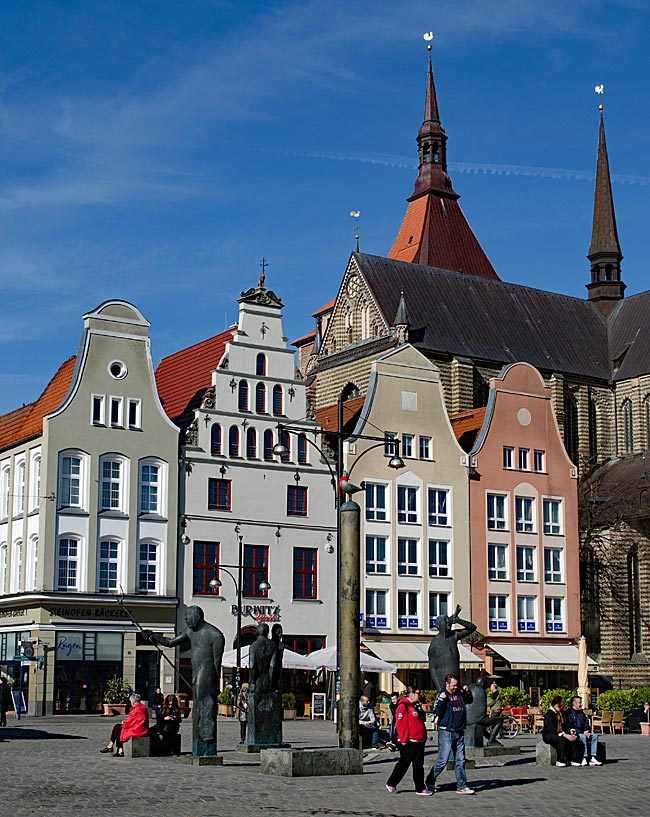
In the Probstei in late summer
Schönberger Strand and sea and more
Can you walk or ride a bike from Brasilien (Brazil) to Kalifornien (California) in just a few minutes, always with a view of the water? No, not with your finger on the globe or map, but in person. You’ll have to forgo Copacabana and the Sunset Strip with the Angels in Los Angeles (Spanish for "The Angels"). Instead, you get Germany’s "True North" with all its bright sides. Of course, there are sometimes shadows here too, but they belong only on the margins of this story.
read more about Schönberger Strand ...
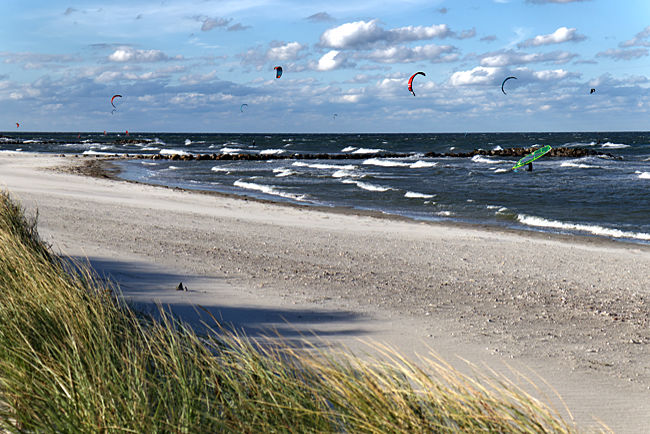
Crabs, dikes and the Wadden Sea
The North Sea spa town of Büsum
Once an island, Büsum was repeatedly threatened by the "Blanken Hans". When the greatest flood of the last century struck in 1962, Büsum was already long connected to the mainland - since 1585. Today, this town of around 5,000 residents, part of the Dithmarschen district, is one of the most important holiday destinations along Schleswig-Holstein's North Sea coast. Since 1985, the sea in front of Büsum has been protected as the Schleswig-Holstein Wadden Sea National Park, and since 2009, it has also been listed as a UNESCO World Heritage Site.
read more about Büsum ...