

DISTANT PLACES
Travel tips by Bremen sehenswert far from the Hanseatic City of Bremen
Hanseatic City of Rostock - A Travel Guide
Kröpeliner Tor (Gate)
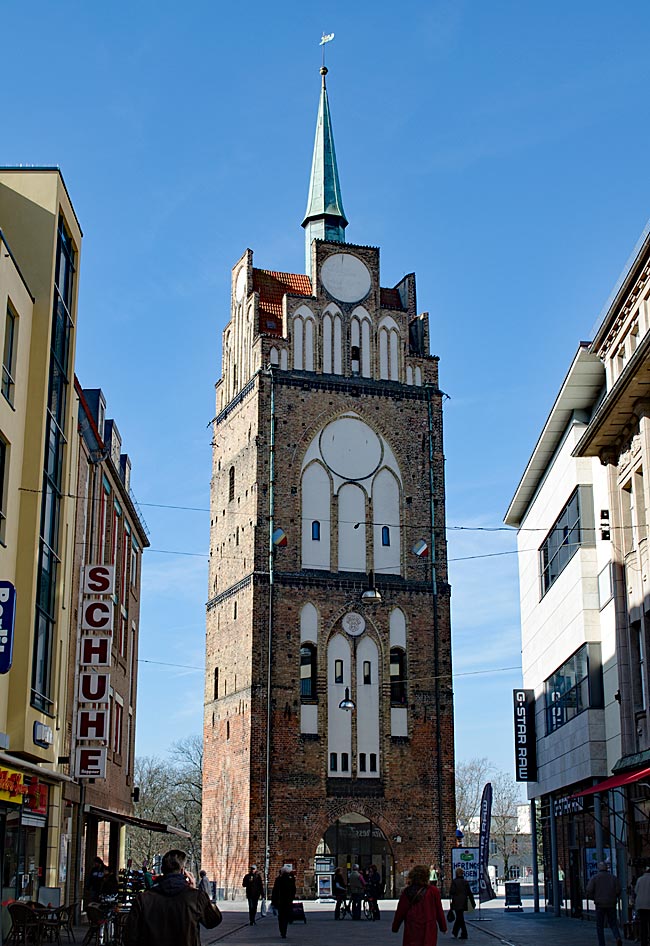
Kröpeliner Tor
The Kröpeliner Tor is undoubtedly the most impressive of the four remaining city gates out of the original twenty-two. Standing 54 meters tall, this brick structure is visible from afar and today marks the western end of Kröpeliner Straße, a pedestrian shopping street in the heart of Rostock's inner city. Historically, this important trade route to Lübeck and Wismar passed through this gate.
Originally, the square tower, likely built around 1270 in the Gothic style and first mentioned in documents in 1280, consisted of only two stories topped by a double German band - a decorative frieze made of overlapping bricks. The expansion to its current height, adding five more stories with a stepped gable featuring four blind arches and a small turret as the crowning element, took place in 1400. The different coloration of the stones used reveals where this addition was made.
The reason for expanding this important structure lies in the significance of the Hanseatic League, an association of Low German merchants who conducted successful trade - primarily by sea and with foreign countries - between the mid-12th century and the mid-17th century. After the people of Rostock purchased the fishing village of Warnemünde from the Danes in 1323 (located at the mouth of the river flowing through their city), they received the right to mint their own coins two years later and finally gained full judicial authority in 1358. This elevated status made Rostock one of the most important members of the Hanseatic League, a position it held until the league's dissolution in 1669. The expansion of the Kröpeliner Tor reflected Rostock’s growing economic importance as a city of the Hanse - incidentally, the easternmost one.
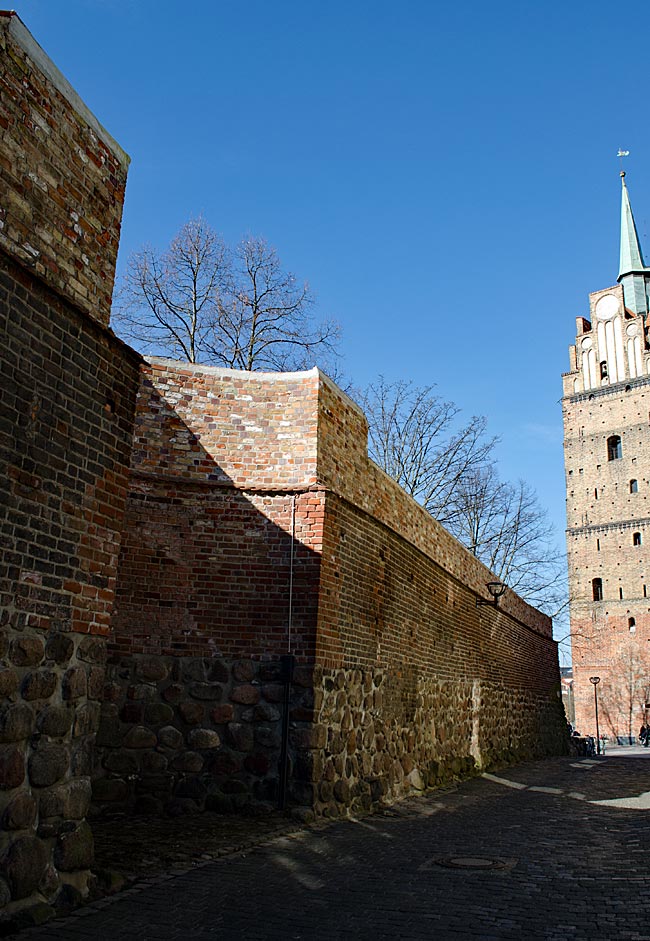
Old city wall near the Kröpeliner Tor
If the city became involved in military conflicts, the tower provided the opportunity to install a wooden walkway at a height of 7 meters. At that time, the gate was still connected to the city wall, which was later demolished after World War II - despite the gate surviving the war almost unscathed - due to traffic planning. Nevertheless, alongside the opening for Kröpeliner Straße, part of the old city wall remains, and one can still walk along it toward the Abbey of the Holy Cross.
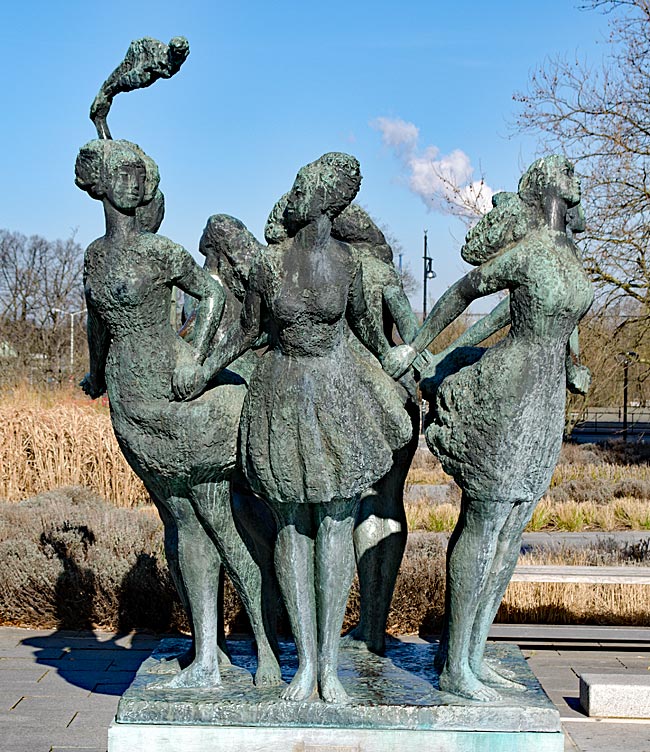
Sculpture "Seven Proud Sisters Kiss One Sea" by Artist Reinhard Dietrich (1970) on a square near the gate
Until 1960, trams passed through the gate. From 1966 to 1969, the structure was restored and its rooms converted into the Museum of City History. After the museum closed in 2004, the spaces now house the Rostock History Workshop (Geschichtswerkstatt Rostock e.V.).
previous page
 next page
Read more about Rostock: The table of contents
Map
Rügen by the Baltic Sea
Active holiday featuring cycling and hiking
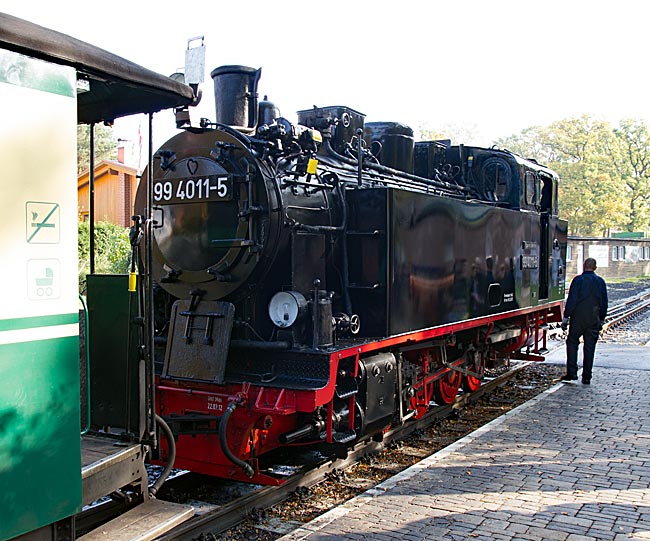
Enjoy an active holiday featuring cycling and hiking along the Baltic coast in Mönchgut on the island of Rügen. Long sandy beaches, rolling hills, and lush forests provide a varied and beautiful setting for your getaway. Often, the only thing breaking the peace is the distant whistle of the historic 'Rasender Roland' steam train. Despite its name (which suggests something "racing" or fast), it’s actually quite the opposite. A journey by train is simply part of the holiday experience.
read more about Rügen ...
In the Probstei in late summer
Schönberger Strand and sea and more
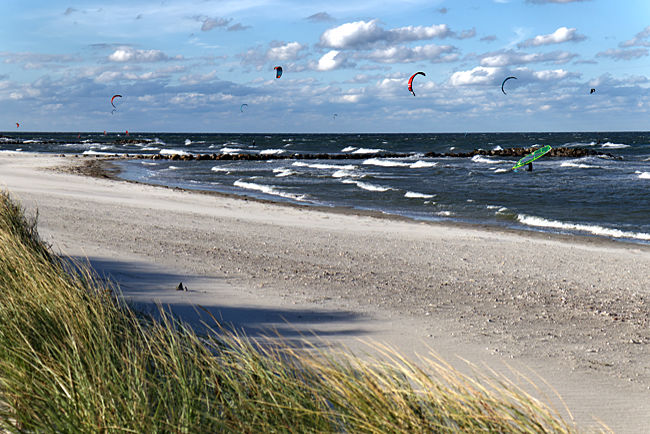
Can you walk or ride a bike from Brasilien (Brazil) to Kalifornien (California) in just a few minutes, always with a view of the water? No, not with your finger on the globe or map, but in person. You’ll have to forgo Copacabana and the Sunset Strip with the Angels in Los Angeles (Spanish for "The Angels"). Instead, you get Germany’s "True North" with all its bright sides. Of course, there are sometimes shadows here too, but they belong only on the margins of this story.
read more about Schönberger Strand ...
Wismar
The Hanseatic City on the Baltic Sea and its UNESCO World Heritage
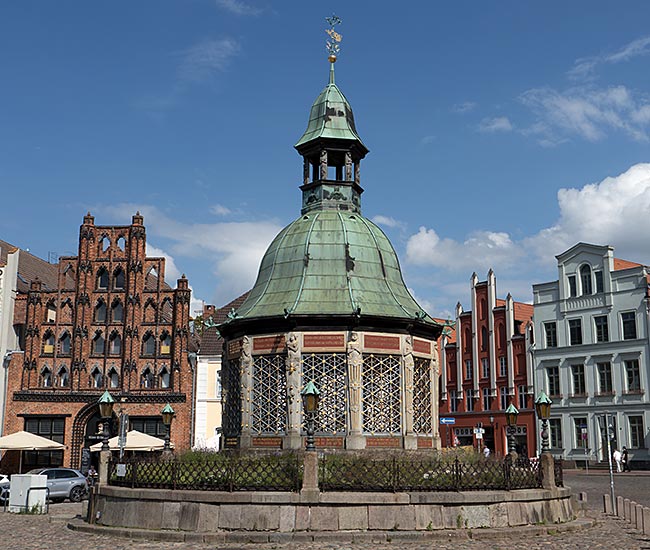
The World Heritage House is a building with a stone front house and an attached timber-framed Kemladen on a foundation of loose fieldstones from a medieval predecessor building. This beautifully restored small building complex visually illustrates and provides information via text panels about the lives of past generations in the hall houses typical for Wismar, along with their outbuildings. Additionally, there is extensive information about the city’s history and numerous protected buildings in the old town - there are 1,754 in total, with 306 designated as individual monuments. In the old town, one is right in the middle of Wismar’s UNESCO World Heritage Site.
read more about Wismar ...
Crabs, dikes and the Wadden Sea
The North Sea spa town of Büsum
Once an island, Büsum was repeatedly threatened by the "Blanken Hans". When the greatest flood of the last century struck in 1962, Büsum was already long connected to the mainland - since 1585. Today, this town of around 5,000 residents, part of the Dithmarschen district, is one of the most important holiday destinations along Schleswig-Holstein's North Sea coast. Since 1985, the sea in front of Büsum has been protected as the Schleswig-Holstein Wadden Sea National Park, and since 2009, it has also been listed as a UNESCO World Heritage Site.
read more about Büsum ...