
 exploring Bremen & its surrounding areas
 You are here: worth seeing in Schwachhausen district
 Schwachhausen district - "better to live strongly than house weakly (schwach hausen)" (1/2)
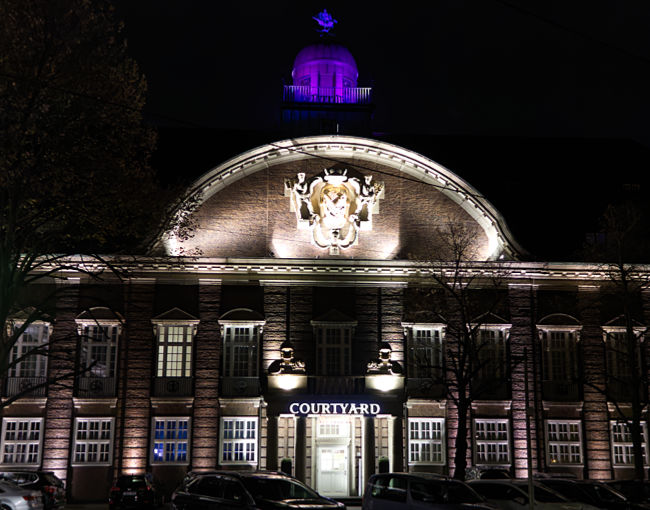
Part of the former Lloyd Station, today’s Courtyard hotel, as seen from Gustav-Deetjen-Allee at night. It is also beautiful to see the copper-clad roof turret, topped with a weather vane featuring a three-masted sailing ship turning with the wind
On February 20, 1857, Hermann Heinrich Meier, Eduard Crüsemann, and Gustav Kulenkampff founded the shipping company Norddeutscher Lloyd, known as NDL, headquartered in Bremen. The Bremen merchants - after whom streets in the Schwachhausen district are today named - could not have imagined that the company would one day become one of the largest shipping companies in the world. Their steamships served scheduled routes from Germany to Australia, East Asia, and across the Atlantic to New York (from 1863).
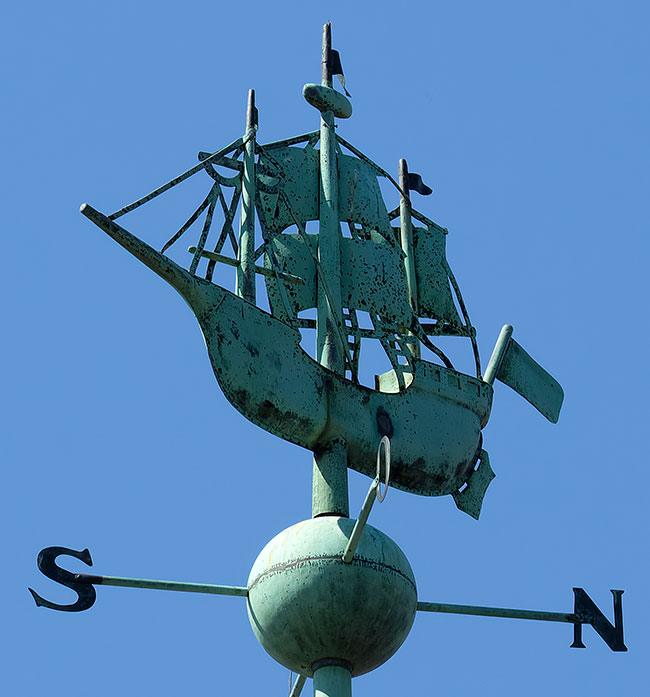
Weather vane with a three-masted sailing ship
Launched in Stettin in 1897, the twin-screw fast steamer with four funnels named "Kaiser Wilhelm der Große" won the prestigious "Blue Riband" that same year for the fastest Atlantic crossing, reaching an average speed of over 22 knots (slightly more than 40 km/h) from Bremerhaven to New York, and held it until 1900. The shipping company reached its zenith in 1914, with 116 steamships transporting passengers and goods to many parts of the world, including countless emigrants. Between 1897 and 1914, millions of people emigrated from Europe, primarily to America. This peak in the wave of emigration made Bremerhaven the largest European port for emigrants, and NDL profited handsomely from it. More information can be found at the German Emigrant House (Deutsches Auswandererhaus) in Bremerhaven.
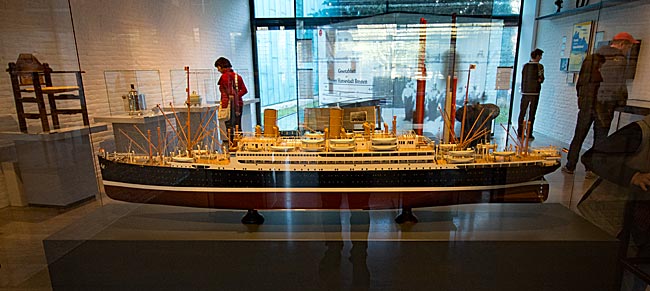
Model (on loan) of the 15,000 GRT passenger steamer "Berlin" of the Norddeutscher Lloyd in the Focke Museum, which was launched on March 24, 1925, at the "Bremer Vulkan" shipyard in Vegesack. The original ship has been on the bottom of the Black Sea since 1986.
Even though the Norddeutscher Lloyd lost nearly its entire fleet during the two World Wars, it never went under before its merger with the Hamburger shipping company HAPAG to form HAPAG-Lloyd. The magnificent main building of the NDL in the city center was destroyed during the war and subsequently demolished. One remaining piece of the demolished Lloyd building in the city center can still be found today in the Schnoor district - specifically, in the street of the same name between house numbers 28 and 29. It is a wrought-iron door with numerous ornaments and the Norddeutscher Lloyd logo set in gold. The door, sometimes referred to as the "Elephant Door" because it happened to fit the dimensions of this new location perfectly, actually features two elephant heads above the NDL logo.
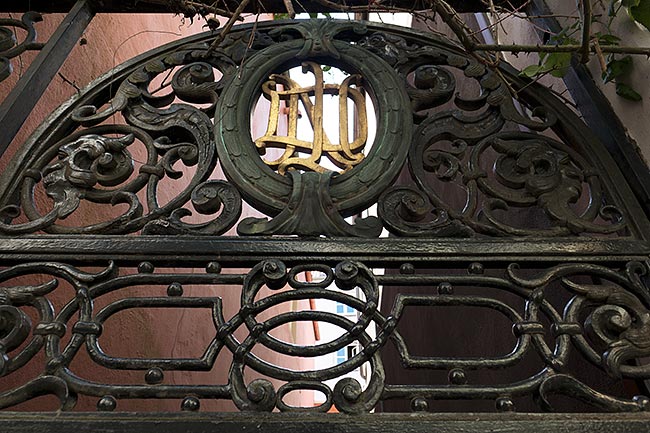
At the time of the photo in 2026, the door was unfortunately overgrown with some greenery and the backyard was not very photogenic
The former - and since 2001, protected monument - Lloyd Station still stands next to the North exit of the main station at the corner of Gustav-Deetjen-Allee and Theodor-Heuss-Allee in the Findorff district on the border of Schwachhausen. The brick building with a hipped roof, constructed in 1913, served as a collection point for emigrants and their luggage before they continued to Bremerhaven until the start of the war. Later, the building was used as a second administrative office and during the Nazi era by the Gestapo. Today, it houses the Courtyard Hotel.
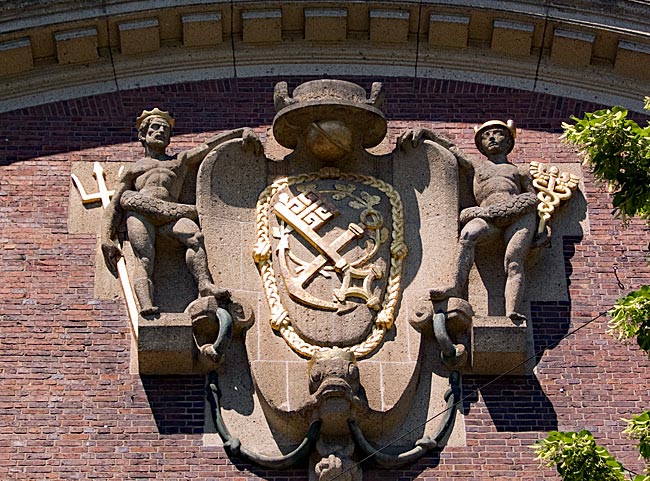
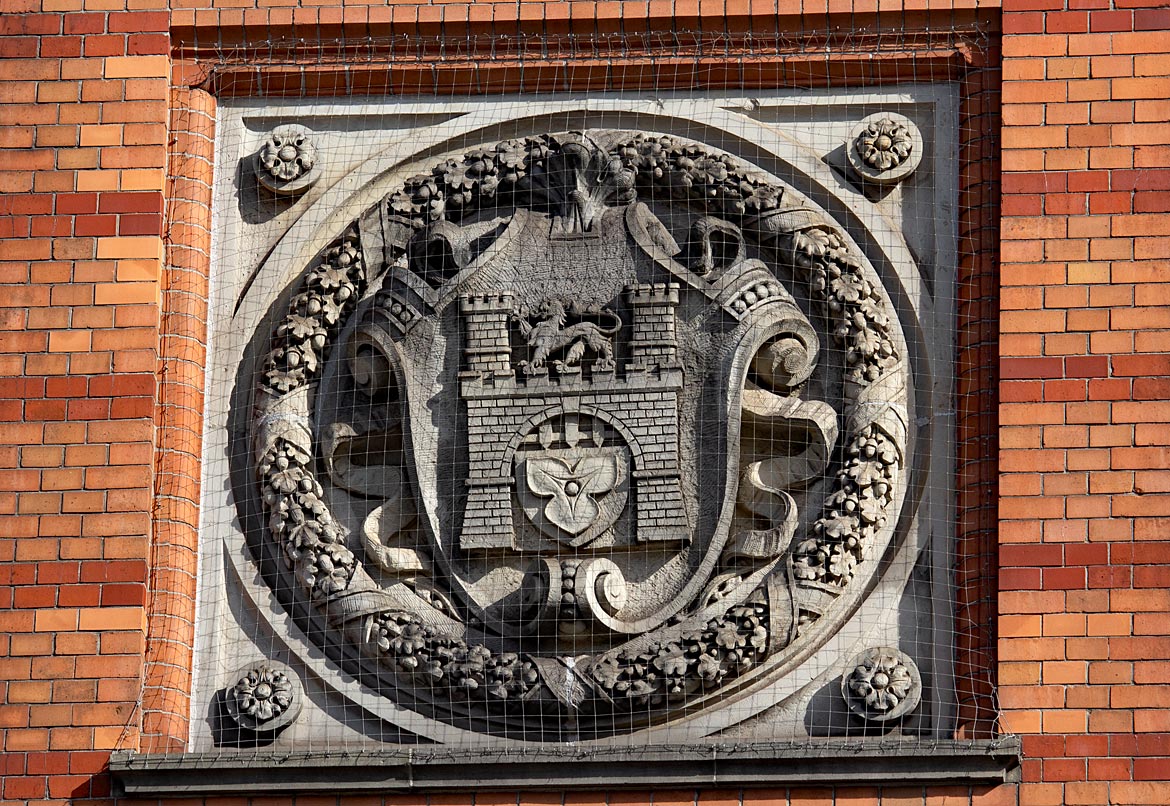
The emblem of Norddeutscher Lloyd at the former Lloyd Station
What wars and subsequent generations have spared in terms of old architecture is increasingly threatened by the passage of time. Softer construction materials used in the past, such as sandstone, are naturally much more susceptible to external environmental influences than materials like concrete. In cases requiring renovation, the expected costs can sometimes exceed those of a new construction. This, among other reasons, is why many old houses continue to disappear from the cityscape in Bremen. Aside from that, not every building is worth protecting or preserving from a heritage conservation perspective simply because it was built one hundred or more years ago.
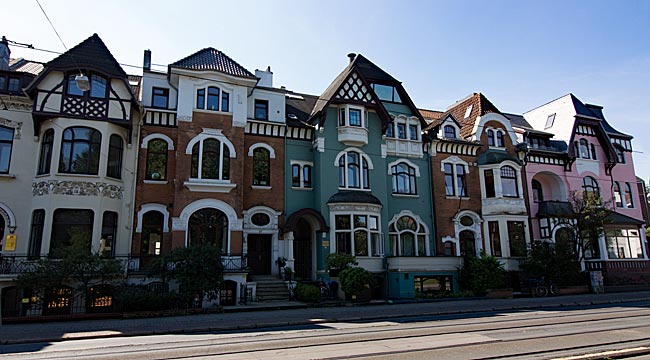
Worth preserving: Part of the monument group on Hermann-Böse-Straße
However, the State Office for Heritage Conservation has placed many residential houses in Schwachhausen under protection. In addition to many others in the district near Parkallee, there are also buildings on Hermann-Böse-Straße, which passes by the "Elephant" anti-colonial monument. Slevogtstraße and Goebenstraße branch off from it. Here, as well as in the adjacent Delbrückstraße, entire rows of houses are protected as monument groups. The predominantly Neoclassical buildings - sometimes featuring historicist elements or features of Art Nouveau (Jugendstil) - were built between 1900 and 1919 for affluent citizens according to designs by architect and contractor Wilhelm Blanke. At that time, entire streets were often constructed from a single design. In total, the Bremen architect - who died in 1945 and was laid to rest at the Riensberger Cemetery - constructed approximately 500 buildings in the Hanseatic city during his career, shaping the cityscape to this day.
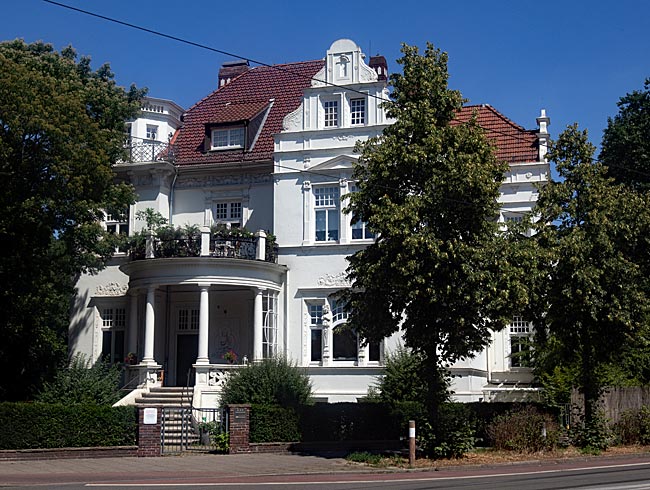
For the petroleum merchant Wilhelm August Korff, architects Friedrich Wellermann and Paul Frölich, along with landscape architect Christian Roselius, designed the Villa Korff at the corner of Parkallee and Wachmannstraße in 1903
The honoring of the Impressionist painter and graphic artist Max Slevogt by naming Slevogtstraße after him is related to his artistic work in the Ratskeller (council cellar) beneath the town hall. In 1927, he painted scenes from "Fantasies in the Bremen Ratskeller" by author Wilhelm Hauff on the walls of what is now known as the Hauff-Keller.
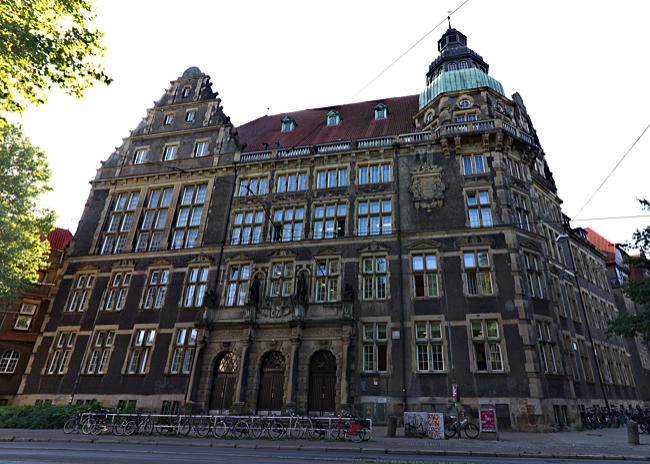
Front view of the Hermann-Böse-Gymnasium with an entrance portal in the style of Weser Renaissance
The design for the building complex of the former Realgymnasium and today's bilingual Hermann-Böse-Gymnasium came not from Blanke’s drafting board, but from those of Berlin architects Ferdinand Köhler, Otto Gröffel, and Paul Kranz. The group from Charlottenburg won the tender for the new construction, and thus their design became a reality in sandstone between 1902 and the official inauguration in 1906. The Neo-Renaissance building with elements of Weser Renaissance, which extends along Hermann-Böse-Straße (formerly Kaiser Friedrich-Straße), Blumenthalstraße, and Hohenlohestraße, has been under monument protection since 1977 and is located only a few meters from today's anti-colonial monument.
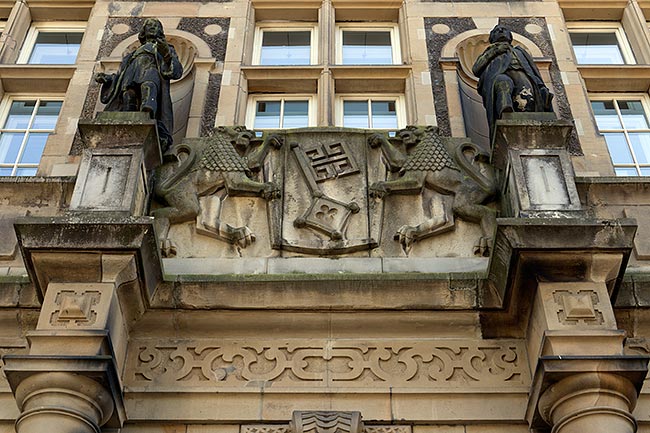
Details of the front view of the Hermann-Böse-Gymnasium
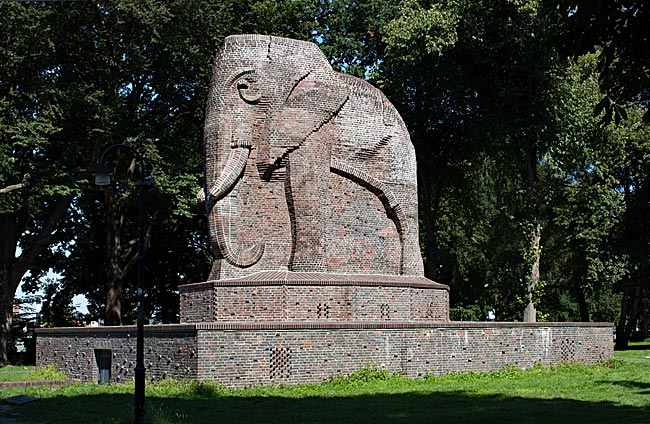
The elephant made of red moor-fire bricks was originally erected in 1932 as a reminder of German colonial history (in Africa), which, from today’s perspective, offers little reason to be proud of. Appropriately, between 1933 and '45, the school bore the name of the German infantry general and commander of the predominantly indigenous Askari-based protection force in German East Africa (modern-day Tanzania) during World War I: Paul von Lettow-Vorbeck. The son of a Prussian infantry general lived in Bremen between 1923 and 1945 after his return. In the meantime, the barracks completed on about 10 hectares in the Vahr district also bore his name, but that too belongs to the past.
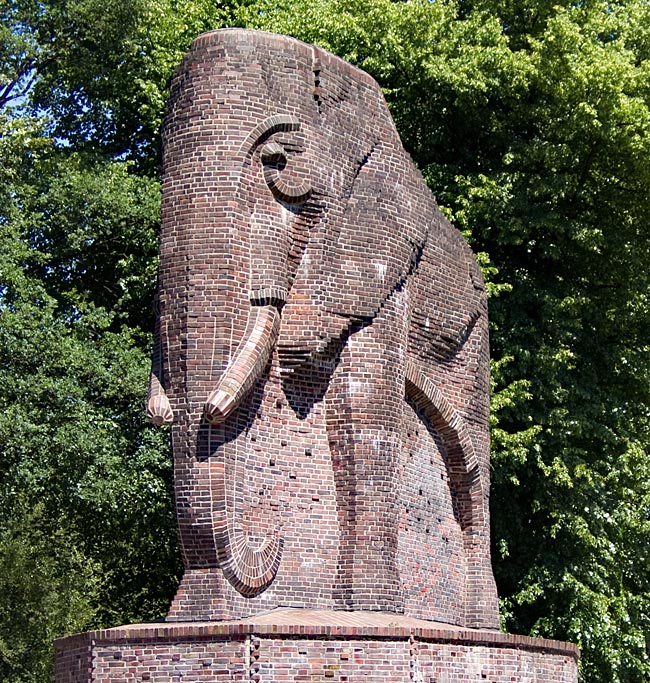
The elephant on its base, which contains a room, in Nelson-Mandela-Park
The current name of the school, as well as the street it sits on, reminds us of the politically active music teacher of the former Realgymnasium and resistance fighter against National Socialism: Hermann Böse. He was affiliated with the KPD (Communist Party). He died from illness in 1943 after being released from the Mißler concentration camp in the Bremen district of Findorff.
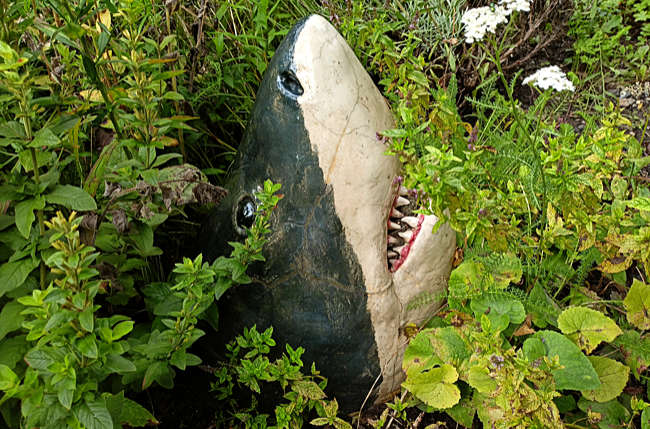
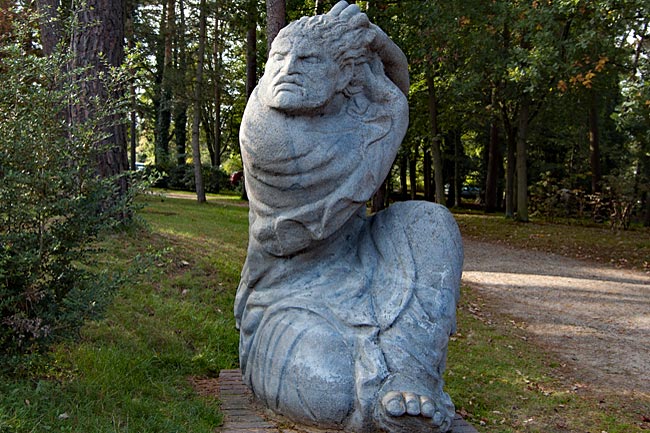
Politics is often a shark-fish-pool - especially in non-democratic societies - where the lives of many actors are threatened and even extinguished. Whoever sacrifices democracy today has learned nothing from the past. Photo: a very successful sculpture in Schwachhausen district.
While honor was stripped from one, another was placed on a pedestal where he stands to this day. And who was it? The Berlin sculptor Louis Tuaillon, whose workshop also produced the bronze statue "The Rider of Rossel" (1902) located in the Wallanlagen. And here on Slevogtstraße, not far from the gymnasium? Since its unveiling on March 22, 1905, the military commander and German Emperor Friedrich III. has sat in bronze in a heroic pose in the style of Roman imperial portraits atop his horse; he has been on the heritage protection list since 1973. Crown Prince Friedrich Wilhelm of Prussia was the son of Emperor Wilhelm I from the House of Hohenzollern.
After his father's death in 1888, he ascended the throne. However, at that time, he was already so severely afflicted by throat cancer that he reigned for only 99 days until his death and was succeeded by his son, Wilhelm II, who was ultimately deposed in 1918 after World War I. This also marked the end of the monarchy in Germany. In common parlance, Friedrich III. is called the "99-Day Emperor," and the year of his short reign is known as the "Year of the Three Emperors."
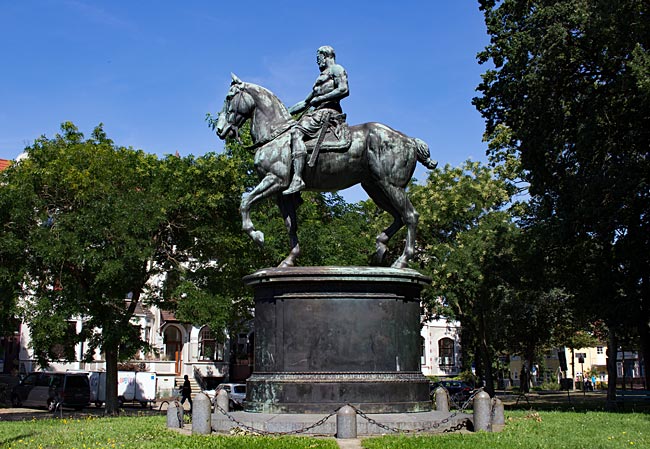
Monument of Kaiser Friedrich III. on Hermann-Böse-Straße; protected houses in Slevogtstraße are behind it
Incidentally, until World War II, there was also another bronze equestrian monument with a stone base of Emperor Wilhelm I in Bremen. However, the neo-baroque monument designed by sculptor Robert Bärwald and unveiled in 1893 at the Liebfrauenkirchhof did not only face opposition from the public; later considerations to move it to a less central location were never implemented. Instead, it was melted down as a "metal donation" for the armaments industry in 1942, after the figures representing the Brema, Neptune, and the Imperial Eagle had already been removed from the base in 1940.
previous page
 next page
Map
Bremerhaven in general
Bremerhaven was founded only in 1827. To secure its importance as a port city amid the threat of silting up of the Weser River - the lifeline of Bremen - Bremen acquired 342 morgen (approximately 850 acres) of land at the mouth of the Weser from the Kingdom of Hanover for 74,000 talers in 1827 under then-mayor Johann Smidt. About 60 km downstream from Bremen, the first urgently needed seaport for Bremen, known as the Alte Hafen (Old Harbor), was established there by 1830.
read more ...
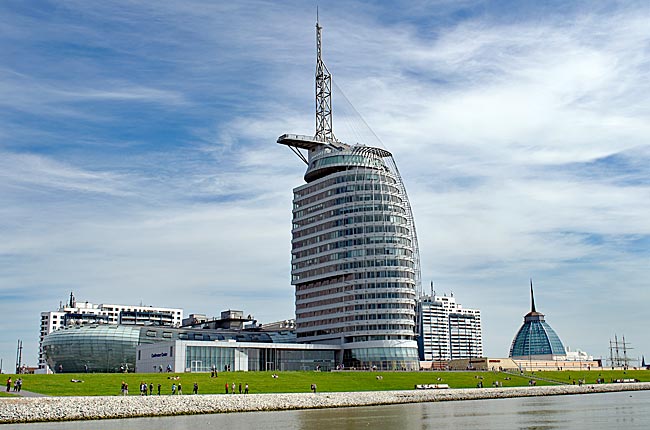
German Emigration Center Bremerhaven (Deutsches Auswandererhaus®)
Opened in 2005, the German Emigration Center® vividly and engagingly presents the history of emigration to America across five eras, spanning from 1830 to 1974. In total, 7.2 million people departed from Bremerhaven to seek a new home and build a new life beyond the Atlantic. For its emotionally compelling and historically grounded exhibition, the museum received the European Museum Award in 2007.
read more ...
Anti-Colonial Elephant Monument
The commissioning of this brick structure was carried out by the German Colonial Society, which inaugurated the monument on July 6, 1932. However, even at that time, the construction was controversial in this traditionally more cosmopolitan Hanseatic city. The monument did not merely commemorate those who fell in the First World War in former German colonies but also symbolized the oppression and exploitation of the indigenous populations there. Since its restoration and repurposing in 1989, the Elephant has stood as an Anti-Colonial Monument representing equality and justice, serving as a warning against racism, oppression, and exploitation.
read more ...
Riensberg Cemetary
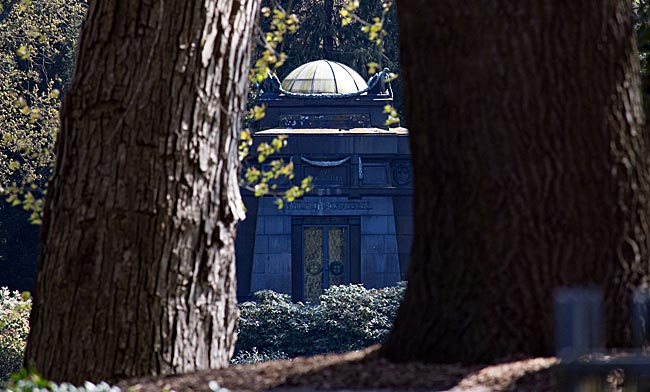
Located near the Focke Museum, this cemetery was established between 1872 and 1875 as a replacement for two abandoned cemeteries elsewhere, simultaneously with Waller cemetery. Today, the well-maintained park cemetery spans approximately 28 hectares on the former estate of Riensberg. The landscape gardener and garden architect Wilhelm Benque was commissioned to design its horticultural layout. He had previously been responsible for the artistic landscaping of Bürgerpark and, among others, Knoops Park in Lesum.
read more ...
Town Hall
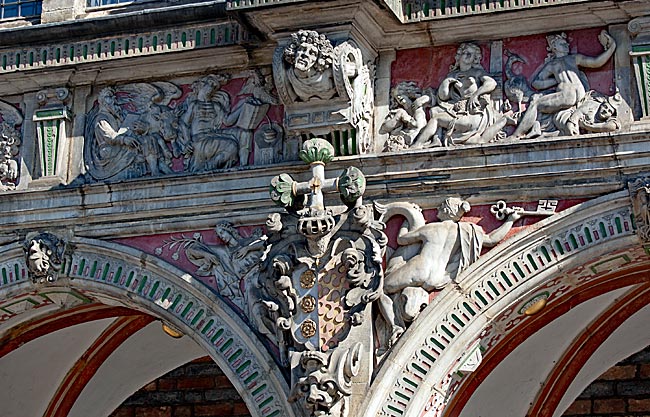
The original Old Town Hall on market square was built between 1405 and 1412. Little of this originally rather plain late Gothic brick structure remains today. The Renaissance façade, which gives the UNESCO-protected building its distinctive appearance, was constructed between 1608 and 1614 by Lüder von Bentheim. Above the arcades in particular, it is lavishly adorned with various depictions from ancient mythology, blending uniquely with Christian symbolism, Bremen city symbols, and other representations.
read more ...
Wallanlagen
Almost entirely surrounding the old town is a zigzagging park landscape with a moat. These are the last visible remnants of the fortifications that enclosed the old town and parts of the new town until the early 19th century. The transformation into a garden landscape began in 1802 with the first section between the Weser River and Herdentor Gate.
read more ...
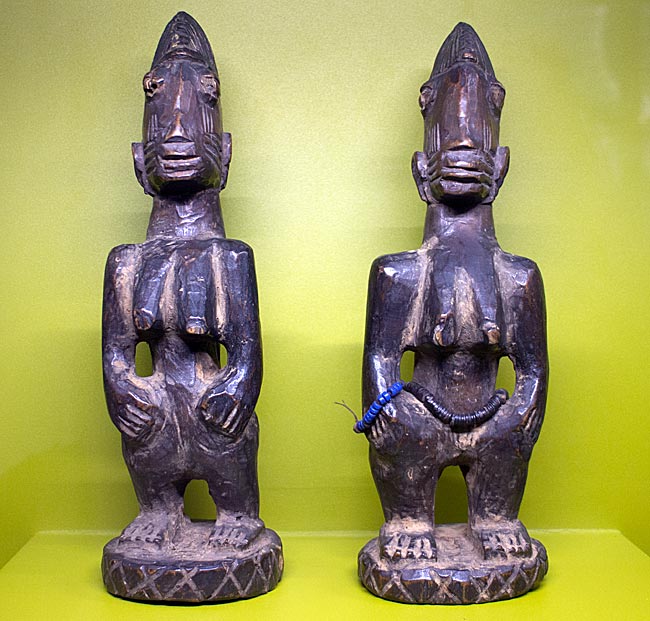
Übersee-Museum (Overseas Museum)
In 1896, what is now known as the Übersee-Museum first opened its doors under the name 'Municipal Museum for Natural History, Ethnology, and Commerce.' The exhibits initially came from the 'Municipal Collections of Natural History and Ethnography,' which were partly displayed as a 'Trade and Colonial Exhibition' at the 'Northwest German Trade and Industry Exhibition' in 1890 with great success. Since its founding, the museum's concepts have changed several times, evolving toward a stronger focus on museum education that continues to this day.
read more ...
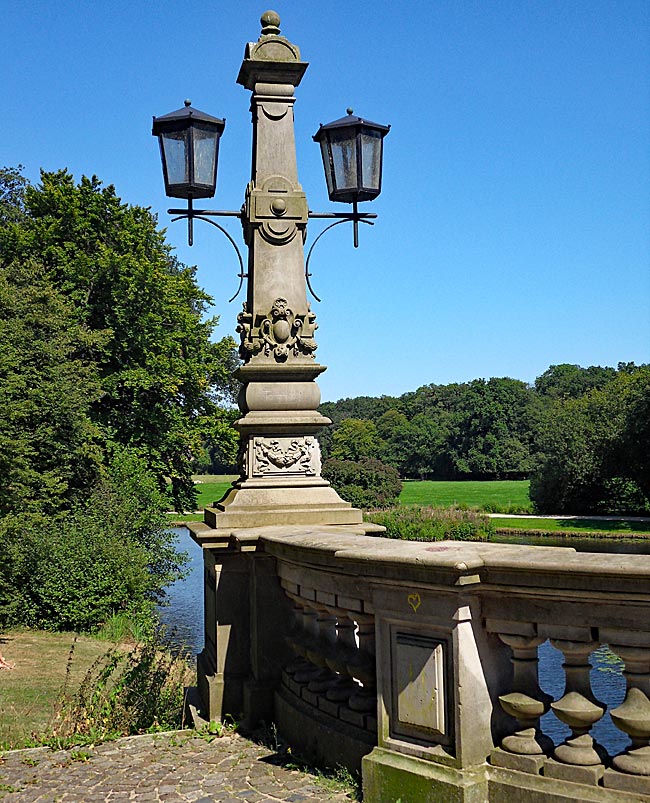
Bürgerpark (Citizens' Park)
A green oasis near the city center and a popular recreational area is the Bürgerpark. This extensive park, which adjoins today's Bürgerweide behind the train station, was initiated by the citizens themselves. In the early 19th century, the old defensive structures of the city had already been dismantled, transforming the ramparts into a landscaped park. However, as the city rapidly expanded throughout the century, demands for more green spaces grew louder and louder.
read more ...
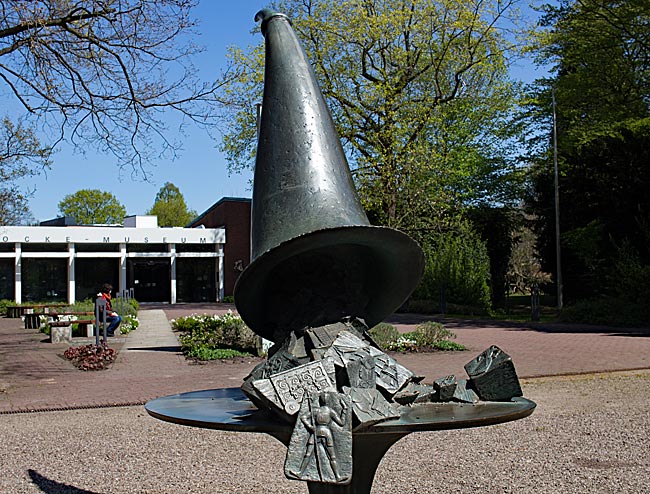
Focke-Museum
Every city has its history, and in many cities, there is a museum that tells this story. In the Hanseatic city, it is the Focke Museum in the Riensberg district, where urban history is presented most vividly. The "Bremer State Museum of Art and Cultural History" was established in 1924 by merging two collections: the Gewerbemuseum, founded in 1884, and the Historisches Museum für bremische Altertümer (Historical Museum for Bremen Antiquities), founded six years later. The museum's founder, who passed away in 1922, also gave it his name.
read more ...
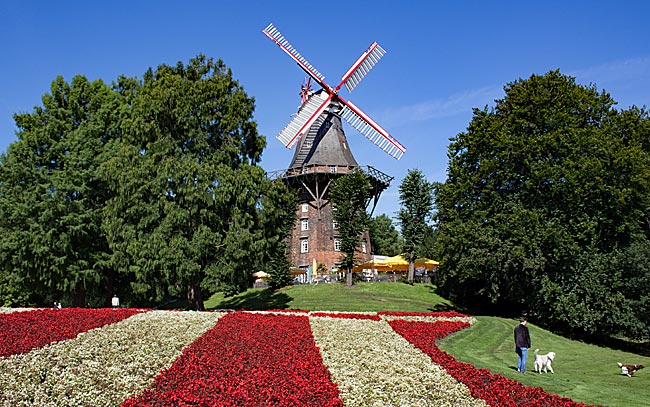
Exploring Horn-Lehe district
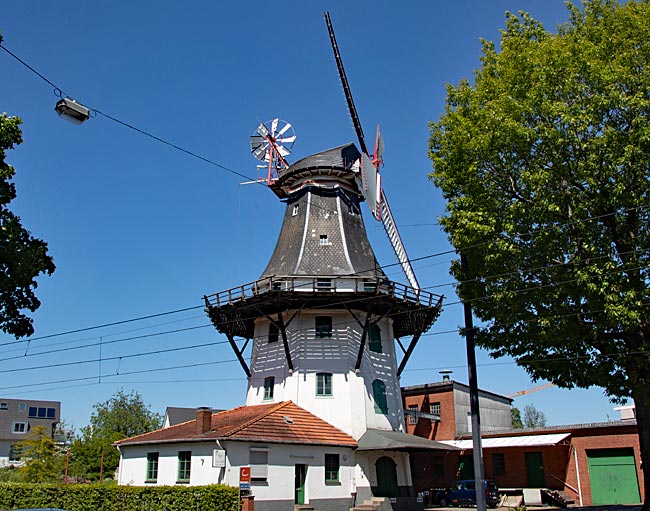
Some mills grind slowly, while others no longer operate at all - like the Horner Mill. Built in 1848 as a Dutch-style windmill, its preservation for passersby to enjoy today required significant effort and funding. It stands as the district's emblem.
read more ...
Water-based activities in Bremen
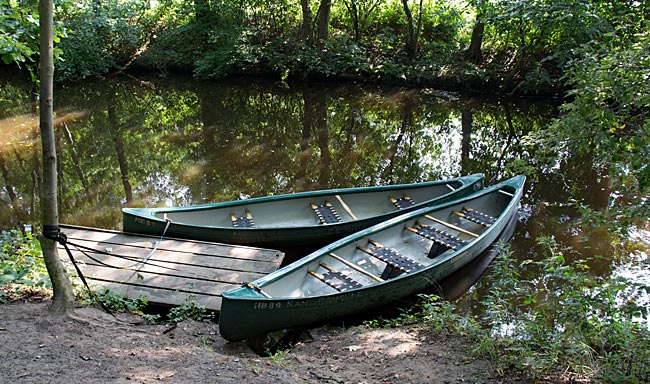
Since not everyone owns a boat, it's convenient that you can easily rent canoes and kayaks—for example, at Torfhafen in the Findorff district, which borders Bürgerpark, or just beyond the city limits at Kanu-Scheune in Lilienthal, accessible by tram line 4.
read more ...
Stadtwald & Stadtwaldsee (urban forest & lake)
Stadtwald & Stadtwaldsee. The design of the Bürgerpark is attributed to Wilhelm Benque, who served as its director from 1866–1870 and again from 1877–1884. Carl Orth succeeded him in this role, and under his plans, construction of the Stadtwald began in 1907. The 66.5-hectare site north of the railway tracks had been donated to the Bürgerpark Association by the Bremen merchant Franz E. Schütte one year earlier.
read more ...
Cycling to Lilienthal
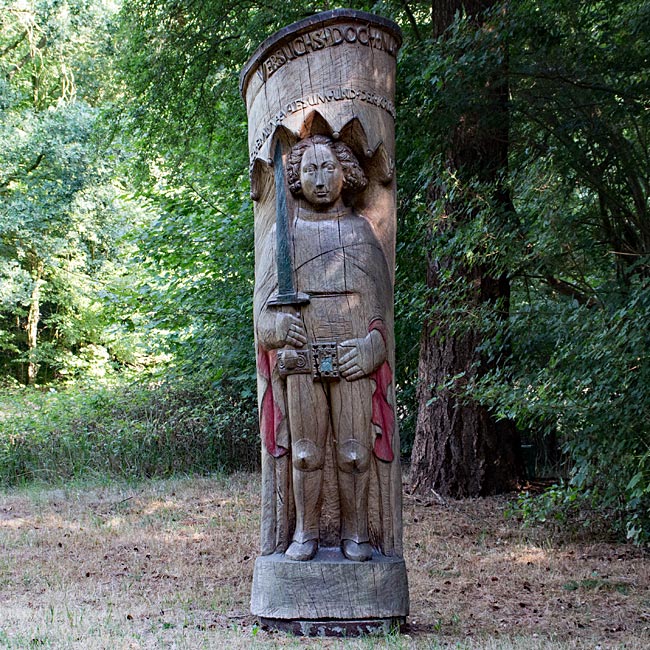
It's about 11 kilometers from Bremen's city center to Lilienthal in Lower Saxony, just beyond the city limits. While tram line 4 connects both places, a bike tour is much more fun. Along the Jan-Reiners-Weg, you can cycle through a green landscape without car traffic, and even within Lilienthal itself, the route follows small paths along the Wörpe River with light traffic, leading to the historic city center.
read more ...