
 exploring Bremen & its surrounding areas
 You are here: worth seeing in the surroundings
 Cycling to Lilienthal (1/3)
Cycling to Lilienthal
The Lower Saxon town and municipality of Lilienthal borders Borgfeld, a district in eastern Bremen. Since 2014, the municipality has even been connected to the network of Bremer Tram AG, with line 4 running as far as the Lilienthal district of Falkenberg. However, a more enjoyable way to visit Lilienthal from Bremen is by bike, where the approximately 11-kilometer route from Bremen's city center to Lilienthal is more of a destination in itself than the town, without intending any disrespect to its residents. Starting from the Horn-Lehe district, you cycle along the car-free Jan-Reiners-Weg through green landscapes, and even in Lilienthal, cycling alongside the small Wörpe River is very relaxing until you reach the town's attractions.
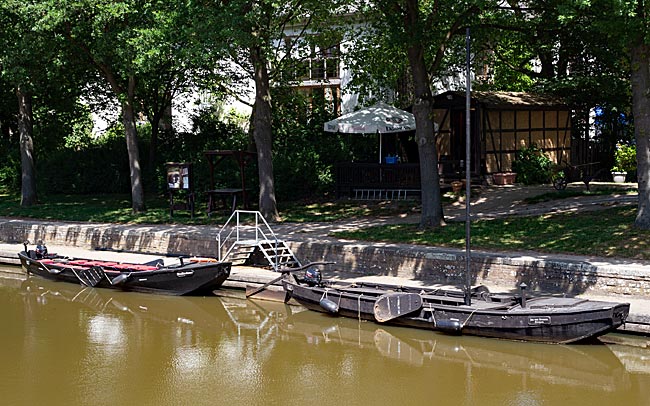
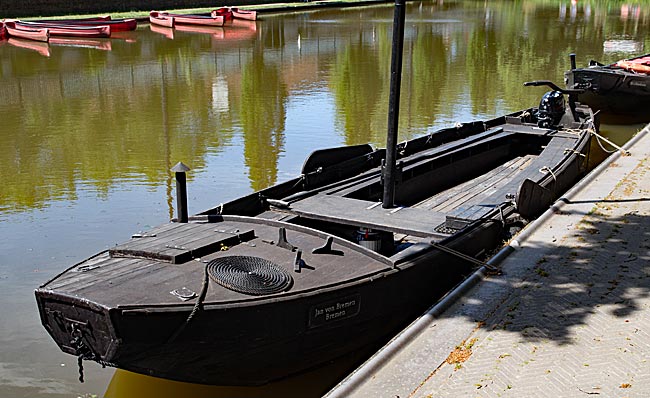
Peat barges in the peat harbor in the Findorff district. An outboard motor is additionally used for today's leisure trips
The Jan-Reiners-Weg, often referred to as a hiking or cycling path, was not such a thing until May 22, 1956, but rather a railway line of the "Kleinbahn Bremen-Tarmstedt." The construction of the route was initiated by the "Landwirtschaftliche Vereinigung" in Lilienthal, whose chairman at the time was Johann Reiners. The background was the extensive peat extraction, especially from the mid-19th century onwards, in the moorland areas such as the Teufelsmoor, and the laborious and slow transport of numerous so-called peat barges via rivers like Hamme and Wümme, as well as canals, primarily into the peat canal and peat harbor in Bremen. At that time, there were several thousand trips per year.
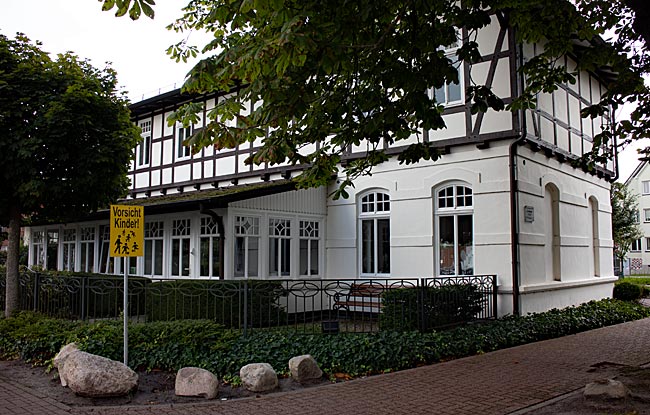
Former station of the Kleinbahn Bremen-Tarmstedt in Lilienthal at Bahnhofstraße / Jan-Reiners-Weg, today a kindergarten
After the route with 15 stops was put into operation in 1900, the narrow-gauge railway (1000 mm) did not only transport the fuel peat but also other supply and luxury goods in its wagons, as there were no roads in the moors, making it very difficult to transport goods from A to B. In honor of the man whose commitment might have never brought the train onto the tracks, the first locomotive was named "Johann Reiners," and even today, the name Jan Reiners stands for the entire railway in common parlance. Thanks to the Bürgerverein Findorff e.V., this first steam locomotive is not scrapped but displayed as an exhibit in the Findorff district - named after the moor colonizer Jürgen Christian Findorff (1720-1792) - not far from the peat harbor on a pedestal.
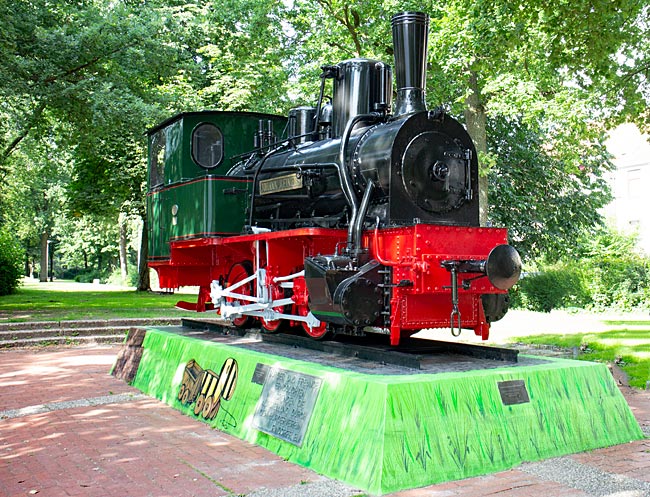
The first steam locomotive of the Kleinbahn Bremen-Tarmstedt "Johann Reiners" (currently being refurbished)
Near the Horner Bad (swimming pool), a bridge leads off Vorstraße for people traveling on foot or by bike over the Autobahn 27, and shortly afterward, the paved path crosses the associated highway access road. Behind it lies Hollerland. It is no coincidence that the name evokes associations with Holland, as it was indeed Dutch people who drained this and other marshy lands, made them arable, and founded settlements. This process is called Hollerkolonisation, and the land in historical documents was also referred to as "Hollandria" or "Nova terra." The beginning dates back to the year 1106 when a handful of men from Utrecht came to Bremen and, after negotiations with the archbishop, signed a contract. They were to cultivate the land and make it habitable but had to pay a tithe of their yields to the church and an annual sum for the cultivated and inhabited land (Hufe), in return receiving extensive special rights, which was already extraordinary for that time.
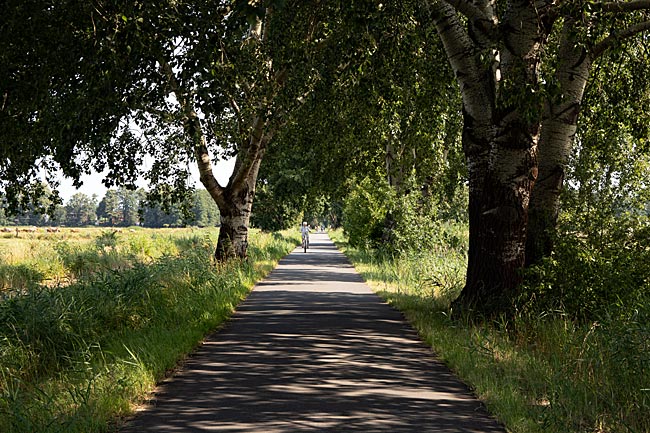
On the car-free Jan-Reiners-Weg through Hollerland
On the land drained by the Dutch, among other things, the present-day districts of Horn-Lehe and Oberneuland developed. The fact that this western part along the Jan-Reiners-Weg and beyond, with a total of 293 hectares, was not built upon is thanks to a citizens' initiative that successfully fought for seven years for the preservation of the biotope. Since 1985 or 1991, the area with its partly rare plant and animal life has been under nature protection. Around 1,000 small bodies of water have been created in Hollerland and the adjacent Blockland through bomb impacts during World War II. The water-filled craters fulfill an important task for flora and fauna such as frogs, toads, and birds and are correspondingly maintained, just as the water level is artificially controlled so that the wet meadows do not dry out.
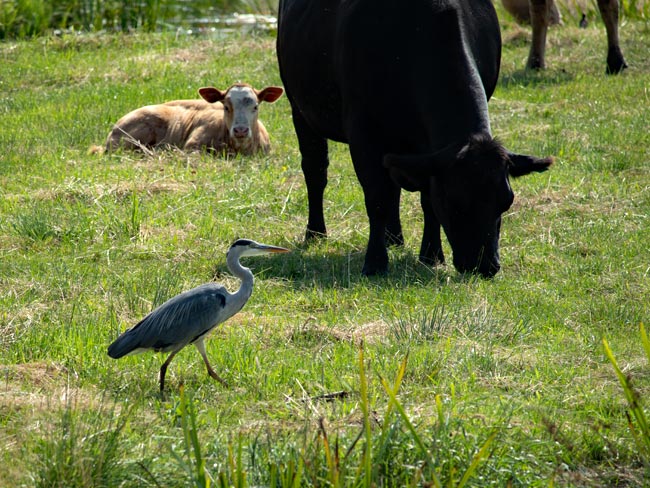
A grey heron cautiously approaches grazing cows in Hollerland
To a certain extent, drying out at the Wümme, on the other hand, is everyday and normal. The 118-kilometer-long river is the border river between Bremen and Lower Saxony and, in this case, between Borgfeld and Lilienthal. The Wümme is the source river of the only 10-kilometer-long Lesum, which flows into the Weser at Vegesack in northern Bremen. From there to Borgfeld, the Wümme is tide-dependent. Where the bypass road Lilienthaler Allee crosses the river, the bike and footpath through the green ends.
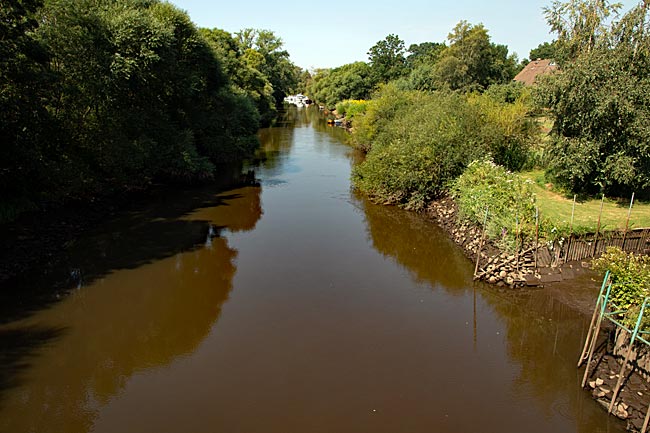
View from Lilienthaler Allee onto the border river Wümme; the left bank belongs to Bremen, the right to Lower Saxony
Trupe is the district of Lilienthal on the other side, and our path leads straight ahead through Truperdeich Street. Worth seeing - briefly inserted here - in the neighboring street Trupe opposite the "Lilienthaler Kunststiftung / Kunstschau Wümme, Wörpe, Hamme" is the Truper Chapel. An information board next to the entrance of the simple church building points out that the place name Trupe was mentioned as early as 937 and this building, probably erected around 1200, was first documented in 1283. Thus, a place with history, which is also shown by the gravestones from the 18th and 19th centuries.
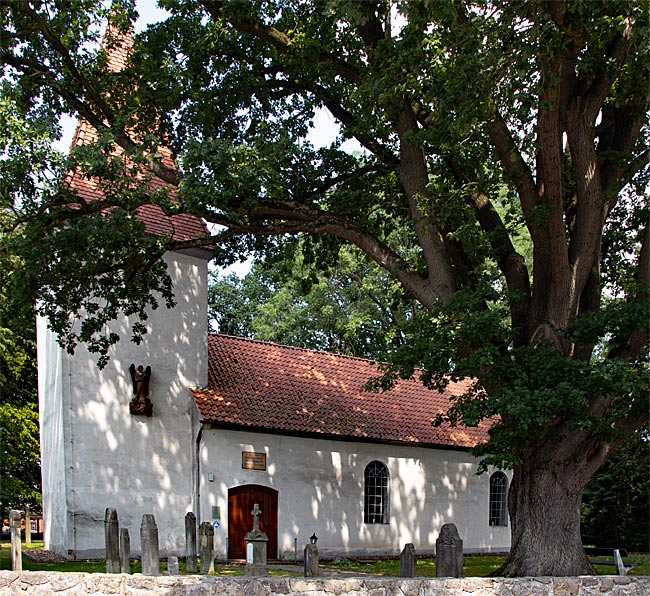
The Truper chapel
However, the chapel burned down in 1813 during the two-year-long Wars of Liberation. The arsonists were French troops under Napoleon Bonaparte, who almost completely reduced Lilienthal to rubble in a punitive action. However, the chapel was rebuilt six years later, as Napoleon's reign had finally come to an end after his defeat in the battle near the Belgian town of Waterloo on June 18, 1815. Such is life.
previous page
 next page
Map
Further information
From Bremen's main station to Vegesack by bike
The journey starts at Bremen's central station, passing through Bürgerweide near the distinctive Stadthalle, Congress Center, and trade fair halls, then through Findorff along the Torfkanal. This canal, which runs along the edge of Bürgerpark and Stadtwald, was constructed between 1817 and 1826 to transport peat from the Teufelsmoor near Worpswede in Lower Saxony to Bremen using peat barges.
read more ...
Artists' colony & peasant village: Fischerhude
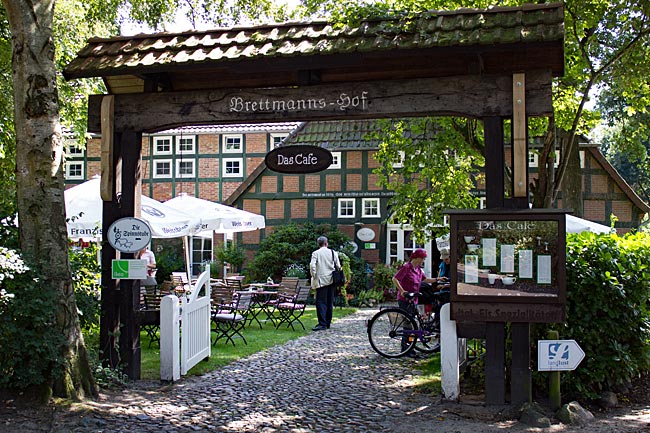
Signposts make it clear to every previously unaware visitor that this place differs significantly from many other traditionally agricultural villages. Fischerhude is hip. Numerous cafés and restaurants, ceramics studios, art galleries, a local history museum, the Modersohn Museum, and more vie for the favor of an audience that is sometimes more and sometimes less interested in art but regularly strolls through Fischerhude in large numbers.
read more ...
Worpswede
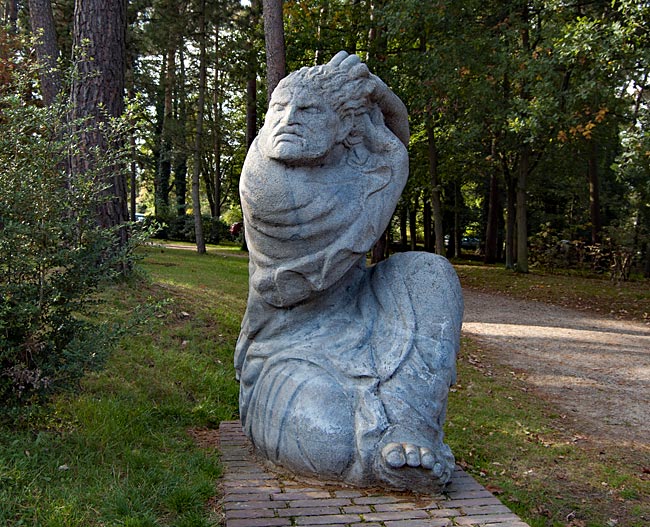
In 1889, the painters Fritz Mackensen, Otto Modersohn, and Hans am Ende laid the foundation for this art center with their decision to work and live in the small, previously unknown village. They were quickly followed by other artists such as the painter Paula Becker, the poet Rainer Maria Rilke, Clara Rilke-Westhoff, Fritz Overbeck, Heinrich Vogeler, and later the sculptor, painter, and craftsman Bernhard Hoetger, after whose designs, among others, the Paula-Becker-Modersohn-House in Bremen's Böttcherstraße was built.
read more ...
Cycling tour in Bremen: from the city center to Weser weir & back
On the way back toward the city center, you pass by sports facilities, Café Sand with its small beach, as well as a motorhome parking area with over 70 spaces surrounded by many trees right on the Weser River. With your mobile home, you couldn't be in a better spot - by bike, you're just a few minutes away from the Neustadt district and the city center. Not far from the parking area stands a red-brick building that the people of Bremen affectionately call the "Umgedrehte Kommode" (upside-down dresser), a comparison that, upon closer inspection, isn't entirely unfounded.
read more ...
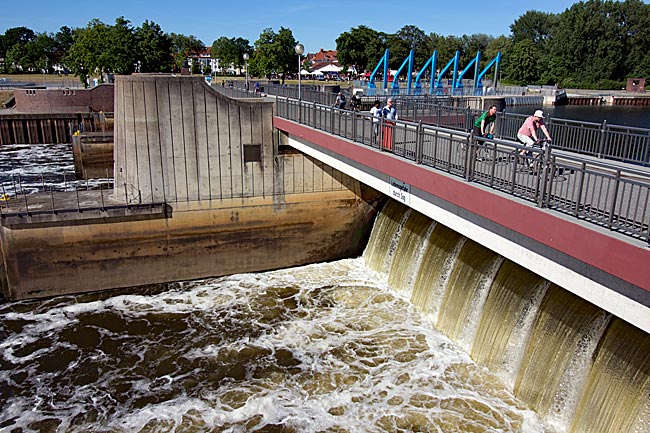
Water-based activities in Bremen
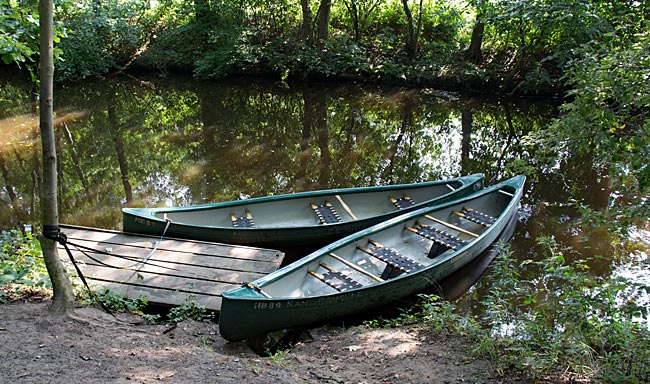
Since not everyone owns a boat, it's convenient that you can easily rent canoes and kayaks—for example, at Torfhafen in the Findorff district, which borders Bürgerpark, or just beyond the city limits at Kanu-Scheune in Lilienthal, accessible by tram line 4.
read more ...
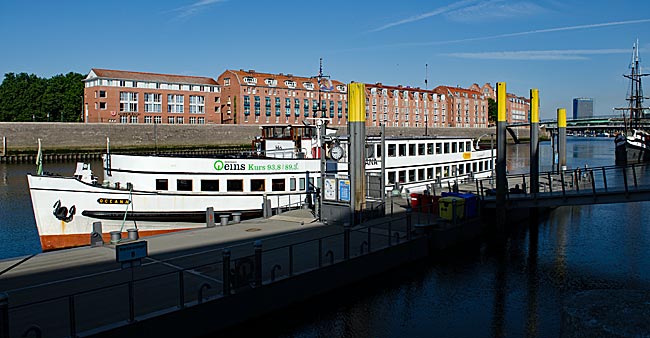
Weser cruise from Bremen to Bremerhaven
Of course, you can take a car for a visit to Bremerhaven from Bremen or board the regional train at the main station. However, with suitable weather and enough time, it is more interesting to cover the route on the Weser by ship. The shipping company "Hal över" operates the connection from May to September. The ship departs from the Martinianleger near the city center along the Schlachte. Those who wish can even take their bicycle with them; additionally, you can pre-book a breakfast onboard.
read more ...
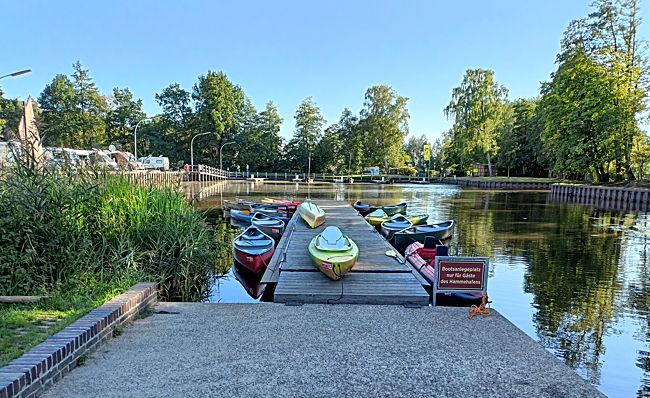
Neu-Helgoland (New Heligoland) / Hamme Harbor Worpswede
From April to October, the Hamme Harbor in Worpswede attracts many day visitors, weekend trippers, cyclists, and campers. The campsite operators run not only a bistro & beer garden with waterside seating but also rent out kayaks and canoes. Those who don’t want to paddle on the Hamme themselves can instead book an excursion trip aboard one of the Adolphsdorf Peat Boats. Food and drinks are also available just a few meters from the harbor at "Hamme Hütte Neu Helgoland." Tip: A great bike trip destination from Bremen!
read more ...
Brake & the River Island of Harriersand
As soon as the sun shines in spring and temperatures reach around 20 degrees, many Northern Germans are drawn to the North Sea coast for some water fun. The main thing is having a beach to lie on in the sun and sand for the kids to dig and build castles. That's why many people from Bremen also head north on warm weekends via the highway, packed with bags and picnic baskets ready for a day of beach vacation. But why travel far when the nearest beach is just around the corner - as a visit to Brake and Harriersand demonstrates.
read more ...