
 exploring Bremen & its surrounding areas
 You are here: worth seeing in the surroundings
 Cycling to Lilienthal (2/3)
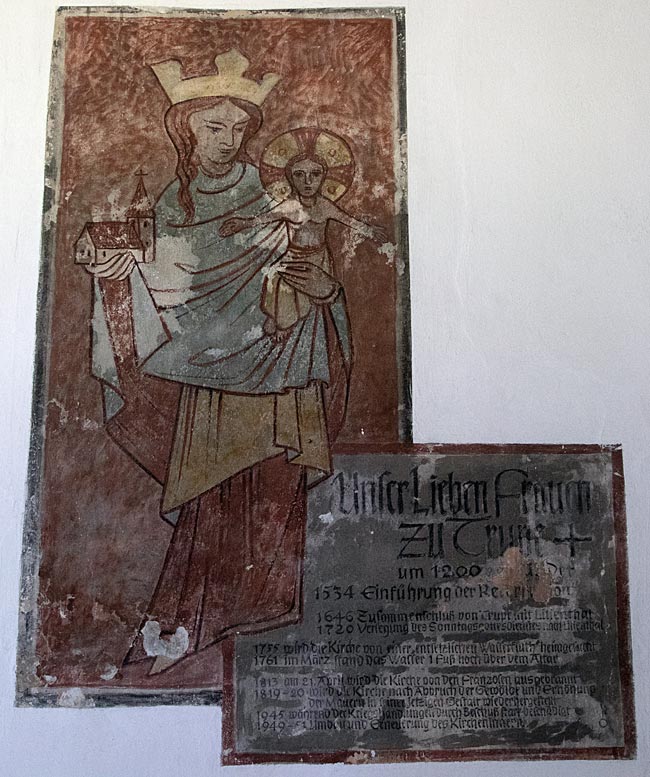
Mural in Truper Chapel
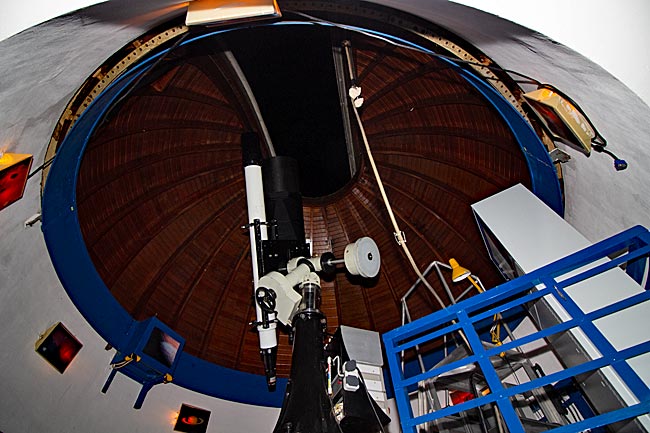
Johann Hieronymus Schroeter likely found his personal Waterloo only in death on August 1816, a day before his 72nd birthday. Otherwise, his work was crowned with success far beyond the borders of Lilienthal. If you turn right at the end of Truperdeich onto the main road and cycle a few meters back toward the Wümme River, you will encounter Schroeter's magnum opus - the TELESCOPIUM-Lilienthal - in material terms, at least. This is his 27-foot reflecting telescope, which he erected in 1793. The condition of the construction makes it clear that this is not the original but a (donor-funded) reconstruction, inaugurated after nine months of construction on November 28, 2015. The primary mirror of the telescope has a diameter of 50.8 centimeters, and the focal length is 7.75 meters. The white tube measures 8.20 meters (1 foot = 30.48 cm × 27 = 822.96 cm) and weighs approximately 450 kilograms. Of course, the entire apparatus is rotatable and precisely adjustable; otherwise, Schroeter would not have been able to observe the planets and the moon - particularly its dark side - so intensively. He even created highly detailed maps of it and documented everything else.
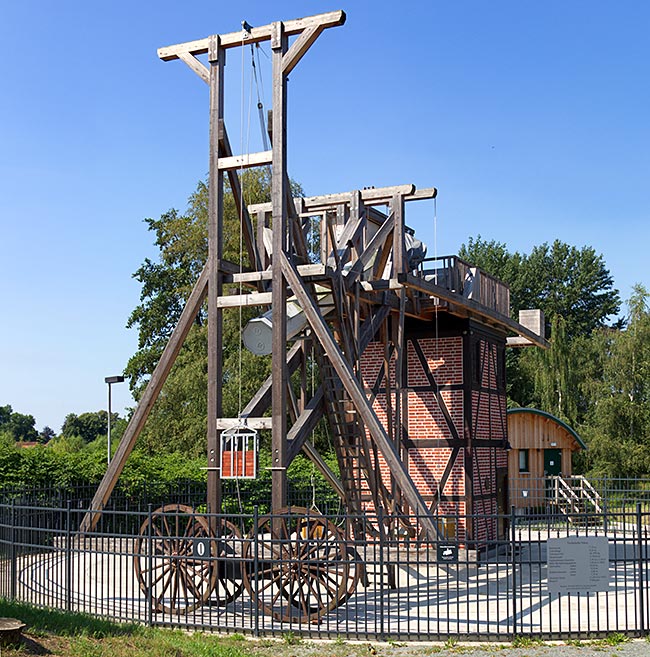
TELESCOPIUM-Lilienthal: Replica of Schroeter’s 27-Foot Reflecting Telescope
Born in Erfurt in 1745, the astronomer was an Oberamtmann (high-ranking administrative official) by profession. He was transferred to Lilienthal in 1782 and held a position that allowed him time to pursue his interests so intensely that he first built a small observatory in the garden of the government building. As early as 1784, he constructed a reflecting telescope with an aperture of 12 cm and a focal length of 122 cm, expanding his observatory four years later into a two-story facility. Contacts with astronomers in other European countries, such as Wilhelm Herschel in England - who had been building telescopes himself since 1766 - provided him with components and broadened his expertise. Eventually, he also built the 27-foot reflecting telescope in Lilienthal’s government garden and put it into operation. At that time, Schroeter’s observatory was the largest in all of Europe, and visitors from the highest circles suddenly came to the moorland village. Schroeter became famous.
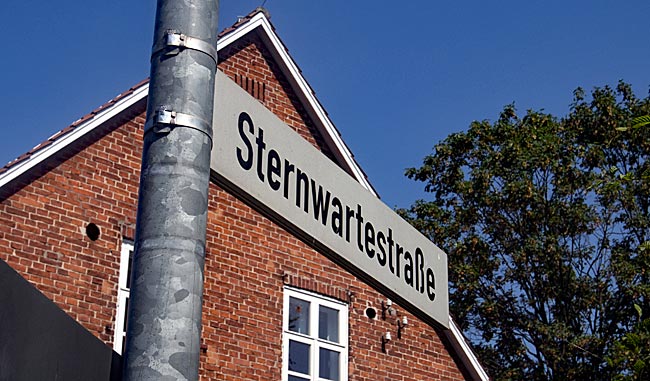
Street Sign
In 1799, however, the financial burden exceeded his means, and he sold the observatory to King George III of Great Britain and Ireland - without the equipment leaving Lilienthal. Instead, he received a purchase price, a pension, and a budget for hiring an observatory inspector. This position was held by Karl Ludwig Harding and later Friedrich Wilhelm Bessel before the French put an end to the “star-gazing” in 1810. Schroeter retired involuntarily, and in 1813, although the observatory remained undamaged during the aforementioned fire, it was plundered.
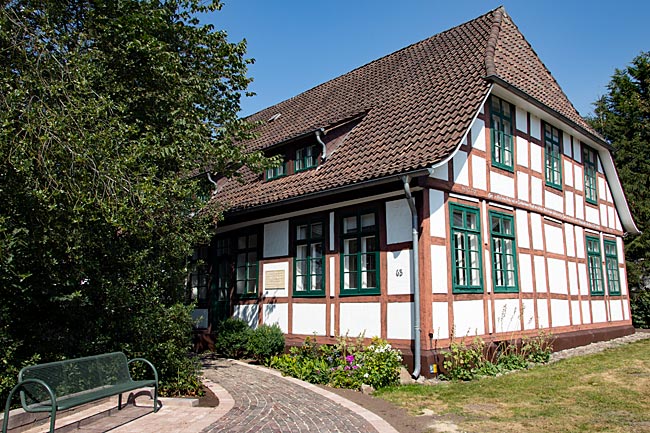
The Amtmann-Schroeter House at Hauptstraße No. 63: Where the Astronomer lived and died
Today, with the replica, visitors once again have the opportunity to gaze into the universe during viewing sessions. Alternatively, you can contact the Walter-Stein Observatory in Bremen. In Bremen, the astronomer and physician Heinrich Wilhelm Olbers was active; he was also a founding member of the Astronomical Society in Lilienthal in 1800, as was Harding. The society’s first president was naturally Schroeter, whose house is now one of Lilienthal’s attractions - here he lived and died. However, you will search in vain for an observatory on Sternwartestraße in the town.
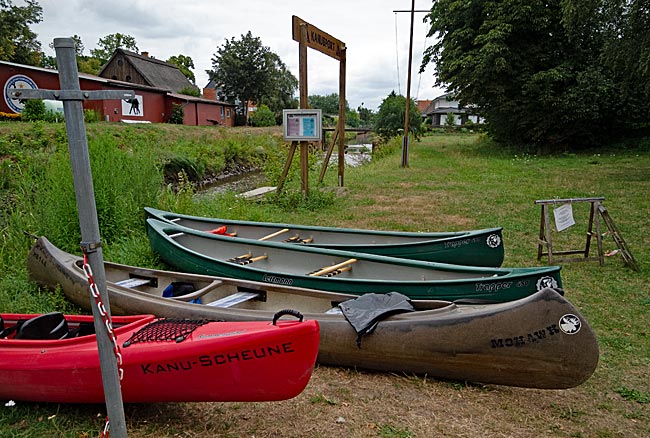
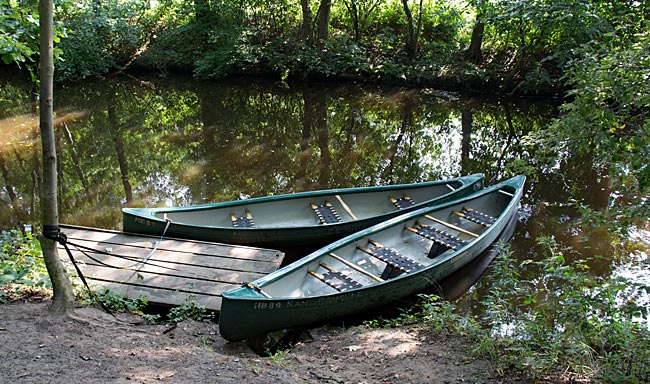
At the Kanu-Scheune on the Wörpe River
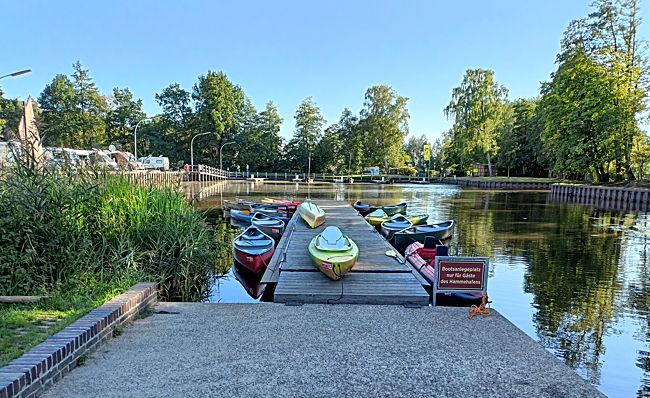
Across from TELESCOPIUM-Lilienthal, you can rent canoes and kayaks to paddle on the Wümme River - either downstream toward Kuhsiel or upstream toward Fischerhude - but only as far as the river’s fork into its north, south, and middle branches. You can also paddle on the Wörpe, a tributary of the Wümme, though it is significantly smaller, as you can see near the Kanu-Scheune rental station.
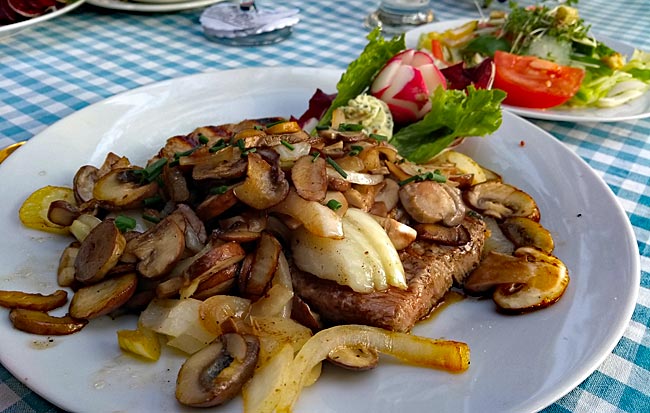
The highly recommended restaurant “Zur Schleuse” is beautifully situated right on a bend in the Wümme River and features a small passenger ferry. Alternatively, you can reach it by bike or car via Truper Deich Road
From here, you can cycle along many shops on the main road, which, thanks to the bypass opened in 2013 and the reduction of automobile traffic since the tram line was routed through the main street, is much more relaxed than before. Or, from the Kanu-Scheune, you can turn right onto Mehlandsdeichweg and ride with the Wörpe on your left toward the center - also historically speaking. The street names change, but the path along the Wörpe remains. From Lake Street, you finally turn left onto Klosterstraße. And there you are in the historic center of town.
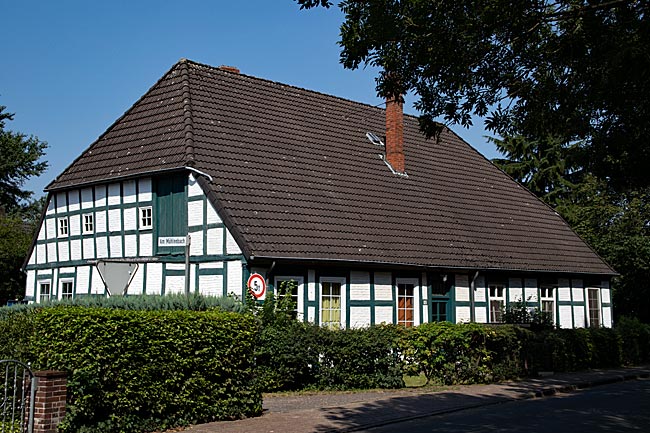
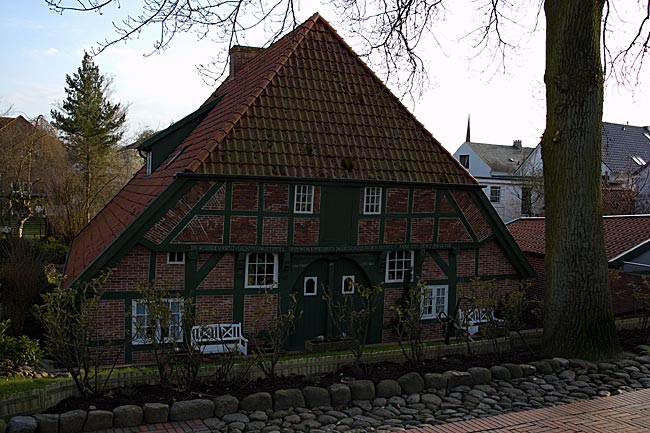
A restored farmhouse on Klosterstraße: One of many in town, emphasizing the former rural character of the moorland village
A restored farmhouse at the intersection with Am Mühlenberg Lane is the first in a small series of buildings that represent the history of the place in stone. Across the street to the right lies Murkens Hof, whose history began in 1730 with Daniel Murken. But Murkens Gasthof is no longer an inn; it is now Lilienthal’s cultural center. Nevertheless, there is something for your palate and against a dry mouth next door - weather permitting - even outdoors with a view of the courtyard.
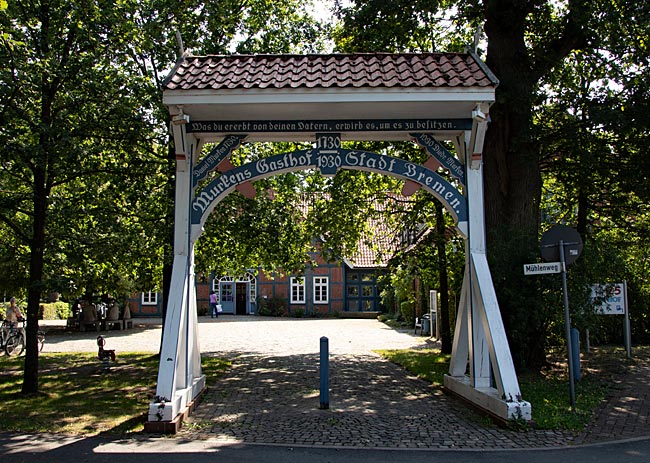
Murkens Hof
At Murkens Hof, Mühlenweg branches off. Along Mühlenbach and Mühlenweg, almost directly behind it lies the Wörpe River? Yes, it existed, but the centuries-old tradition at what was once an important but now insignificant waterway ended in 1975 with its demolition despite previous modernization attempts. What remains is the memory of the watermill in the form of the aforementioned street names and that of Arpsdamm, which commemorates miller Philipp Arps, who operated the mill in the second half of the 17th century. As a tenant, as an article in the WÜMME-ZEITUNG (a newspaper) from 1883 reported. The local historian Rupprecht Knoop rediscovered the contribution, which states that around Easter 1689, a contract was signed between the miller and Amtmann Thile as representative of the landlady Landgravine Eleonora Katharina von Hessen-Eschwege. The contract obligated the landlady to maintain the mill with state funds and granted the miller the right to use Klosterweide in the summer as pasture for two cows and to catch eels without restriction. In addition, he received some peat. The annual rent imposed on him amounted to 160 Reichsthalers.
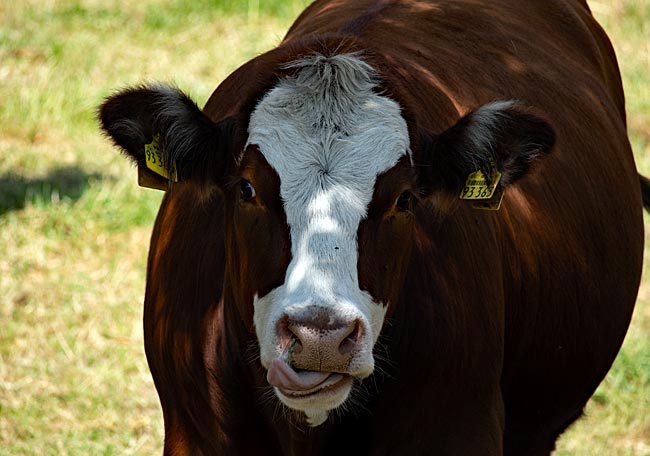
... but the millers did not have plastic tags in their ears
This was not the miller’s only obligation, for the mill made a significant contribution to drainage and, more broadly, to regulating water levels in the moorland areas where new villages were constantly being established. For this purpose, the Wörpe River was dammed with sluice gates. In return for his work, the miller was allowed to use the water power to grind grain from farmers in the surrounding area. At times, there was even an obligation for producers to have their grain ground only here. The use of the Wörpe River as a peat transport route turned the weir into a problem. From top to bottom in terms of water level, thanks to a kind of slide device, it was less of a problem than getting back up again, which also incurred costs. Often, the peat barges would get stuck, and the restaurateur Georg Murken seized the profitable opportunity to cater to the sailors for cash while they waited.


Map
Further information
www.lilienthal.de
TELESCOPIUM-Lilienthal gemeinnützige Stiftungsgesellschaft mbH
Am Staugraben 5
28865 Lilienthal
Phone: 0171 / 6152337
Fax: 04298 / 469802
Email: info@telescopium-lilienthal.de
www.telescopium-lilienthal.de
Kanu-Scheune
Hauptstraße 2
28865 Lilienthal
Phone: 0162 / 900 36 14
Fax: +49 (0)421 577 99 103
Email: info@kanuscheune.de
www.kanuscheune.de
Observatory & Planetarium
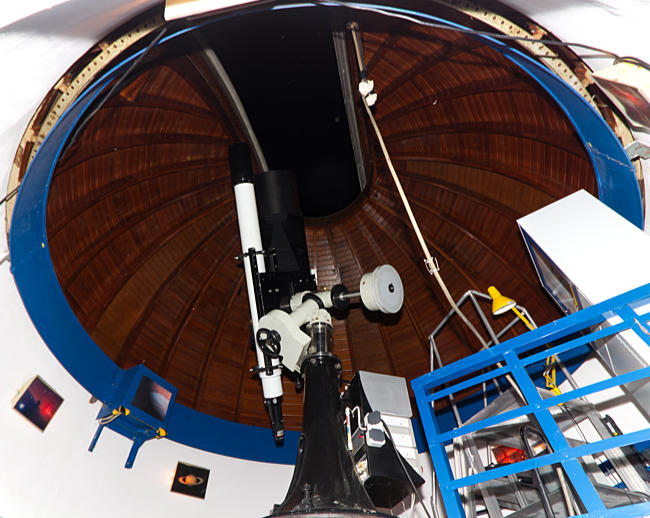
On selected days, visitors can also take a look through the large stationary and smaller mobile telescopes of the Walter-Stein Observatory, which are set up on the terrace. In the Olbers-Planetarium in the same building, members of the society give lectures on varying topics. The Olbers-Planetarium, opened in 1952, belongs to the small planetariums with its dome measuring 6 meters in diameter. A total of 35 seats (including accessible ones) are available for visitors.
read more ...
From Bremen's main station to Vegesack by bike
The journey starts at Bremen's central station, passing through Bürgerweide near the distinctive Stadthalle, Congress Center, and trade fair halls, then through Findorff along the Torfkanal. This canal, which runs along the edge of Bürgerpark and Stadtwald, was constructed between 1817 and 1826 to transport peat from the Teufelsmoor near Worpswede in Lower Saxony to Bremen using peat barges.
read more ...
Artists' colony & peasant village: Fischerhude
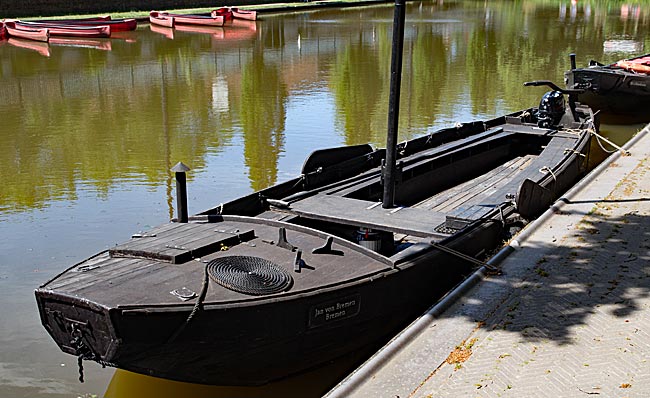
Signposts make it clear to every previously unaware visitor that this place differs significantly from many other traditionally agricultural villages. Fischerhude is hip. Numerous cafés and restaurants, ceramics studios, art galleries, a local history museum, the Modersohn Museum, and more vie for the favor of an audience that is sometimes more and sometimes less interested in art but regularly strolls through Fischerhude in large numbers.
read more ...
Worpswede
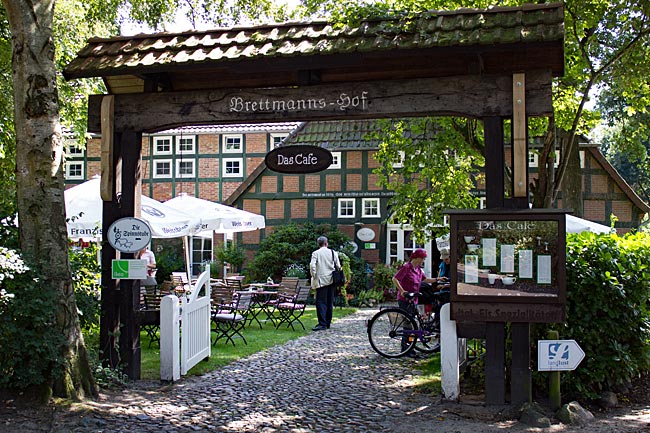
In 1889, the painters Fritz Mackensen, Otto Modersohn, and Hans am Ende laid the foundation for this art center with their decision to work and live in the small, previously unknown village. They were quickly followed by other artists such as the painter Paula Becker, the poet Rainer Maria Rilke, Clara Rilke-Westhoff, Fritz Overbeck, Heinrich Vogeler, and later the sculptor, painter, and craftsman Bernhard Hoetger, after whose designs, among others, the Paula-Becker-Modersohn-House in Bremen's Böttcherstraße was built.
read more ...
Cycling tour in Bremen: from the city center to Weser weir & back
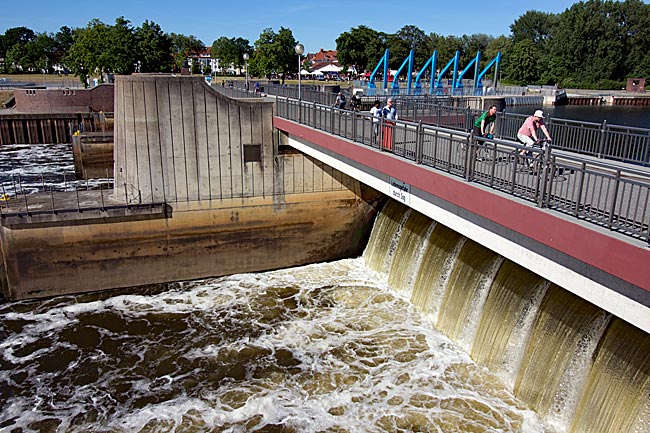
On the way back toward the city center, you pass by sports facilities, Café Sand with its small beach, as well as a motorhome parking area with over 70 spaces surrounded by many trees right on the Weser River. With your mobile home, you couldn't be in a better spot - by bike, you're just a few minutes away from the Neustadt district and the city center. Not far from the parking area stands a red-brick building that the people of Bremen affectionately call the "Umgedrehte Kommode" (upside-down dresser), a comparison that, upon closer inspection, isn't entirely unfounded.
read more ...
Water-based activities in Bremen
Since not everyone owns a boat, it's convenient that you can easily rent canoes and kayaks—for example, at Torfhafen in the Findorff district, which borders Bürgerpark, or just beyond the city limits at Kanu-Scheune in Lilienthal, accessible by tram line 4.
read more ...
Weser cruise from Bremen to Bremerhaven
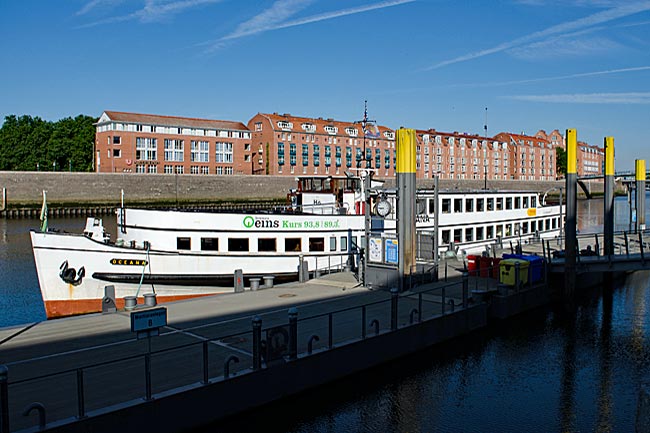
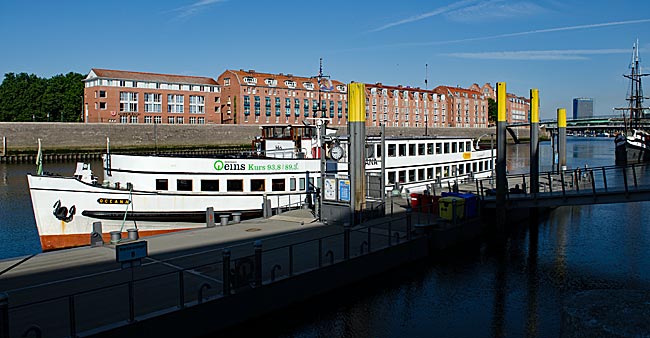
Of course, you can take a car for a visit to Bremerhaven from Bremen or board the regional train at the main station. However, with suitable weather and enough time, it is more interesting to cover the route on the Weser by ship. The shipping company "Hal över" operates the connection from May to September. The ship departs from the Martinianleger near the city center along the Schlachte. Those who wish can even take their bicycle with them; additionally, you can pre-book a breakfast onboard.
read more ...
Bremerhaven in general
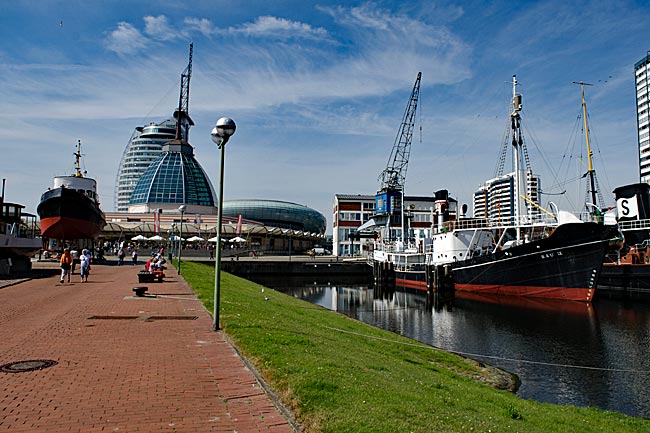
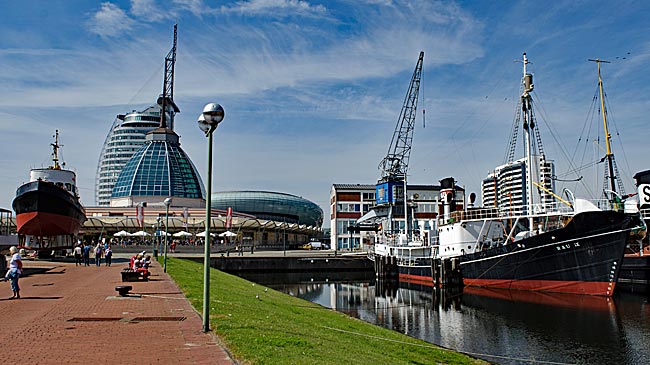
Bremerhaven was only founded in 1827. To secure its status as a port city amid the threat of the Weser - Bremen's lifeline - silting up, Bremen purchased 342 acres of land at the mouth of the Weser from the Kingdom of Hanover for 74,000 talers under then-mayor Johann Smidt. About 60 kilometers downstream from Bremen, this became the site of the first urgently needed seaport built by Bremen, known as the Alter Hafen (Old Harbor), completed by 1830.
read more ...
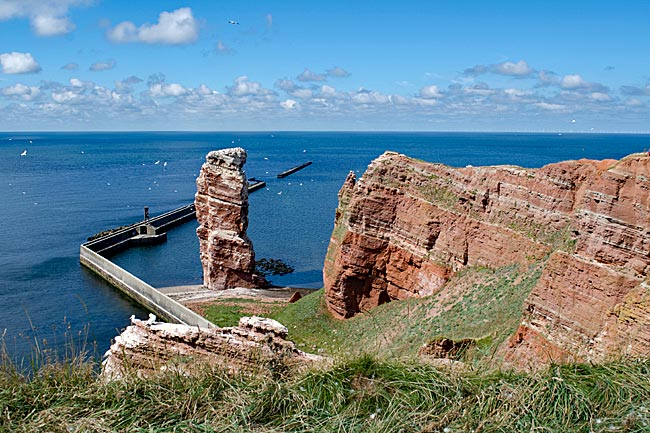
Neu-Helgoland (New Heligoland) / Hamme Harbor Worpswede
From April to October, the Hamme Harbor in Worpswede attracts many day visitors, weekend trippers, cyclists, and campers. The campsite operators run not only a bistro & beer garden with waterside seating but also rent out kayaks and canoes. Those who don’t want to paddle on the Hamme themselves can instead book an excursion trip aboard one of the Adolphsdorf Peat Boats. Food and drinks are also available just a few meters from the harbor at "Hamme Hütte Neu Helgoland." Tip: A great bike trip destination from Bremen!
read more ...