
 exploring Bremen & its surrounding areas
 You are here: worth seeing in Hemelingen district
 From Weser weir through Hemelingen Harbor to the sports harbor and to the beach (1/2)
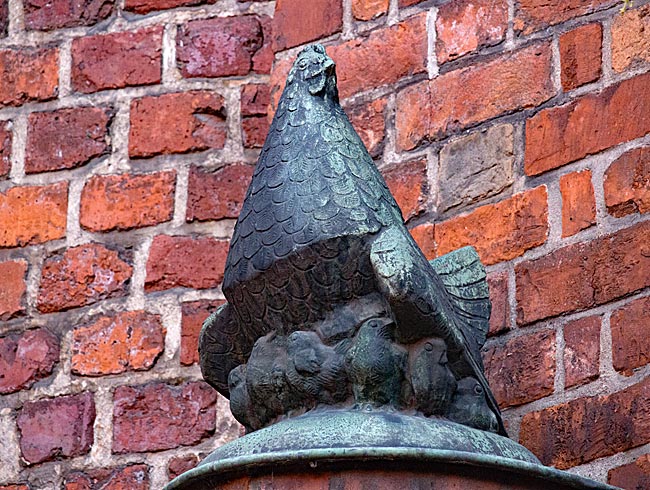
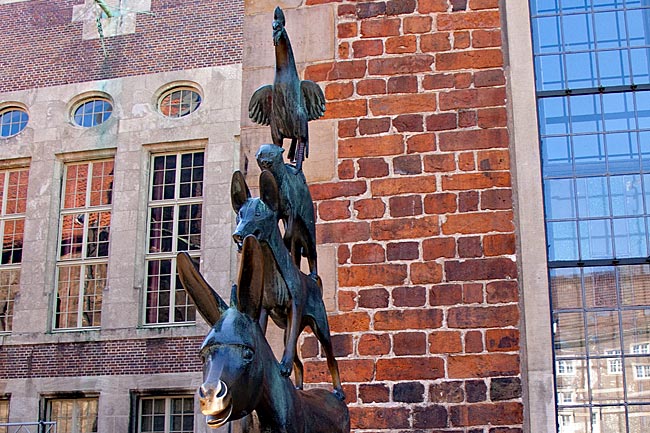
Bronze sculpture of the Bremer Gluckhenne in Böttcherstraße
In the past, harbors or harbor-like boat and ship docking areas were often part of the nucleus of today's river cities. These settlement sites along rivers were not chosen randomly but deliberately - for example, where the water current was less strong, there was a ford, or a frequently used land trade route passed nearby. According to the legend of the Bremer Gluckhenne, it was fishermen who laid the foundation for the city of Bremen on a dune by the Weser River, where St. Petri Cathedral stands today.
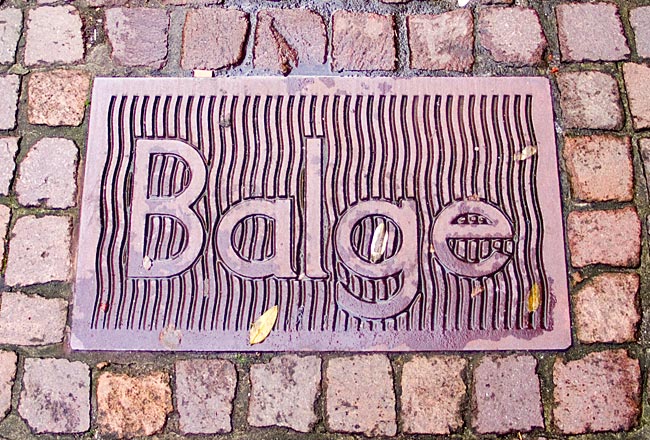
At the edge of Böttcherstraße, the cobblestone pavement commemorates the Balge
How much truth lies in this legend is debatable, but one fact remains: the river has always shaped the fate of the city. The old harbor at today's Schnoor district has left only memories behind. The Balge, a tributary of the Weser that made this area ideal for a harbor, is now remembered only by street names and metal plates in the cobblestone pavement; the waterway itself was filled in long ago. The medieval harbor at Schlachte near the market square is also history.
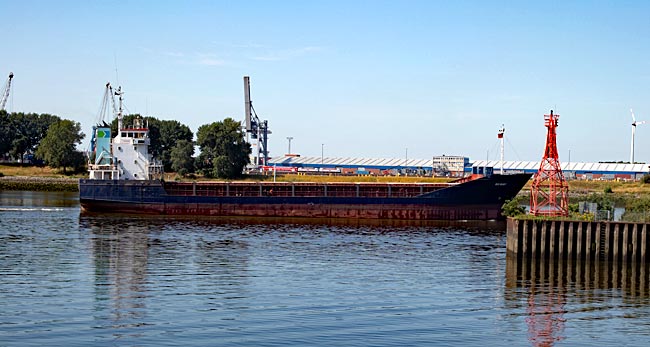
The small freighter "Rix Ruby" passes through Überseestadt on the Weser coming from the grain port, with facilities of Neustädter Harbor in the background
So no more harbors in the Hanseatic city? Yes, besides numerous facilities for leisure boats at several locations, there is the Neustädter Harbor, Hohentorshafen (also in Neustadt), and the industrial ports in the Gröpelingen district and Überseestadt in Walle district. They all share one thing: they were built on the tide-dependent part of the Weser, the Lower Weser. The port in Hemelingen is the only one in the city located on the dammed Middle Weser.
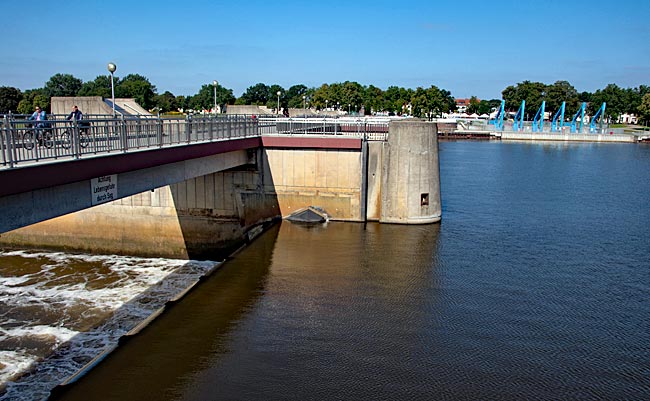
The Weser weir in the Hastedt district with viewpoints over the river and surroundings; with luck, you can watch a ship lock from above
Since the completion of the first weir in 1911, the fairway here has been much calmer, and different water levels are no longer an issue. The latter is also a factor for agriculture along the river. The current Weser weir, which went into operation in 1993 in the Hastedt district, is one of the most impressive structures in Hemelingen. From here, let's set off by bike to the Hemelinger Hafen and then to the Sporthafen, a small idyll amidst an otherwise industrial setting - with a public beach right next door.
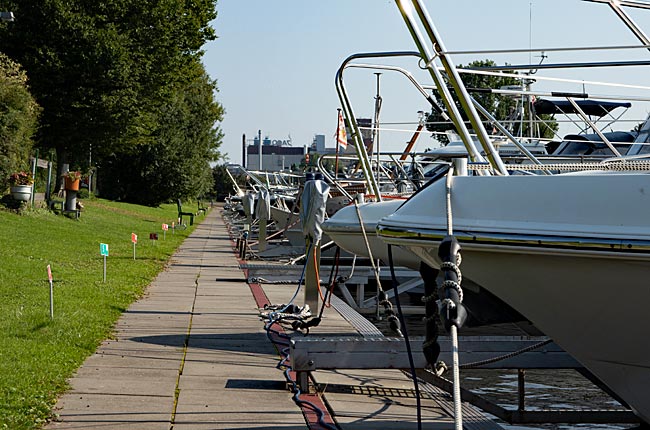
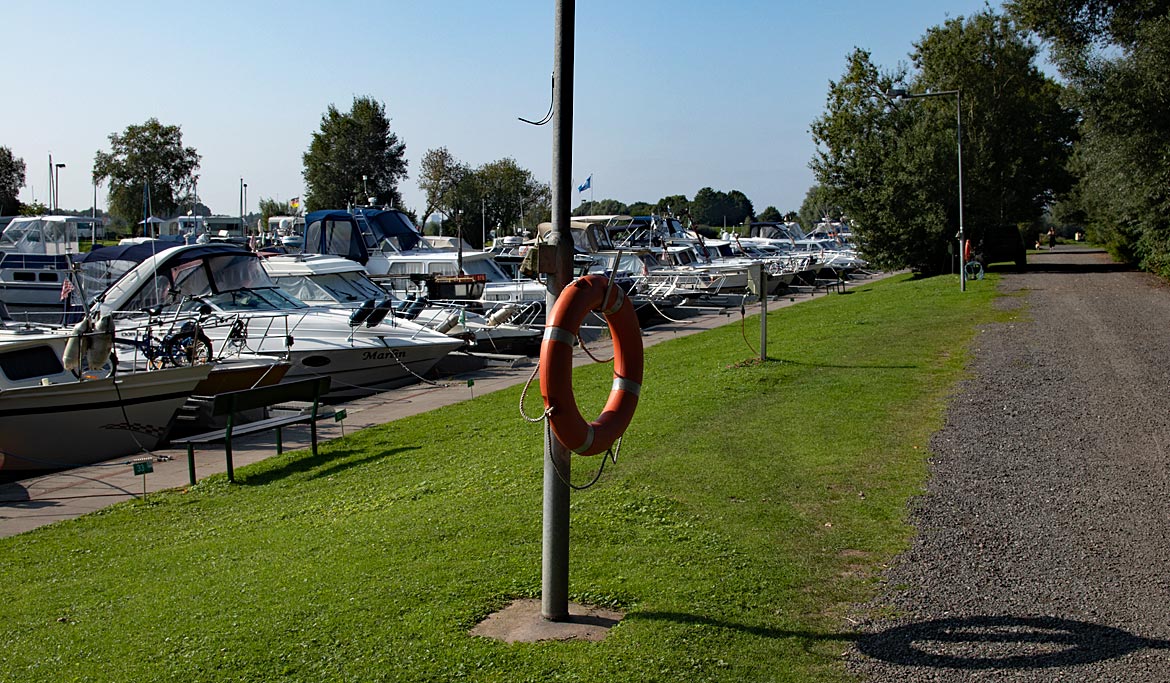
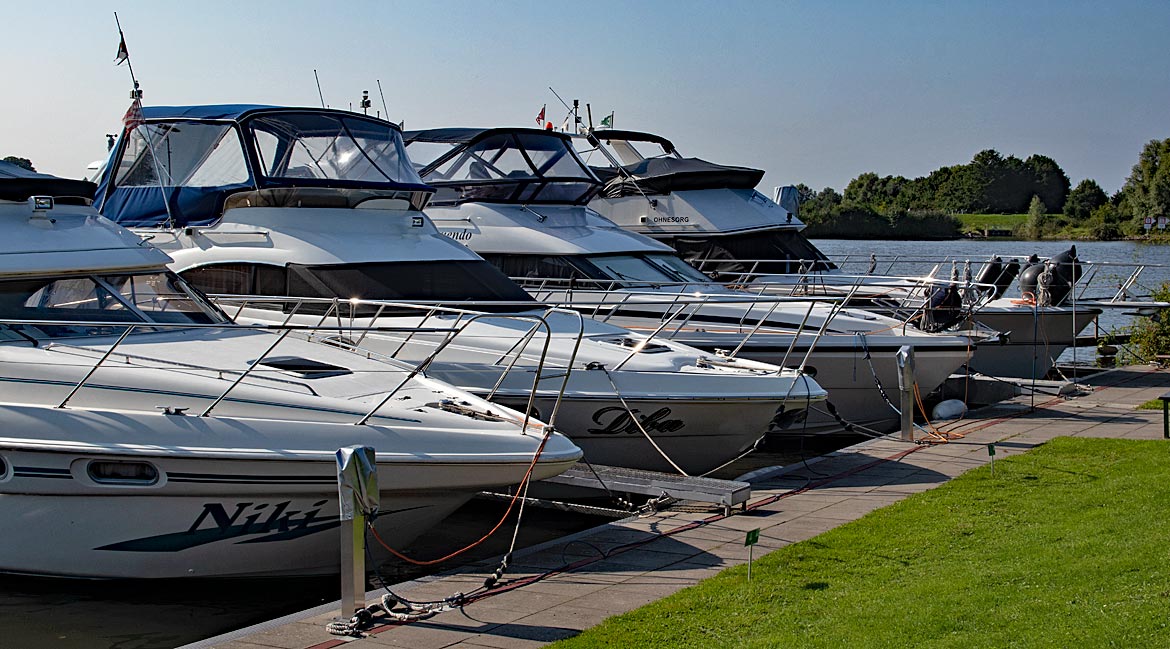
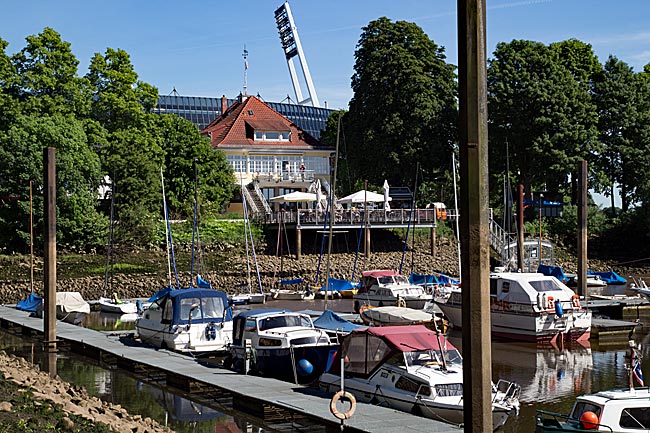
Boats in the marina; in the background, Jacobs Douwe Egberts roasts coffee at the plant near the A1. If you hold your nose into the wind, you can sometimes smell it too
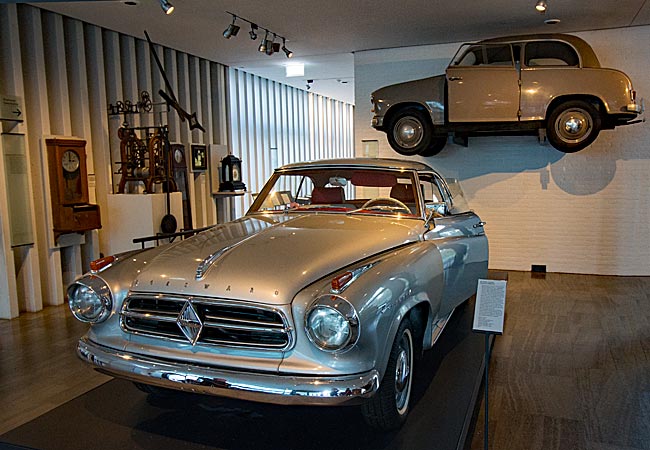
Until 1939, Hastedt, which had belonged to Bremen since 1803 and was formerly a farming village, was a district of the Hanseatic city before becoming a subdistrict of the newly annexed Hemelingen. From 1928 onward, automobiles were manufactured in the Goliath Works in Hastedt. Later, the manufacturer became part of the Borgward Works, which also produced cars in the district until their spectacular bankruptcy in 1961. The Goliath House on Hastedter Osterdeich still reminds us of this company today. Since 1915, electrical motors and generators - including those for shipping - have been developed and manufactured in the Lloyd-Dynamowerk factories across the street. This company, known as LDW, still exists today. The same cannot be said for any significant shipbuilding in the nearby harbor area.
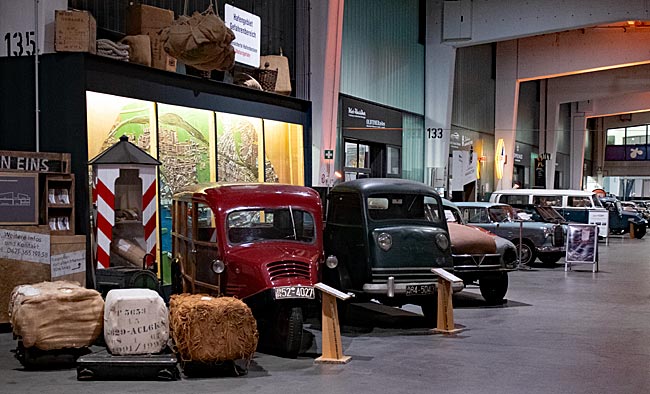
In the "Center for Automobile Culture and Mobility" at Schuppen Eins in Überseestadt, you can admire restored Goliath models alongside other vehicles
At the end, Hastedter Osterdeich merges into Föhrenstraße. Turning onto the small street "Kraftwerkdeich," we are on our way to the harbor. The power plant complex of the local energy provider swb is unmistakably dominant here. Since 1905, electricity has been generated at this site using various methods over time, including coal-fired power generation today. Currently, a new power plant is being built on the premises to replace coal combustion. The company also produces "green" electricity, for example, through hydropower at the Weser weir.
A narrow cobblestone path leads from Kraftwerkdeich to Strotthoffkai and thus to the first harbor basin (Allerhafen). A concrete plant is located here, and it is not the only one in Hemelinger Hafen. From Strotthoffkai, you can reach Hemelinger Hafendamm via Allerkai. Here, it becomes clear that many businesses from the construction materials industry are based in the harbor alongside others. Romantic notions of a harbor operation with exotic goods from around the world and aromas like those on an oriental bazaar - from the time before the invention of containers - are far removed here.
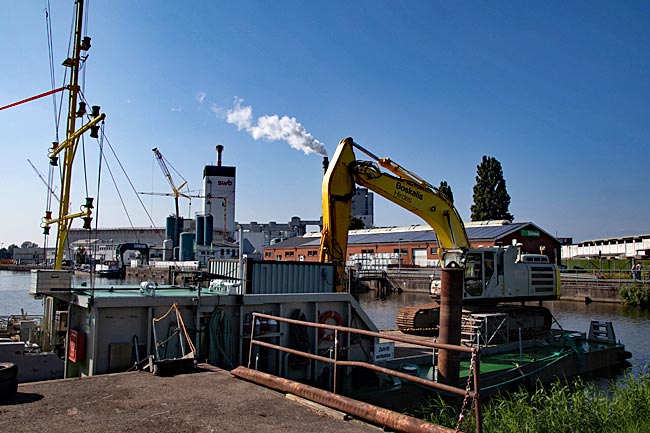
Harbor basin at Strotthoffkai with the power plant in the background – don't be put off
When the harbor first went into operation in 1903, things might have been a little different. However, products from overseas such as coffee, cocoa, tea, spices, and tropical fruits were unloaded and stored in the city's harbors in Walle district, where Überseestadt is located today. Nevertheless, a harbor world still holds a certain charm if you let yourself be drawn into it.
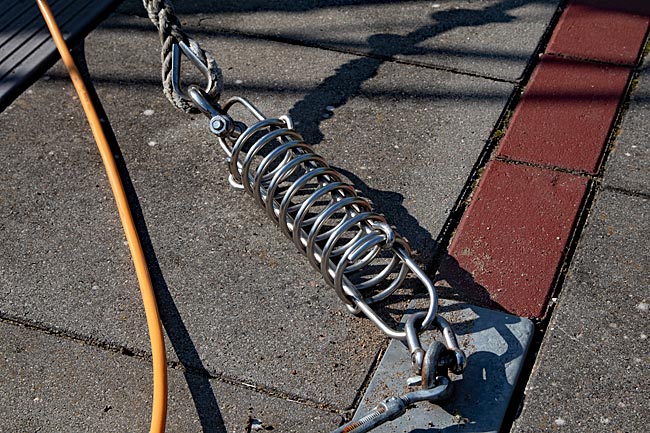
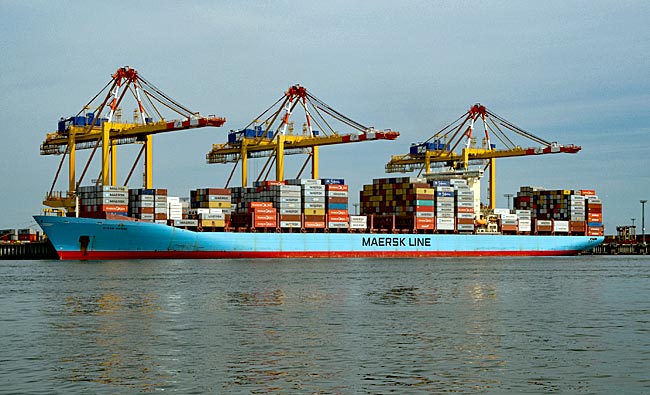
A harbor can be exciting, even if the giant ships of the world's oceans are not docked at the quay – that’s something you can see in Bremerhaven, and that’s another story
As mentioned earlier, ships were also built in the Hemelingen harbor. In what was then a relatively small harbor (250 meters long and 75 meters wide), Rolandwerft was founded in 1913. Initially, coastal motor vessels and ferries were built for civilian shipping; after the outbreak of World War I, smaller units such as fast boats or boats for submarine hunting were produced for the Imperial Navy. Military equipment was also manufactured on other Bremen shipyards until the end of World War II.
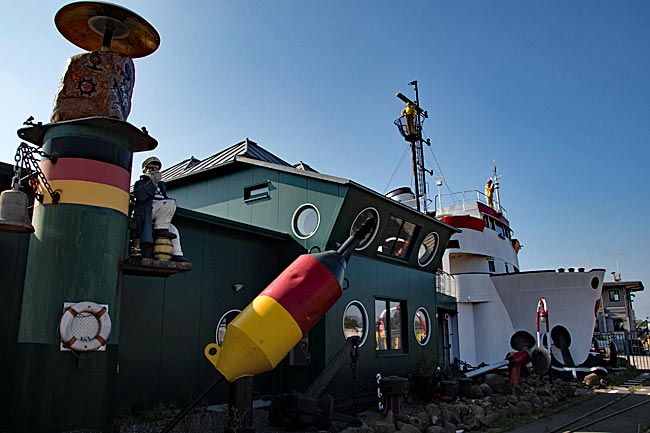
Ship ahoy at Hemelinger Hafendamm? Not really, here only the bow of a ship is incorporated into an ensemble next to a car dealer
After the large-scale sinking of ships on the world's oceans had ended, freight and ferry ships as well as excursion ships were once again built at Rolandwerft. Almost 60 years after the harbor opened, it had grown in length by more than three kilometers, reflecting the importance of this harbor site on the Middle Weser for Bremen. However, while several new supertankers - including the world's largest at the time, the "Shat Alarab" - slid into the Weser water at "AG Weser" on the Lower Weser in the first half of the 1970s, the lights went out at Rolandwerft in 1972. The hope for a future after insolvency and takeover by Hegemann in "Detlef Hegemann Rolandwerft GmbH" soon faded, and operations were finally discontinued.
previous page
 next page
Map
Further information
https://wvh-bremen.de
https://bootshaus-hemelingen.de
https://de-de.facebook.com/diekomplettepalette/
The legend of the Bremer Gluckhenne
Bremen writer Friedrich Wagenfeld interpreted the legend of the "Bremer Gluckhenne" as a story of freedom and even went further to consider it as a founding myth of Bremen. In his brief creative period, Wagenfeld also wrote the tale of the "Seven Lazy Ones."
read more ...
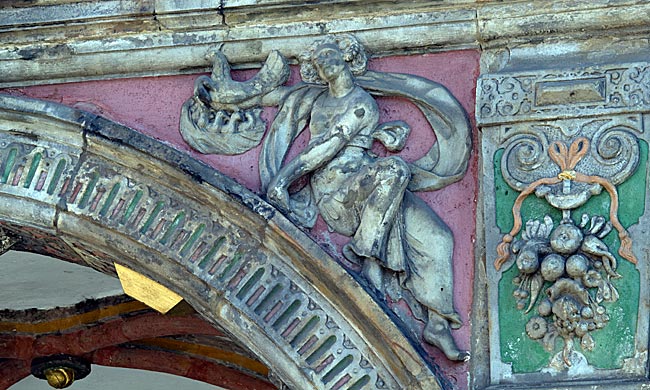
Schnoor
Bremen's oldest preserved neighborhood is the Schnoor. In earlier times, this area was primarily inhabited by fishermen and sailors, as it was here that the Balge - a tributary of the Weser - ran, and one of Bremen's first harbors was located. Many of the small houses date back to the 17th century or have been reconstructed based on historical models. The house at No. 15 in Schnoor Lane, built in 1402 on medieval foundations, is one of the oldest structures in the Schnoor, alongside the Packhaus (1401).
read more ...
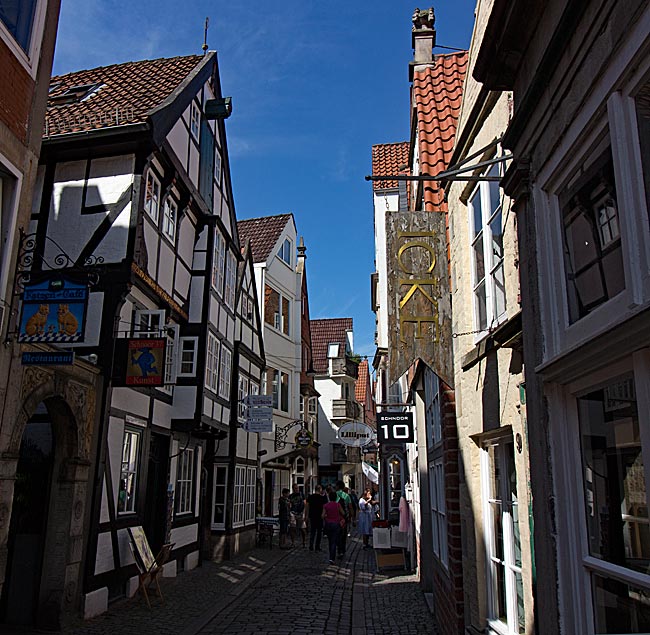
Market Square
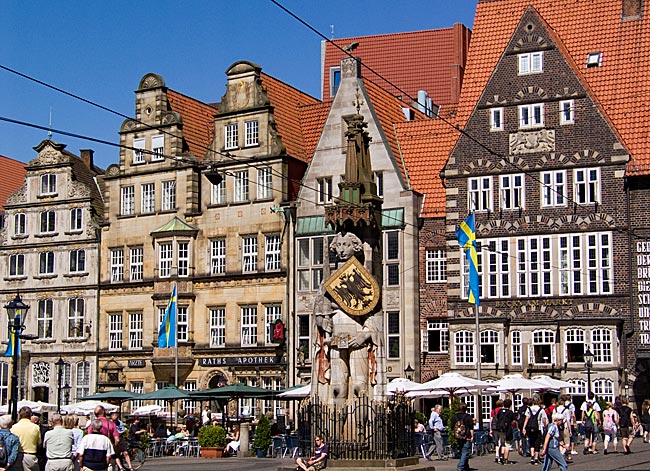
As it was in the past and as it is today, the market square is the political center of Bremen and also a major attraction for thousands of tourists, undoubtedly due to its unique architectural atmosphere. Almost unobtrusive and plain in appearance, the Bürgerschaft (Bremen's parliament) stands next to the magnificent Old Town Hall.
read more ...
Through Walle district to the industrial ports
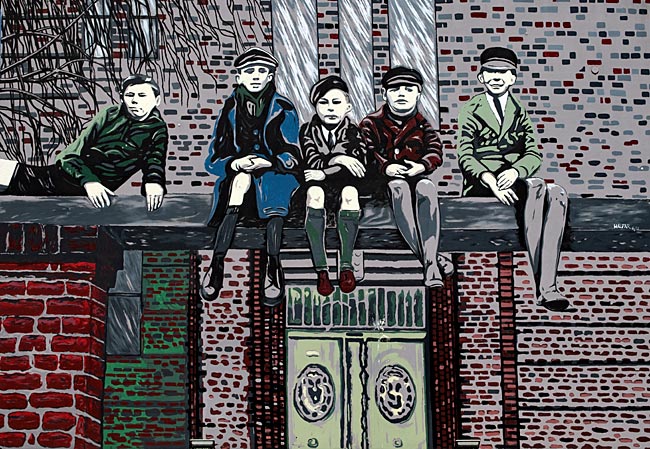
The history of Walle began, like that of many other districts in Bremen, long ago as an independent village, more precisely, it started only as the seat of the Ministerial family von Walle. The first mention of the old village dates back to the year 1139. From this family came both farmers and citizens. Thus, with the settlement of more people, the family estate grew into a village around the manor. Walle was incorporated into the Hanseatic city in several steps, first between 1885 and 1902.
read more ...
Überseestadt
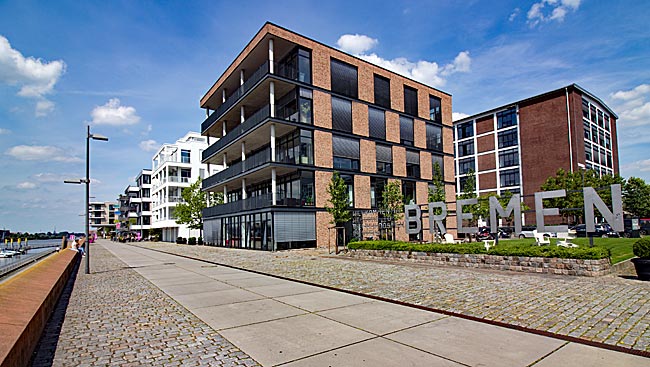
When the overseas port (Überseehafen) needed to be renovated, it was decided in 1991 in the Hanseatic city to simply close the basin. In 1998, the overseas port was finally filled with sand that resulted from dredging operations in the outer Weser. Together with the also decommissioned but still existing Europa Harbor as a harbor basin, this formed the basis for the conceptual development and creation of today's Überseestadt.
read more ...
The Weser weir
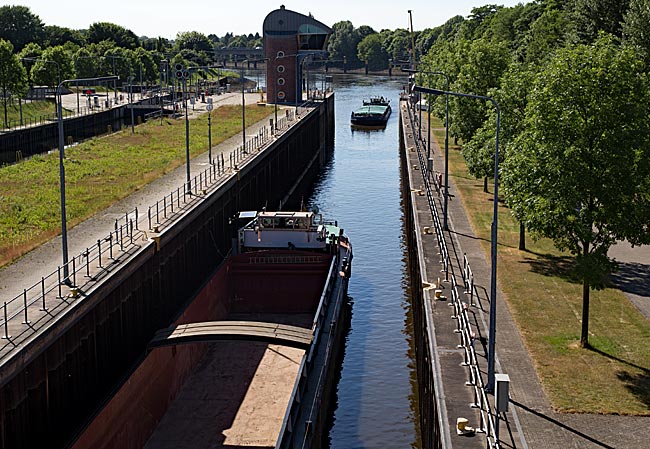
After the old Weser weir from 1911, one of seven weirs on the Weser, had become dilapidated, a newly built Weser weir was put into operation in 1993. To make navigation possible at all, the weirs are equipped with locks. In the chambers up to 225 meters long, inland vessels with a maximum width of 11.45 meters are locked through. The difference in water levels ranges between approximately three and a half and six and a half meters. As in the past, electricity is still generated by hydropower today. The weir is accessible to pedestrians and cyclists. There is something to see here.
read more ...
Borgward, Daimler & cars from around the world
Among the vehicles that are shipped or imported via the large auto transport ships in Bremerhaven and travel across the world's oceans, there are also many that have rolled off the production line at Daimler's manufacturing site in Bremen, in the Sebaldsbrück district. The automobile production in this district continues a tradition that dates back to the early years of the 20th century.
read more ...
Round trip: from the City Center to the Weser weir and back
From Tiefer or Altenwall, the section of the Weser riverbank in front of Schnoor and diagonally opposite the DGzRS (German Maritime Search and Rescue Service), the planetarium, and the observatory on the other side of the river, a beautiful path for pedestrians and cyclists runs directly along the water upstream toward the Weser weir. After crossing the Weser weir, the return route of the tour leads via Stadtwerder.
read more ...
Bremerhaven - Überseehafen (Overseas Port)
In addition to the Old Harbor (now the Museum Harbor), which was the first to be built, other ports were later added. Adjacent to the New Harbor lies Kaiserhafen I, the first in a series of additional harbor basins. Even a glance into this initial section of the expansive port area reveals a different world of maritime activity - one of large ships. And we will see even larger ones along the five-kilometer-long quay on the Weser.
read more ...