
 exploring Bremen & its surrounding areas
 You are here: worth seeing in Bremerhaven
 Bremerhaven Overseas Port (1/3)
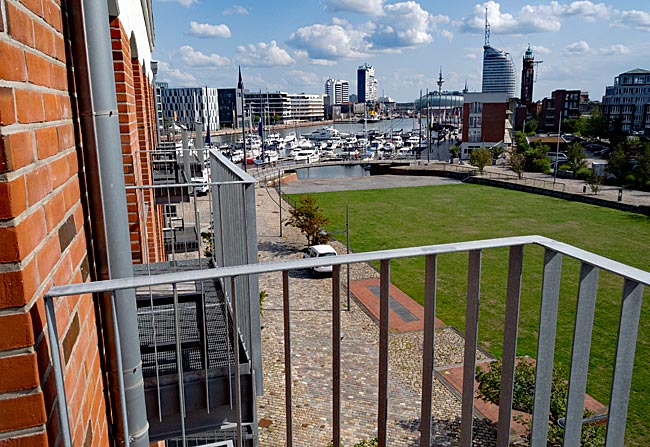
View from the balcony of a room at the Hotel Im-Jaich at Lloyd Marina in the New Harbor, naturally self-paid
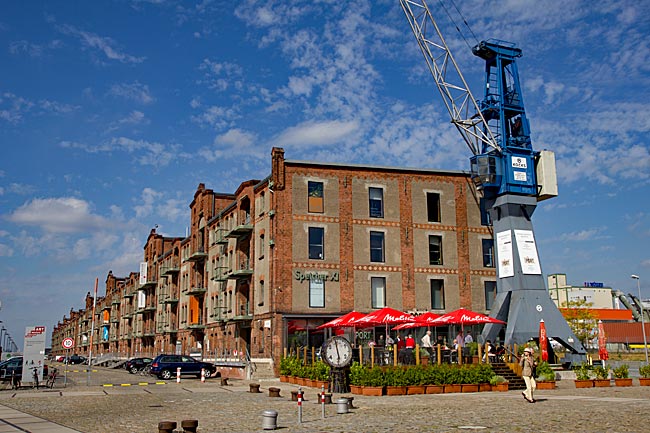
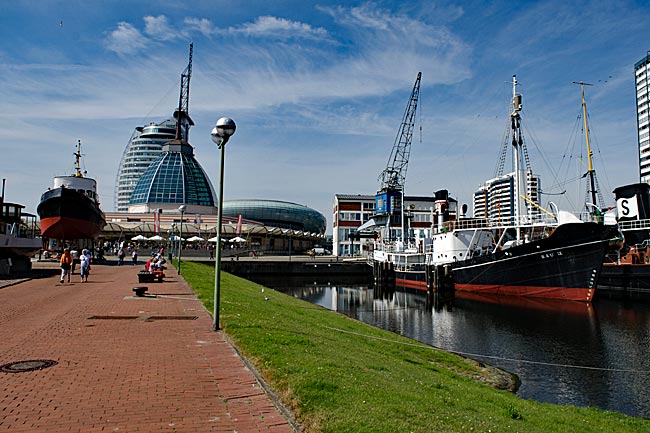
After years of construction, the New Harbor has been fully developed on both sides since 2019. During this time, hotels, restaurants, cafés, office spaces, and residential areas have emerged along both shores of the marina. The areas in front are paved, car-free, and invite you to stroll along relaxedly.
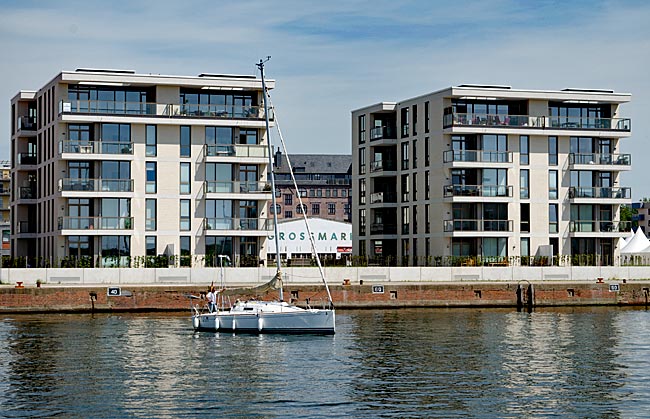
Apartment buildings at the New Harbor
At the northern end of the harbor basin, opposite the complex with the Climate House, Emigration Museum, etc., however, it is largely over with the peace and tourist activity. Unless part of the Lock Street with the folding bridge is pointing vertically into the sky to let a ship pass, heavy traffic rolls over the asphalt. Because behind it begins what Bremerhaven was built for by the city of Bremen in the first half of the 19th century on previously acquired land: the overseas ports. Since the Middle Ages, the trading city of Bremen had repeatedly faced problems with overseas shipping due to the silting up of the Weser River. Even then, ships were becoming larger and could no longer or only temporarily call at the Bremen ports.
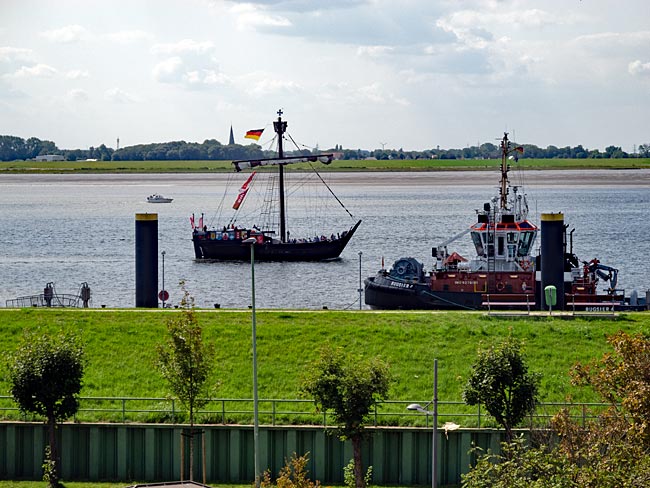
The "Ubena von Bremen," a cog replica launched in 1991 on the Weser. During the Hanseatic era, merchant ships were still quite small
In addition to the Old Harbor, today's Museum Harbor and the first one built, other harbors were added later. Thus, with Kaiserhafen Eins on the other side of the aforementioned Lock Street, the first in a series of harbor basins extends. Even a glance into this first part of the extensive port area reveals another world of seafaring, that of large ships. Here, goods are handled on a large scale, stored, and ships are repaired.
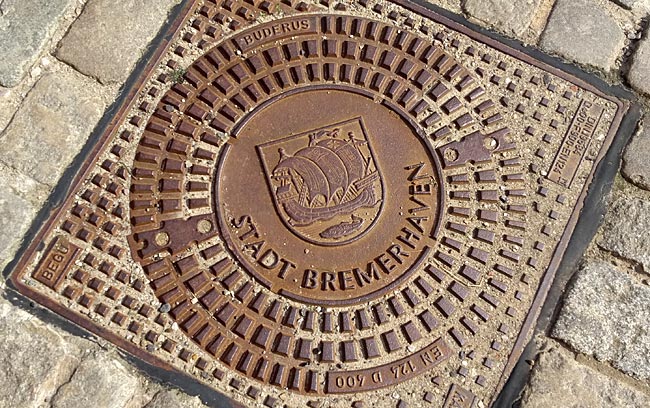
Seafaring and fishing even play a role on manhole covers in Bremerhaven
But for these steel giants to safely navigate the tide-dependent Weser River up to the ports, they often take pilots aboard during their journey in the river mouth via the Jacob's ladder (a rope ladder lowered at the ship's side), who know the tricks of the waterway well. The pilots are transferred from the pilot station ship, which anchors in the Weser estuary for several weeks and can accommodate around 50 pilots alongside the crew, with small transfer boats (tenders). They return to the station with ships departing from Bremerhaven.
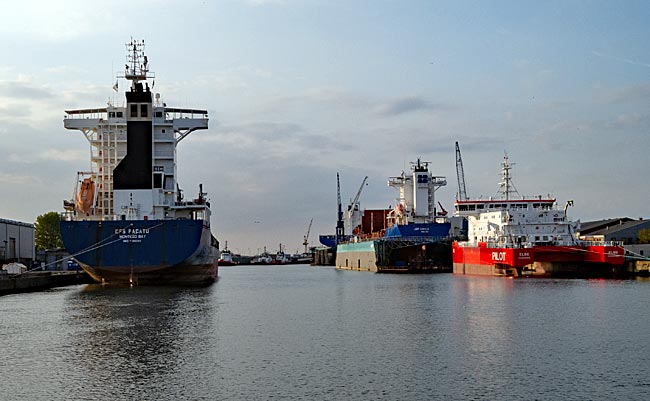
The pilot station ship Elbe (right in the picture) was built as a more seaworthy double-hull ship (SWATH) by Abeking & Rasmussen in Bremerhaven's Fishery Harbor and completed in 2009. The identical "Weser" anchors in the Weser estuary
Large parts of the port area are not accessible to third parties, but you can still walk, cycle, or even drive through the site on a connection. And what you can see is quite impressive. On foot, it's best to take the path along the Weser dike, which extends from the Simon-Loschen Lighthouse to the Kaiser Schleuse in this section. At the end of Lock Street, there is conveniently a staircase.
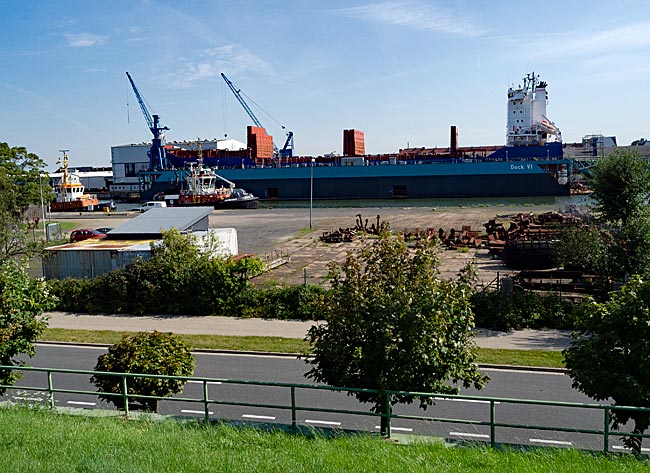
View from the dike onto Kaiserhafen Eins with tugboats and the container freighter "JSP Carla" in Dock VI; in front, decommissioned anchors are rusting away
From the dike crown, the view extends toward the Weser River to the tugboat pier on the left and a small tugboat harbor on the right. Although these extremely maneuverable ships may look like nutshells compared to others, they are powerhouses with over 5,000 kW (approximately 6,400 hp). They not only maneuver huge seagoing vessels into position using towlines but also push directly in one direction, such as bow tractors (tugs). To prevent damage to the ship's sides during this process, these tugboats have an additional wide rubber reinforcement at the bow and sometimes also at the stern.
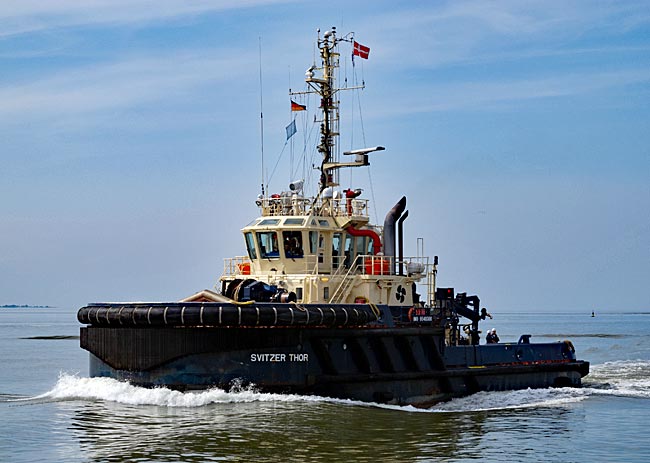
The bow tractor Svitzer Thor. The shipping company Svitzer is a wholly owned subsidiary of the Danish shipping company Maersk, one of the largest in the world
The ships are manned 24/7 by three crew members who live and sleep on board during their duty and are thus always ready to depart when requested.
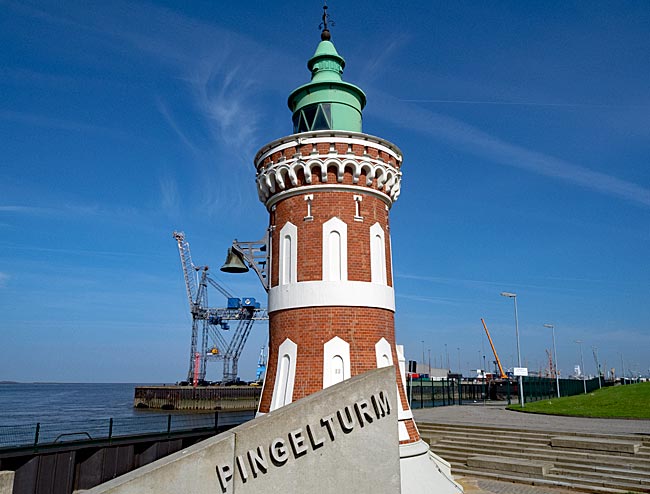
Behind the Pingel Tower with its bell is the entrance to the Kaiser Schleuse
Between the tugboat harbor and the Kaiser Schleuse stands, since the year 1900, the so-called "Pingel Tower," actually the lighthouse "Kaiser Schleuse Ostfeuer." The 15-meter-high brick building is colloquially named thus because it is equipped with a fog bell that was used in pre-digital times during fog when the light of the lighthouse was obscured by water droplets.
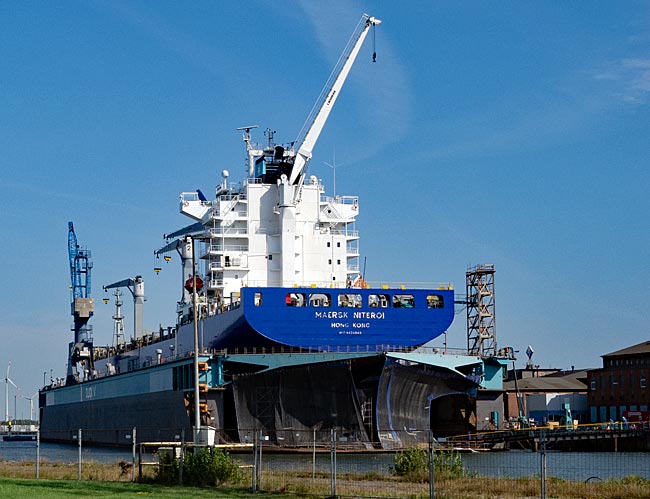
At the level of the Kaiser Schleuse, the freighter Maersk Niteroi is docked in Dock V at Kaiserhafen Eins
The Kaiser Schleuse, which connected the ports to the Outer Weser after five years of construction from August 1897, was the world's largest lock at the time with a chamber length of 200 meters and a width of 28 meters. Since 2011, a newly built even larger and flood-proof one has been in operation.
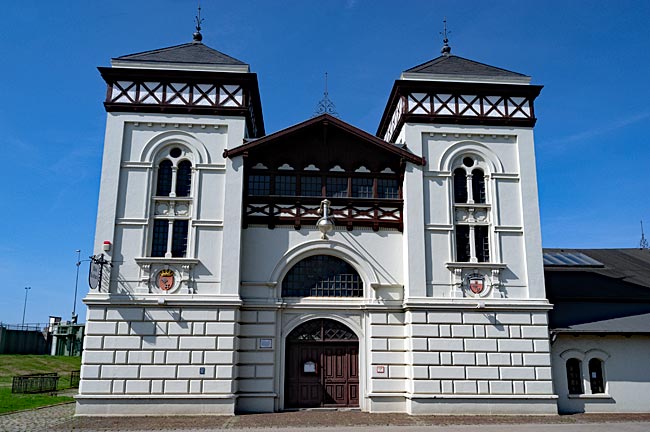
Historic Old Power Plant next to the Kaiser Schleuse, built between 1894 and 1897. Here, direct current for lighting the quays of the harbor basins was generated, and the pressurized water that drove, among other things, the lock gates. In 1910, it was replaced by a new power plant
You don't just have to imagine the dimensions; you can see the extent from above yourself because Lohmannstraße or Wiegandstraße leads into the port area via the lock. From there, you have a good view of Kaiserhafen 2 and Kaiserhafen 3 - and especially see cars lined up in rows and huge shapeless RoRo ships towering in the Nordhafen behind them. Bremerhaven is one of the most important hubs in Europe for car imports and exports. Thousands of vehicles fit distributed over several decks in the belly of such a steel giant and are driven in individually.
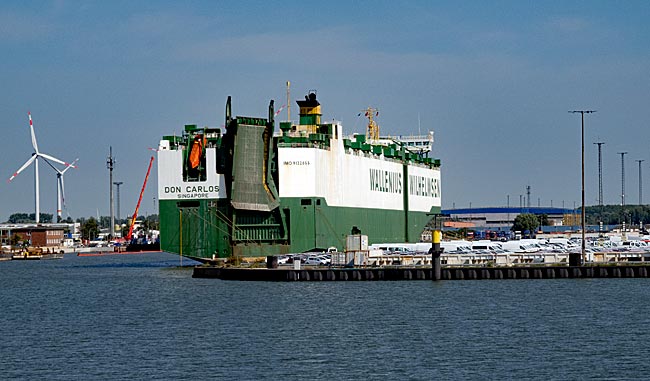
A Ro-Ro ship of the Norwegian-Swedish shipping company Wallenius Wilhelmsen Logistics and cars prepared for export in Kaiserhafen 3
But even these ships are not unsinkable. The "Tricolor," built in Hiroshima (Japan) in 1987 and 190 meters long, could transport 6,030 passenger cars and sank on December 14, 2002, within half an hour after a collision with a container freighter in the English Channel with almost 3,000 new cars on board, including many luxury vehicles. At least no human life was lost in the accident.
previous page
 next page
Map
Further information
Dicke Pötte Tour (Big ships tour)
Reederei Weserfähre GmbH
Zur Hexenbrücke 11
27570 Bremerhaven
Phone: +49 (0)471 3003-600
Email: info@weserfaehre.de
www.ms-geestemuende.de
Travel time: 2 to 2¼ hours, daily 1–2 trips depending on the schedule
Hafenrundfahrten (Harbor Tours)
HaRuFa Maritime Tourismus GmbH
H.-H.-Meier-Straße 4
27568 Bremerhaven
Phone: +49 (0)471 415850
Email: kontor@hafenrundfahrt-bremerhaven.de
https://hafenrundfahrt-bremerhaven.de
Bremerhaven in general
Bremerhaven was founded only in 1827. To secure its importance as a port city amid the threat of silting up of the Weser River - the lifeline of Bremen - Bremen acquired 342 morgen (approximately 850 acres) of land at the mouth of the Weser from the Kingdom of Hanover for 74,000 talers in 1827 under then-mayor Johann Smidt. About 60 km downstream from Bremen, the first urgently needed seaport for Bremen, known as the Alte Hafen (Old Harbor), was established there by 1830.
read more ...
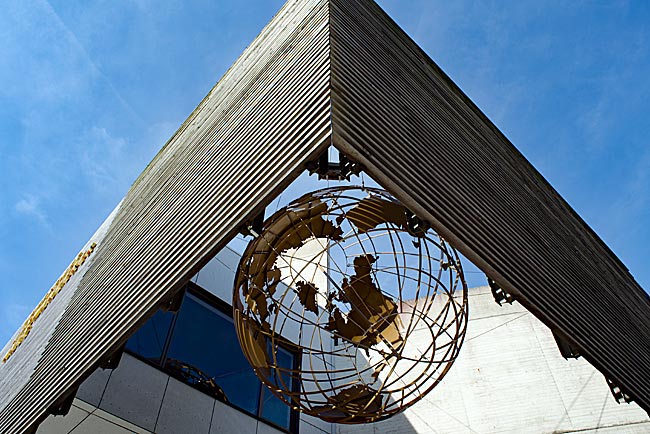
Bremerhaven - Deutsches Auswandererhaus® (German Emigration Center)
Opened in 2005, the German Emigration Center vividly and engagingly presents the history of emigration to America across five eras spanning from 1830 to 1974. In total, 7.2 million people departed from Bremerhaven to seek a new home and build a new life beyond the Atlantic. The emotionally compelling exhibition, backed by historically accurate research, earned the museum the European Museum Award in 2007.
read more ...
Bremerhaven - Zoo am Meer (Zoo by the Sea)
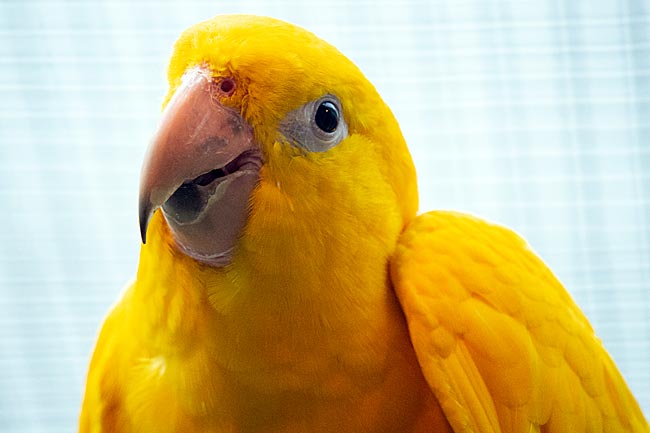
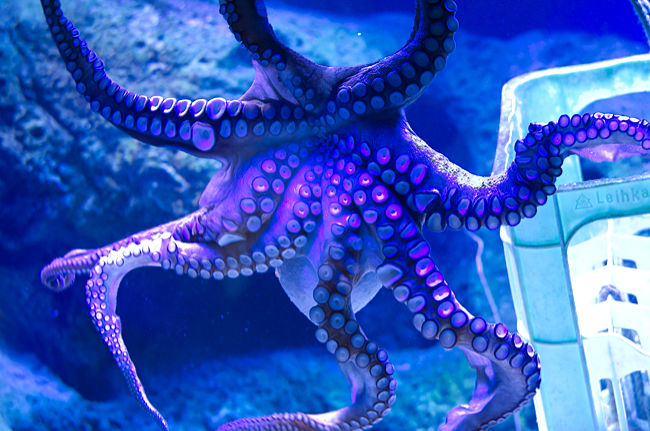
In addition to the 19th-century harbor facilities, the Zoo am Meer is the oldest attraction on the site between the Weser River and the pedestrian zone. It opened in 1928 under the name "Tiergrotten." The enclosures house polar bears, seals, penguins, various bird species such as gannets and keas, reptiles like turtles, raccoons, Arctic foxes, pumas, monkeys, and others - almost 50 animal species in total.
read more ...
Bremerhaven Havenwelten
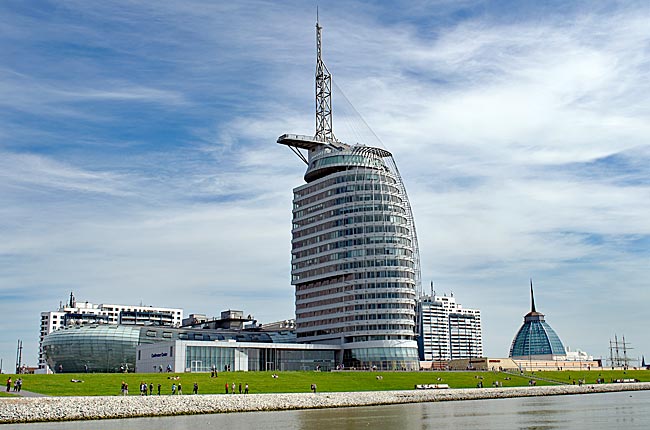
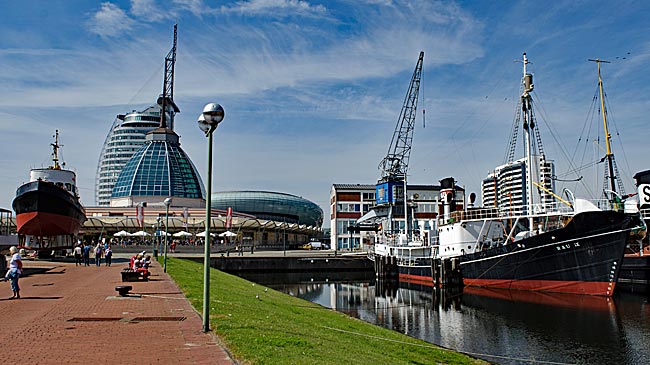
Since early 2008, Bremerhaven has not only had a new tallest building but also a new landmark in its Weser-side skyline with the ATLANTIC Hotel SAIL City, which rises 147 meters directly behind the Weserdeich. Architecturally, the structure perfectly embodies a maritime city - it stands like a powerful, rounded ship's superstructure. On the 20th floor, at a height of 77 meters, there is an observation deck (SAIL City) that is also accessible to non-guests.
read more ...
Bremerhaven - Schaufenster Fischereihafen (Fishery Harbor Showcase)
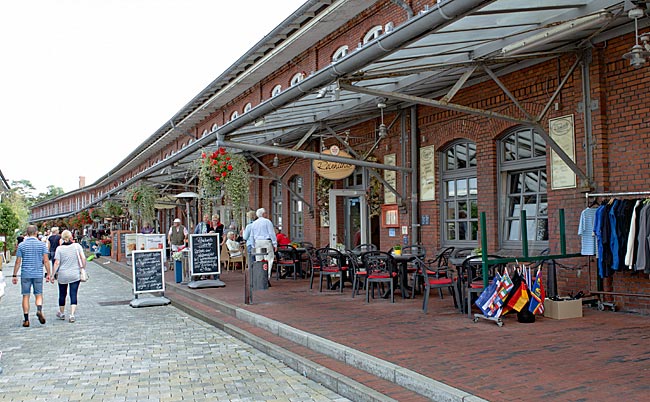
Away from the Havenwelten and older than both the Emigration Center and Klimahaus is the "Fishery Harbor Showcase." In fact, the Fishery Harbor was originally Geestemünde's deep-sea fishing harbor, built between 1891 and 1896. After a period of decline and decay - including partial demolitions - the idea emerged to transform the area into a maritime experience world. In 1990, efforts began to restore Fish Packing Hall IV, the oldest surviving hall, which had been slated for demolition just shortly before.
read more ...
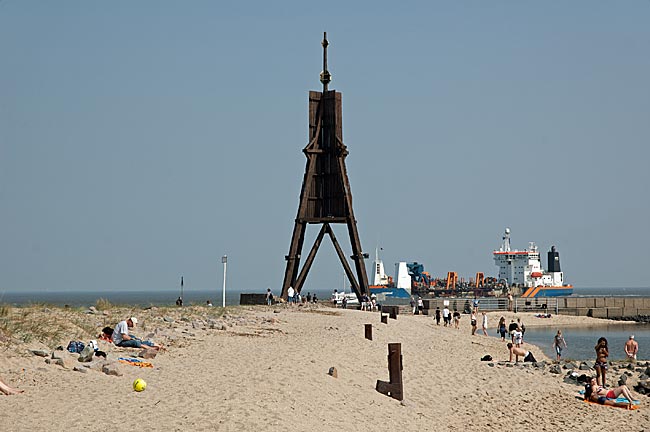
Cuxhaven - a day trip
Many people from Bremen consider the seaside resorts of Cuxhaven to be "their home beach." The coastal city at the mouth of the Elbe is easily accessible from Bremen by car via the A27, which passes by Bremen and Bremerhaven before ending in Cuxhaven. By train, the journey takes a bit longer with a transfer in Bremerhaven. However, even in the off-season, Cuxhaven with its seaside resorts is a great destination for an outing - for example, by bicycle.
read more ...
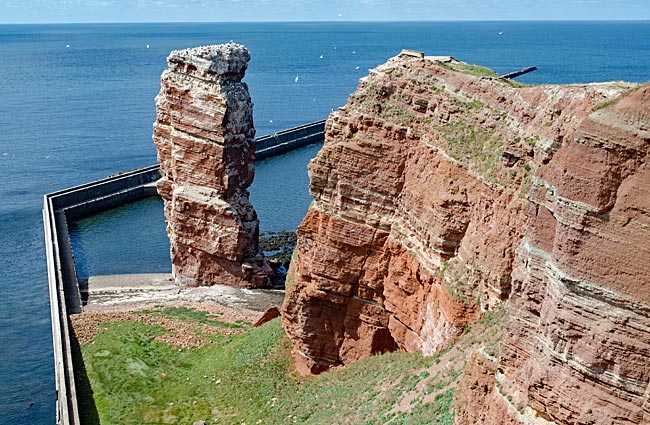
Heligoland - a day trip
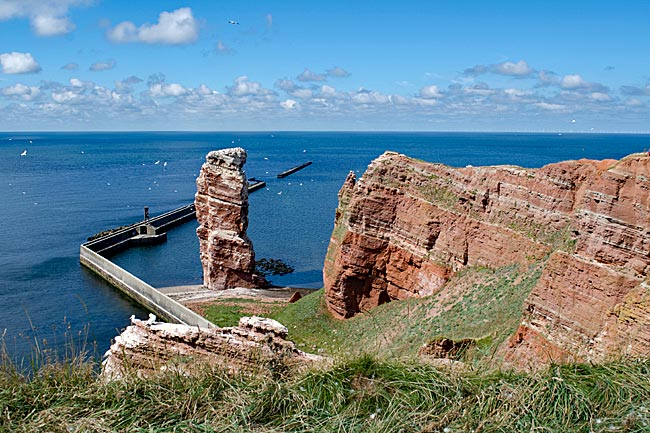
Germany's only supposed high-seas island is visited each year by thousands of tourists, most of them day-trippers in the warmer months. And yes, admittedly, Heligoland isn't located right in the vicinity of Bremen. However, it can be reached as a day trip from Bremerhaven and Cuxhaven - which is why we decided to visit.
read more ...
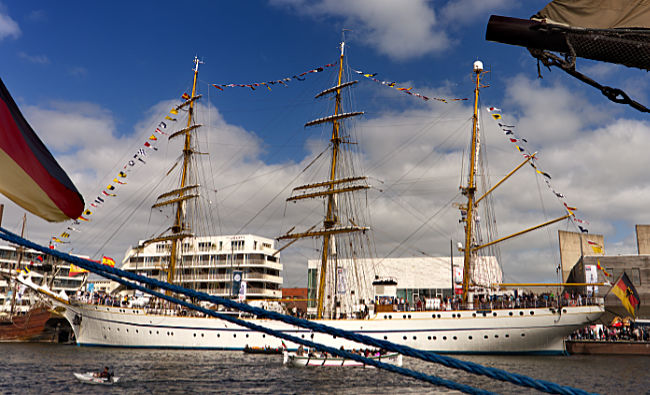
SAiL Bremerhaven
When SAiL Bremerhaven takes place, the port city becomes an even more international stage than it already is, both in terms of participants and visitors, who exceed ten million over the five days of the event. Unlike the usual focus on cargo ships at the container terminal and cruise ships at the cruise terminal, this time - true to its name - the spotlight shifts primarily to sailing ships. In total, 250 vessels were attracted or involved in the SAiL, which returned for the first time in ten years in 2025.
read more ...
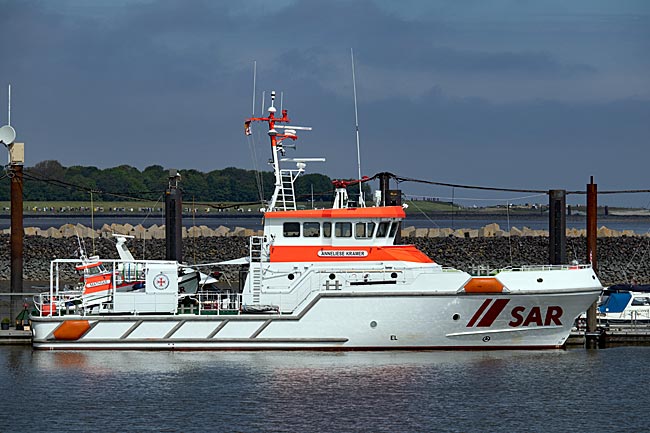
DGzRS - The Maritime Rescuers
Anyone in distress at sea today has far better chances of receiving help, even out on the open water, thanks to modern technology and professionals who take care of it. Along Germany’s North and Baltic Sea coasts, these are primarily the approximately 1,000 full-time and volunteer men and women of the DGzRS (German Maritime Search and Rescue Service), also known as "The Maritime Rescuers." In 2020 alone, they conducted 1,720 operations and rescued 357 people. Since its founding, the organization has helped 86,000 individuals.
read more ...
Neu-Helgoland (New Heligoland) / Hamme Harbor Worpswede
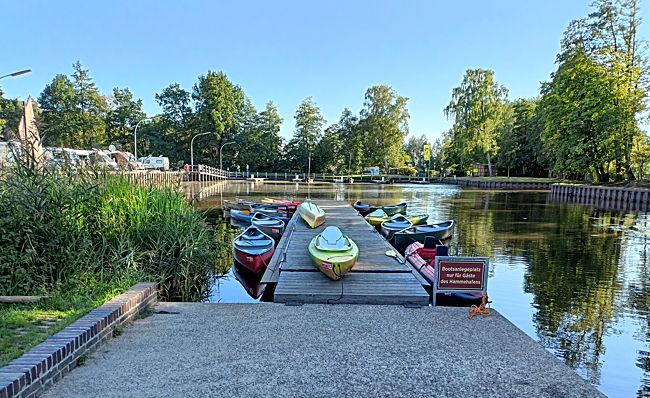
From April to October, the Hamme Harbor in Worpswede attracts many day visitors, weekend trippers, cyclists, and campers. The campsite operators run not only a bistro & beer garden with waterside seating but also rent out kayaks and canoes. Those who don’t want to paddle on the Hamme themselves can instead book an excursion trip aboard one of the Adolphsdorf Peat Boats. Food and drinks are also available just a few meters from the harbor at "Hamme Hütte Neu Helgoland." Tip: A great bike trip destination from Bremen!
read more ...