
 exploring Bremen & its surrounding areas
 You are here: worth seeing in the surroundings
 Wilhelmshaven, seaside city on the North Sea bay Jadebusen (2/4)
Just a few years after the completion of the naval facility in Wilhelmshaven, the harbor area was expanded - for example, by a third entrance inaugurated in 1909 (today cut off on two sides) with a double lock - and later had to be adapted to the space requirements and ever-larger ships; eventually, several battleships were permanently stationed here. Since 1888, the Ems-Jade Canal, completed after eight years of construction, has flowed into Wilhelmshaven’s harbors and from there into the Jadebusen. The connection between the waters is still used today as a waterway with numerous industrial settlements on both shores and serves to drain parts of East Frisia, which would otherwise perhaps be uninhabitable.
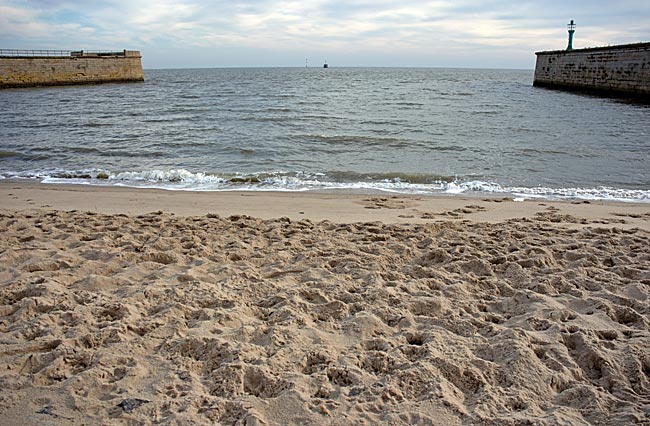
A ship will come ... but not far: the former 2nd entrance, completed in 1869, now ends at the dike; behind it, a lake remains
Far from Wilhelmshaven, in 1895, the waterway later named the North Sea-Baltic Canal was ceremonially inaugurated as the Kaiser-Wilhelm Canal and subsequently massively expanded over seven years until 1914, allowing fleet units to be relatively quickly relocated between the naval base of Kiel and Wilhelmshaven without having to take the long detour via Skagerrak.
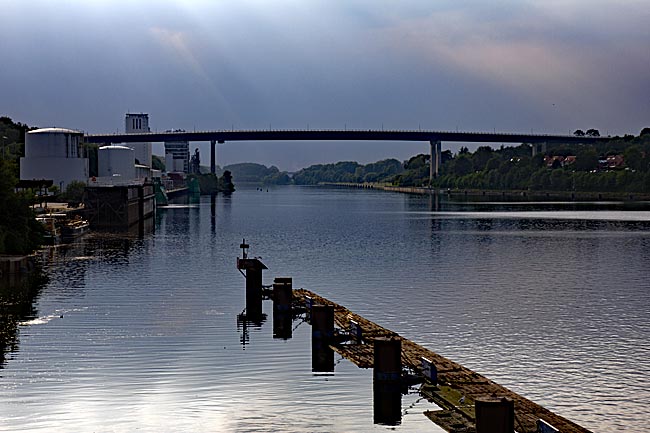
The North Sea-Baltic Canal at the lock in Kiel during twilight
After the outbreak of World War I, however, initially very little happened on the water; the large battleships of the High Seas Fleet with over 1,000 crew members per ship remained docked in Wilhelmshaven. The naval battles near Heligoland on August 28, 1914, and at the Dogger Bank on January 24, 1915, were fought by smaller units such as cruisers, destroyers, and torpedo boats of the British Royal Navy and the Imperial German Navy, with the latter suffering heavy losses; around 2,000 of their men died at sea.
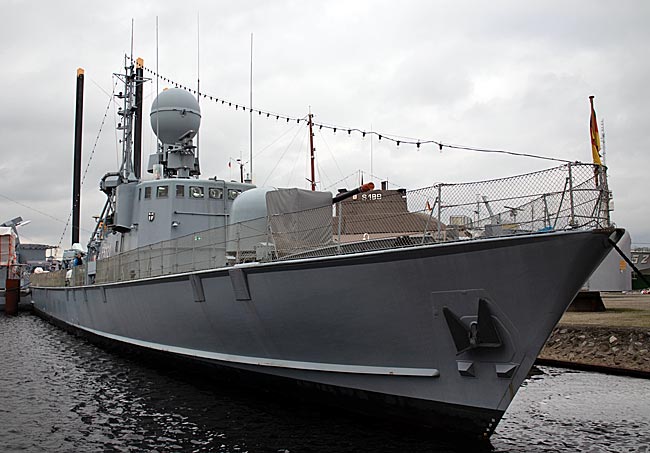
With 42 knots (78 km/h), the missile boat was very fast. Since June 2016, the boat decommissioned in 2014 after 32 years of service has been a museum ship
And then the expensive battleships finally set sail from the Imperial Naval Harbor in Wilhelmshaven. The largest conventional naval battle in history to date took place from May 31 to June 1, 1916, at Skagerrak. 150 ships of the British Grand Fleet faced off against 99 German ships and boats. The Germans had actually been on their way to Norway on another mission when the British, who had intercepted radio communications and realized that their plans for blockading the Jadebusen were obsolete, engaged them in battle over distances of several kilometers. In the end, 14 British and 11 German ships had sunk, claiming 6,094 lives on the British side and 2,551 on the German side, including the poet Gorch Fock. It was likely due to British navigational and tactical errors that the 8:5 superiority did not result in disaster for the German High Seas Fleet and even more deaths.
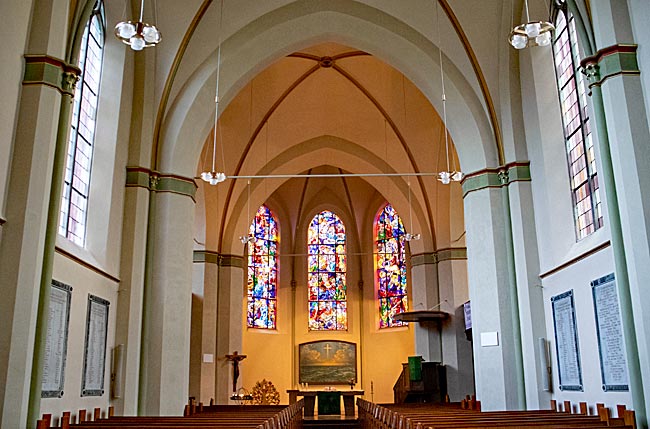
The altar painting by Hugo Schnars-Alquist in the Christ and Garrison Church was unveiled in 1926 on the tenth anniversary of the Skagerrak battle. "Through the Cross to Light" is the title of the work, which shows a comforting cross over the now peaceful, deserted sea after the battle, according to its interpretation.
There were no more deployments for the large ships by the end of the war, but to prevent them from becoming spoils of the victors after the war, the Admiralty wanted to send the High Seas Fleet out one last time in October 1918 for a decisive battle against the Grand Fleet. After all, the noble or upper-class commanders and officers could hardly cope with the shame of surrender. Let them go down with flying colors ... But unrest among sailors in Wilhelmshaven - mutinous sailors from the fleet at anchor near Schillig - and the quickly escalating sailors' revolt in Kiel that followed ultimately led to no naval ship leaving a German port.
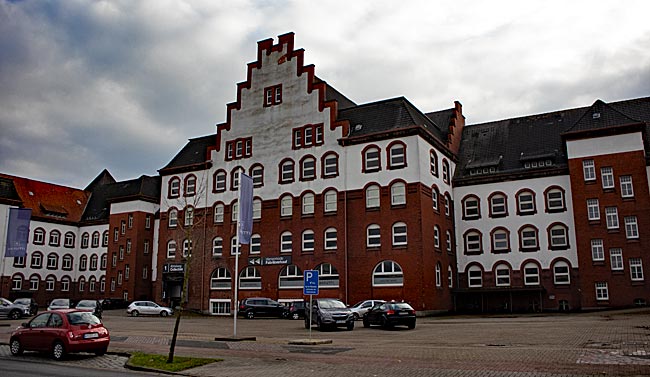
On November 6, 1918, sailors freed imprisoned mutineers from the naval investigation prison in the torpedo casemate on Ebertstraße
Instead, 74 German ships were interned in the Scottish Scapa Flow near the Orkney Islands in November 1918 after the armistice. From there, the British fleet had sailed to Skagerrak; now, the enemy’s ships lay at anchor here. But not for long, because in an action still unique worldwide today, officers and sailors on the orders of Rear Admiral Ludwig von Reuter scuttled most of the High Seas Fleet by opening and subsequently destroying the sea valves themselves.The British retaliated against this breach of the armistice agreement with equally unlawful shots at the crews in the lifeboats, resulting in some deaths and subsequent burial on a cemetery. Except for seven that remain as monuments on the seabed, the ships were salvaged over the years until 1937 and scrapped or repurposed.
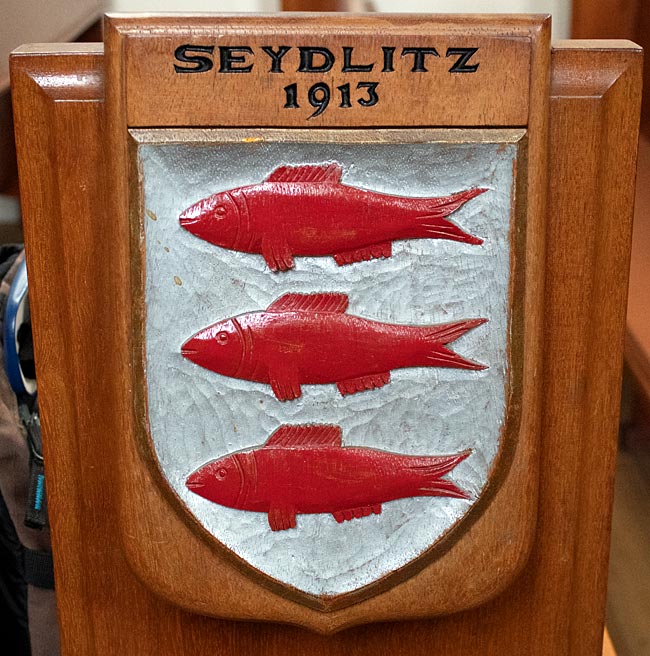
The coat of arms of the "SMS Seydlitz" in the Christ and Garrison Church. The battlecruiser commissioned in 1913 would have nearly sunk after suffering over 20 heavy hits in the Skagerrak battle and only just made it back to Wilhelmshaven with around 5,300 tons of water in its hull. A damaged gun barrel is displayed today in the naval museum. The "Seydlitz" also ended up in Scapa Flow.
At this point,a reading tip for those interested: Des Kaiser Kulis by Theodor Plievier.The author was a sailor on an auxiliary cruiser during World War I and involved in the unrest in Wilhelmshaven that shortly thereafter led to the sailors' revolt in Kiel, which in turn heralded the end of the German Empire.
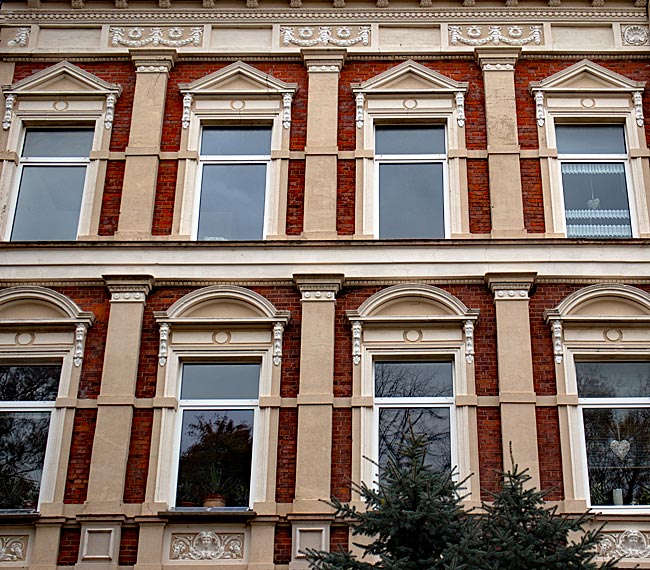
Facade of a residential building
But Wilhelmshaven was also an Imperial Naval Harbor and shipyard location during World War II and thus naturally a preferred and quickly reachable target for Allied bombers. From September 4, 1939 to March 30, 1945, the British Royal Air Force and the US Air Force flew over 100 raids on the city, also aiming to destroy the supply-producing shipyard, though this ultimately failed. Instead, the deadly cargo from above primarily reduced the densely populated inner city to rubble; overall, the city suffered severe damage.
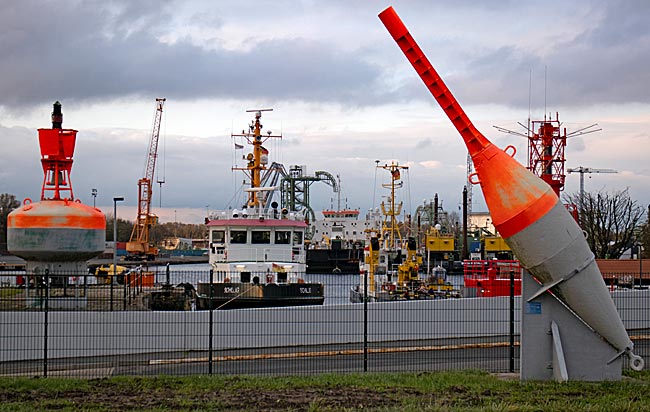
View over the fence into part of the harbor area
It is hardly possible to imagine Wilhelmshaven without its navy, especially since the Bundeswehr still maintains a large base here with several squadrons today, meaning that vast parts of the harbor facilities are military security zones accessible only to authorized personnel. Ship spotting is thus somewhat limited.


Map
Further information
Tourist Information
Ebertstraße 110
26382 Wilhelmshaven
Phone: +49 (0) 4421 913000
Open: Monday – Friday 10 AM – 6 PM, Saturday 10 AM – 4 PM
Email: tourist-info@wilhelmshaven-touristik.de
www.wilhelmshaven-touristik.de
Stiftung Deutsches Marinemuseum
Südstrand 125
26382 Wilhelmshaven
Phone: +49 (0) 4421 400840
Open: April 1 – October 31 daily 10 AM – 6 PM, November 1 – March 31 daily 10 AM – 5 PM, Closed December 24
Email: info@marinemuseum.de
www.marinemuseum.de
UNESCO World Heritage Wadden Sea Visitor Center
Südstrand 110 b
26382 Wilhelmshaven
Phone: +49 (0) 4421 910733
Open: January – March: Tuesday – Sunday 10 AM – 5 PM, April – June: Daily 10 AM – 5 PM, July – August: Daily 10 AM – 6 PM, September – October: Daily 10 AM – 5 PM, November – December: Tuesday – Sunday 10 AM – 5 PM
Closed: December 23–25, 31
Email: info@wattenmeer-besucherzentrum.de
www.wattenmeer-besucherzentrum.de
Küstenmuseum Wilhelmshaven
Weserstraße 58
26382 Wilhelmshaven
Phone: +49 (0) 4421 400940
Open: February – November: Tuesday – Sunday 11 AM – 5 PM
Closed in December
www.kuestenmuseum.de
Kunsthalle Wilhelmshaven
Adalbertstraße 28
26382 Wilhelmshaven
Phone: +49 (0) 4421 41448
Open: Tuesday 2 PM – 8 PM, Wednesday – Sunday 11 AM – 5 PM
Closed: Monday, December 24–26, 31, January 1
Email: kunsthalle@wilhelmshaven-touristik.de
www.kunsthalle-wilhelmshaven.de
Kulturzentrum Pumpwerk
Banter Deich 1a
26382 Wilhelmshaven
Email: pumpwerk@wilhelmshaven-touristik.de
www.pumpwerk.de
Aquarium Wilhelmshaven Bullermeck GmbH
Südstrand 123
26382 Wilhelmshaven
Phone: +49 (0) 4421 5066444
Open: Daily 10 AM – 6 PM
Closed: Christmas Eve
Email: info@aquarium-wilhelmshaven.de
www.aquarium-wilhelmshaven.de
Dangast
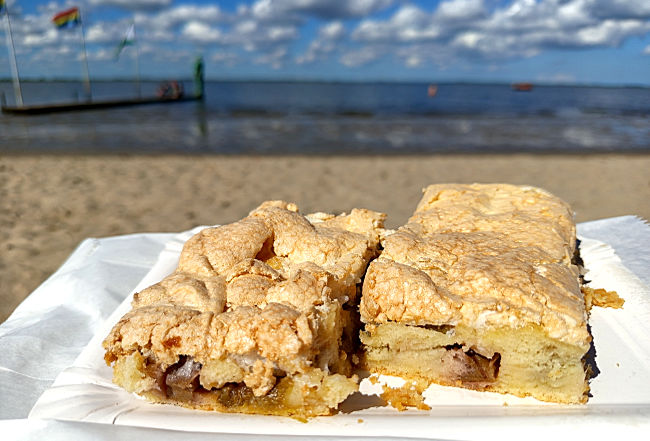
Dangast is located on the Jadebusen, a 190 km² sea bay at the North Sea created by storm surges. The town, which belongs to Varel, is a popular holiday and excursion destination. Campers will find two campsites right by the water here, and cyclists have excellent conditions for tours in the surrounding area. The rhubarb cake in the picture is a classic with a rich tradition at the old spa house, which has been run by a family business for several generations.
read more ...
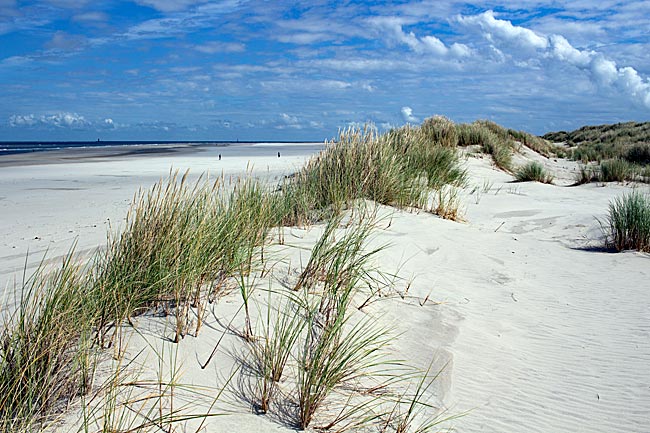
The East Frisian Island Wangerooge
Among the inhabited East Frisian Islands, Wangerooge is the second smallest (7.94 km²) after Baltrum and car-free, making a stroll through town much more pleasant compared to other islands, especially since distances can easily be covered on foot. From the small train station, you're just a few steps away from the heart of the village, quickly finding yourself in front of the unmistakable Old Lighthouse, which now houses the island museum. From 1856 to 1969, this lighthouse served as a maritime navigation aid, guiding ships safely along their routes. Just how far its light could be seen becomes clear when you climb the 149 steps to the lantern room—from there, you can step out onto the surrounding gallery and enjoy a sweeping view of the island and the North Sea.
read more ...
Oldenburg
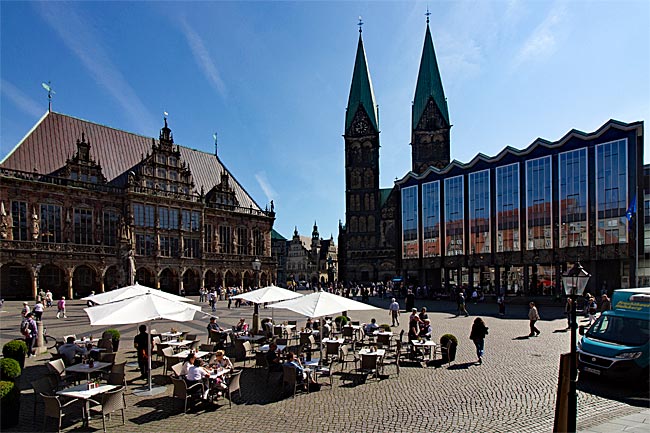
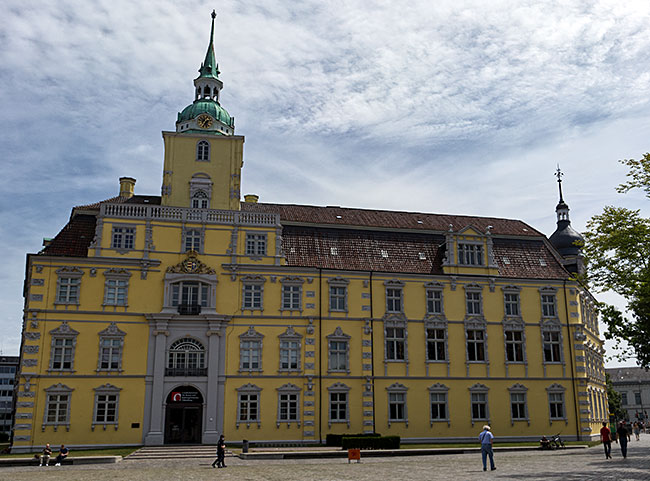
The third-largest city in Lower Saxony today was once the seat and capital of ruling counts, dukes, and grand dukes, later a Free State and state capital. Remnants of the time when nobles ruled the city include the palace and numerous primarily neoclassical buildings in the city center. But even beyond that, there is much to discover in the expansive, largely car-free inner city. And again and again, one comes across water during a stroll, such as the Old City Harbor.
read more ...
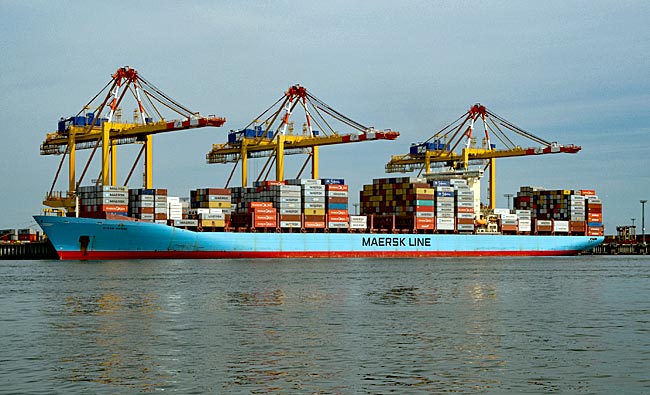
Bremerhaven - Überseehafen (Overseas Port)
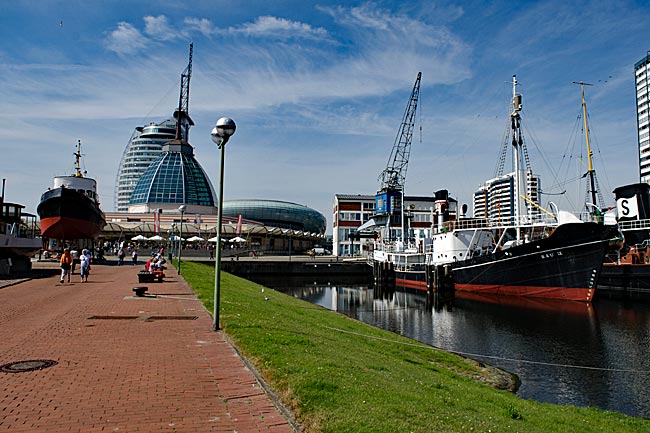
In addition to the Old Harbor (now the Museum Harbor), which was the first to be built, other ports were later added. Adjacent to the New Harbor lies Kaiserhafen I, the first in a series of additional harbor basins. Even a glance into this initial section of the expansive port area reveals a different world of maritime activity - one of large ships. And we will see even larger ones along the five-kilometer-long quay on the Weser.
read more ...
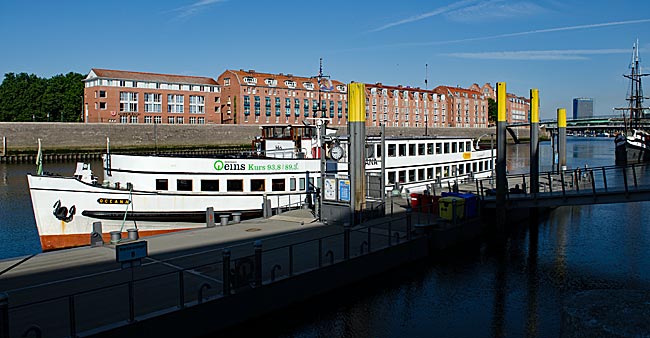
Weser cruise from Bremen to Bremerhaven
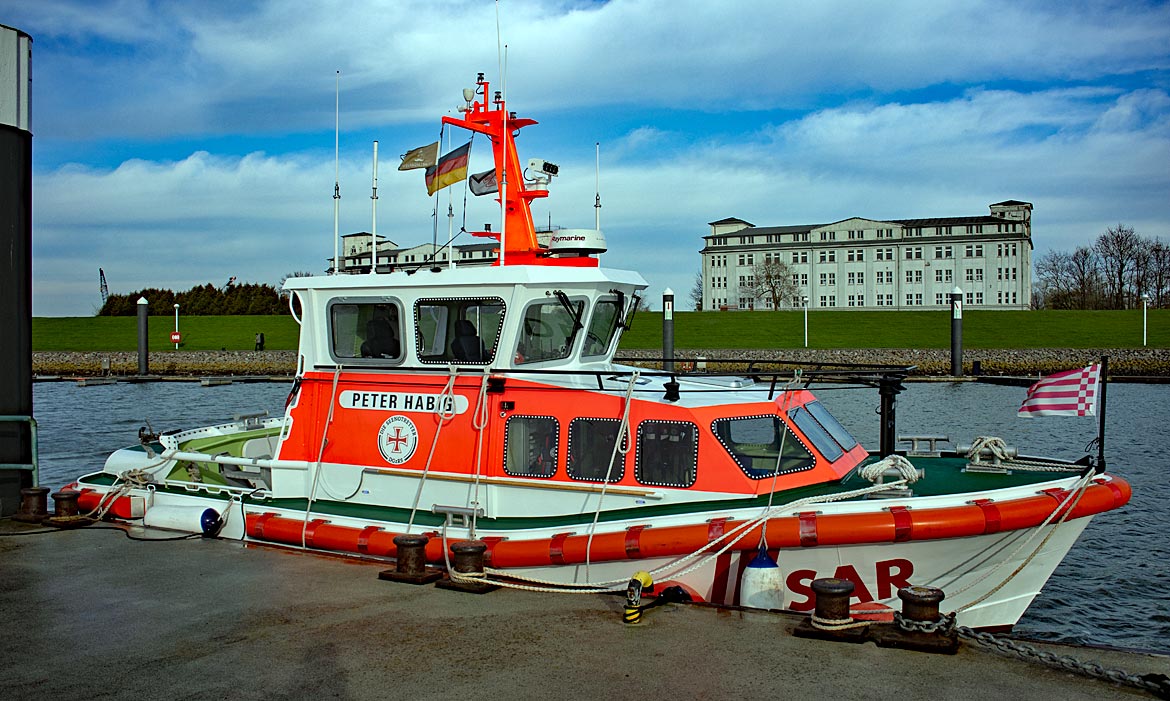
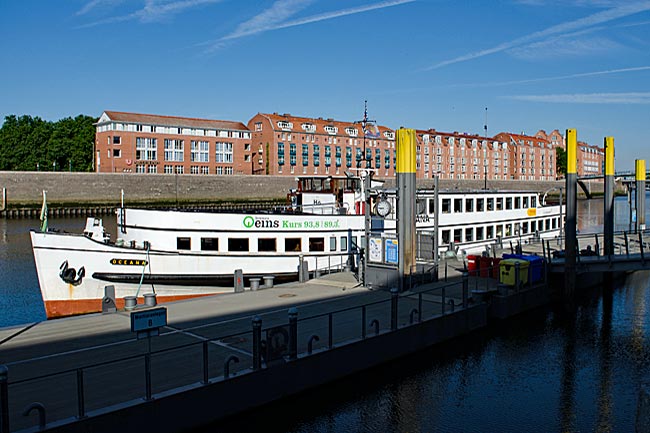
Of course, you can take a car for a visit to Bremerhaven from Bremen or board the regional train at the main station. However, with suitable weather and enough time, it is more interesting to cover the route on the Weser by ship. The shipping company "Hal över" operates the connection from May to September. The ship departs from the Martinianleger near the city center along the Schlachte. Those who wish can even take their bicycle with them; additionally, you can pre-book a breakfast onboard.
read more ...
Brake & the River Island of Harriersand
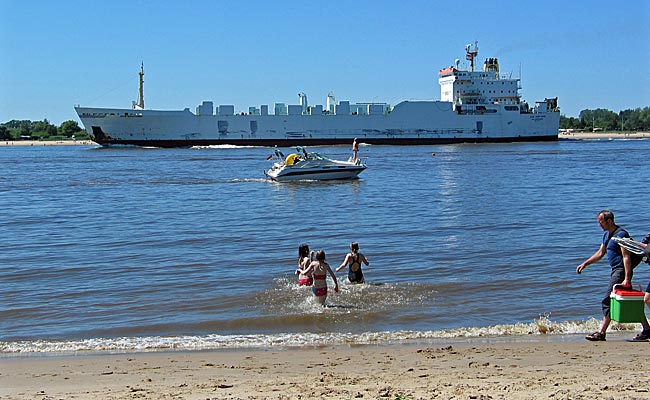
As soon as spring arrives and the temperatures reach around 20 degrees, many Northern Germans are drawn to the North Sea coast. The main attraction? A beach to lie in the sun and sand for children to dig and build castles. This also draws many people from Bremen to the highways heading north on warm weekends, equipped with bags packed and picnic baskets ready for a day of seaside relaxation. But why travel far when the nearest beach is just around the corner? A visit to Brake and Harriersand proves that.
read more ...