
 exploring Bremen & its surrounding areas
 You are here: worth seeing in the surroundings
 Dangast (1/2)
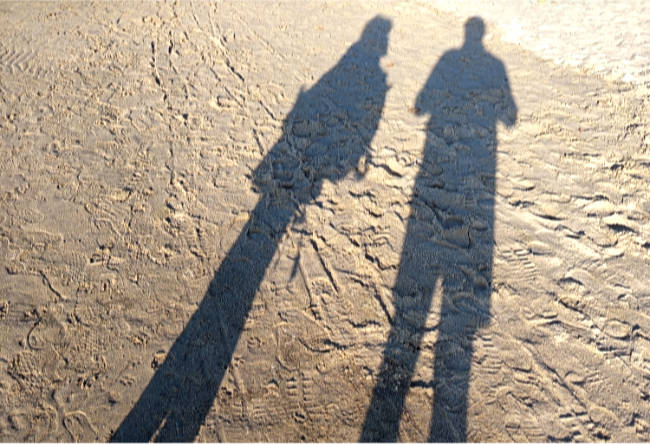
Conspiratorial gathering on the beach ... much remains in the shadows
The district of Dangast, which belongs to Varel and has fewer than 600 inhabitants, is definitely worth a visit. Especially on spring-like and summer weekends, a not insignificant number of cars, motorcycles, camper vans, cars towing caravans, and cyclists make their way along the two-lane main road toward the water, with the regular bus service between Dangast and Varel weaving through them.
And it was precisely this bus that dropped us off at one of the stops on the main road after we had taken the regional train from Bremen to Oldenburg and then another regional train from there to Wilhelmshaven and finally to Varel.
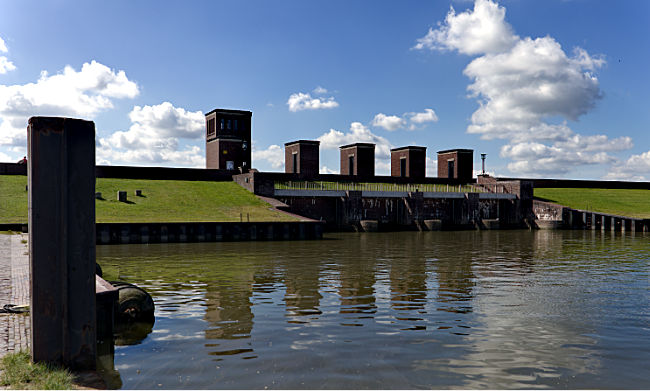
Barrier at the harbor. The flood stones on the left side of the dike show the highest water levels of some storm surges. Without dikes, it would mean: Land under.
In fact, the 190 km²-wide Jadebusen, at whose southwestern end the spa town is located, belongs to the North Sea. The former mouth of the Jade was transformed into an open large sea bay (busen) by devastating storm surges such as the First Marcellus Flood and the Lucia Flood in the 13th century or especially the Antonius or Great Ice Flood in the year 1511 through massive erosion of land. As part of the tides, nearly the entire floor of the bay dries out and is filled again with saltwater in what is likely an endless cycle of ebb and flow.
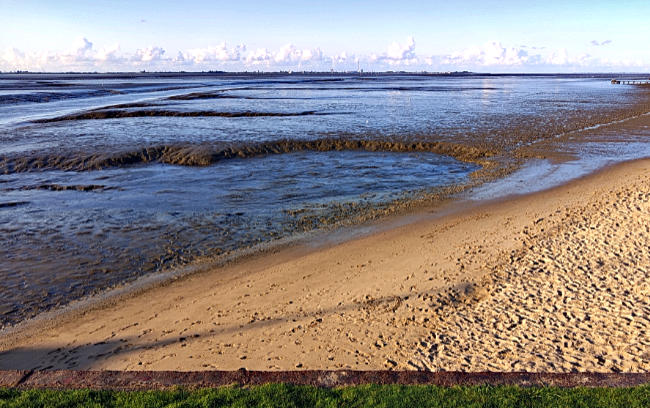
Bizarre formations of the muddy seabed sometimes appear when the water recedes
That these storm surges were not the only threatening ones in the history of the small settlement is shown by the Dangast flood stones at the barrier between the small harbor and the Dangaster Tief, through which the land behind it is permanently drained, as can be seen at low tide when the massive gates open.
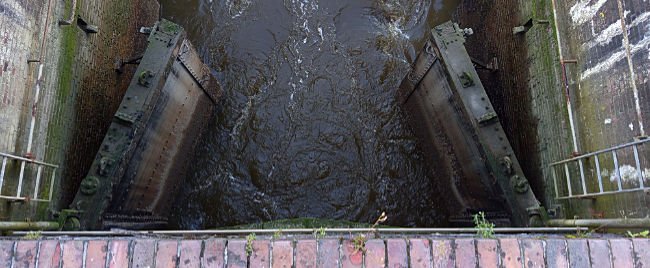
At low tide, the heavy gates open, and water flows from the land side into the bay
To keep the North Sea's water out during extreme weather and despite a climate-induced rise in sea level, the bay is diked in the coastal area and massively reinforced in direct settlement areas like Wilhelmshaven, sometimes making direct access to the water impossible. In exchange, it’s a beautiful experience walking among sheep on the dike crown and looking out over the bay. The wind in your ears, the bleating of the sheep, the occasional cries of seagulls - there isn’t much else to hear here.
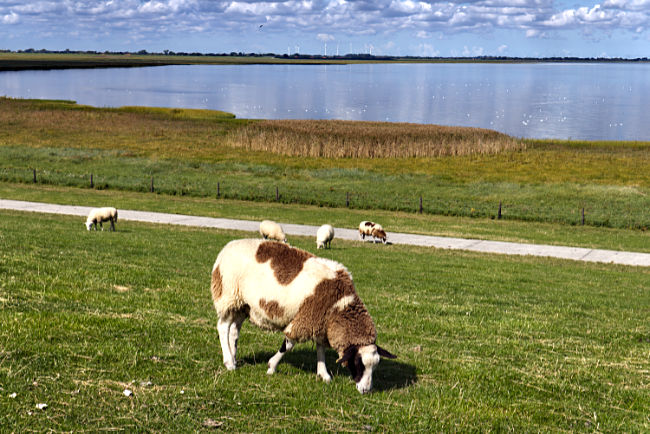
Among the sheep on the dike
Boring? Okay, let's dive into the action and head to the main beach & Co., yes, with access to the water - if it’s actually there.
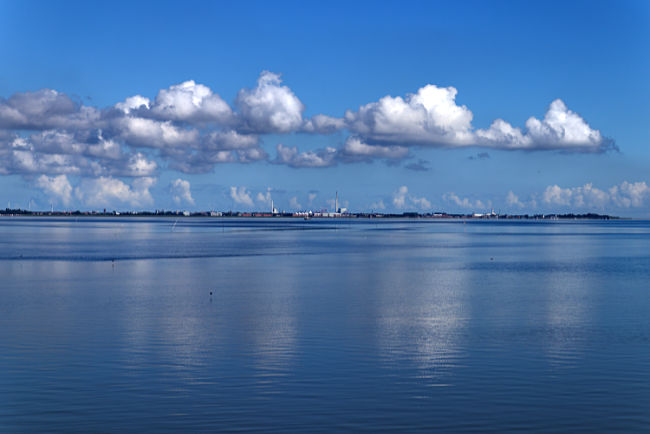
Yes, it is. From the shore, you can see Wilhelmshaven across the bay
Two campsites flank the man-made sandy beach with beach chairs, a playground, benches, and plenty of dining options right next door. The green strip between the sand and the base of the dike is often used as an event area - for example, for medieval markets, concerts, etc..
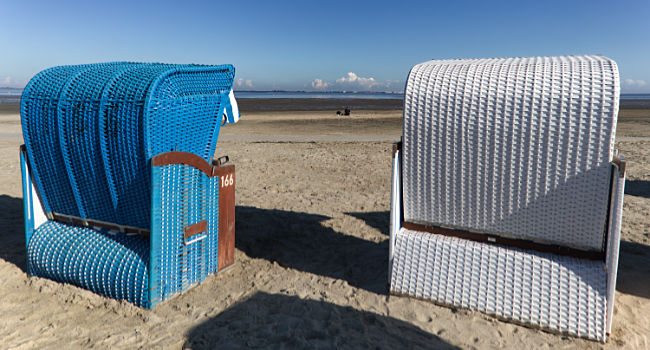
Okay, the action was just on lunch break, and the water was splashing elsewhere - low tide. Time for a walk through the mudflats, maybe with an expert guide?
Anyone who walks barefoot from the sandy beach into the water or mudflats will almost inevitably end up with black feet, as the seabed here is not sandy but muddy. Mud is a fine-grained sediment, as Wikipedia knows. “… it squelches so nicely,” as Torfrock named one of their albums, probably fits better at this point, just like the colloquial North German term *Modder*. For some, it takes a bit of overcoming to walk on the yielding ground that envelops your feet with a wet smack after every step. But it’s neither unhealthy nor overly smelly, and it’s only dangerous if you get stuck and the tide comes in. But after a few hours, the water will flow back out anyway ... ;-)
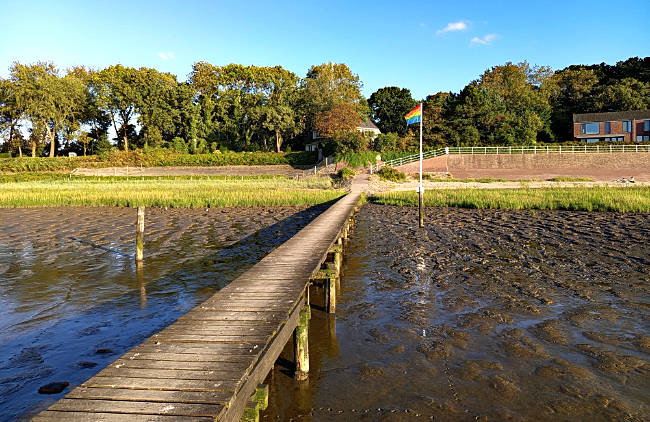
Even waterfowl leave their tracks on the soft mud (lower edge of the image).
Curiously enough, Dangast has two different faces, if one can put it that way. On the one hand, the one just described above, and another that some visitors might know as the only one, since the access road to it branches off directly at the town entrance and ends near the regionally known Old Spa House (Altes Kurhaus).
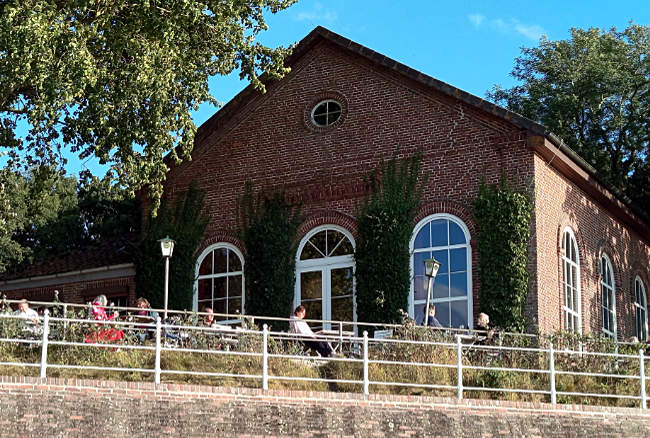
The Old Spa House seen from the beach
The Old Spa House is a former establishment housing a gastronomic business with a long family tradition. Protected from storm surges, you can sit there rustically and casually above the small beach while enjoying a good view of the bay and across to the small harbor. The area with a handful of other brick houses surrounded by trees not only appears spatially separated from the rest of the town but also feels somewhat different in atmosphere.
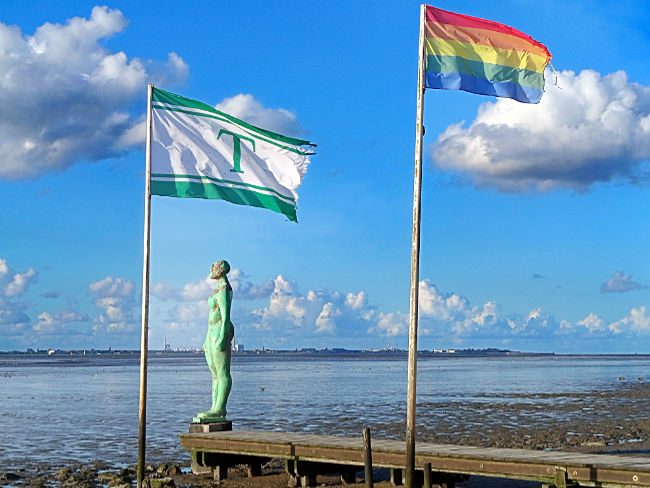
The Jade greets
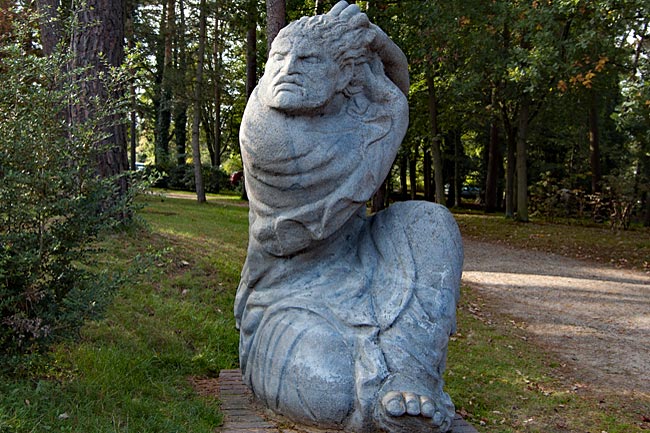
Rainbow flags flutter on poles at a pier into the water, and at the end of the wooden structure, the "Jade" greets fishermen and all those who feel greeted by this artwork of Anatol, a student of Beuys. The sculpture made of iron and polyester is somewhat lighter than its predecessor cast in lead from 1975 on firmer ground, which is not surprising.
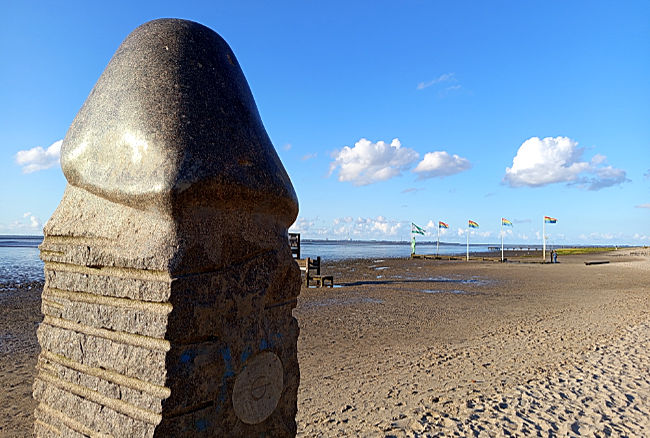
Carved in stone
In general, you come across numerous artistic works in both public and private spaces here, including a stone phallus by Eckart Grenzer on the beach. Starting in 1907, renowned artists such as the Brücke painters discovered the village for themselves, stayed longer, or settled there permanently, creating parts of their works here.
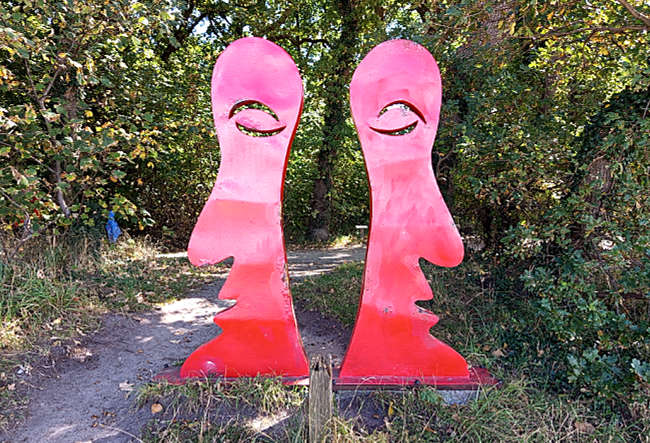
Along the Dangast Art Path.
21 picture boards along the Dangast Art Path provide information about their work. Some of the boards, like the artworks themselves, are a bit dated, but who says creative creations need to be in high gloss?
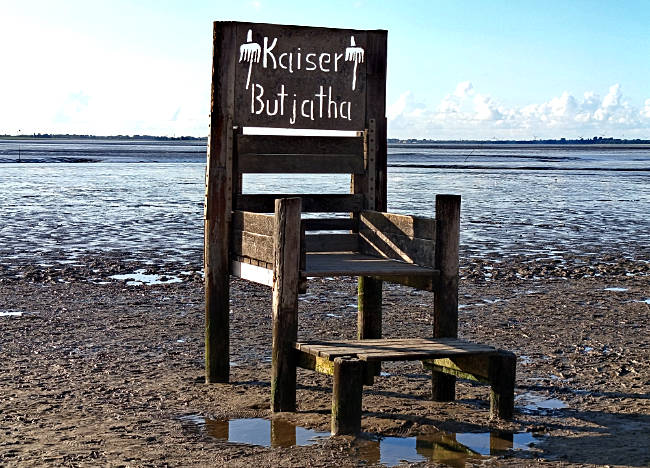
Popular photo motif
Since 1884, you can sit on Emperor Butjatha's chair on the beach and briefly feel like an empress/emperor over a realm of sand, water, and mud where he stands. And we remember, “… it squelches so nicely.” Fortunately, the almost famous traditional rhubarb cake from the Old Spa House does not.
previous page
 next page
Map
Further information
Tourism Service Nordseebad Dangast
Edo-Wiemken-Str. 61
26316 Varel-Dangast
Phone: +49 (0) 4451 9114 0
Email: info@dangast.de
www.dangast.de/tourist-information.html
Jantje von Dangast
Hafen Dangast
26316 Varel
www.jantjevondangast.de
Kurhaus Dangast: www.kurhausdangast.de
Camping: www.dangast.de/strandcampingplatz-nordsee-dangast.html, www.rennweide.de
Wilhelmshaven – Seaside City on the Jadebusen
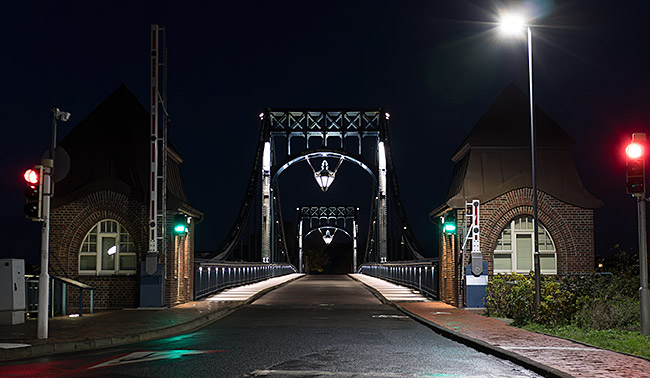
It's hard to imagine Wilhelmshaven without its naval presence, as the city only developed after a naval base was built in the 19th century. Even today, the German Armed Forces (Bundeswehr) maintain a large base here with several squadrons. Yet, there is much more to discover in this port city beyond its military significance.
read more ...
Oldenburg
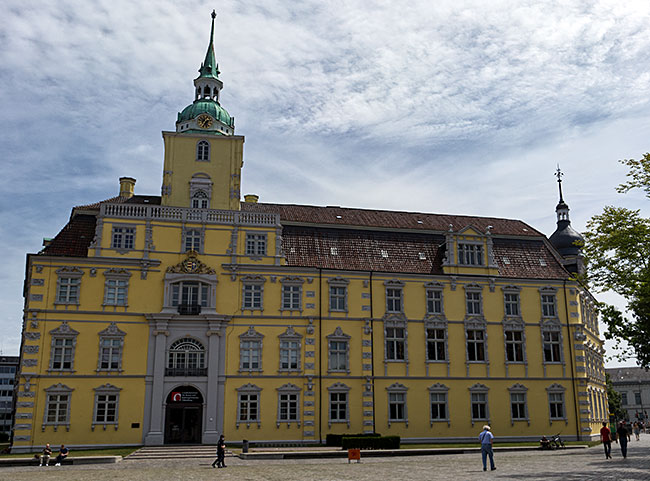
The third-largest city in Lower Saxony today was once the seat and capital of ruling counts, dukes, and grand dukes, later a Free State and state capital. Remnants of the time when nobles ruled the city include the palace and numerous primarily neoclassical buildings in the city center. But even beyond that, there is much to discover in the expansive, largely car-free inner city. And again and again, one comes across water during a stroll, such as the Old City Harbor.
read more ...
The East Frisian Island Wangerooge
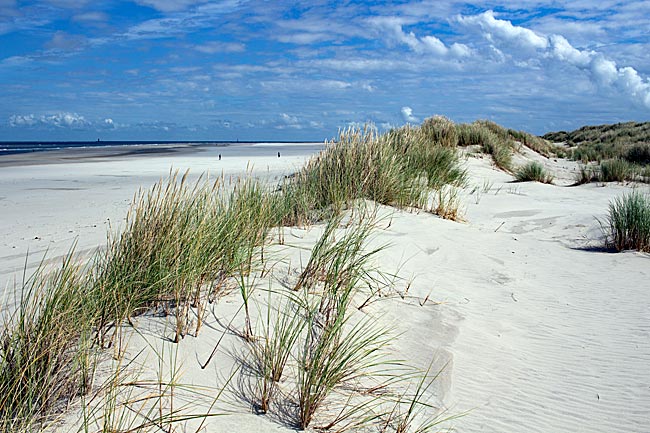
Among the inhabited East Frisian Islands, Wangerooge is the second smallest (7.94 km²) after Baltrum and car-free, making a stroll through town much more pleasant compared to other islands, especially since distances can easily be covered on foot. From the small train station, you're just a few steps away from the heart of the village, quickly finding yourself in front of the unmistakable Old Lighthouse, which now houses the island museum. From 1856 to 1969, this lighthouse served as a maritime navigation aid, guiding ships safely along their routes. Just how far its light could be seen becomes clear when you climb the 149 steps to the lantern room—from there, you can step out onto the surrounding gallery and enjoy a sweeping view of the island and the North Sea.
read more ...
Stade - on the banks of the Schwinge River
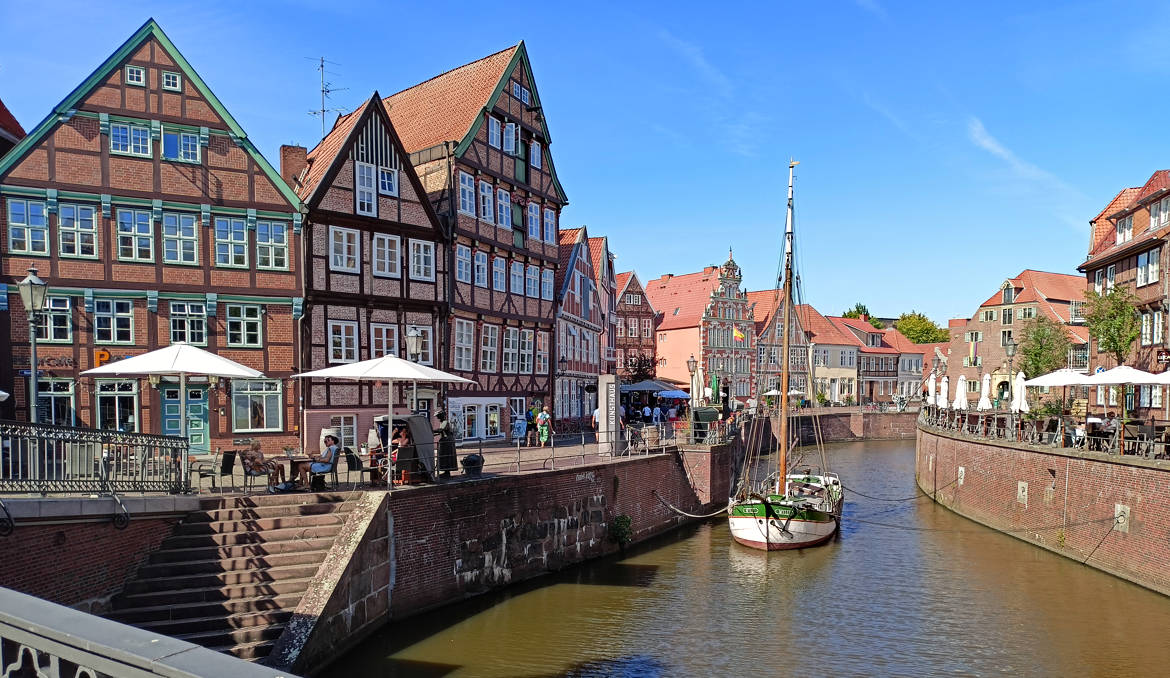
Do you know Stade? No? What a shame! Then feel free to read on if you'd like to learn about this smaller Hanseatic city on the Elbe, neighboring the much larger Elbe metropolis of Hamburg. As is often the case, the tourist's gaze doesn't fall on the entire city but rather focuses here on the historic city center and a bit of its surroundings. In our opinion, Stade is a beautiful and worthwhile destination for a short visit or even a few extra days.
read more ...
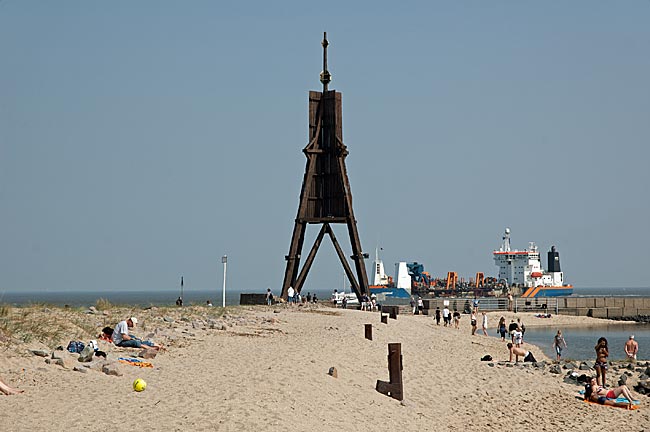
Cuxhaven - a day trip
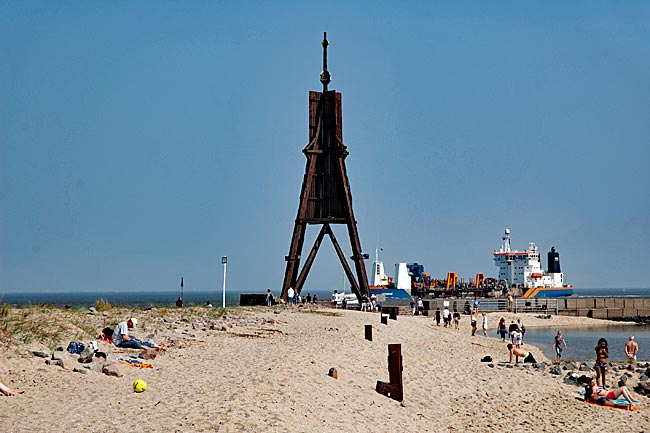
Many people from Bremen consider the seaside resorts of Cuxhaven to be "their home beach." The coastal city at the mouth of the Elbe is easily accessible from Bremen by car via the A27, which passes by Bremen and Bremerhaven before ending in Cuxhaven. By train, the journey takes a bit longer with a transfer in Bremerhaven. However, even in the off-season, Cuxhaven with its seaside resorts is a great destination for an outing - for example, by bicycle.
read more ...
Walsrode World Bird Park
The name "Weltvogelpark" (World Bird Park) sounds ambitious, but in fact, the park in the Lüneburg Heath is the largest of its kind worldwide and has only carried the addition "Welt" ("World") since 2010. Over 4,000 birds, including many rare species, live on the 24-hectare site, representing around 650 different bird species from all continents. The bird park was founded in 1962 as a private breeding station and later expanded into a full-fledged park. It is highly recommended as a family-friendly day trip.
read more
...

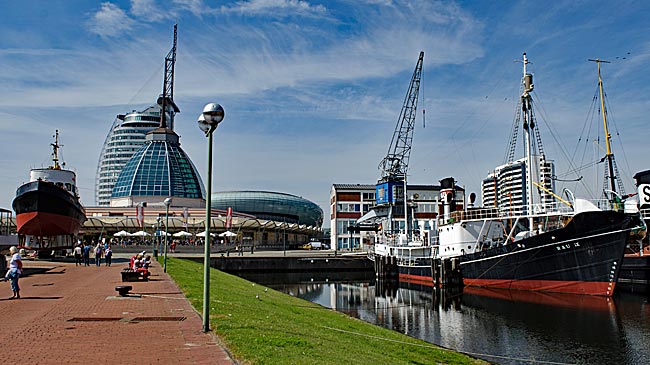
Bremerhaven in general
Bremerhaven was only founded in 1827. To secure Bremen's status as a port city amid the threat of the Weser - Bremens lifeline - silting up, Bremen acquired 342 acres (morgen) of land from the Kingdom of Hanover for 74,000 talers under then-mayor Johann Smidt. About 60 km downstream from Bremen, this land became home to the first urgently needed seaport built by Bremen: the so-called Old Harbor, completed by 1830.
read more ...
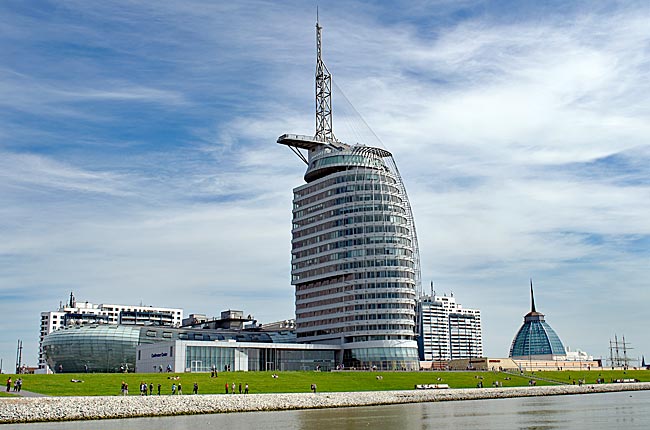
Bremerhaven Havenwelten
Since early 2008, Bremerhaven has not only had a new tallest building but also a new landmark in its Weser-side skyline with the ATLANTIC Hotel SAIL City, which rises 147 meters directly behind the Weserdeich. Architecturally, the structure perfectly embodies a maritime city - it stands like a powerful, rounded ship's superstructure. On the 20th floor, at a height of 77 meters, there is an observation deck (SAIL City) that is also accessible to non-guests.
read more ...
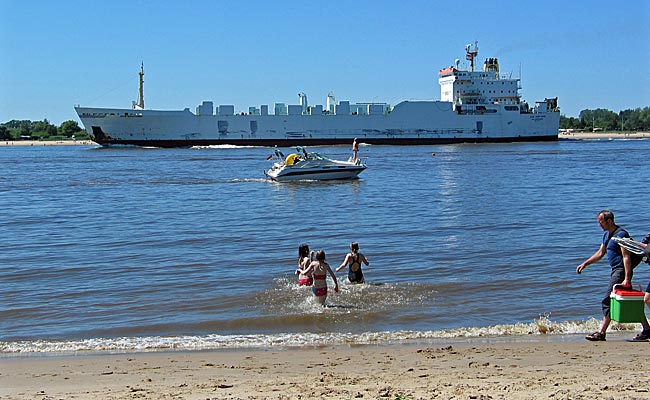
Brake & the River Island of Harriersand
As soon as spring arrives and the temperatures reach around 20 degrees, many Northern Germans are drawn to the North Sea coast. The main attraction? A beach to lie in the sun and sand for children to dig and build castles. This also draws many people from Bremen to the highways heading north on warm weekends, equipped with bags packed and picnic baskets ready for a day of seaside relaxation. But why travel far when the nearest beach is just around the corner? A visit to Brake and Harriersand proves that.
read more ...
Neu-Helgoland (New Heligoland) / Hamme Harbor Worpswede
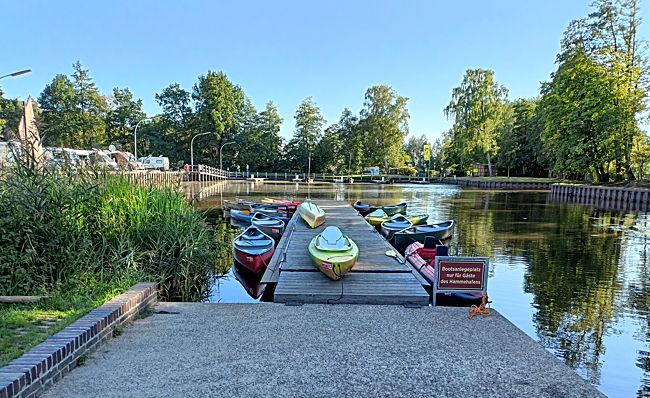
From April to October, the Hamme Harbor in Worpswede attracts many day visitors, weekend trippers, cyclists, and campers. The campsite operators run not only a bistro & beer garden with waterside seating but also rent out kayaks and canoes. Those who don’t want to paddle on the Hamme themselves can instead book an excursion trip aboard one of the Adolphsdorf Peat Boats. Food and drinks are also available just a few meters from the harbor at "Hamme Hütte Neu Helgoland." Tip: A great bike trip destination from Bremen!
read more ...
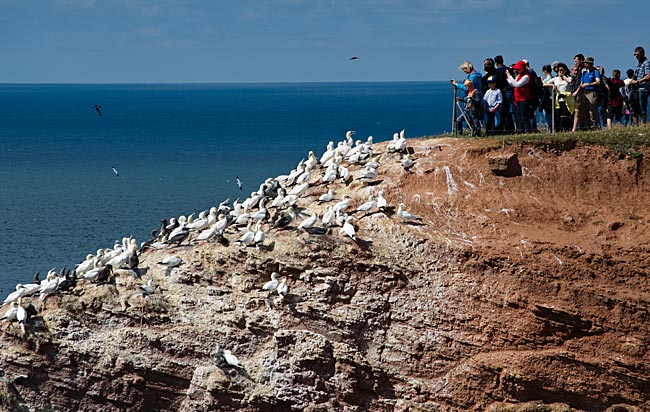
Heligoland - a day trip
Germany's only supposed high-seas island is a destination for thousands of visitors each year, most of whom are day-trippers during the warmer months. And yes, admittedly, Heligoland isn't immediately in Bremen's surrounding area. However, it can be reached as a day trip from Bremerhaven and Cuxhaven - which is why we decided to visit.
read more ...