
 exploring Bremen & its surrounding areas
 You are here: backgroundstories
 Eiswette & Eiswettprobe (Ice Wager & Ice Trial)
The prize for the bet - a “patriotic brown cabbage (kale) with accompaniments” - was hardly a serious reward for the 18 well-to-do gentlemen in 1828, given that each had staked one taler. None of them could have predicted that their wager - whether the Weser River would freeze over by dawn on January 4th of the following year or continue flowing as usual toward the North Sea - would spark a tradition lasting into the next millennium. History does not record whether the Weser actually froze on that January 4, 1829, but it does note that the cabbage was eaten together in good spirits, and on a whim, they decided to repeat the bet the following year: whether “de Werser steiht or geiht” (the Weser stands or flows).
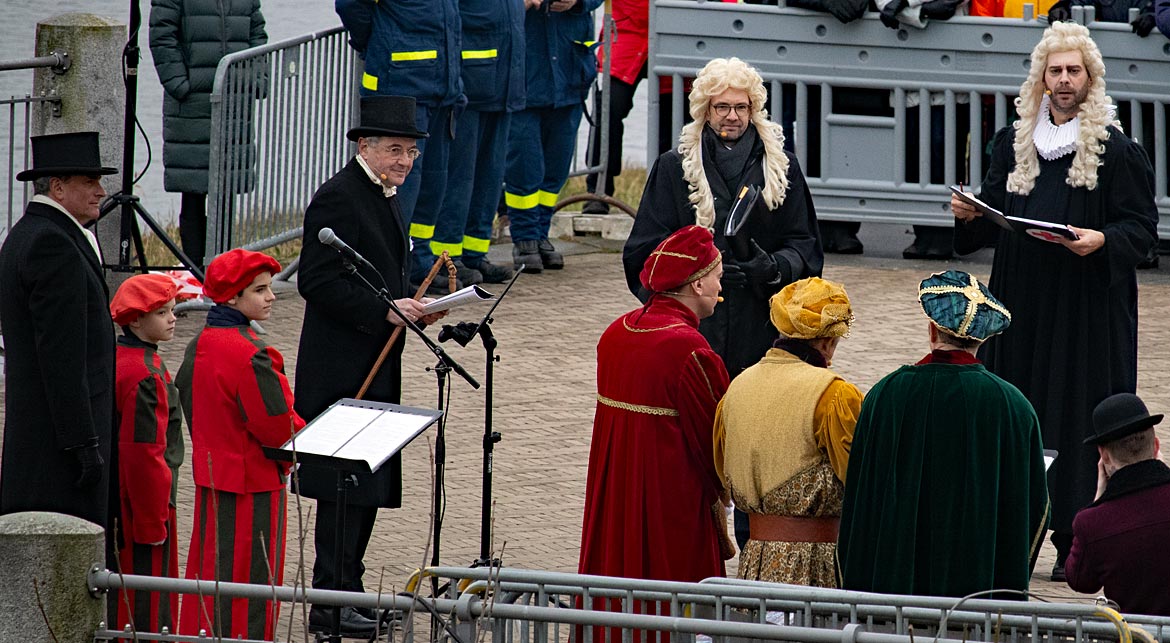
The first actors appear under a gray sky
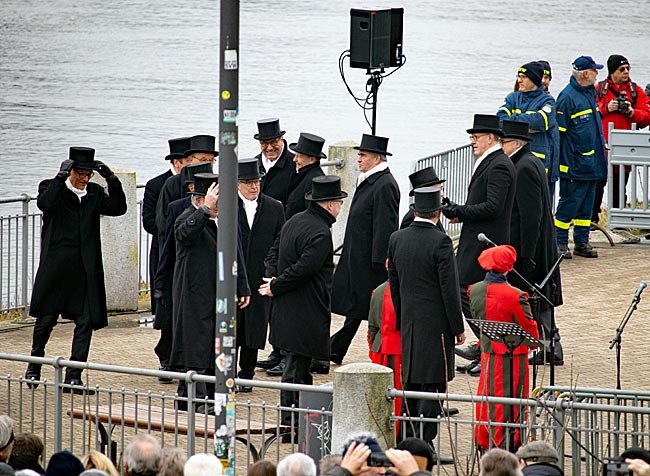
Today, the Ice Wager, or rather the Ice Trial, takes place on January 6th, Epiphany, not at dawn but precisely at noon. At that time, historically dressed men in black gather at Punkendeich by Osterdeich near the Sielwall ferry, along with a large crowd of spectators. This spectacle, however, stems from a custom introduced only in 1928 to mark the centennial anniversary and has since persisted, now accompanied by extensive media coverage.
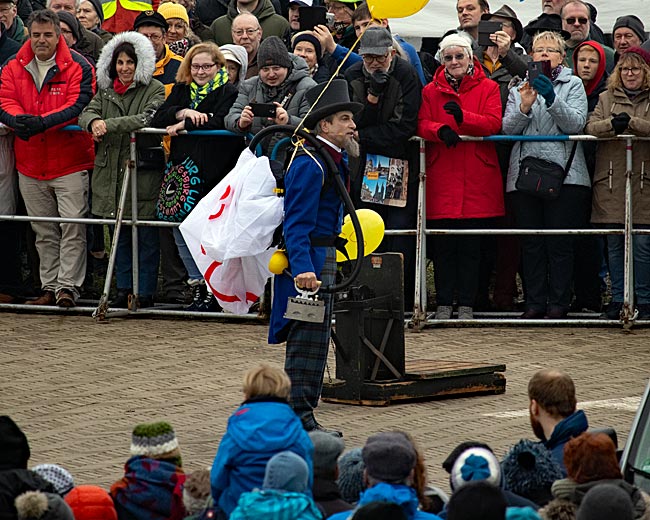
The tailor in tails: the 191st edition in 2020 features an air cushion with CO² label amid climate debates
The question is whether a 99-pound tailor with a pointed beard, dressed in an old-fashioned tailcoat, wearing a top hat and holding a hot iron, can cross the frozen Weser on dry land. Present are the notary public, the physician publicus, the president of the Ice Wager, the presidium, and the novices. Naturally, the Three Wise Men from the East cannot be absent on Epiphany.
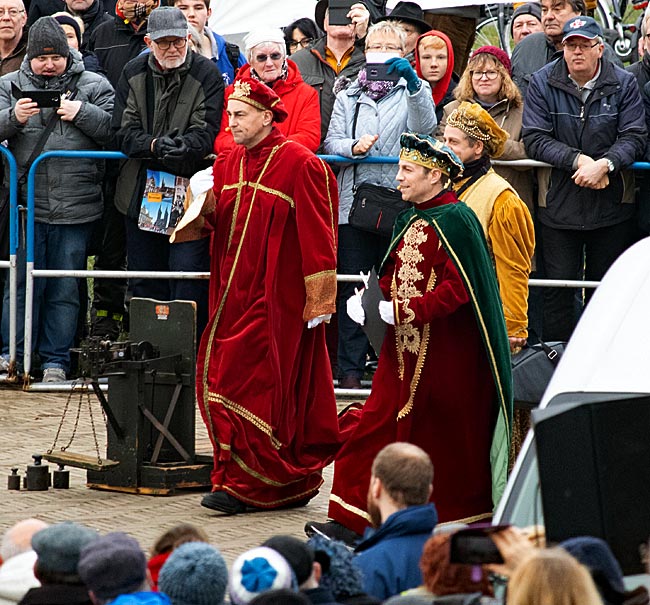
the Three Wise Men from the East bring color to the scene
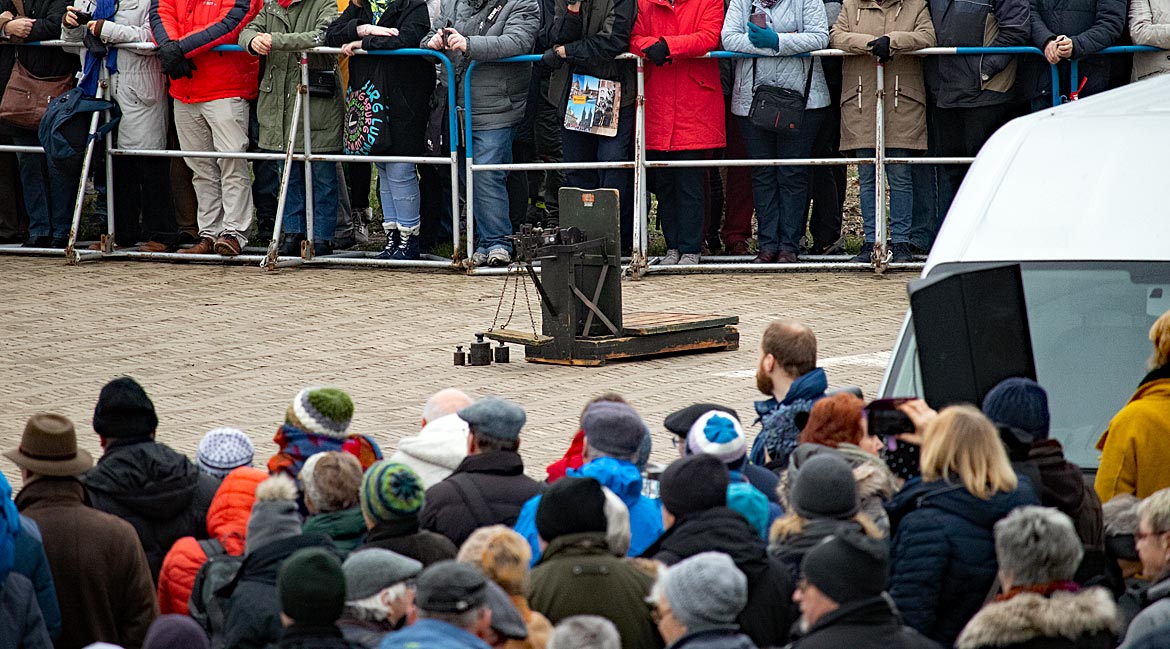
The ritual includes the tailor - who is weighed during the proceedings with an old decimal scale - arriving late and mocking social and political events since the last Ice Wager before crossing the river, much to the amusement of the spectators. His rebellious attitude invariably leads to verbal sparring between him, the president of the Ice Wager, and the notary, who appears in a stylishly curled wig.
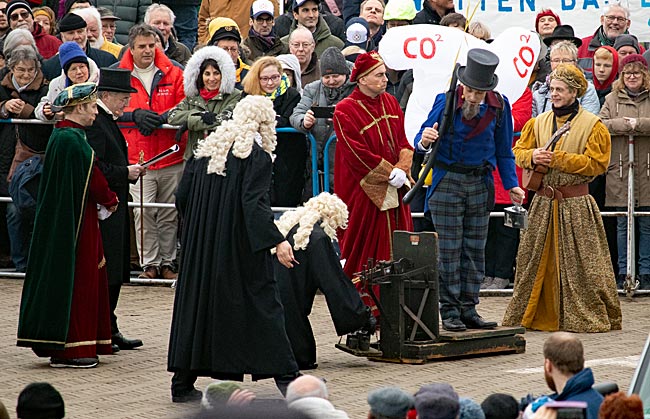
The finale approaches: the tailor is weighed
It doesn’t detract from the event that, since the extensive river correction planned by Bremen’s chief construction director Ludwig Franzius and implemented from 1883 onward, the Weser has frozen over only rarely in the past, and due to the reality of climate change, it is unlikely to freeze again in the future. That the tailor nevertheless reaches the opposite shore safely and dryly is thanks to the German Maritime Search and Rescue Service (DGzRS), headquartered in Bremen. Since the 1928 centennial celebration, they have also been involved in the Ice Wager, quite literally: it is their daughter boat from a rescue cruiser waiting mid-river that successfully ferries the tailor across.
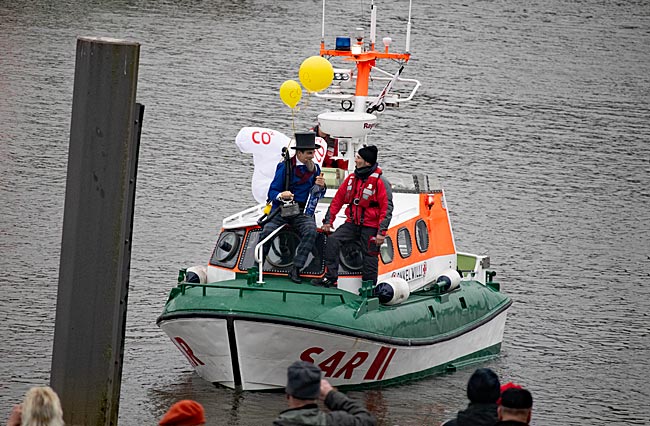
The end of the approximately one-hour event: the tailor crosses to Café Sand. "Uncle Willi," named after longtime station foreman Willi Wald of Massholm, is the daughter boat of the rescue cruiser "Nis Randers
The Ice Wager concludes definitively on the third Saturday in January with the Ice Wager Festival. Like the event at Punkendeich, this follows a fixed ritual and set of rules. Around 800 gentlemen - and, following a scandal with the Senate, for the first time in 2020 also ladies - gather for a multi-course meal at round tables resembling ice floes. The substantial number of participants comes primarily from the approximately 300 Ice Wager companions, each of whom may bring one guest. In addition are the members of the presidium, the novices, and finally, guests of honor invited by the presidium. Apart from the presidium members and a few others who appear in tails, black tie is mandatory.
From 2:30 p.m., the participants enjoy an eight-hour program. Culinary delights include local specialties served in multiple courses, such as wedding soup, cabbage and pinkel (a type of sausage), fish, and red berry pudding with vanilla sauce, accompanied by drinks like Ice Wager wine in red or white. Between courses, speeches are given, honors bestowed, and more. A significant “more” is the treasurer’s call for donations to the DGzRS, the German Maritime Search and Rescue Service, which relies entirely on contributions. Thanks to the illustrious company of prominent figures from business, politics, and society, record sums exceeding €400,000 have been raised at recent Ice Wager festivals.
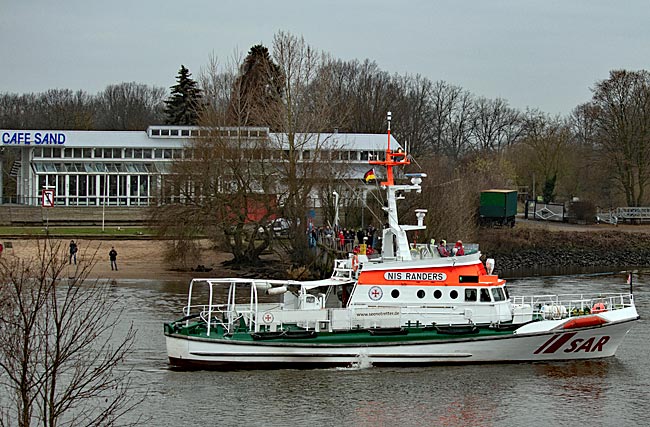
The rescue cruiser "Nis Randers" of the 23.3-meter class, commissioned in 1990, sails downriver for the Ice Trial
previous page
 next page
Map
Further information
Circular route: from the city center to the Weser weir and back
From Tiefer or Altenwall, the section of the Weser riverbank in front of Schnoor and diagonally opposite the DGzRS (German Maritime Search and Rescue Service), the planetarium, and the observatory on the other side, a beautiful path for pedestrians and cyclists runs directly along the water upstream toward the Weser weir. After crossing the Weser weir, the return route takes you via Stadtwerder.
read more ...
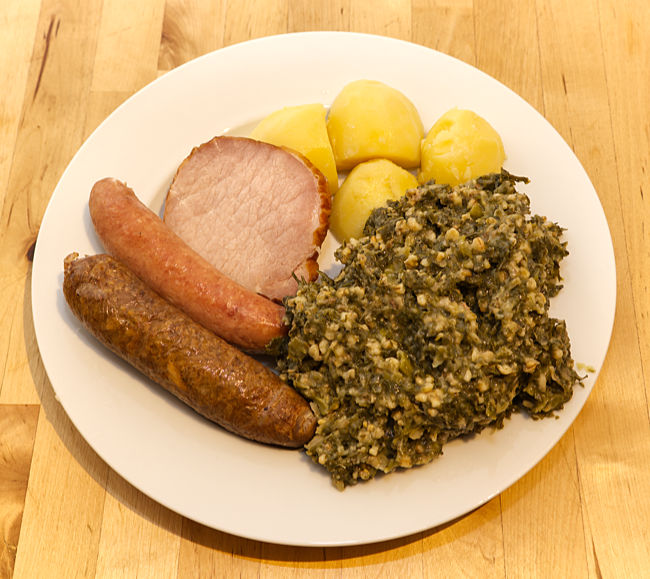
Kale & Pinkel
Every year between October and February, it's that time again: kale season. Typically by late October or early November, the mostly green, palm-like plants - reaching up to 180 cm tall depending on the variety and packed with vitamins and minerals - are ready for harvest. In Bremen, these vegetables are often found in allotment gardens. Since the curly leaves of this cruciferous plant (stripped of stems and stalks) can appear slightly brown or green - or even take on a brownish hue when cooked with a bit of imagination - many people from Bremen also call kale "brown kale."
read more ...
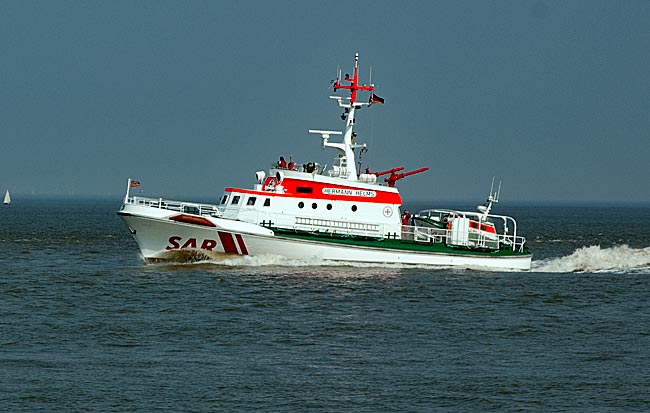
DGzRS - The Maritime Rescuers
Anyone in distress at sea today has far better chances of receiving help, even out on the open water, thanks to modern technology and professionals who take care of it. Along Germany’s North and Baltic Sea coasts, these are primarily the approximately 1,000 full-time and volunteer men and women of the DGzRS (German Maritime Search and Rescue Service), also known as "The Maritime Rescuers." In 2020 alone, they conducted 1,720 operations and rescued 357 people. Since its founding, the organization has helped 86,000 individuals.
read more ...
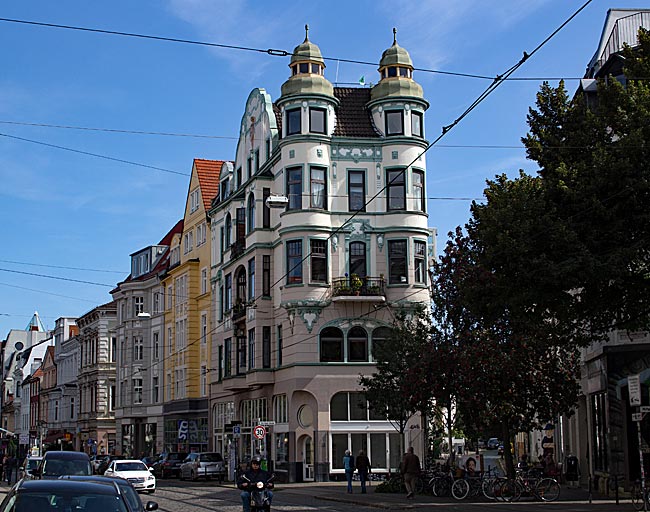
Das Viertel (The Quarter)
Although the area around these two main streets and their many small side streets technically belongs partly to the Mitte district and partly to the Östliche Vorstadt, Bremen residents simply call it "das Viertel." It is both loved and hated, feared and much more. Few other neighborhoods in this Hanseatic city have displayed such stark - and at times violent - contrasts over decades as the Viertel has.
read more ...
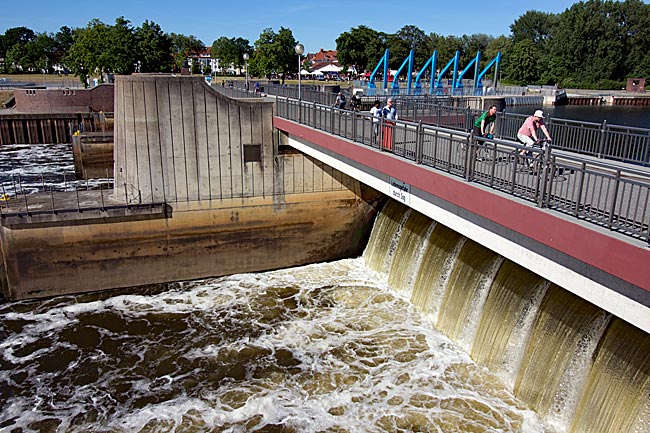
The Weserwehr Weir
To make navigation possible at all, the weir sections are equipped with locks. In chambers up to 225 meters long, inland vessels with a maximum width of 11.45 meters are locked through. The difference in water levels ranges between approximately three and a half and six and a half meters. The drop in water level made it advantageous to generate electricity from it, as was also the case in Bremen. The capacity of the power plant, whose turbines were gradually connected to the grid between 1915 and 1917, was increased in 1926 by the commissioning of additional turbines to such an extent that the generated energy temporarily covered half of the demand in the Hanseatic city.
read more ...
Weser cruise from Bremen to Bremerhaven
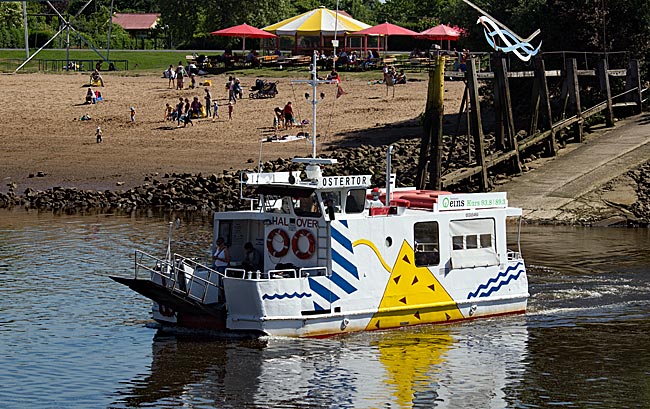
Of course, you can take a car for a visit to Bremerhaven from Bremen or board the regional train at the main station. However, with suitable weather and enough time, it is more interesting to cover the route on the Weser by ship. The shipping company "Hal över" operates the connection from May to September. The ship departs from the Martinianleger near the city center along the Schlachte. Those who wish can even take their bicycle with them; additionally, you can pre-book a breakfast onboard.
read more ...