
 exploring Bremen & its surrounding areas
 You are here: attractions in the city center
 Böttcherstraße (2/2)
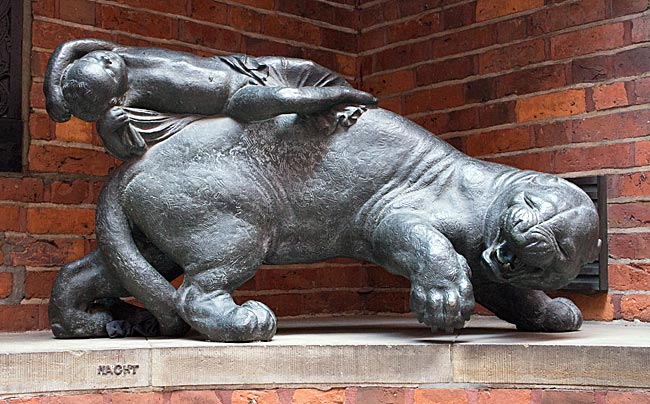
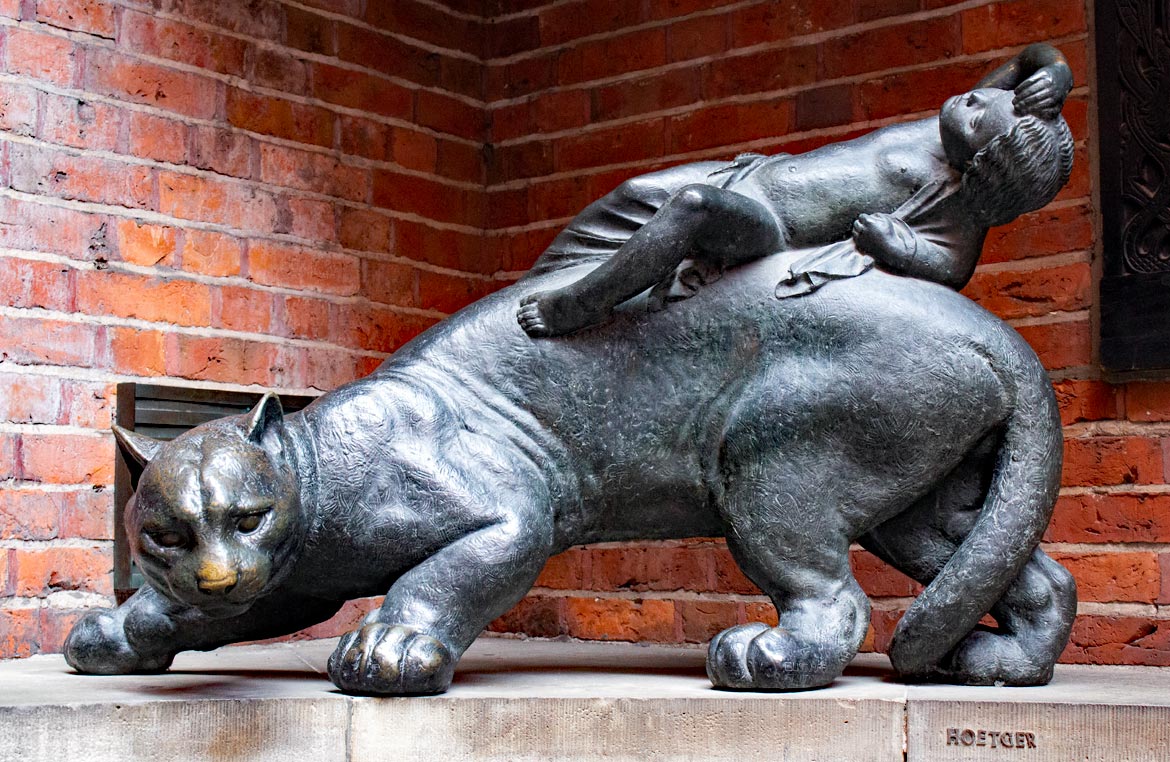
Another work by Hoetger from 1912: the Panther, Carrying the Night
One of the last buildings constructed in Böttcherstraße is the House Atlantis (1930/31). The name was not chosen randomly but was intended to provide a group of Atlantis utopians with a place for research and events. The problematic aspect was that Roselius had in mind followers of Germanic culture who associated Atlantis with Heligoland, thus seeing Aryans as Atlanteans. Despite the dubious undertone regarding the dark chapter of German history that followed shortly afterward - where diffuse references to Germanic cultures and an equally vague sense of mission played a significant role - the realized designs by Bernhard Hoetger are absolutely worth seeing and are an important part of German architecture between the two world wars.
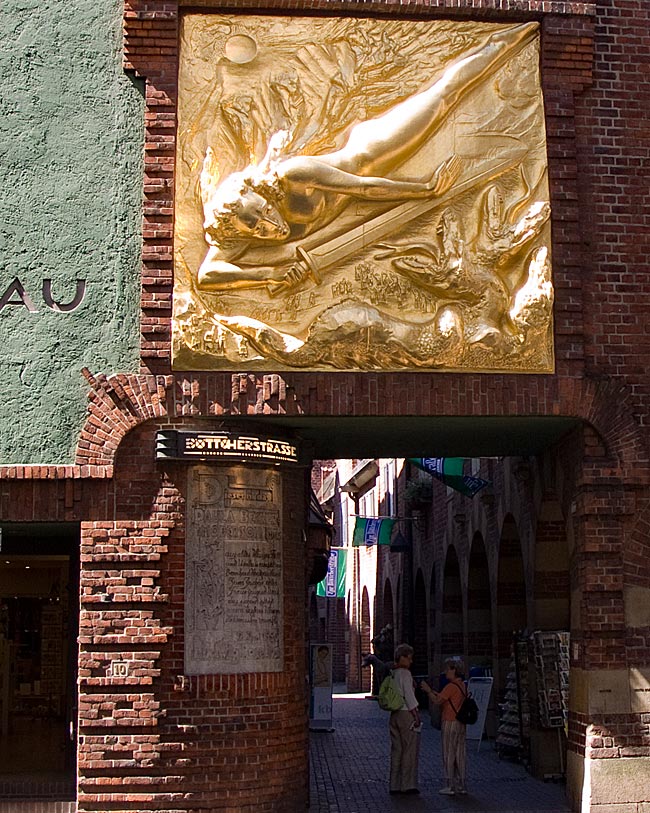
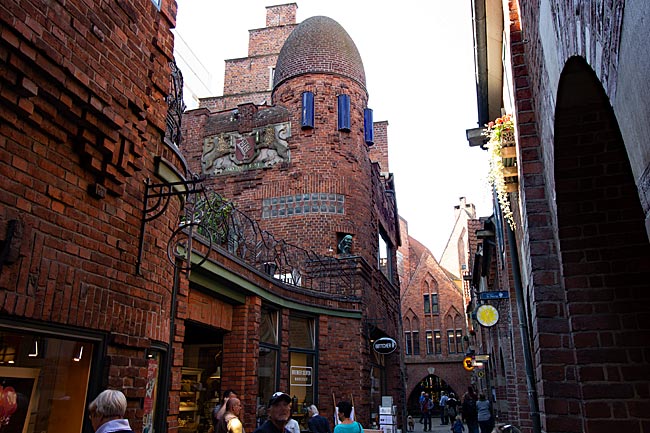
Entrance to Böttcherstraße with the "Lichtbringer" (1936) by Bernhard Hoetger
The celestial hall on the upper floor, with its blue and white glass bricks in the arched reinforced concrete ceiling, is particularly noteworthy. Today, the building houses a hotel. (Monday - Open Day). Despite all of Roselius' attempts to curry favor, Böttcherstraße and its artistic value found no grace in the eyes of the Nazis; indeed, it was even labeled a "shameful monument." The "Lichtbringer" (1936) by Bernhard Hoetger at the entrance to Böttcherstraße did nothing to change this.
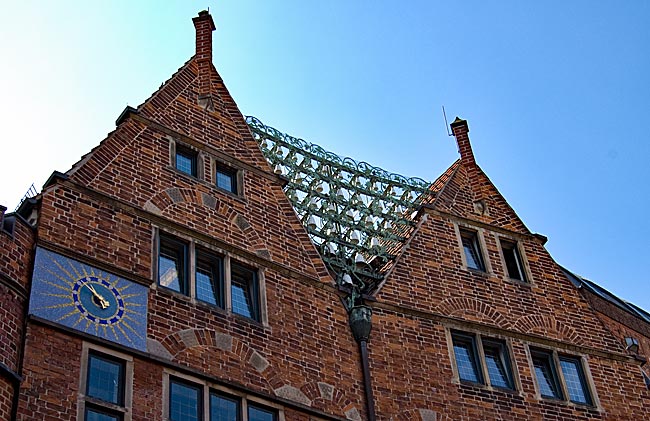
Carillon between the gables
Another highlight in Böttcherstraße is the carillon between the gables of the House of the Carillon. The original carillon, consisting of 30 Meissen porcelain bells - blue on the outside and gilded inside - was inaugurated in 1934. On a rotating tower within the masonry, ten carved wooden panels depict famous ocean conquerors such as Columbus. Like many other elements in Böttcherstraße, the motifs on these panels were created by Hoetger at Roselius' commission. The carillon, intended as a monument to human pioneering spirit and drive, received a new look with white bells after being damaged during World War II in 1954. Even the 30 Meissen porcelain bells visible since an extensive restoration in 1991 are light-colored.
Carillon times: January 1 – March 31 at 12, 3, and 6 PM; April 1 – December 31 hourly from 12 to 6 PM
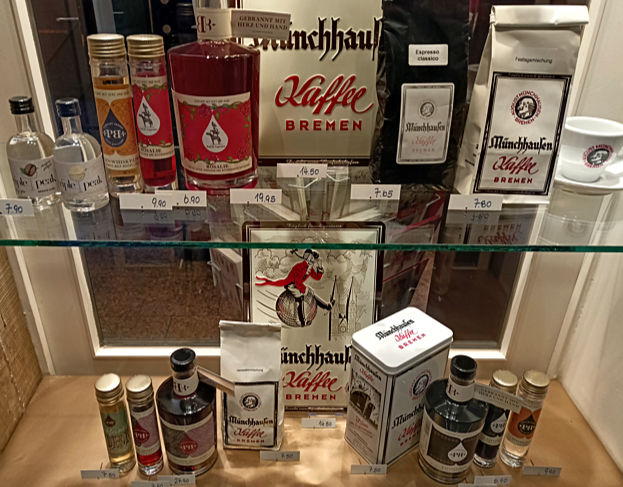
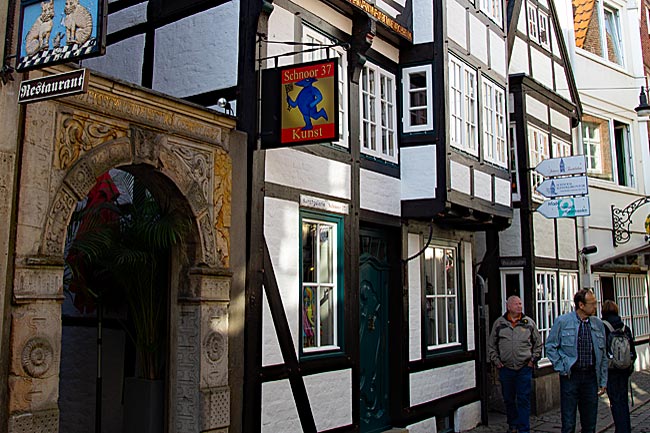
View into the display window of a shop in Böttcherstraße
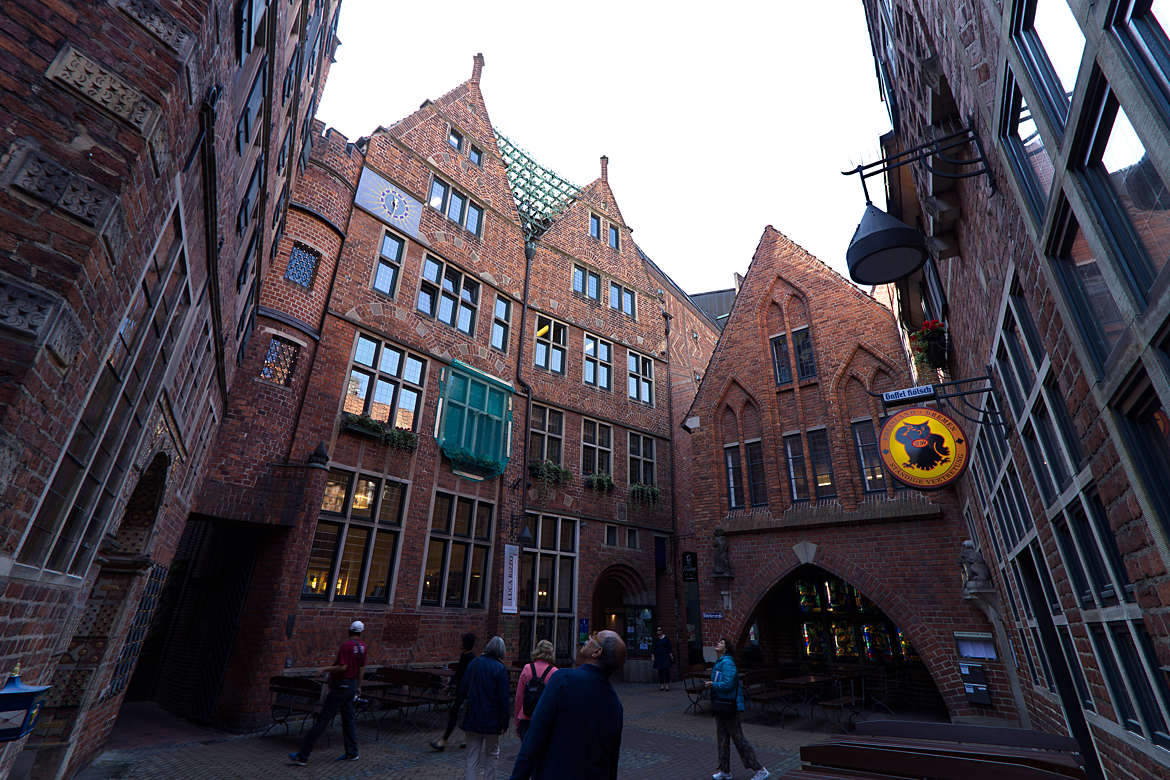
Only thirteen years after the completion of Böttcherstraße, one year after Roselius' death, most of the buildings were destroyed or burned down during bombing raids in October '44. At least the facades could be restored by 1954, thanks to Kaffee HAG. However, another extensive renovation was urgently needed three and a half decades later. The Sparkasse purchased the houses and properties - with the exception of House Atlantis - and had them restored until 1999. A reference to Kaffee HAG can still be found today in words on the colorful panes of the House St. Petrus, which was built between 1923 and 1927 and also rebuilt in 1954. Then as now, this Gothic-gabled building opposite Roselius-Haus houses gastronomic businesses.
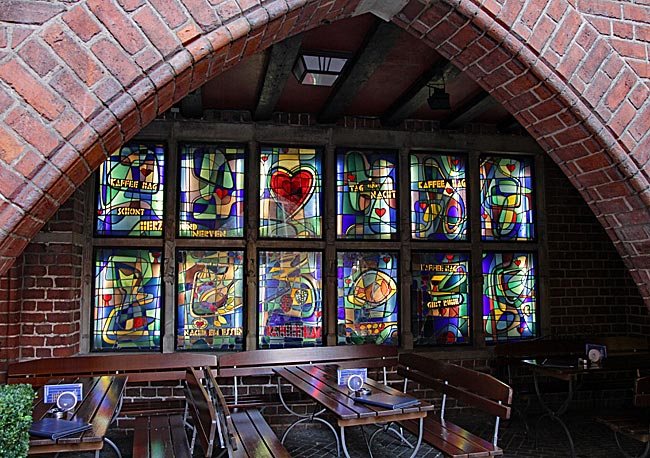
House St. Petrus with colored windows
previous page
 next page
Map
Further information
Museen Böttcherstraße
Paula Modersohn-Becker Museum
Ludwig Roselius Museum Collection
Bernhard Hoetger
Böttcherstraße 6–10
28195 Bremen
Phone: +49 (0)421 33882-22
Email: info@museen-boettcherstrasse.de
www.museen-boettcherstrasse.de
Opening Hours: Tuesday to Sunday, 11 AM – 6 PM, closed on Mondays
Market Square
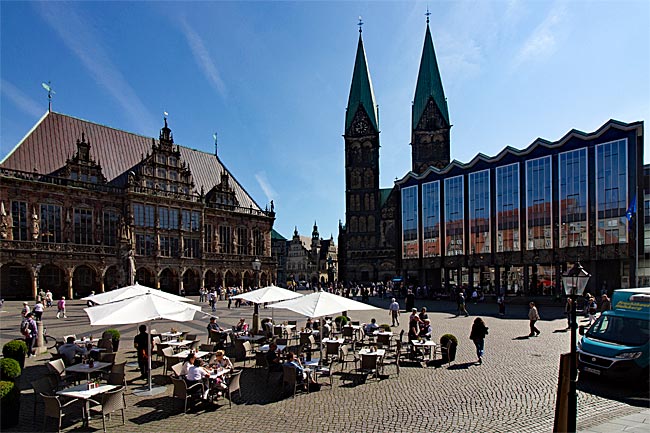
Just as it was in the past, Market Square remains the political center of Bremen and is now also a major attraction for thousands of tourists, undoubtedly due to its unique architectural atmosphere. Almost unobtrusively and plainly, the Bürgerschaft (Bremen's Parliament) stands next to the magnificent Old Town Hall.
read more ...
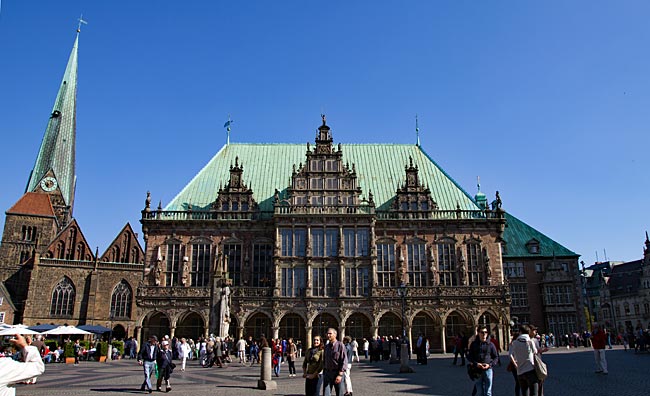
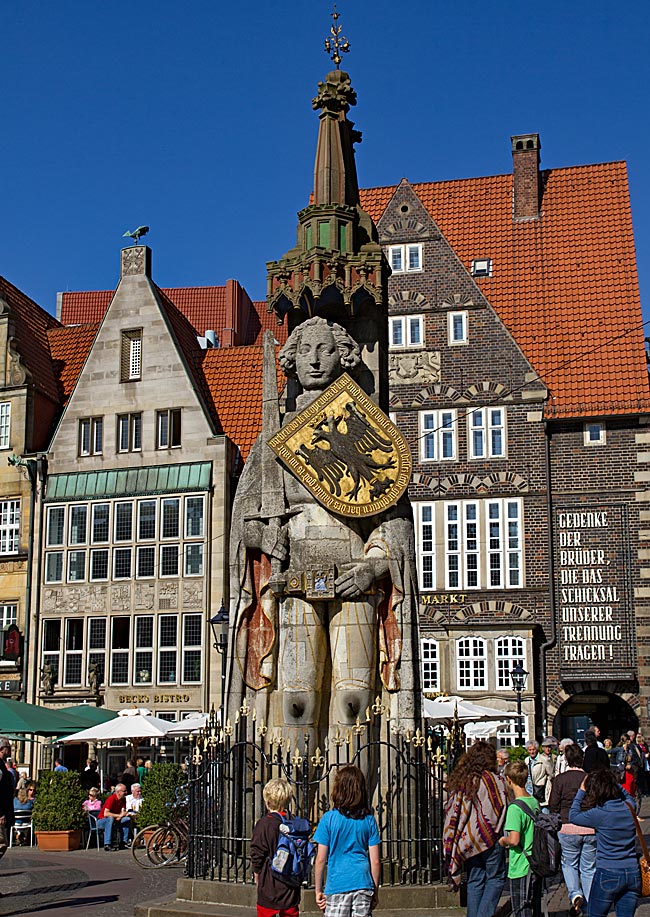
Roland statue
Since 1404, the Roland statue - a 5.55-meter-tall (10.21 meters total) sandstone knight with drawn sword and shield - has stood on Market Square in front of the Town Hall. As in many other European cities, Bremen's Roland symbolizes the city's freedom, which in earlier times stemmed from its market rights and independent jurisdiction.
read more ...
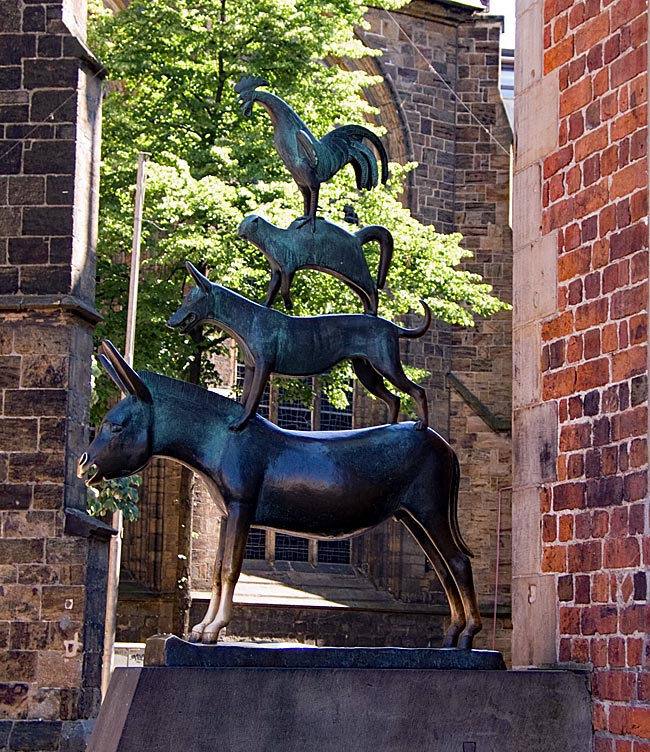
Bremen Town Musicians
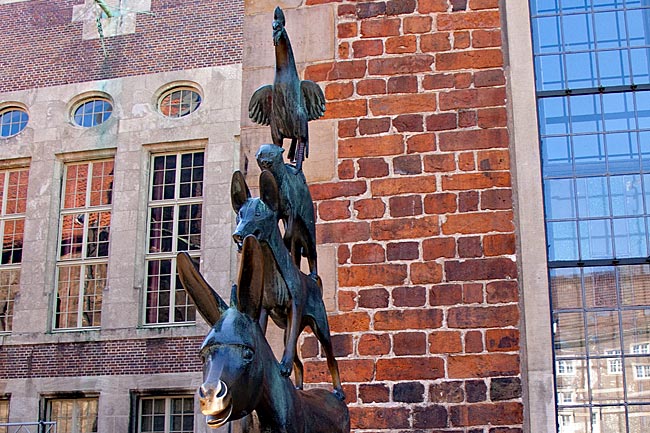
On the left side of the Old Town Hall, next to the entrance to the lower hall, stand four bronze-cast heroes of a world-famous fairy tale - the Bremen Town Musicians. However, it remains a contentious point whether these mismatched four - donkey, dog, cat, and rooster - actually made it to Bremen, as the fairy tale does not provide a clear answer on this matter. But perhaps that is not so important, for what truly matters is the message conveyed in the story.
read more ...
Schlachte
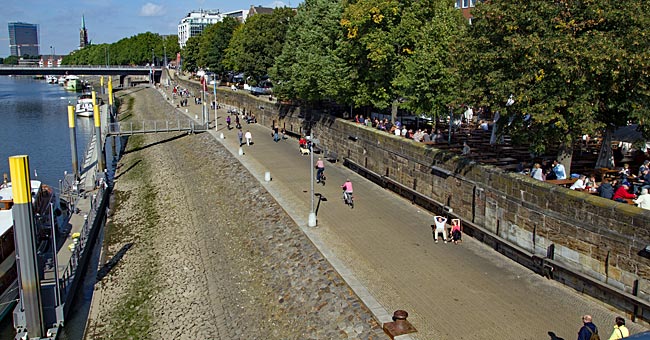
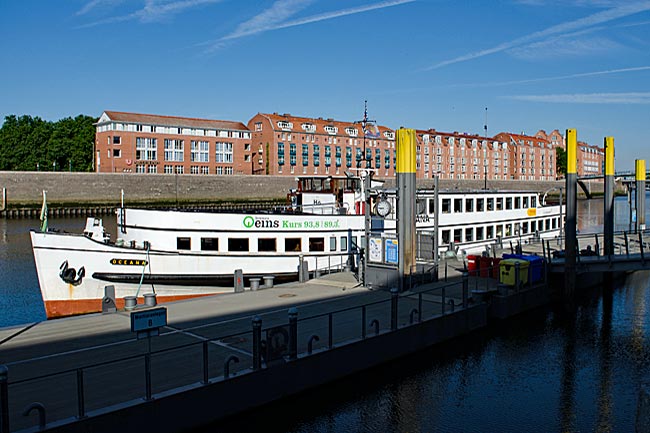
Between the Wilhelm-Kaisen Bridge and the Stephani Bridge, from the start of construction in 1993 to its grand opening on May 27, 2000, a promenade with a boulevard, ship docks, and numerous dining options was created for over €20 million (mostly EU-funded). This area, now lined with 60 trees and granite, offers something for every palate, where medieval harbor workers once toiled.
read more ...