

DISTANT PLACES
Travel tips for destinations far from the Hanseatic City of Bremen
A stroll through Kiel
Sights in the fjord city and a visit to Laboe
Page 5 of 7
Ravensberg Water Tower and Botanical Garden
In some places, old water towers that once supplied drinking water to citizens still stand, as is the case in Kiel on Ravensberg. The 34-meter-high and nearly 24-meter-wide brick tower with a 1,500 cubic meter capacity ring tank was built in 1896 and expanded a high reservoir constructed ten years earlier, which was no longer sufficient for supplying the newly developing adjacent neighborhood from a technical standpoint. Since 1976, the structure has been protected as a "cultural monument of particular significance." Fourteen years later, the water tower was finally taken out of service and sold in the year 2000. After the round building was initially used as an event venue, today its interior houses 34 apartments following extensive renovations.
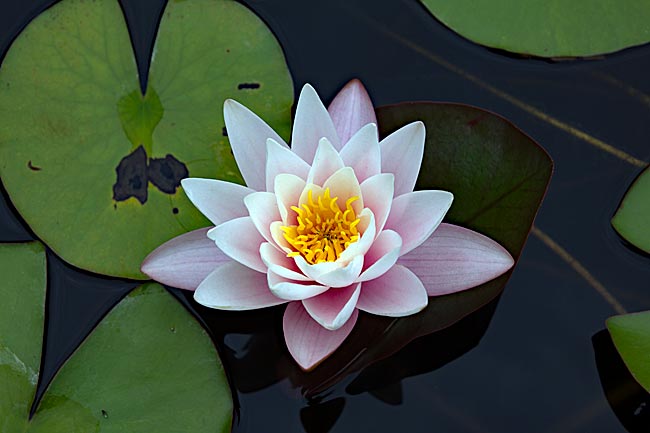
Water lily in the Botanical Garden's outdoor area
The functional buildings on the university campus may not be architecturally impressive or visually appealing, but beauty and diversity await visitors beyond the building complex - the Botanical Garden. The approximately 8-hectare facility was established in the mid-1970s and has been freely accessible to the public since 1985. The paths in the garden's outdoor area lead through the plant life of America, Europe, and Asia, as well as a hilly, rocky section featuring plants from mountain regions in America, across the European Alps to the Himalayas and New Zealand - the Alpinum. Several ponds, streams, and a marshy area illustrate the vegetation predominant in each location, such as desert plants along the North and Baltic Seas. Depending on the season, the garden blooms beautifully and multicoloredly or is dominated by the blossomless green of leaves.
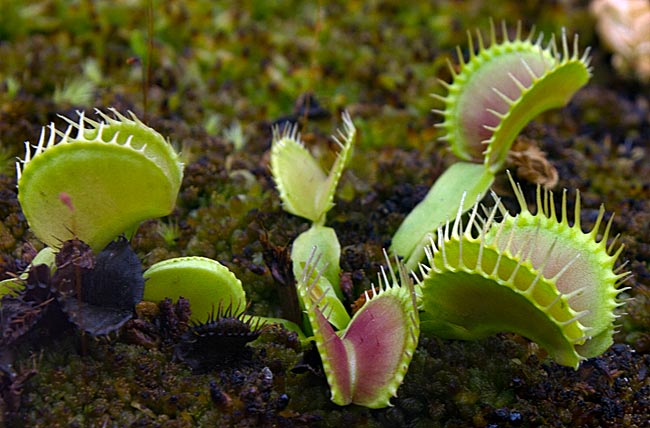
Carnivorous plant: The Venus Flytrap seen through a glass pane
A special highlight is the freely accessible show greenhouses. During a tour through the various glasshouses, one can certainly work up a sweat, as some maintain unfamiliar climate conditions for us, such as in the Tropical House, the Mist Forest House, or the Victoria House - even the camera lens fogs up.
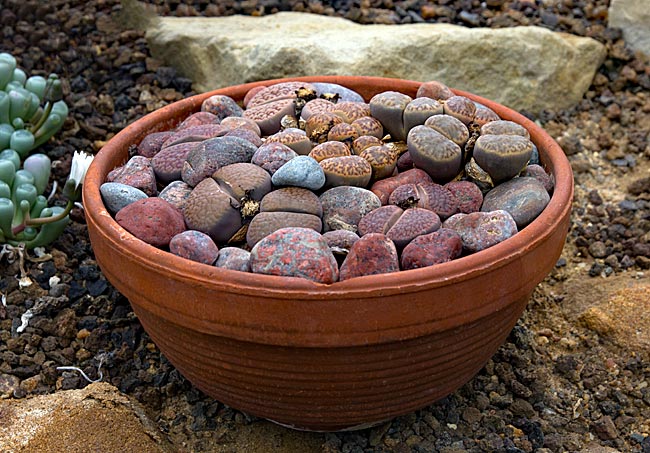
Living stones in a bowl
Other temperatures and humidity levels greet visitors in the Mediterranean House, the America or Africa House, and the Subtropical House. One can discover exotic spices like vanilla just as easily as coffee and cocoa plants, tropical fruits such as pineapples, bananas, and citrus plants like lemons, see how the raw material for many items of clothing grows on a bush - cotton, encounter living stones or carnivorous plants, keep a safe distance from large cacti, and suddenly find oneself in a mangrove forest while the giant leaves of Victoria water lilies float on the water nearby.
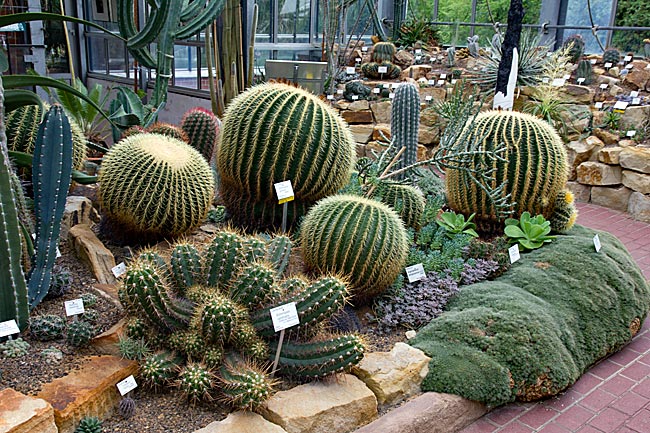
Cacti
The meticulously cared-for plantings serve both to provide visitors with deeper insight into the diversity of global nature and the functioning of various ecosystems and are also research areas for university-scientific institutions. Those who walk through the greenhouses with open eyes will notice how many plants worldwide are threatened in their habitats, as the signage indicates alarmingly many of the plants are listed on the red list of endangered species. Thus, the Botanical Garden plays an important role in preserving plants - at least in such protected areas - to prevent their extinction and preserve them for future generations.
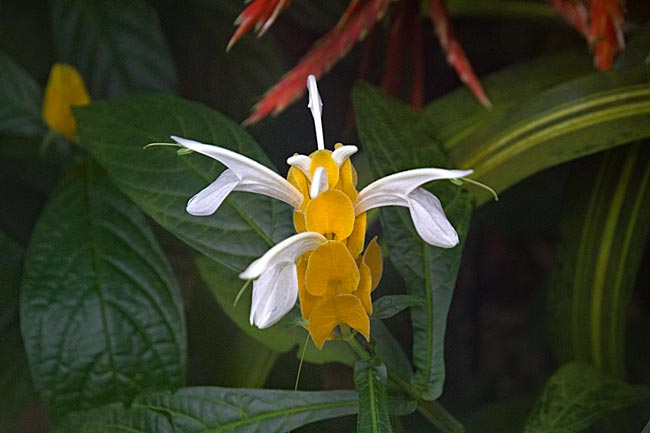
Lily
The North Sea-Baltic Sea Canal and the Lighthouse in Holtenau
The North Sea-Baltic Sea Canal runs north of the Botanical Garden. The nearly 100-kilometer-long artificial waterway is the busiest in the world for seagoing ships. More than 30,000 vessels pass through the connection annually instead of taking the long detour via the Skagerrak. The idea of creating a water connection between the North and Baltic Seas is much older than today's canal, as maritime trade in Northern Europe was part of coastal life even before the Hanseatic League. After various attempts in previous times, it was finally Emperor Wilhelm I who laid the cornerstone in 1887 in Kiel's Holtenau district for the construction of a waterway from there to Brunsbüttel on the North Sea side. For eight years, thousands of workers and engineers dug through Schleswig-Holstein soil, built bridges and locks until the grandson and successor of the old emperor, Emperor Wilhelm II, could open the canal. In honor of his grandfather, the canal was called Kaiser-Wilhelm-Kanal until 1948, while it is still known internationally today as the Kiel Canal.
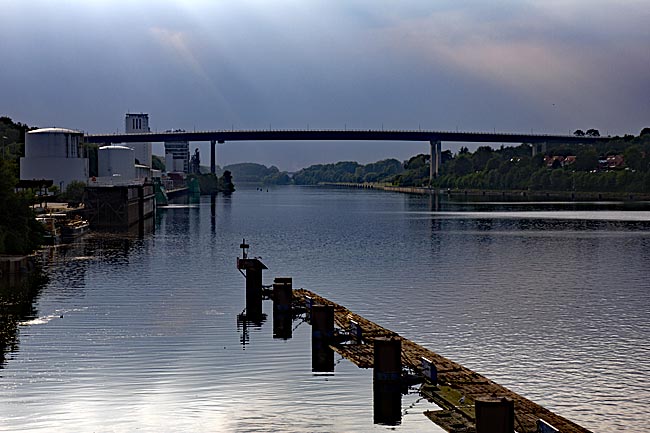
Evening mood at the North Sea-Baltic Sea Canal
A trend in shipbuilding today was no different then: ships kept getting bigger. Thus, the canal has been widened and deepened several times since its completion, and the locks have been replaced with larger ones. And even today, construction is continually underway on the North Sea-Baltic Sea Canal - naturally during ongoing operations.
Ships coming from Brunsbüttel must first pass through one of the locks before they can proceed to the Baltic Sea. Right there on the southern bank, interested landlubbers can get a particularly good view of the ships, as an observation platform has been specially built here, partially even covered in case it rains - which sometimes happens in Northern Germany. As time is also money in seafaring, ships are occasionally resupplied with consumables via their own cranes from the quay during their layover in the lock.
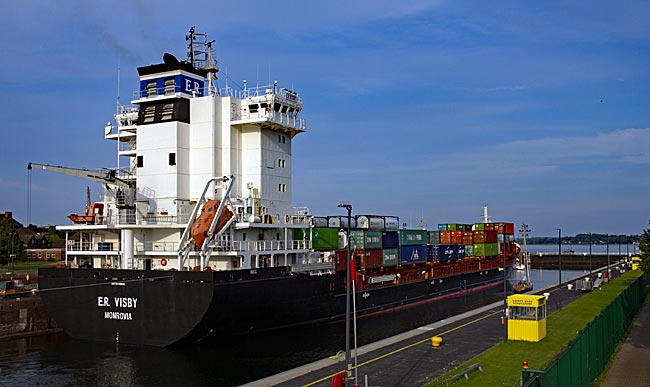
A container freighter is locked through
On the northern bank of the canal, right opposite the lock entrance, stands one of the most beautiful lighthouses of its kind - the Holtenau Lighthouse. The 24-meter-high brick tower was built simultaneously with the canal and put into operation as an entrance light in 1895. In the so-called Three-Emperors Hall inside the tower, a memorial plaque commemorates the three German emperors who ruled during the construction of the North Sea-Baltic Sea Canal: Frederick III, albeit only for 99 days until his death from illness. On the occasion of the canal's 100th birthday - not just the lighthouse - the navigational aid was extensively renovated in 1995. Today, couples seeking a somewhat unusual venue for their wedding can be married in the Three-Emperors Hall in the presence of up to 10 guests.


Map
Information
Tourist Information Kiel
Andreas-Gayk-Straße 3
24103 Kiel
Phone: +49 (0)431 / 679 100
Email: info@kiel-sailing-city.de
Internet: www.kiel-sailing-city.de
Transportation
Train
The state capital is easily accessible by train. However, during storms, trees sometimes fall onto the tracks, disrupting rail services as there are no alternative routes.
Car
You can also comfortably reach Kiel by car via the highway. While a car isn’t necessary within the city, it is practical for trips to nearby attractions like Eckernförde.
Public Transport
Kiel’s tram service was discontinued in 1985 - a decision many now regret. However, the well-organized bus network extends throughout Kiel and its surroundings, provided buses aren’t stuck in traffic. Tickets are purchased from the driver upon boarding. Depending on your plans, day passes, group tickets, or small-group tickets may be cost-effective. In my experience, drivers are generally very friendly and willing to provide information - a quality many of their colleagues in other cities could learn from, especially since it costs nothing to do so. More info: www.kvg-kiel.de
For public transport connections beyond Kiel, visit: www.nah.sh
By Water
The Schlepp- und Fährgesellschaft Kiel mbH is a municipal service operating ferry and tugboat services. It offers passenger transport on the Kieler Förde with small ships known colloquially as "Fördedampfer" (ferry). These vessels depart from the central station and serve multiple stops along both sides of the fjord, including Laboe, Schilksee, and Strande. Bicycles are allowed in moderation. The company is part of the Verkehrsverbund Region Kiel, so regional tickets are valid on board. Students can use their semester ticket for free rides. However, schedules vary, so check the timetable: www.sfk-kiel.de/en
Additional Information
www.zoologisches-museum.uni-kiel.de
www.kunsthalle-kiel.de
www.uni-kiel.de/nickol/botgar.html
www.geomar.de/en/
www.maritimesviertel.de
www.mahnmalkilian.de
www.strande.de
www.laboe.de
www.seenotretter.de
www.deutscher-marinebund.de
www.stenalinetravel.com/routes/kiel-gothenburg
www.colorline.com
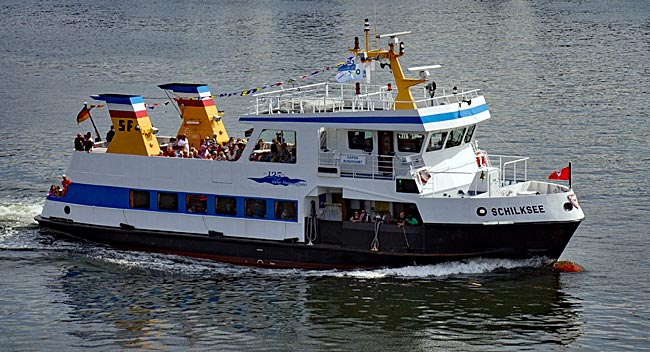
"Fördedampfer"
Rügen by the Baltic Sea
Active holiday featuring cycling and hiking
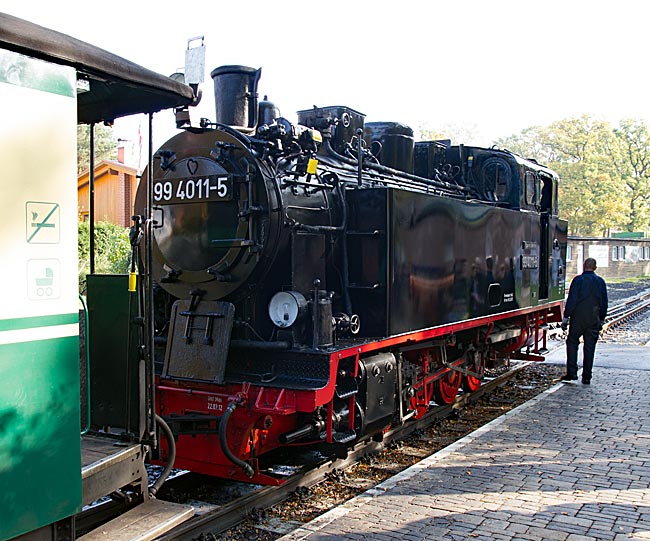
Enjoy an active holiday featuring cycling and hiking along the Baltic coast in Mönchgut on the island of Rügen. Long sandy beaches, rolling hills, and lush forests provide a varied and beautiful setting for your getaway. Often, the only thing breaking the peace is the distant whistle of the historic 'Rasender Roland' steam train. Despite its name (which suggests something "racing" or fast), it’s actually quite the opposite. A journey by train is simply part of the holiday experience.
read more about Rügen ...
Rostock and Warnemünde by the Baltic Sea
A travel guide
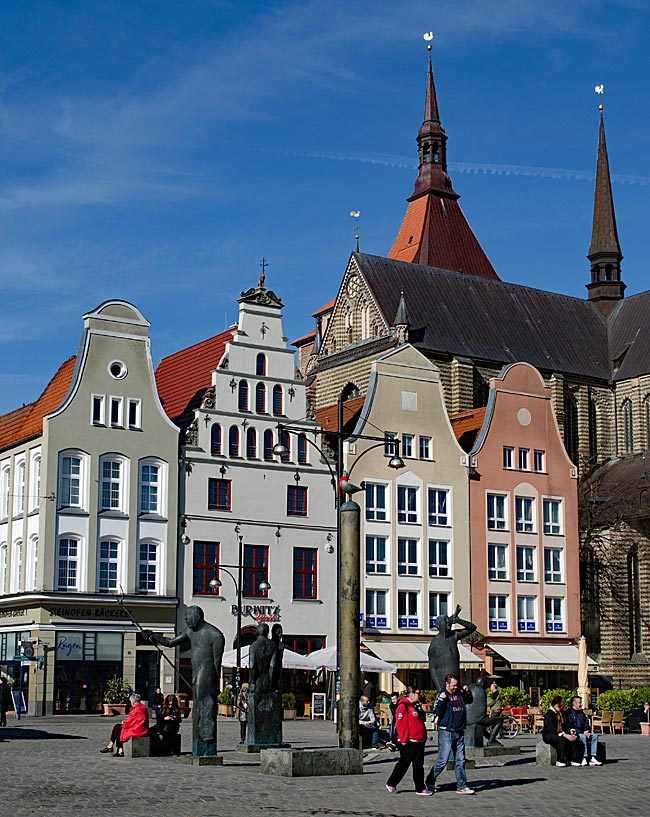
A mini-guide through the Hanseatic city of Rostock and its beautiful beach destination, Warnemünde. Home to one of the oldest universities in the Baltic region, the city boasts a rich history. Join us on a tour of discovery.
read more about Rostock ...
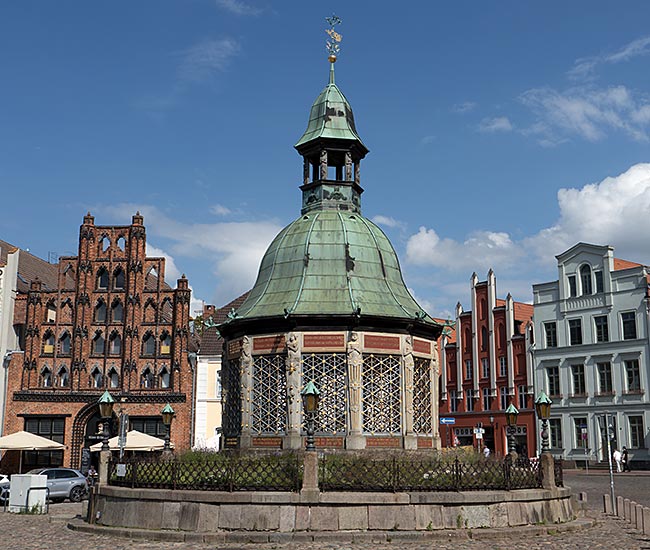
Wismar
The Hanseatic City on the Baltic Sea and its UNESCO World Heritage
The World Heritage House is a building with a stone front house and an attached timber-framed Kemladen on a foundation of loose fieldstones from a medieval predecessor building. This beautifully restored small building complex visually illustrates and provides information via text panels about the lives of past generations in the hall houses typical for Wismar, along with their outbuildings. Additionally, there is extensive information about the city’s history and numerous protected buildings in the old town - there are 1,754 in total, with 306 designated as individual monuments. In the old town, one is right in the middle of Wismar’s UNESCO World Heritage Site.
read more about Wismar ...
Crabs, dikes and the Wadden Sea
The North Sea spa town of Büsum
Once an island, Büsum was repeatedly threatened by the "Blanken Hans". When the greatest flood of the last century struck in 1962, Büsum was already long connected to the mainland - since 1585. Today, this town of around 5,000 residents, part of the Dithmarschen district, is one of the most important holiday destinations along Schleswig-Holstein's North Sea coast. Since 1985, the sea in front of Büsum has been protected as the Schleswig-Holstein Wadden Sea National Park, and since 2009, it has also been listed as a UNESCO World Heritage Site.
read more about Büsum ...