

DISTANT PLACES
Travel tips for destinations far from the Hanseatic City of Bremen
A stroll through Kiel
Sights in the fjord city and a visit to Laboe
Page 4 of 7
Along the Kiellinie with Old Botanical Garden, Gorch Fock, and Flandernbunker
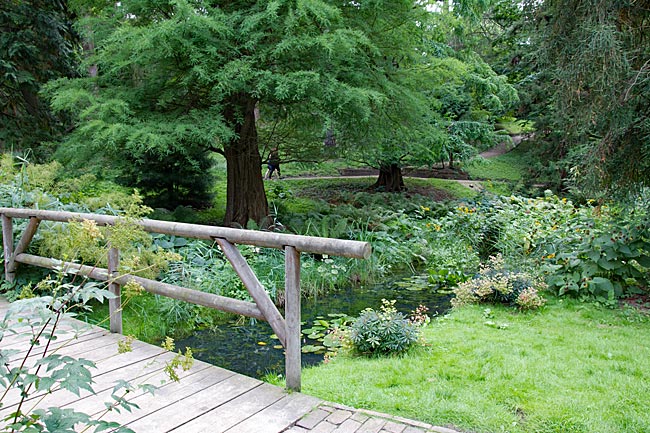
In the Old Botanical Garden
Water on one side and plenty of greenery on the other, the Kiellinie is a maritime promenade par excellence in its car-free section near the city center, featuring small marinas, restaurants, bars, cafés, and the occasional mobile stand selling fish sandwiches, fried fish, etc. This area becomes even more populated during the Kieler Week, as it offers a clear view of the ship traffic on the water. Apparently, many state politicians also appreciate this strip, as buildings of the Schleswig-Holstein state government are located near the shore with a view of the fjord - let them enjoy it, as long as it doesn’t dilute their political decisions ...
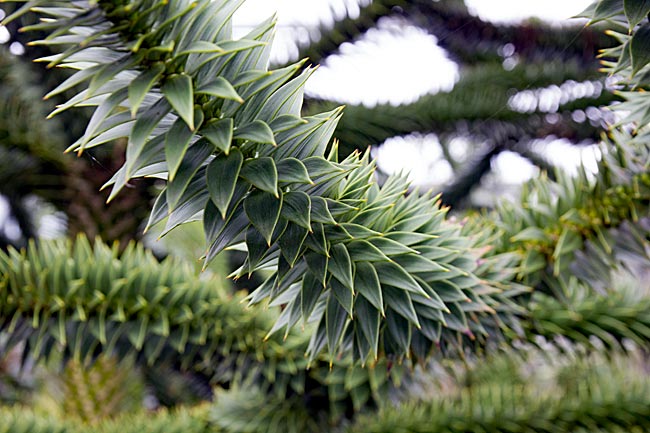
Leaves of an Araucaria, which is actually native to the Southern Hemisphere
However, the plants in the Old Botanical Garden are naturally well-watered. A signpost from the Kiellinie leads to this garden. Unlike the first of its kind in Kiel over 200 years earlier and others that followed, the Old Botanical Garden, opened in 1884, still exists today. However, it has lost its original significance since the mid-1970s when a new botanical garden was established on the university campus, and many plants were subsequently moved there. What remains are primarily trees such as Araucaria, Ginkgo, Tamarisk, Dawn Redwood, and shrubs like the Rough Hydrangea native to China. It is likely thanks to the "Association for the Preservation and Promotion of the Old Botanical Garden Kiel e.V." that the site is not only designated as a natural and cultural monument but also serves as a public park frequently visited by many residents of Kiel.
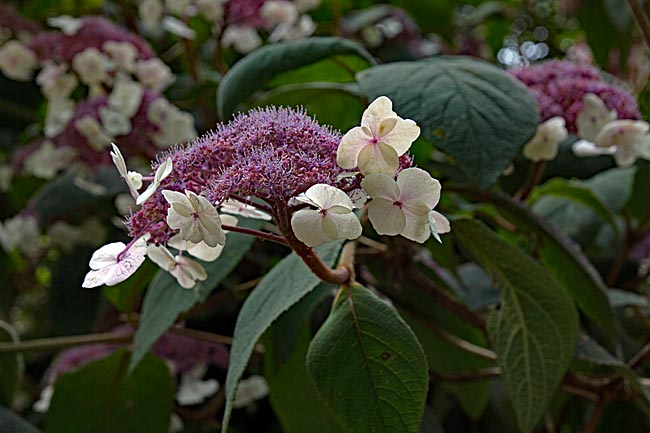
Rough Hydrangea native to China in the Old Botanical Garden
Numerous footpaths wind through the 2.5-hectare garden, which, with a height difference of about 20 meters, is quite hilly for northern German standards. The paths also pass by a half-timbered house built at the beginning of the 20th century on the premises, which in 1998 became home to the Literature House Schleswig-Holstein, occasionally using the park itself as an event space. At the highest point of the garden, since 1988, stands an octagonal brick pavilion next to the former greenhouse in memory of Hermann Jacobsen, the technical director of the botanical garden. The pavilion features a small exhibition room inside and a flat roof accessible via a narrow staircase, covered by an open wrought-iron canopy. Unlike from the numerous benches in the park, one can enjoy a view through the treetops to the fjord from up there.
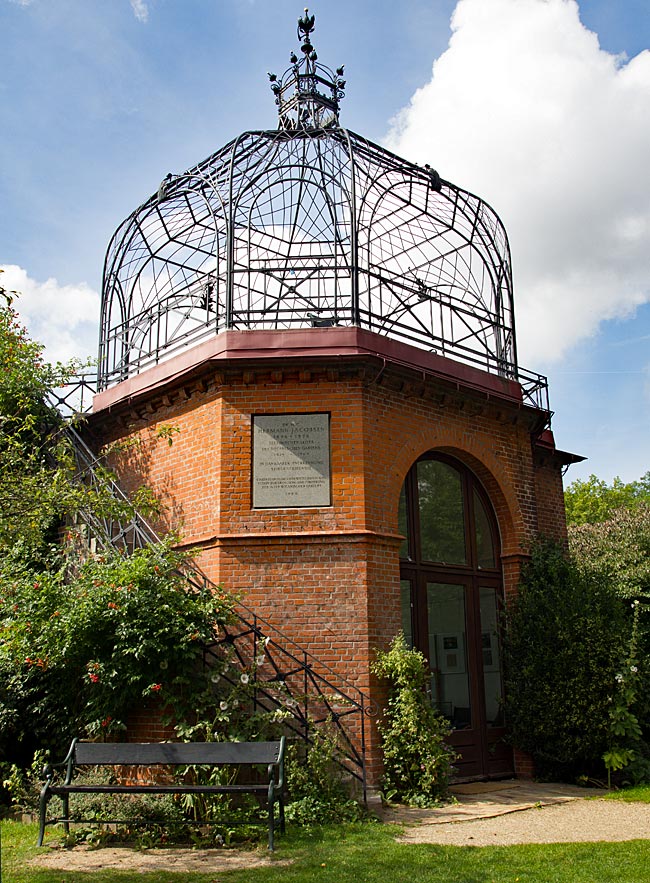
Octagonal brick pavilion
Back on the Kiellinie, the tranquility ends when the car-free zone transitions into a road with a now significantly narrower combined pedestrian and cycling path without any separation from the water side. This means that cyclists and pedestrians must keep their eyes open in traffic; otherwise, the journey might end for "smartphone gawkers" quickly in the wetness of the Baltic Sea. Conversely, this is exactly the business of the Düsternbrook Seabath during the summer months, which attracts visitors with a 60-meter slide, diving board, and even a non-swimmer area. The bath is the rear part of a pier, similar to those built at numerous locations along the Baltic coast from the late 19th century onwards, such as on Rügen or Usedom. Although not as spectacular in appearance, the year-round open Seebar on stilts in the water of the Kieler Fjord is still worth a visit, even if the seabath behind it is not in season at the moment, simply for the ambiance.
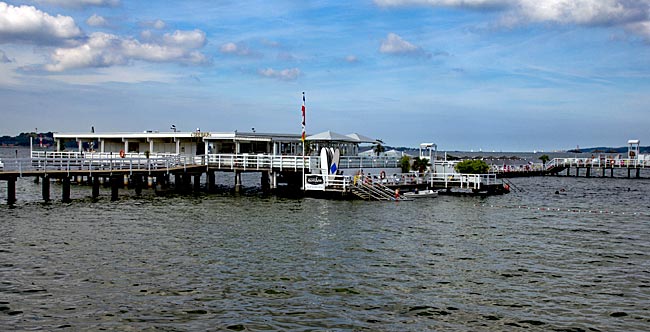
Düsternbrook Seabath
From the pier, the Tirpitzhafen naval base in the Wik district is already visible. Named after Alfred von Tirpitz, the fleet admiral during Emperor Wilhelm II's reign and one of the minds behind the, from today's perspective, megalomaniacal plan to defeat the Empire beyond the English Channel at sea. As history reports, despite also, from a contemporary perspective, insane financial investments in the construction of large ships, nothing came of it - they were deployed less frequently than planned; finally, in November 1918, the sailors in Kiel mutinied, thus ringing in the end of the war, and in 1919 German officers scuttled almost all 74 ships of the High Seas Fleet in Scapa Flow, a bay near the Orkney Islands where the fleet was interned. If the Germans were not allowed to keep their Imperial Navy, then no one should have it, was the sentiment at the time. Today, the ship graveyard off the Scottish archipelago is a popular destination for wreck divers, even though most of the ships were later salvaged.
Not much can be seen of the strategically advantageous harbor located near the North Sea-Baltic Canal and the open Baltic Sea, nor of the ships currently moored there - perhaps only the superstructures of the boats belonging to the 3rd Minesweeping Squadron stationed here. However, a highlight is the Gorch Fock (II) sailing training ship also based here. The 1958-built navy bark with its white metal hull and equally white sails under way is not only an impressive sight for fans of large windjammers. In contrast, the boats of recreational sailors in the adjacent marina then appear rather like nutshells.
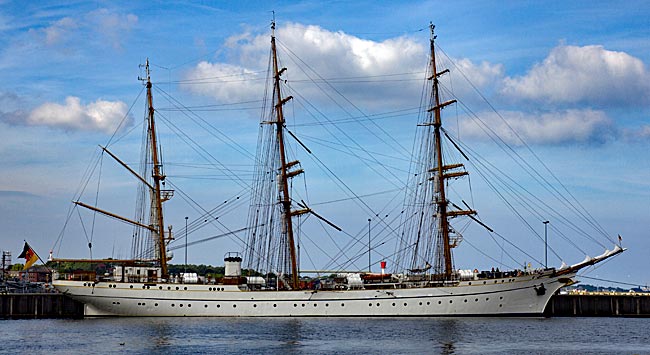
The Gorch Fock II at Tirpitzhafen
Diagonally opposite the naval base stands the Flandernbunker, a nearly indestructible relic from a dark time, built in 1943. Although the structure, which has been under monument protection since early 2005, has received a somewhat friendlier appearance through large windows installed later on all three floors, one can imagine how people endured behind the two-and-a-half-meter-thick ugly, intentionally left unpainted concrete walls and under a roof that is still over a meter thicker while the engines of Allied bombers roared overhead. But not only civilians sought refuge here; it also housed the naval harbor's anti-aircraft and emergency command center. Given that demolishing this 12.5-meter-high concrete block would even be a challenge with today's technical means, the bunker still stands.
In 2001, the association "Mahnmal Kilian e.V." acquired the bunker and has operated it as a meeting and educational center, museum, and memorial where exhibitions also take place since its renovation. The name of the association, founded in 1995, is derived from the ruins of the U-boat bunker Kilian on the eastern shore of the fjord, whose preservation as a cultural monument the association was established to achieve. After an unsuccessful attempt, the association has been visibly more successful with the Flandernbunker. Its name, by the way, comes from the Flandern Monument that once stood nearby, erected in 1927 in memory of the fallen soldiers of the Marinekorps Flandern, founded after the outbreak of World War I in November 1914. The monument was destroyed in 1945.
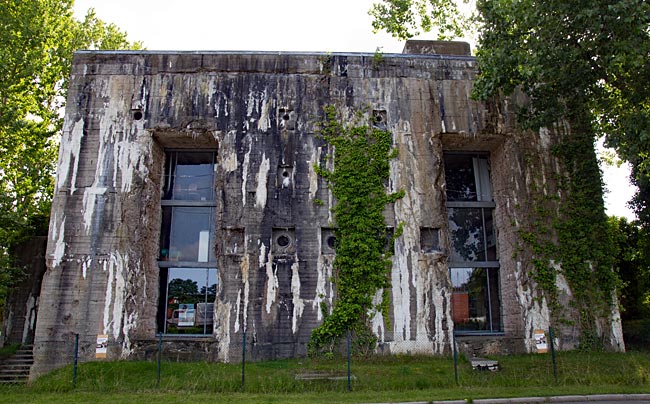
Memorial and warning - the Flandernbunker in the Wik district
The aforementioned Grand Admiral Tirpitz also had the evangelical Petrus Church built not far from the naval harbor and Flandernbunker on Weimarer Straße. This may sound odd at first, but the red brick building was constructed between 1905 and 1907 as a garrison church to accommodate the then-increasing number of navy personnel, replacing its predecessor which had become too small. The Art Nouveau church, one of the largest and most significant in Germany, was designed by the renowned architects Robert Curjel and Karl Moser, who gave the sacred building a broad, imposing tower. Memorial plaques inside and outside, as well as a monument there, still commemorate today the dead of the Imperial Navy.


Map
Information
Tourist Information Kiel
Andreas-Gayk-Straße 3
24103 Kiel
Phone: +49 (0)431 / 679 100
Email: info@kiel-sailing-city.de
Internet: www.kiel-sailing-city.de
Transportation
Train
The state capital is easily accessible by train. However, during storms, trees sometimes fall onto the tracks, disrupting rail services as there are no alternative routes.
Car
You can also comfortably reach Kiel by car via the highway. While a car isn’t necessary within the city, it is practical for trips to nearby attractions like Eckernförde.
Public Transport
Kiel’s tram service was discontinued in 1985 - a decision many now regret. However, the well-organized bus network extends throughout Kiel and its surroundings, provided buses aren’t stuck in traffic. Tickets are purchased from the driver upon boarding. Depending on your plans, day passes, group tickets, or small-group tickets may be cost-effective. In my experience, drivers are generally very friendly and willing to provide information - a quality many of their colleagues in other cities could learn from, especially since it costs nothing to do so. More info: www.kvg-kiel.de
For public transport connections beyond Kiel, visit: www.nah.sh
By Water
The Schlepp- und Fährgesellschaft Kiel mbH is a municipal service operating ferry and tugboat services. It offers passenger transport on the Kieler Förde with small ships known colloquially as "Fördedampfer" (ferry). These vessels depart from the central station and serve multiple stops along both sides of the fjord, including Laboe, Schilksee, and Strande. Bicycles are allowed in moderation. The company is part of the Verkehrsverbund Region Kiel, so regional tickets are valid on board. Students can use their semester ticket for free rides. However, schedules vary, so check the timetable: www.sfk-kiel.de/en
Additional Information
www.zoologisches-museum.uni-kiel.de
www.kunsthalle-kiel.de
www.uni-kiel.de/nickol/botgar.html
www.geomar.de/en/
www.maritimesviertel.de
www.mahnmalkilian.de
www.strande.de
www.laboe.de
www.seenotretter.de
www.deutscher-marinebund.de
www.stenalinetravel.com/routes/kiel-gothenburg
www.colorline.com
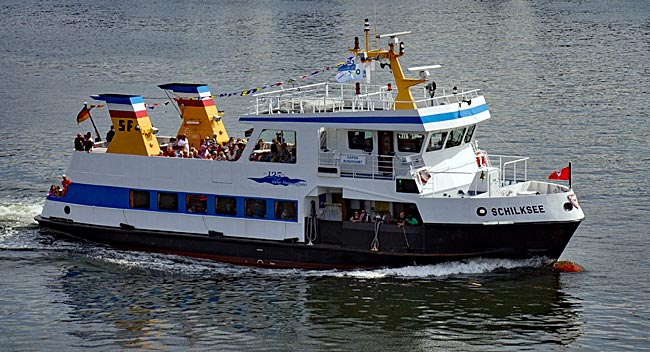
"Fördedampfer"
Rügen by the Baltic Sea
Active holiday featuring cycling and hiking
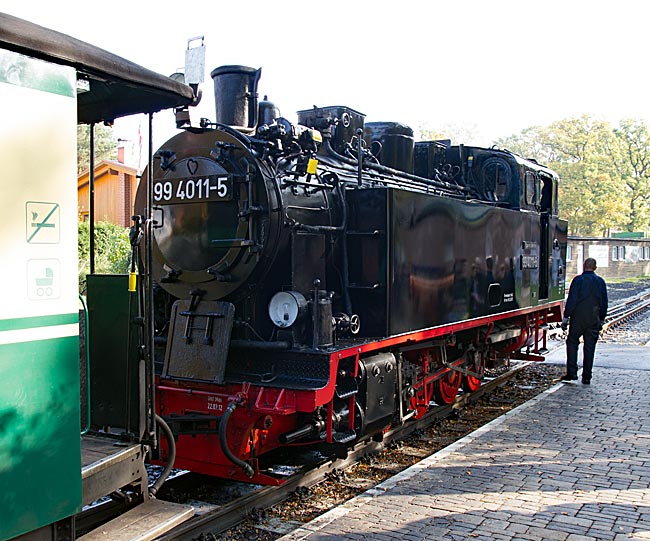
Enjoy an active holiday featuring cycling and hiking along the Baltic coast in Mönchgut on the island of Rügen. Long sandy beaches, rolling hills, and lush forests provide a varied and beautiful setting for your getaway. Often, the only thing breaking the peace is the distant whistle of the historic 'Rasender Roland' steam train. Despite its name (which suggests something "racing" or fast), it’s actually quite the opposite. A journey by train is simply part of the holiday experience.
read more about Rügen ...
Rostock and Warnemünde by the Baltic Sea
A travel guide
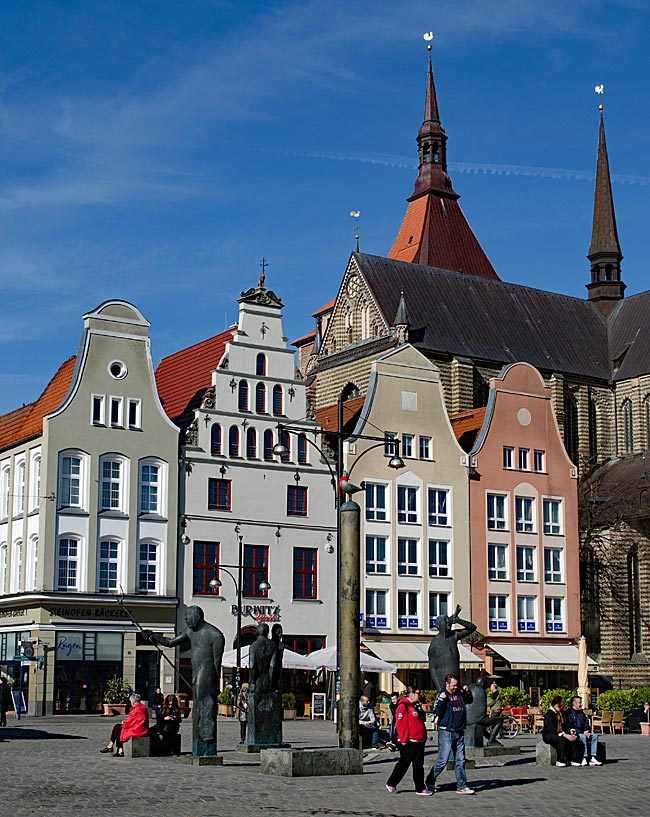
A mini-guide through the Hanseatic city of Rostock and its beautiful beach destination, Warnemünde. Home to one of the oldest universities in the Baltic region, the city boasts a rich history. Join us on a tour of discovery.
read more about Rostock ...
Wismar
The Hanseatic City on the Baltic Sea and its UNESCO World Heritage
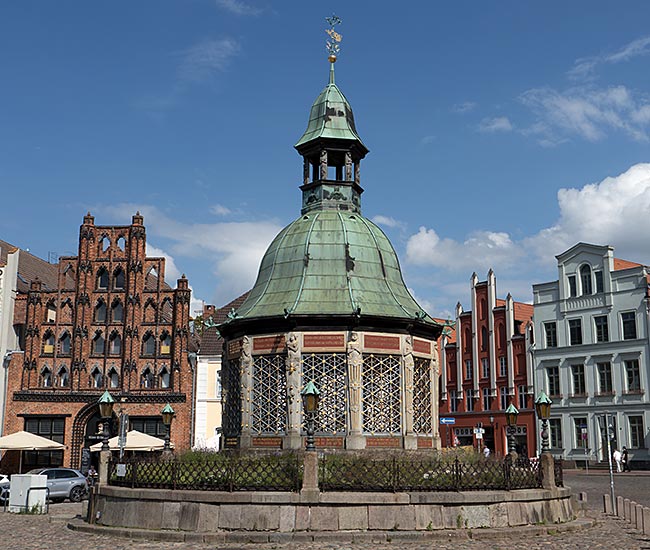
The World Heritage House is a building with a stone front house and an attached timber-framed Kemladen on a foundation of loose fieldstones from a medieval predecessor building. This beautifully restored small building complex visually illustrates and provides information via text panels about the lives of past generations in the hall houses typical for Wismar, along with their outbuildings. Additionally, there is extensive information about the city’s history and numerous protected buildings in the old town - there are 1,754 in total, with 306 designated as individual monuments. In the old town, one is right in the middle of Wismar’s UNESCO World Heritage Site.
read more about Wismar ...
Crabs, dikes and the Wadden Sea
The North Sea spa town of Büsum
Once an island, Büsum was repeatedly threatened by the "Blanken Hans". When the greatest flood of the last century struck in 1962, Büsum was already long connected to the mainland - since 1585. Today, this town of around 5,000 residents, part of the Dithmarschen district, is one of the most important holiday destinations along Schleswig-Holstein's North Sea coast. Since 1985, the sea in front of Büsum has been protected as the Schleswig-Holstein Wadden Sea National Park, and since 2009, it has also been listed as a UNESCO World Heritage Site.
read more about Büsum ...