

DISTANT PLACES
Travel tips for destinations far from the Hanseatic City of Bremen
A stroll through Kiel
Sights in the fjord city and a visit to Laboe
Page 7 of 7
A visit to Laboe
From the main train station, a fast bus heads to Laboe on the eastern shore of Kiel Fjord. Many might think this popular holiday destination is a district of Kiel, but the municipality actually belongs to Plön County. The 5,000-resident town is 19 kilometers away from the nearby big city, and along the way - passing through Mönkeberg and Heikendorf - one could briefly get the impression of being on a countryside excursion, as the hinterland appears sparsely populated and agriculturally shaped.
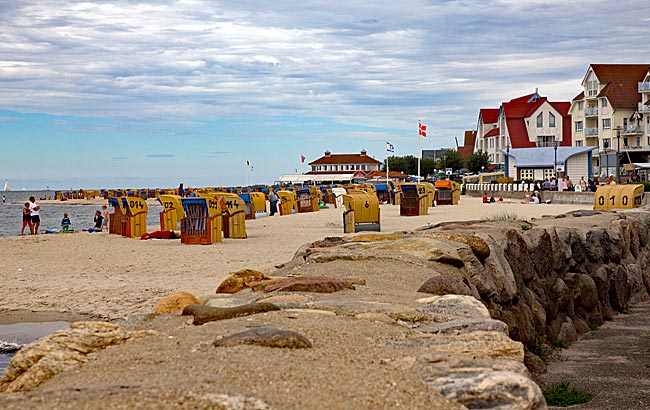
Main beach
The bus line ends in the harbor area, and immediately you're right in the middle of the tourist bustle. Adjacent to the harbor with many leisure boats and the DGzRS rescue station is the paid main beach with numerous beach chairs on fine sand. Along the promenade just behind it are dining options for almost every taste, as well as everything else one might need - or think they need - for a successful vacation. Anything not available here can be found in the shops further into town. If the weather doesn’t cooperate, having a "Plan B" isn't bad - like going swimming in the covered and heated seawater pool right on the beach with a view of the Baltic Sea.
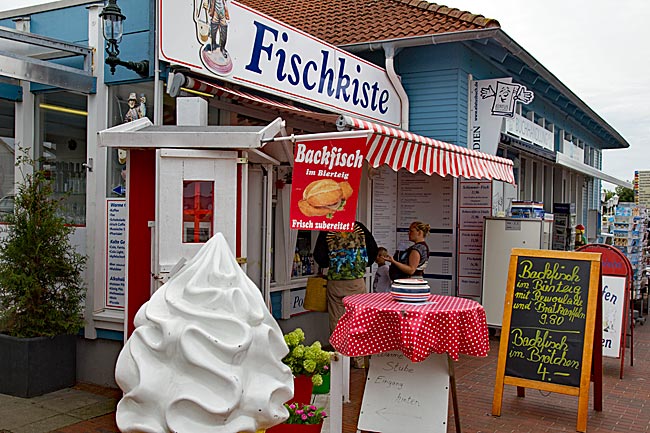
"Fish to go" at the promenade
This is on the way to the landmark that every visitor to Laboe has likely seen from the outside: the Naval Memorial. The 85-meter-tall tower made of red brick stands out over the Baltic Sea and can be seen from afar, even from the other side of the fjord. Originally, the site was intended as a memorial for soldiers of the Imperial Navy who died in World War I. Due to cost-related modifications to architect Gustav August Munzer’s design, construction began in 1927 but was halted soon after due to the global economic crisis that started in 1929. As a result, the building wasn’t completed and inaugurated until 1936. After honoring the fallen sailors of both wars from the Navy, it was reoriented in 1954 to also include soldiers from other nations who died in the two world wars. Since its final rededication in 1996, the memorial is now a monument and - with a more civilian focus - a memorial site for all sailors of every nation who lost their lives at sea.
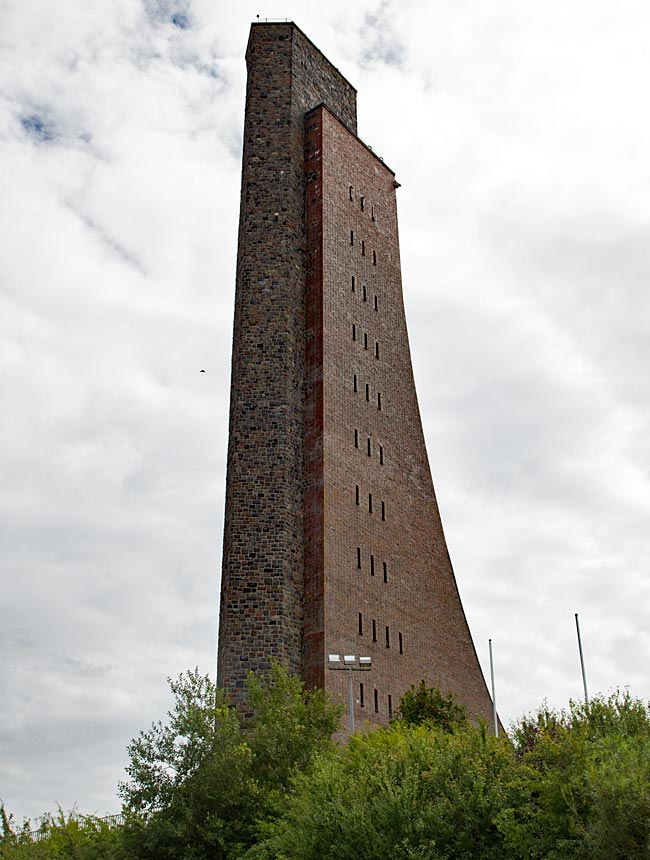
Naval Memorial
The somewhat unadorned, rather threatening and forbidding tower resembles a stylized submarine conning tower in its architecture, though this was likely not intended by the architect. Inside exhibition rooms, visitors learn primarily about military and civilian shipping, supplemented with ample visual aids such as images, maps, ship models, and flags. Those uninterested in history and current events in this thematic context can instead enjoy a panoramic view of the area from the observation platform high above - 85 meters over the water is enough for a good look into the distance. The platform is accessible via two elevators; athletic spirits, of course, seek the challenge on the 341 steps.
More fascinating at first glance than the masonry monument is the decommissioned submarine lying nearby. Built by Blohm & Voss shipyard in Hamburg and commissioned as U-995 in 1943, the boat was placed on a green field near the beach in 1972 as a technical museum after other locations were rejected for financial reasons - they feared high costs just for transport and installation.
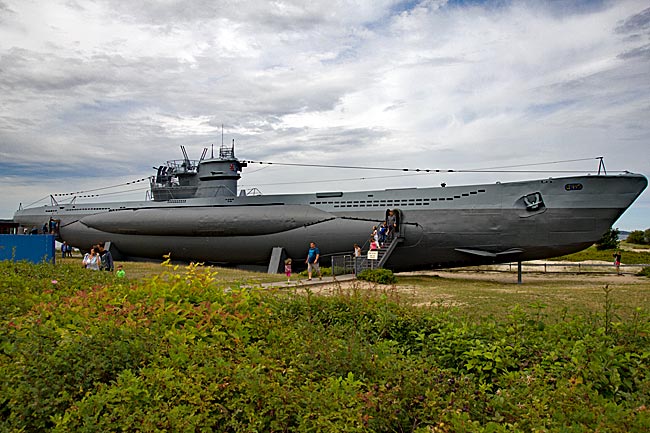
U-Boot U-995
Under the German flag, the warship sailed for only two years before the war ended, and the boat was decommissioned where it lay in Norwegian Drøbak. The Royal Norwegian Navy took over the boat and operated it under the Scandinavian nation’s flag for several more years until the German Federal Navy received it as a gift in 1965 - twenty years after the end of the war - as an act of reconciliation. The submarine, largely restored to its original museum-worthy condition by the Kiel Naval Arsenal, still belongs to the navy but is operated as a loan by the German Marinebund e.V., which also owns the Naval Memorial.
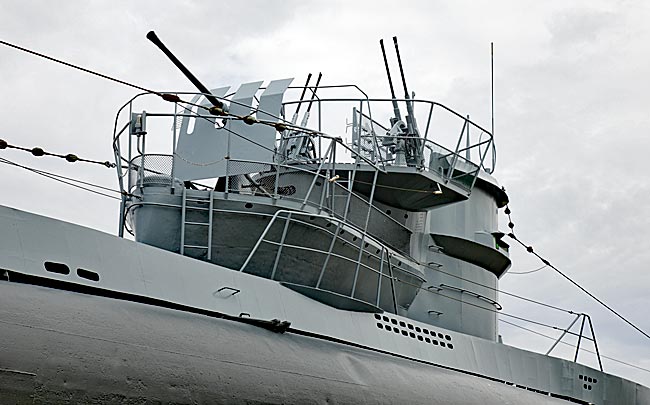
U-Boot U-995: details
Those suffering from claustrophobia should avoid touring the interior of the boat. One can only imagine how the men endured their enemy missions in this cramped steel tube under water - the fear of being sunk by water bombs or torpedoes, and the constant presence of rats presumably always looming. E-machine at the stern upon entry, diesel engine, bunks, toilet, kitchen, command center with periscope, radio room - stopping to look around longer is only possible if visitor traffic is low or the "caravan" halts for other reasons, such as someone having trouble stepping through the small opening of the hatch that was supposed to separate the central area from the front of the boat in an emergency. The tour becomes more relaxed in the torpedo room at the bow, as this is also where the exit is.
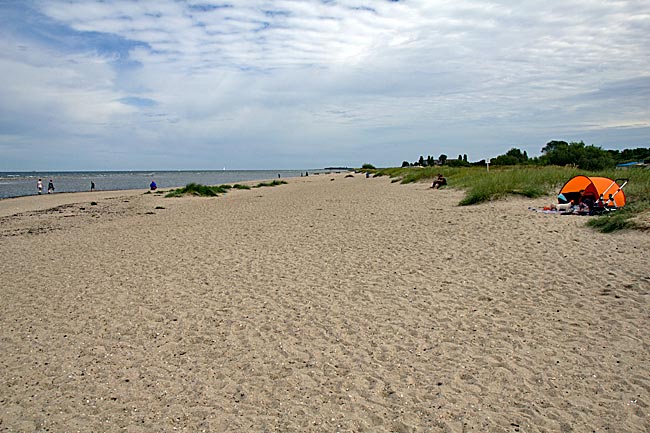
Beach beyond the tourist hub
The confinement of the space gives way to the expanse of the beach once you’ve left behind the steel-and-stone ensemble that serves as a reminder and warning. Here, those who have no use for beach chairs gather - those who want to bring their dog to the beach or simply seek more individual freedom and tranquility. Ahoy!
previous page
 next page
Map
Information
Tourist Information Kiel
Andreas-Gayk-Straße 3
24103 Kiel
Phone: +49 (0)431 / 679 100
Email: info@kiel-sailing-city.de
Internet: www.kiel-sailing-city.de
Transportation
Train
The state capital is easily accessible by train. However, during storms, trees sometimes fall onto the tracks, disrupting rail services as there are no alternative routes.
Car
You can also comfortably reach Kiel by car via the highway. While a car isn’t necessary within the city, it is practical for trips to nearby attractions like Eckernförde.
Public Transport
Kiel’s tram service was discontinued in 1985 - a decision many now regret. However, the well-organized bus network extends throughout Kiel and its surroundings, provided buses aren’t stuck in traffic. Tickets are purchased from the driver upon boarding. Depending on your plans, day passes, group tickets, or small-group tickets may be cost-effective. In my experience, drivers are generally very friendly and willing to provide information - a quality many of their colleagues in other cities could learn from, especially since it costs nothing to do so. More info: www.kvg-kiel.de
For public transport connections beyond Kiel, visit: www.nah.sh
By Water
The Schlepp- und Fährgesellschaft Kiel mbH is a municipal service operating ferry and tugboat services. It offers passenger transport on the Kieler Förde with small ships known colloquially as "Fördedampfer" (ferry). These vessels depart from the central station and serve multiple stops along both sides of the fjord, including Laboe, Schilksee, and Strande. Bicycles are allowed in moderation. The company is part of the Verkehrsverbund Region Kiel, so regional tickets are valid on board. Students can use their semester ticket for free rides. However, schedules vary, so check the timetable: www.sfk-kiel.de/en
Additional Information
www.zoologisches-museum.uni-kiel.de
www.kunsthalle-kiel.de
www.uni-kiel.de/nickol/botgar.html
www.geomar.de/en/
www.maritimesviertel.de
www.mahnmalkilian.de
www.strande.de
www.laboe.de
www.seenotretter.de
www.deutscher-marinebund.de
www.stenalinetravel.com/routes/kiel-gothenburg
www.colorline.com
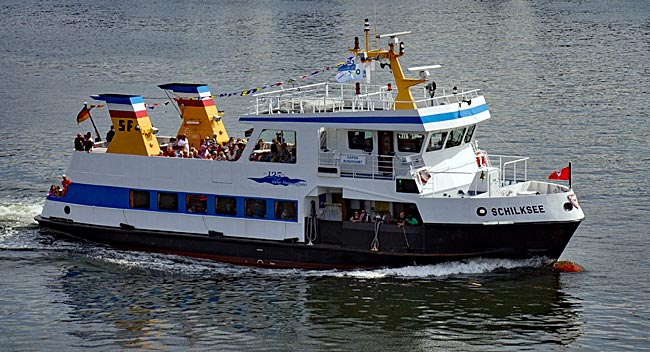
"Fördedampfer"
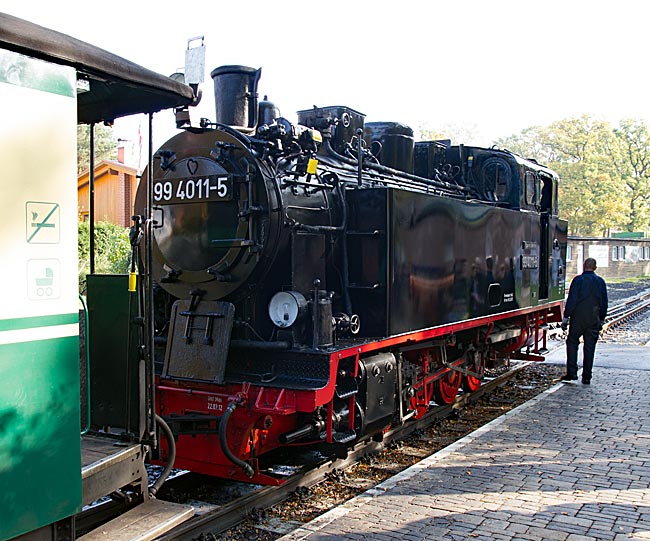
Rügen by the Baltic Sea
Active holiday featuring cycling and hiking
Enjoy an active holiday featuring cycling and hiking along the Baltic coast in Mönchgut on the island of Rügen. Long sandy beaches, rolling hills, and lush forests provide a varied and beautiful setting for your getaway. Often, the only thing breaking the peace is the distant whistle of the historic 'Rasender Roland' steam train. Despite its name (which suggests something "racing" or fast), it’s actually quite the opposite. A journey by train is simply part of the holiday experience.
read more about Rügen ...
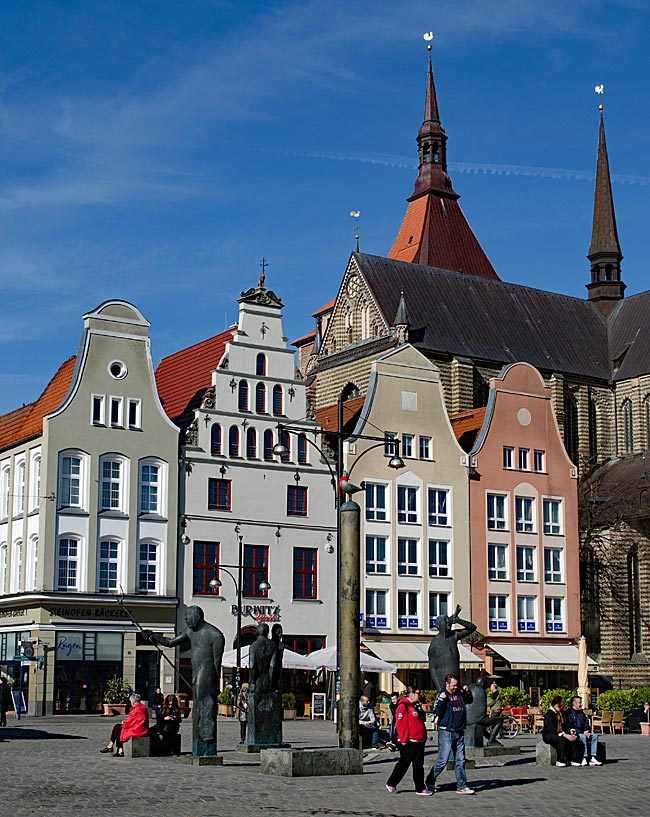
Rostock and Warnemünde by the Baltic Sea
A travel guide
A mini-guide through the Hanseatic city of Rostock and its beautiful beach destination, Warnemünde. Home to one of the oldest universities in the Baltic region, the city boasts a rich history. Join us on a tour of discovery.
read more about Rostock ...
Wismar
The Hanseatic City on the Baltic Sea and its UNESCO World Heritage
The World Heritage House is a building with a stone front house and an attached timber-framed Kemladen on a foundation of loose fieldstones from a medieval predecessor building. This beautifully restored small building complex visually illustrates and provides information via text panels about the lives of past generations in the hall houses typical for Wismar, along with their outbuildings. Additionally, there is extensive information about the city’s history and numerous protected buildings in the old town - there are 1,754 in total, with 306 designated as individual monuments. In the old town, one is right in the middle of Wismar’s UNESCO World Heritage Site.
read more about Wismar ...